
Last updated: May 2026 — written by James Nolan, Gymnase Tips senior trainer.
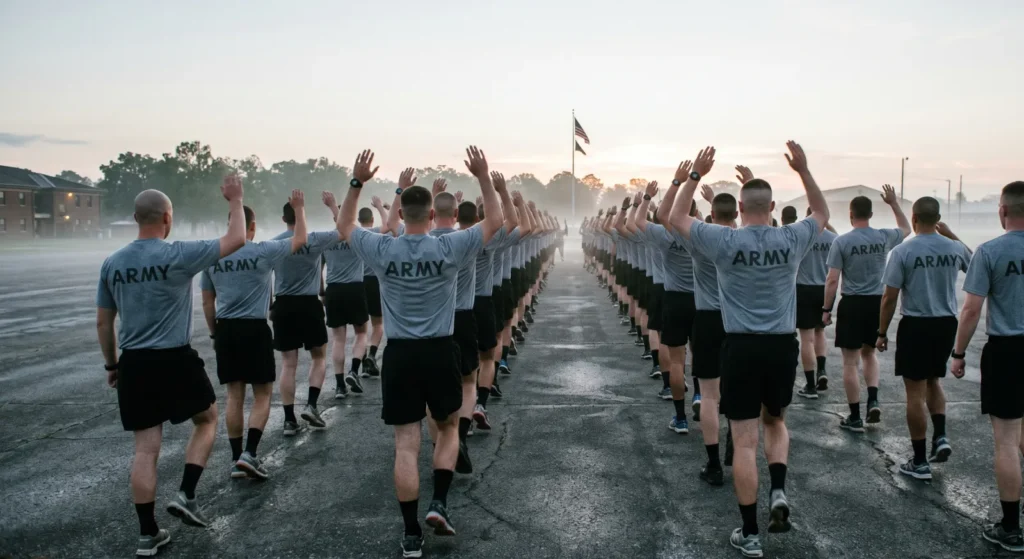
Army PRT (Physical Readiness Training) drills are the standardized warm-up, conditioning, and recovery routines used across the U.S. Army to prepare soldiers for the AFT and combat-ready fitness. The seven core army prt drills are: Preparation Drill (PD), Hip Stability Drill (HSD), Military Movement Drills 1 & 2 (MMD1, MMD2), Conditioning Drill 1 (CD1), Conditioning Drill 2 (CD2), the Recovery Drill (RD), and 4 for the Core (4C). Each one targets a specific physical quality — mobility, power, endurance, core stability, or recovery — and they’re designed to stack together into a complete training session. This guide breaks down every exercise in every drill with sets, reps, and form cues, plus a free downloadable PDF of the full sequence.
Army PRT Drills Reference Card
Preparation Drill · Hip Stability Drill · MMD1 · MMD2 · Recovery Drill · Session tracker
Quick reference: all 7 army PRT drills
| Drill | Purpose | Time | Best used |
|---|---|---|---|
| Preparation Drill (PD) | Warm-up, mobility | 5–8 min | Every session |
| Hip Stability Drill (HSD) | Hip activation, injury prevention | 4–6 min | Pre-running |
| Military Movement Drill 1 (MMD1) | Dynamic warm-up, agility | 4–5 min | Pre-running |
| Military Movement Drill 2 (MMD2) | Power, coordination | 4–5 min | Pre-strength |
| Conditioning Drill 1 (CD1) | Strength endurance | 8–12 min | Main session |
| Conditioning Drill 2 (CD2) | Lower body, plyometric | 8–12 min | Main session |
| Recovery Drill (RD) | Cooldown, flexibility | 5–8 min | End of every session |
| 4 for the Core (4C) | Core endurance | 4–6 min | Daily |
1. Preparation Drill (PD) — the standard warm-up
The Preparation Drill is the universal warm-up in Army PRT. It opens every session and contains 10 exercises performed for 5–10 reps each, in order. The drill takes roughly 5–8 minutes.
The 10 exercises in order:
- Bend and Reach — feet shoulder-width, reach to floor, return overhead. 5–10 reps.
- Rear Lunge — alternating rear lunges, hands on hips. 5 reps each leg.
- High Jumper — jump in place with arms swinging overhead. 5–10 reps.
- Rower — seated row motion lying on back, knees to chest. 5–10 reps.
- Squat Bender — quarter squat into forward bend. 5–10 reps.
- Windmill — feet wide, alternating toe touches with rotation. 5 reps each side.
- Forward Lunge — alternating forward lunges. 5 reps each leg.
- Prone Row — prone position, arms extended, pull elbows back. 5–10 reps.
- Bent-Leg Body Twist — supine, knees bent, drop side to side. 5 reps each side.
- Push-Up — strict push-ups. 5–10 reps.
The army prep drill is the most-searched component of PRT (1,600+ monthly searches for "army prep drill" alone) and works as a complete warm-up even outside military training. Civilians use it before lifting sessions and it still earns its name.
2. Hip Stability Drill (HSD)
The Hip Stability Drill activates the hip stabilizers — gluteus medius, gluteus minimus, and the deep hip rotators — that prevent knee valgus and lower back compensation during running and lifting. Five exercises, 10 reps each side.
- Lateral Leg Raise — side-lying, top leg raised straight up. 10 reps each side.
- Medial Leg Raise — side-lying, bottom leg raised. 10 reps each side.
- Bent-Leg Lateral Raise — side-lying, bent top leg raised (clamshell). 10 reps each side.
- Single-Leg Tuck — supine, single knee to chest, opposite leg straight. 10 reps each side.
- Single-Leg Over — supine, single leg crossed over body. 10 reps each side.
Run the army hip stability drill before any session involving sprinting, agility, or heavy lower-body work. Particularly important for soldiers building toward the AFT 2-mile run and Sprint-Drag-Carry events.

3. Military Movement Drill 1 (MMD1)
MMD1 is a dynamic warm-up sequence performed over 25 meters per exercise. It transitions from the static Preparation Drill into running-ready movement.
Three exercises, 1 rep each over 25m:
- Verticals — high knee skips with strong arm drive
- Laterals — side shuffles, both directions
- Shuttle Sprint — 25m sprint, touch the line, sprint back
Each exercise covers 25 meters; the full drill takes about 4 minutes including walking back between reps. Searches for "army mmd1" and "mmd 1 and 2" together pull 650+ monthly looks — strong evidence soldiers and recruits are actively cramming these names.
4. Military Movement Drill 2 (MMD2)
MMD2 builds on MMD1 with more advanced movement patterns. Three exercises, 1 rep each over 25m:
- Power Skip — explosive skipping with maximum height
- Crossover — side-shuffle with alternating crossovers
- Crouch Run — low athletic stance, 25m sprint
MMD2 is run before strength sessions or sport-specific work. The power skip alone is one of the best single exercises for explosive hip extension.
5. Conditioning Drill 1 (CD1)
CD1 is the strength-endurance backbone of the PRT system. Five exercises performed for 5–10 reps each in circuit fashion. Most users do 2–3 rounds.
- Power Jump — squat into vertical jump with arm swing. 5–10 reps.
- V-Up — supine, simultaneous leg and torso lift to V position. 5–10 reps.
- Mountain Climber — plank position, alternating knee drives. 5–10 reps each side.
- Leg Tuck and Twist — seated, alternating knee tucks with rotation. 5–10 reps each side.
- Single-Leg Push-Up — push-up with one leg lifted. 5–10 reps each side.
CD1 is also called the "basic endurance drill military" in some queries — same drill, different naming convention. With 1,900 monthly searches for that variant, it’s one of the most-asked-about PRT components.
6. Conditioning Drill 2 (CD2)
CD2 emphasizes lower-body strength and plyometric power. Five exercises, 5–10 reps each.
- Turn and Lunge — alternating reverse lunges with rotation. 5 reps each.
- Half Squat Lateral — quarter squat into side-step, alternating. 5 reps each.
- Frog Jump — squat with explosive forward jump. 5–10 reps.
- Alternate 1/4 Turn Jump — vertical jump with 90° rotation. 5 reps each direction.
- Tuck Jump — vertical jump bringing knees to chest. 5–10 reps.
CD1 and CD2 are typically alternated across training days — CD1 emphasizes upper body and core, CD2 emphasizes lower body and power.
7. Recovery Drill (RD)
The Recovery Drill closes every session. Five static stretches held 20–30 seconds each:
- Overhead Arm Pull — arm across body, opposite hand pulls
- Rear Lunge Stretch — long rear lunge, hold position
- Extend and Flex — hamstring stretch, alternating sides
- Thigh Stretch — quad stretch, balanced on opposite leg
- Single-Leg Over — supine spinal rotation
The recovery drills army-wide are non-negotiable in PRT — it’s where soldiers reset hip flexor tightness and shoulder mobility from the day’s load. Skipping the RD accumulates restriction over weeks and tracks with higher injury rates.
8. Four for the Core (4C)
The 4C is the daily core block. Four exercises, 60 seconds each:
- Bent-Leg Body Twist — supine, knees bent, slow side-to-side
- Side Bridge — side plank, 30 seconds each side
- Back Bridge — supine glute bridge, hold
- Quadraplex — opposite arm/leg extension from quadruped
Run the 4C every training day, after the main session and before the Recovery Drill. Total time is 4–6 minutes including transitions.
How to use the army PRT drills in a weekly schedule
A standard PRT-style training week combining all the drills:
| Day | Sequence | Time |
|---|---|---|
| Mon | PD → HSD → MMD1 → CD1 → 4C → RD | 50 min |
| Tue | PD → MMD2 → CD2 → 4C → RD | 45 min |
| Wed | PD → 30-min run → 4C → RD | 50 min |
| Thu | PD → MMD1 → CD1 → 4C → RD | 45 min |
| Fri | PD → HSD → CD2 → 4C → RD | 50 min |
| Sat | PD → 60-min ruck or long run → RD | 70 min |
| Sun | RD only or full rest | 15 min |
For civilians using these drills: the same structure works for general fitness without the running emphasis. Replace the runs with whatever cardio you prefer; the drills themselves are the value.
How PRT compares to civilian programming
| Factor | Army PRT | Typical bodybuilding split | CrossFit |
|---|---|---|---|
| Warm-up | Standardized (PD) | Often skipped | Variable |
| Strength | Endurance-biased | Hypertrophy-biased | Power-biased |
| Conditioning | Built-in (CD1/CD2) | Separate cardio | Built-in (WOD) |
| Recovery | Standardized (RD) | Often skipped | Variable |
| Time per session | 45–60 min | 60–90 min | 30–60 min |
PRT’s biggest advantage is structure — you never skip warm-up or recovery because they’re built in. For lifters who chronically skip these, adopting just the PD and RD is a meaningful upgrade.
Equipment needed: nothing
Every army PRT drill is bodyweight-only. No bars, no benches, no bands. The drills were designed to function in any environment — barracks, deployed locations, any stretch of grass. For at-home military-style training that builds on the PRT framework, see our 28-day military workout and military workout PDF guides.
Common mistakes when running PRT drills
- Skipping the Preparation Drill on light days. The PD takes 5 minutes — there is no day where skipping it makes sense.
- Treating CD1 like a max-effort workout. CD1 is strength-endurance, not max-effort training. Stay at the prescribed reps; don’t push to failure.
- Running MMD1 cold. The MMDs come AFTER the PD, not as a substitute. Cold sprinting risks hamstring strain.
- Forgetting the 4C. Core endurance compounds over weeks. Daily 4-minute work beats sporadic long ab sessions.
- Skipping the Recovery Drill because the session ran long. The RD is the difference between accumulating mobility restrictions and not.
FAQ
What does PRT stand for?
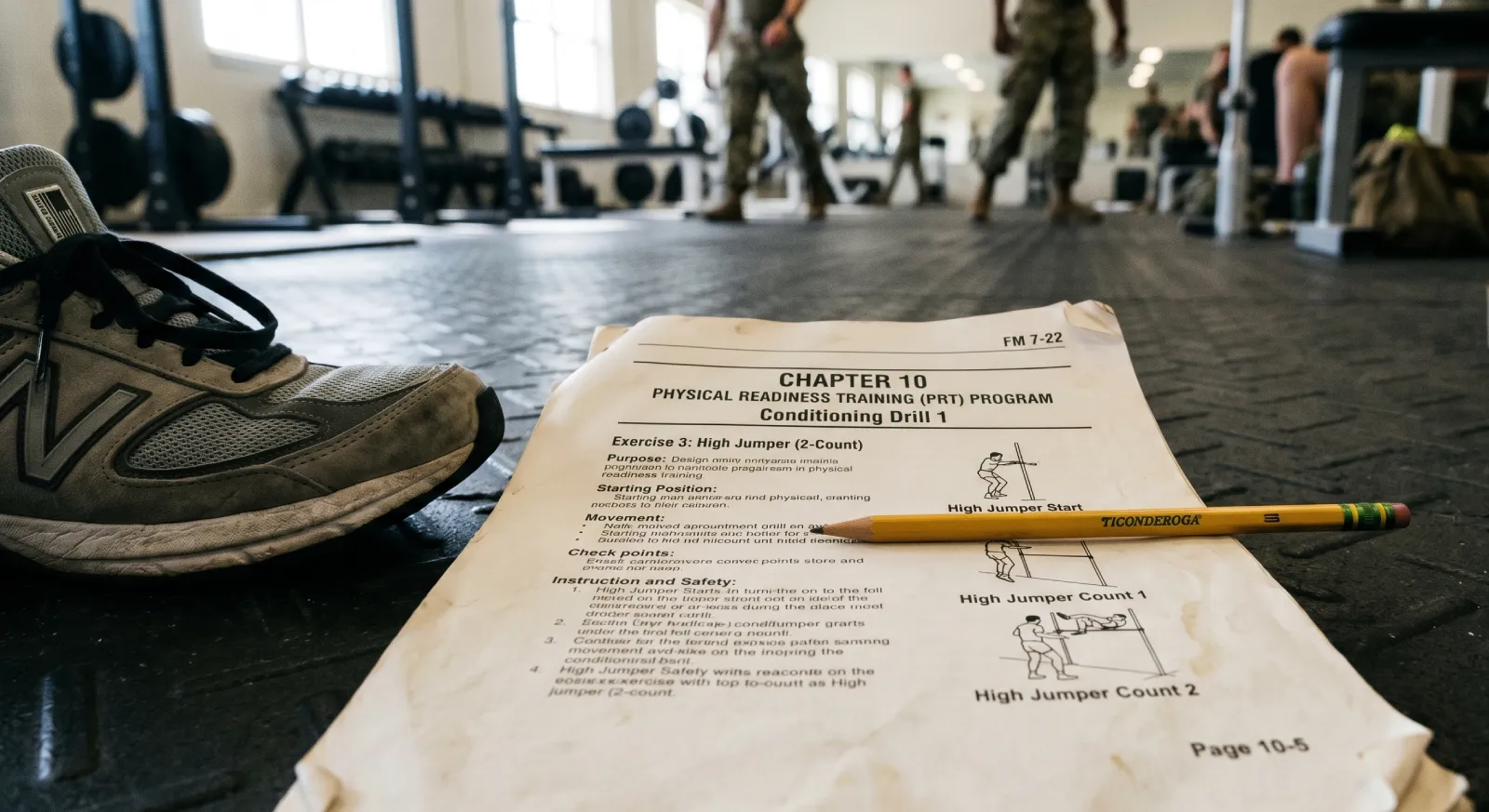
PRT stands for Physical Readiness Training — the U.S. Army’s standardized fitness training system, defined in Field Manual FM 7-22. It replaced the older, less structured PT (Physical Training) approach.
What’s the difference between PRT and PT?
PT was the older, less standardized system. PRT introduced specific named drills (PD, HSD, CD1, MMD1, etc.) and structured progression rules. PT is sometimes still used colloquially, but PRT is the current doctrinal term across the Army.
How long does a full PRT session take?
A complete session — Preparation Drill, conditioning component, 4 for the Core, and Recovery Drill — runs 45–60 minutes. The drills themselves are time-efficient; the bulk of the session is the conditioning piece in the middle.
Can I use the army PT drills outside the military?
Yes. The Preparation Drill is one of the best general warm-ups available. The Recovery Drill is excellent for post-session mobility. CD1 and CD2 work as standalone bodyweight conditioning. Civilians benefit from the same structure soldiers do.
Are PRT drills enough to pass the AFT?
No — PRT prepares you for the AFT but doesn’t replace AFT-specific training. To pass the AFT (3-rep max deadlift, hand-release push-ups, sprint-drag-carry, plank, 2-mile run), add specific event practice once weekly. See our 28-day military workout for a structured AFT-focused build, and use our AFT calculator to score your push-ups, sit-ups, and 2-mile run.
Do I need to do every army PRT drill every day?
No. The PD and RD bookend every session. The 4C runs daily. CD1, CD2, MMD1, MMD2, and HSD rotate through the week — you don’t do all of them in a single session.
How often should I do CD1 and CD2?
Each one twice per week is the standard cadence. Alternate them so consecutive days hit different muscle groups. The Wednesday run day and Saturday long ruck day handle the cardiovascular load.
What’s the difference between MMD1 and MMD2?
MMD1 is the entry-level dynamic warm-up — verticals, laterals, shuttle sprint. MMD2 is more advanced — power skip, crossover, crouch run. New soldiers start with MMD1 and earn MMD2 once movement quality is solid.
Where can I download an official PRT drill PDF?
Official Army documentation is in Field Manual FM 7-22, a free download from the Army Publishing Directorate. Our condensed PDF version (one page per drill with photo cues) is linked in the download box at the top of this article.
The bottom line: Army PRT drills give you a complete, time-efficient training framework — warm-up, conditioning, core, and recovery — with zero equipment. The Preparation Drill, Recovery Drill, and 4 for the Core are worth adopting even if you’re not training for the AFT. Run CD1 and CD2 alternated through the week for the conditioning piece. For more structured military-style training plans, see our 28-day military workout, 8-week military calisthenics plan, military workout PDF, and military calisthenics for men over 50 guides.



Pingback: Navy SEAL Physical Requirements & PST Standards (2026 Guide)
Pingback: Inverted Push-Up: Complete Form Guide & Handstand Progression