
Last updated: May 2026 — written by the Gymnase Tips training team.
An advanced calisthenics workout is a bodyweight training program built around skill-strength elements — muscle-ups, front and back levers, planche progressions, one-arm push-ups, pistol squats, and handstand push-ups — for athletes who already own the foundation lifts (10+ strict pull-ups, 30+ push-ups, 20+ pistol squats unassisted, and a 30-second freestanding handstand). The defining feature of advanced calisthenics is that it splits each session into a skill block (low-rep, high-quality, fresh) and a strength block (higher-rep, accumulating fatigue) — a structure you cannot use productively until the foundation is built. This guide is the 8-week program we use with athletes who have outgrown intermediate plans.
Table of Contents
- Prerequisites Before Starting
- The 6 Advanced Skill-Strength Elements
- 8-Week Program
- Weekly Schedule
- Common Mistakes
- FAQ
Prerequisites Before Starting
Don’t run advanced calisthenics until these standards are clean and unassisted:
- 10 strict pull-ups, dead-hang, no kip
- 30 strict push-ups, full ROM, hollow body
- 20 pistol squats per leg (10 if you weigh 200+ lbs)
- 30-second freestanding handstand against the wall — minimum facing-out, kicked-up
- 5-second tuck front lever hold
- 5-second tuck planche hold
If you don’t yet have these numbers, you’ll get more from intermediate work first — see our military calisthenics workout guide and how to get better at pull-ups for the on-ramp.
The 6 Advanced Skill-Strength Elements
1. Muscle-Up
The transition lift — pull-up that finishes in a dip. Two variants: bar muscle-up (false grip, explosive) and ring muscle-up (rotation through the wrists). Build via false-grip pull-ups, ring transitions on a low bar, and explosive high pull-ups (pulling the bar to sternum-height).
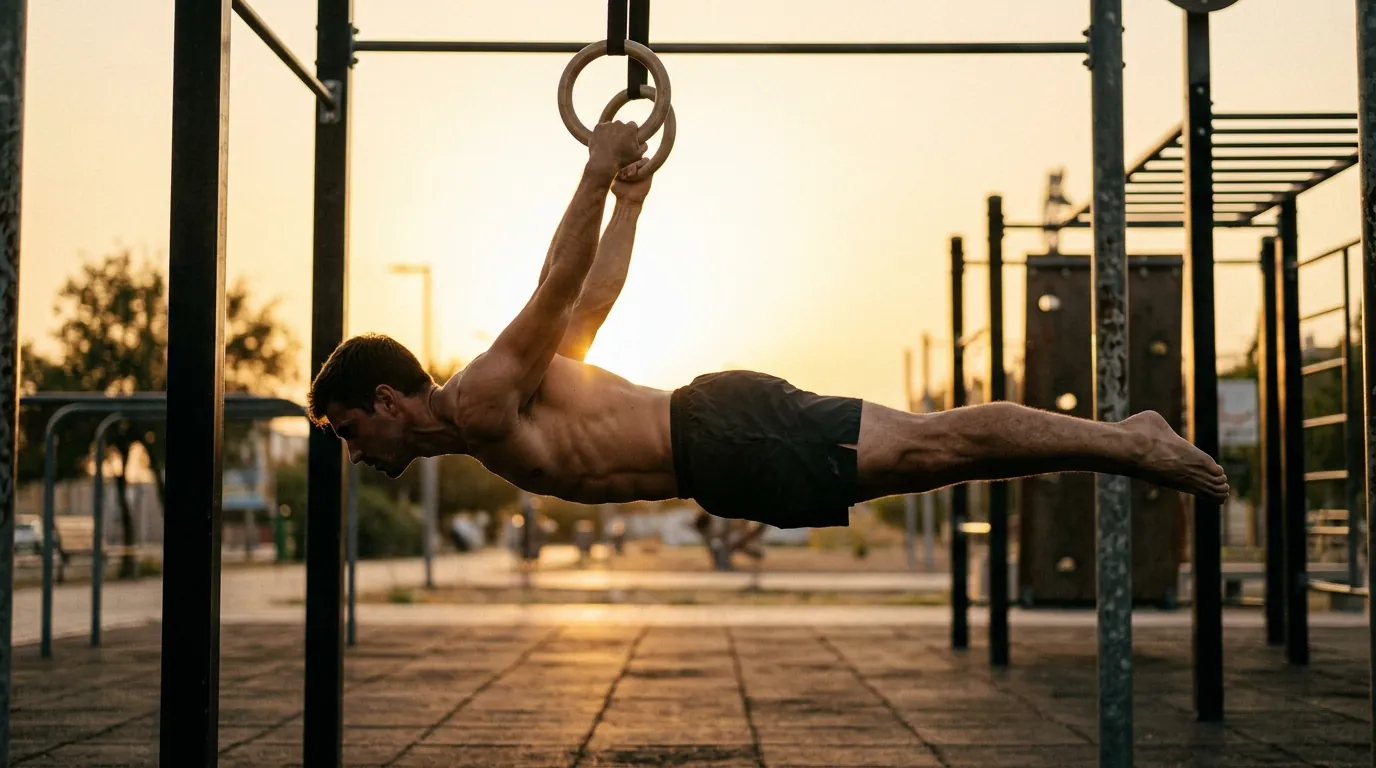
2. Front Lever
Hanging horizontal hold, body parallel to floor, face up. Progress: tuck → advanced tuck → single-leg → straddle → full. Hold-time goal: 5 seconds at each progression before moving to the next. Front levers are exceptionally hard on the lower back and core — programming carefully matters.
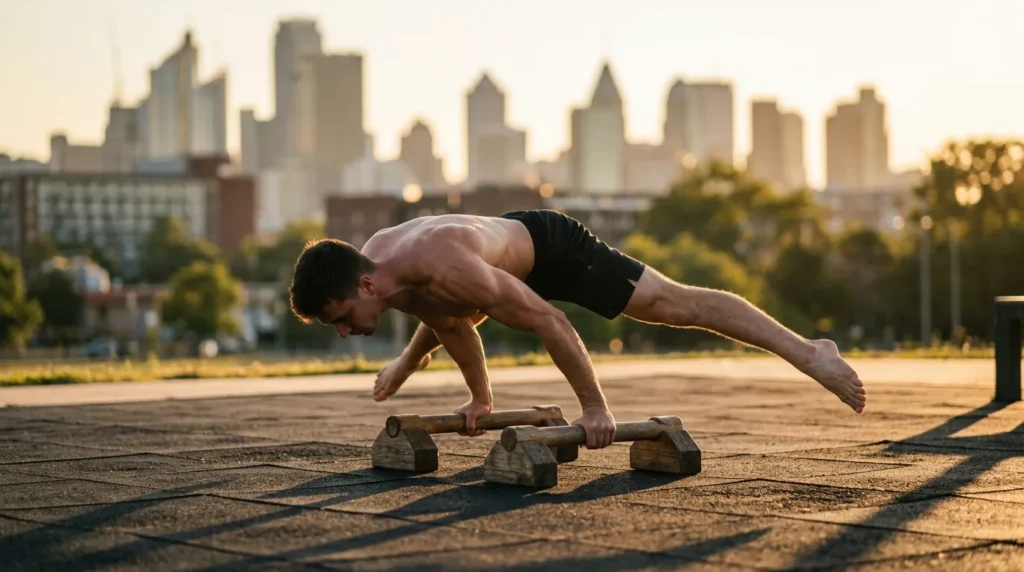
3. Planche
Pushing horizontal hold, body parallel to floor, face down, arms straight. Progress: tuck → advanced tuck → straddle → full. Brutal on wrists and shoulder protraction; expect 6–18 months from tuck to straddle. Wrist conditioning is non-negotiable.
4. One-Arm Push-Up
The most accessible advanced strength element. Progress: archer push-up → assisted one-arm (one hand on box) → one-arm wide-stance → one-arm narrow-stance. Most people own a wide-stance one-arm within 8–12 weeks of dedicated work.
5. Handstand Push-Up
Vertical push from a handstand. Progress: pike push-up on box → wall HSPU (head touches floor) → freestanding HSPU. The freestanding version requires the 30-second handstand prerequisite. Don’t skip the wall variant — full-ROM head-to-floor work builds the strength curve the freestanding version demands.
6. Shrimp Squat / Dragon Pistol
The advanced single-leg squat progressions beyond pistols. Shrimp squat: rear foot held in opposite-side hand, descent to knee touching floor, drive back up. Dragon pistol: pistol with a deeper twist that uses the back leg as a counter-balance. Either gives the foundation for harder unilateral work without external load.
8-Week Advanced Calisthenics Program
Phase 1 — Skill Acquisition (Weeks 1–4)
Each session opens with a 15-minute skill block on one element, performed fresh: 5–8 short, high-quality sets of 3–10 seconds (for holds) or 1–3 reps (for dynamic). Recovery between sets is full — 90 seconds to 3 minutes. The skill block does not chase fatigue; it chases motor pattern.
The strength block follows: 4 sets × 5–8 reps of the underlying strict movements (pull-ups, dips, push-ups, pistols). This is where total volume accumulates.
Phase 2 — Skill Volume (Weeks 5–8)
Skill block grows: 8–10 sets of slightly longer holds or higher-quality reps. Strength block becomes more specific (weighted pull-ups, weighted dips, archer push-up volume). One day per week becomes a “test day” where you measure max holds and max reps in your priority element.
Weekly Schedule
| Day | Skill Block | Strength Block |
|---|---|---|
| Monday | Pull skills (lever, muscle-up) | Weighted pull-ups, archer pull-ups |
| Tuesday | Push skills (planche, HSPU) | Weighted dips, one-arm push-up progression |
| Wednesday | Mobility / wrist conditioning | Pistol/shrimp volume, core |
| Thursday | Pull skills (lever, muscle-up) | Weighted pull-ups, ring rows |
| Friday | Push skills (planche, HSPU) | Wall HSPU volume, push-up variations |
| Saturday | Test day or open practice | Optional skill volume |
| Sunday | Rest | Rest |
Pull and push days alternate twice per week each. Wednesday is a deliberate active-recovery day with mobility, wrist work (planche-essential), and lower-body volume.
Common Advanced Calisthenics Mistakes
- Chasing skills before owning prerequisites. Six months of half-baked planche work is six months you should have spent on push-up volume. The prerequisites in this guide aren’t optional.
- Skipping wrist and shoulder prep. Planche and handstand work load the wrists with full bodyweight at extreme extension. 5 minutes of wrist conditioning before every push session is non-negotiable.
- Skill blocks chased to failure. Skills are a motor-pattern stimulus — failure ruins the pattern. Stop the skill block when form decays, even if it feels light.
- Ignoring the strength block. Athletes who only train holds get good at holds and stop progressing. The strength block is what produces underlying capacity.
FAQ
How long until I get my first muscle-up?
If you arrive with 10+ strict pull-ups and can do explosive high pull-ups to sternum height, expect 4–8 weeks. Most stalls happen on the transition — drill ring transitions on a low bar where your feet can touch the ground.
What’s harder, planche or front lever?
Planche is harder for most people because of the wrist demand and shoulder protraction. Lever is more lat- and core-dependent. Athletes with strong pulling backgrounds usually progress faster on lever; those with strong pressing backgrounds do better on planche.
Do I need rings?
For ring muscle-ups and ring lever variations, yes. For bar muscle-ups, planche on parallettes, and HSPU work, no. A pull-up bar plus parallettes plus a pair of gymnastic rings ($30–60 total) covers the entire program.
How does this compare to military calisthenics?
Military calisthenics emphasizes endurance and high-rep work in a small set of foundational movements. Advanced calisthenics emphasizes maximum strength expressions and motor-skill mastery. Different goals, different rep schemes — see our Navy SEAL calisthenics workout for the endurance side.
Bottom Line
An advanced calisthenics workout is built on a skill-strength split — fresh, low-volume motor work first, accumulated-fatigue strength work second. The 8-week program above progresses muscle-ups, levers, planche, one-arm push-ups, HSPUs, and shrimp squats simultaneously, but only for athletes who already own the prerequisite numbers. The honest sequence is: foundation → intermediate → advanced. Skipping ahead is the single biggest reason calisthenics careers stall around the 6-month mark. For the foundation work that makes this program possible, our military calisthenics workout guide, how to get better at pull-ups, and inverted push-up progression are the three on-ramps we recommend most.

Pingback: Handstand Progression: 8-Week Plan to Your First Freestanding Hold