
Last updated: May 2026 — written by the Gymnase Tips training team.
An Army Ranger workout plan is a structured 12-week program designed to prepare candidates for the Ranger Assessment and Selection Program (RASP), the 8-week course at Fort Moore that selects soldiers for the 75th Ranger Regiment. The plan is built around the Ranger Athlete Warrior (RAW) framework — the regiment’s official physical performance system — emphasizing rucking with load, sustained calisthenics volume, and combat-specific endurance. Successful Ranger candidates typically arrive at RASP capable of 70+ push-ups, 80+ sit-ups, 12+ pull-ups, a sub-13:30 2-mile run, and a 12-mile ruck under 3 hours with 35 lbs. This guide is a 12-week ramp to those numbers.
Table of Contents
- Ranger Selection Standards
- 12-Week Program Structure
- Weekly Schedule
- Rucking Progression
- Common Mistakes
- FAQ
Ranger Selection Standards You’re Training For
| Event | RASP Minimum | Competitive (RAW Gold) |
|---|---|---|
| Push-ups (2 min) | 49 | 70+ |
| Sit-ups (2 min) | 59 | 80+ |
| Pull-ups | 6 | 12+ |
| 2-mile run | 15:12 | 13:30 or faster |
| 5-mile run | 40:00 | 35:00 or faster |
| 12-mile ruck (35 lbs) | 3:00:00 | 2:30 or faster |
| Combat Water Survival Test | Pass | Pass |
Minimums let you start RASP. Competitive numbers — what successful candidates actually arrive with — are what predict graduation.
12-Week Program Structure
Phase 1 — Base (Weeks 1–4)
The base phase builds aerobic capacity and reintroduces ruck loading at conservative weights. Run distances build from 2 miles to 4 miles at conversational pace. Rucks start at 25 lbs for 3 miles, building to 35 lbs for 6 miles. Calisthenics volume sits in pyramid sets (1-2-3-4-5-4-3-2-1) — surprisingly effective for both endurance and strict-form retention.
One day per week is a “Murph”-style long effort: 1-mile run, 100 push-ups, 200 sit-ups, 20 pull-ups, 1-mile run. This builds the sustained-output capacity Ranger work demands.
Phase 2 — Build (Weeks 5–8)
Volume climbs sharply. Run distances reach 6 miles; intervals introduce 800m repeats at race pace. Rucks progress to 35 lbs for 8–10 miles, with one weekly “fast ruck” at 4 mph (the RASP standard pace). Calisthenics shift from pyramids to time-based work that mirrors the actual APFT/ACFT format. The long-effort day expands to a Ranger PT session: 5-mile run plus 80 push-ups, 100 sit-ups, 15 pull-ups in time-pressed circuits.
Phase 3 — Peak (Weeks 9–12)
Specificity peaks. Saturday is full event simulation: 12-mile ruck at 35 lbs, target 3:00 or faster. Run intervals shift to 400m at 5K race pace. Pull-ups become weighted (10–25 lbs added) for 3-rep sets, with bodyweight max attempts every fifth session. Week 12 ends with a full RASP physical mock — every event back-to-back across two days, with the ruck on day two.
Weekly Schedule (Phase 2 Example)
| Day | Session |
|---|---|
| Monday | 4-mile run + push-up/sit-up volume |
| Tuesday | Pull-up volume + 6-mile ruck (35 lbs) |
| Wednesday | Track intervals (800m × 6) + core |
| Thursday | 5-mile run + Ranger PT circuit |
| Friday | Pull-up volume + 8-mile ruck (35 lbs) |
| Saturday | Long effort: Murph or RASP simulation |
| Sunday | Active recovery — mobility, light walk |
Rucking Progression
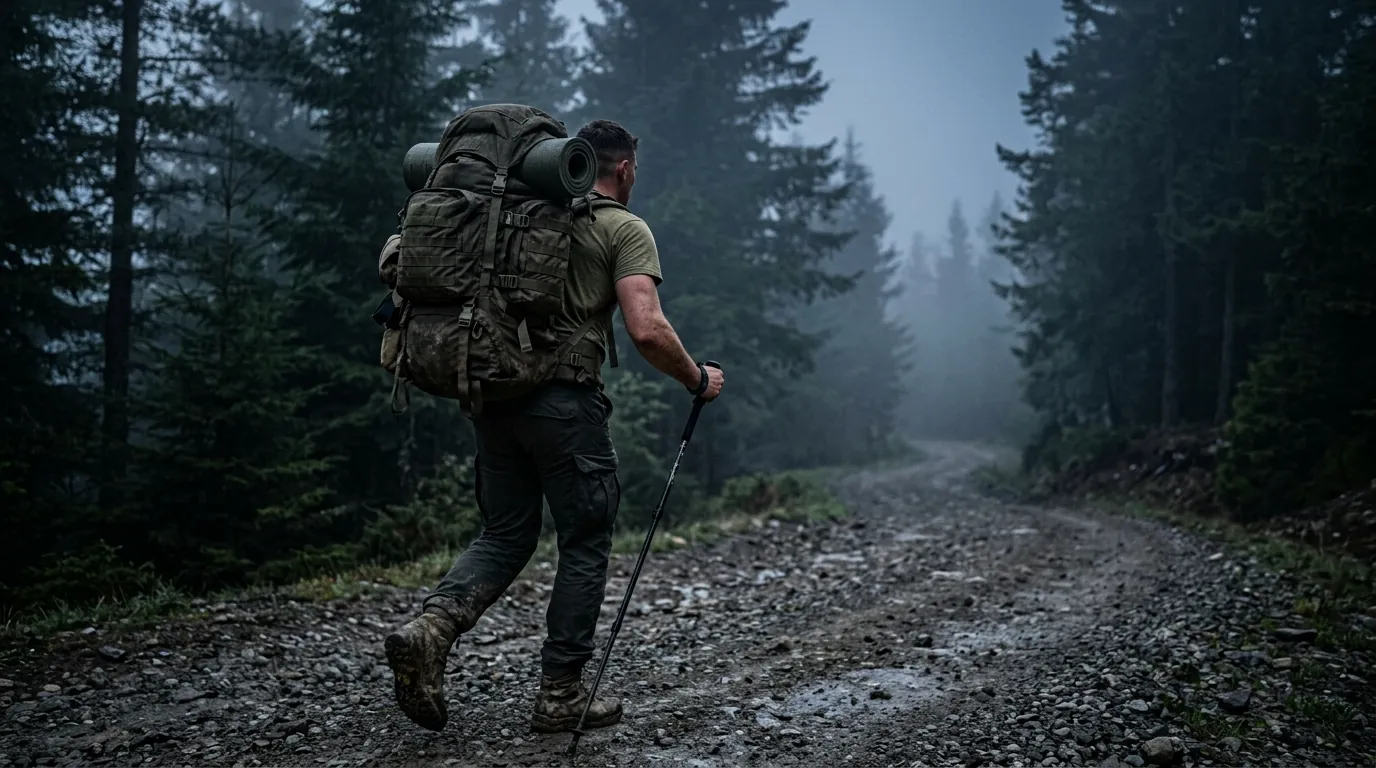
Rucking is the single most-underrated event by candidates and the most predictive of RASP success. Two rucks per week, one short-fast and one long-slow, is the structure used by most graduating candidates:
- Short-fast ruck: 3–6 miles at 4.0–4.2 mph (the RASP target pace) — builds the sustainable speed.
- Long-slow ruck: 8–12 miles at 3.5 mph — builds the foot, ankle, and hip durability that separates finishers from quitters.
Wear the boots and pack you’ll wear at RASP — break-in time matters as much as fitness. A blister in week 8 of training is information; a blister at mile 4 of the RASP 12-miler is a no-go.
Common Ranger Workout Mistakes
- Skipping rucks because they’re “boring.” The 12-mile ruck event eliminates more candidates than any other physical test. There is no substitute for time under load.
- Max-effort calisthenics every session. Two-minute test sets every workout overcooks the CNS. Volume work in pyramids and time blocks beats max-out testing.
- Adding heavy lifting on top. A 5×5 strength program plus this plan exceeds most candidates’ recovery capacity. Pick one or the other for the 12 weeks.
- Not training the swim. The Combat Water Survival Test is pass-fail. Practice clothed swims and 15m underwater swims before reporting.
FAQ
What’s the difference between RASP and Ranger School?
RASP is the selection course for the 75th Ranger Regiment (an active-duty special operations unit). Ranger School is a separate 61-day leadership course at Fort Moore that awards the Ranger Tab — open to soldiers across the Army. Both are physically demanding, but RASP is shorter and weighted more toward sustained physical output; Ranger School is longer and weighted toward leadership under deprivation.
How does Ranger prep compare to Special Forces prep?
Both demand similar baseline calisthenics and run standards. The differences: SFAS rucks are longer (some 18-mile efforts) and emphasize land navigation under load; RASP rucks are faster-paced over shorter distances. See our Special Forces training program guide for the SFAS-specific pipeline.
Do I need a weighted vest if I have a ruck?
No — a 35-lb ruck does the same job and matches the actual event. A vest distributes load differently and won’t condition your shoulders, hips, and feet for the real ruck pattern. Train how you’ll test.
Can I do this plan as a civilian preparing to enlist?
Yes — many “Option 40” Ranger contract candidates run programs like this in the months between MEPS and ship date. Pair it with our Army PRT drills for the official preparation drill, hip stability, and military movement work that BCT will expect you to know, and our AFT calculator to track your push-up, sit-up, and 2-mile run scores throughout the build.
Bottom Line
An Army Ranger workout plan succeeds when it balances three things: rucking volume (the most-skipped event), calisthenics endurance (volume over max-effort), and aerobic base (5-mile pace, not just 2-mile speed). The 12-week program above progresses each element in three phases without overcooking recovery. Hit the competitive numbers — 70+ push-ups, 80+ sit-ups, 12+ pull-ups, sub-13:30 2-mile, 12-mile ruck under 2:30 — and you arrive at RASP physically prepared, leaving the mental and emotional gates as the main filter. For the broader military fitness ecosystem, see our military calisthenics workout guide, Navy SEAL physical requirements, 28-day military workout, and 8-week military calisthenics plan.