By James Nolan · Last updated June 13, 2026
TL;DR — Can you build muscle without weights?
You can build muscle without weights by applying progressive overload through harder exercise variations, more reps, slower tempo, shorter rest, and a fuller range of motion. Bodyweight training matches weighted training for hypertrophy when your sets go close to failure. Beginners usually see visible change in about 8 weeks; advanced lifters eventually need added load — bands first, then weights.
Can you really build muscle without weights?
Yes. When a set is taken close to failure, your muscles can’t tell whether the tension came from a barbell or your own body. In one controlled trial, push-up training loaded to mirror a 40%-1RM bench press produced similar gains in chest and triceps thickness and similar strength over eight weeks (Source: Journal of Exercise Science & Fitness, 2017). The one honest caveat: the more trained you already are, the harder this gets.
That caveat matters, so I’ll put it up front. A complete beginner can add noticeable muscle with nothing but a floor and a doorframe. Someone who has been lifting for five years will struggle to keep growing on bodyweight alone, because the thing that drives growth — hard, near-maximal effort — becomes difficult to load with leverage tricks past a certain point. Most of this guide is about getting the most out of the route that works, then knowing exactly when you’ve hit its limit.
How muscle actually grows (mechanical tension, not the dumbbell)
Muscle grows in response to mechanical tension — the force your muscle fibers generate against resistance — sustained across enough hard reps. Load is one way to create that tension. It is not the only way. A heavy barbell creates high tension on every rep. A bodyweight set creates lower tension per rep, so you make up the difference with volume: more reps, taken close enough to failure that the last few are genuinely hard.
This is why “low load, high effort” works. The deciding factor for hypertrophy is how close you push a set to the point where you can’t complete another clean rep, not the absolute number on the bar. Stop a push-up set at 15 when you could have done 25, and you’ve trained almost nothing. Grind to a true 23 or 24, and the stimulus rivals a moderate barbell set.
What the research says
The load-independence finding holds up across the literature. A systematic review and network meta-analysis of resistance-training studies found that low loads (under 60% of 1RM) and high loads produced similar muscle growth when sets were performed to or near failure (Source: Sports Medicine / PMC, 2021). Separate meta-analyses of training taken to momentary failure report no meaningful difference between low- and high-load work for type I or type II fiber growth (Source: Journal of Strength & Conditioning Research, 2017).
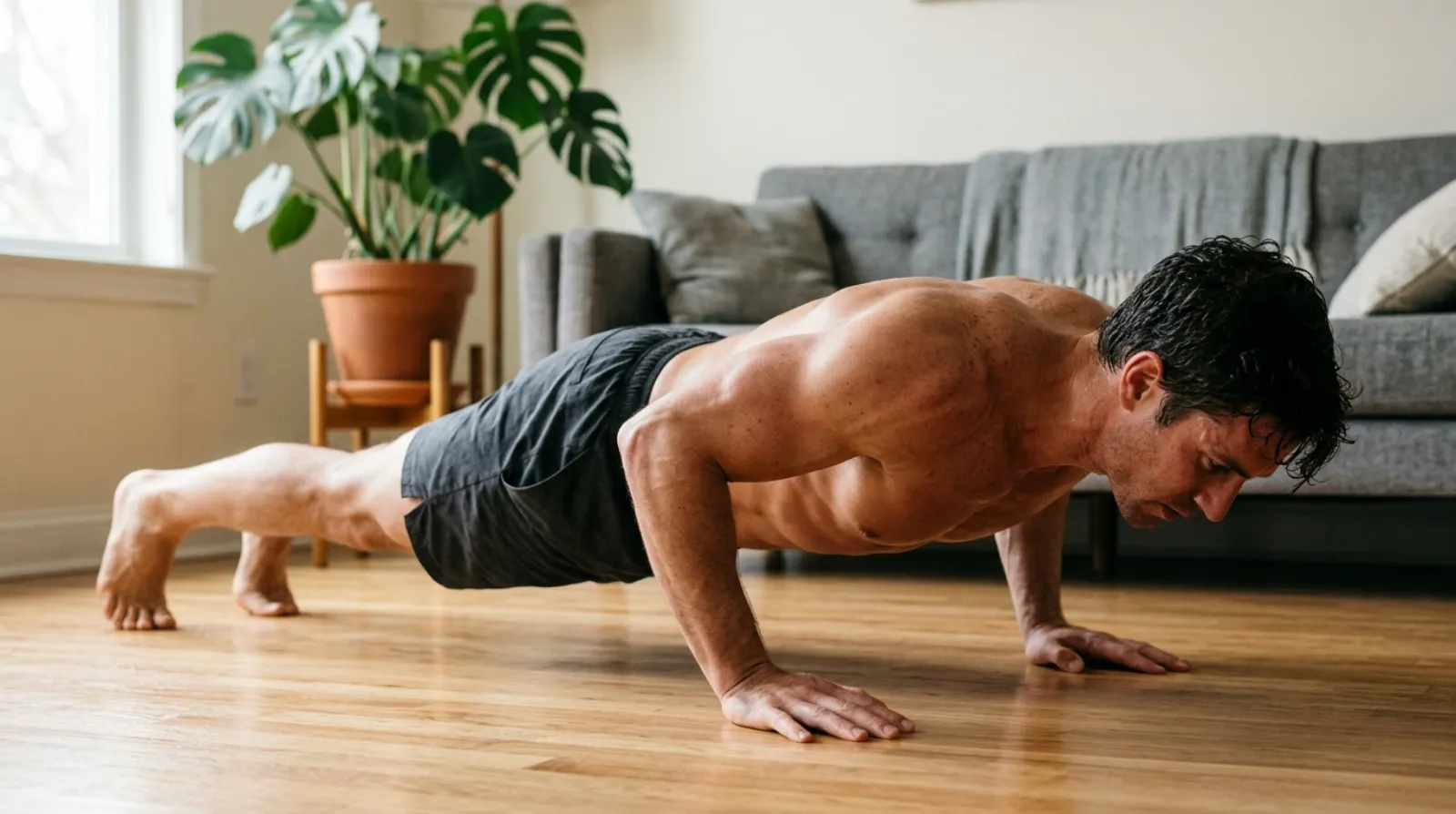
The push-up study is the cleanest single demonstration. Eighteen men trained twice a week for eight weeks; the push-up group, loaded to mirror a 40%-1RM bench press, gained chest and triceps thickness comparable to the bench-press group (Source: Journal of Exercise Science & Fitness, 2017). Strength gains tracked together too. The barbell group did add biceps thickness the push-up group didn’t — a reminder that bodyweight pushing alone leaves gaps you’ll fill with pulling work. For the full breakdown, see how bodyweight compares to lifting weights.
The 5 levers that replace lifting heavier
Without a heavier weight to grab, progressive overload comes from five levers. Pick one to push each week, log it, and you keep forcing adaptation. Here they are, ordered from the biggest driver to the finest adjustment:
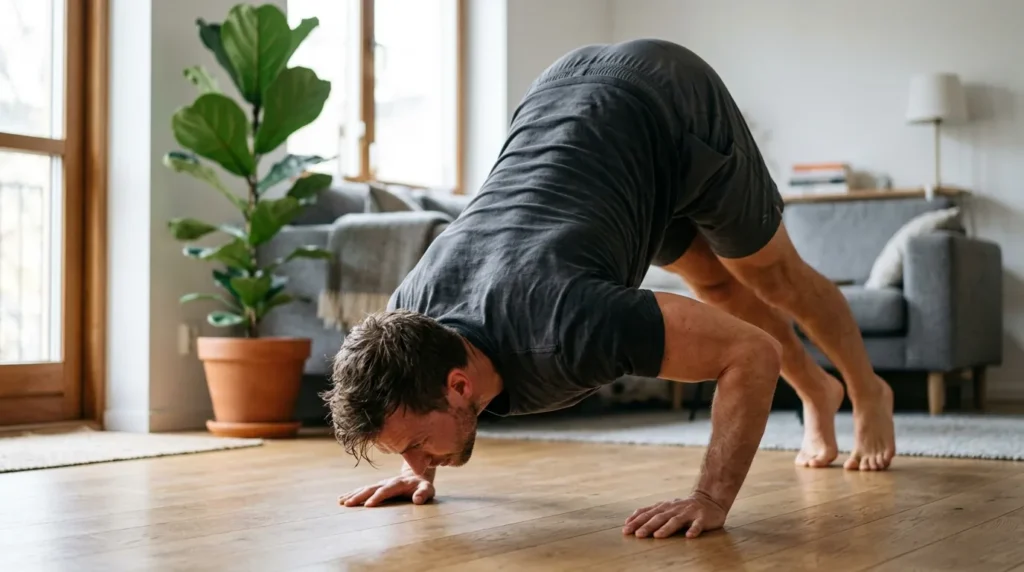
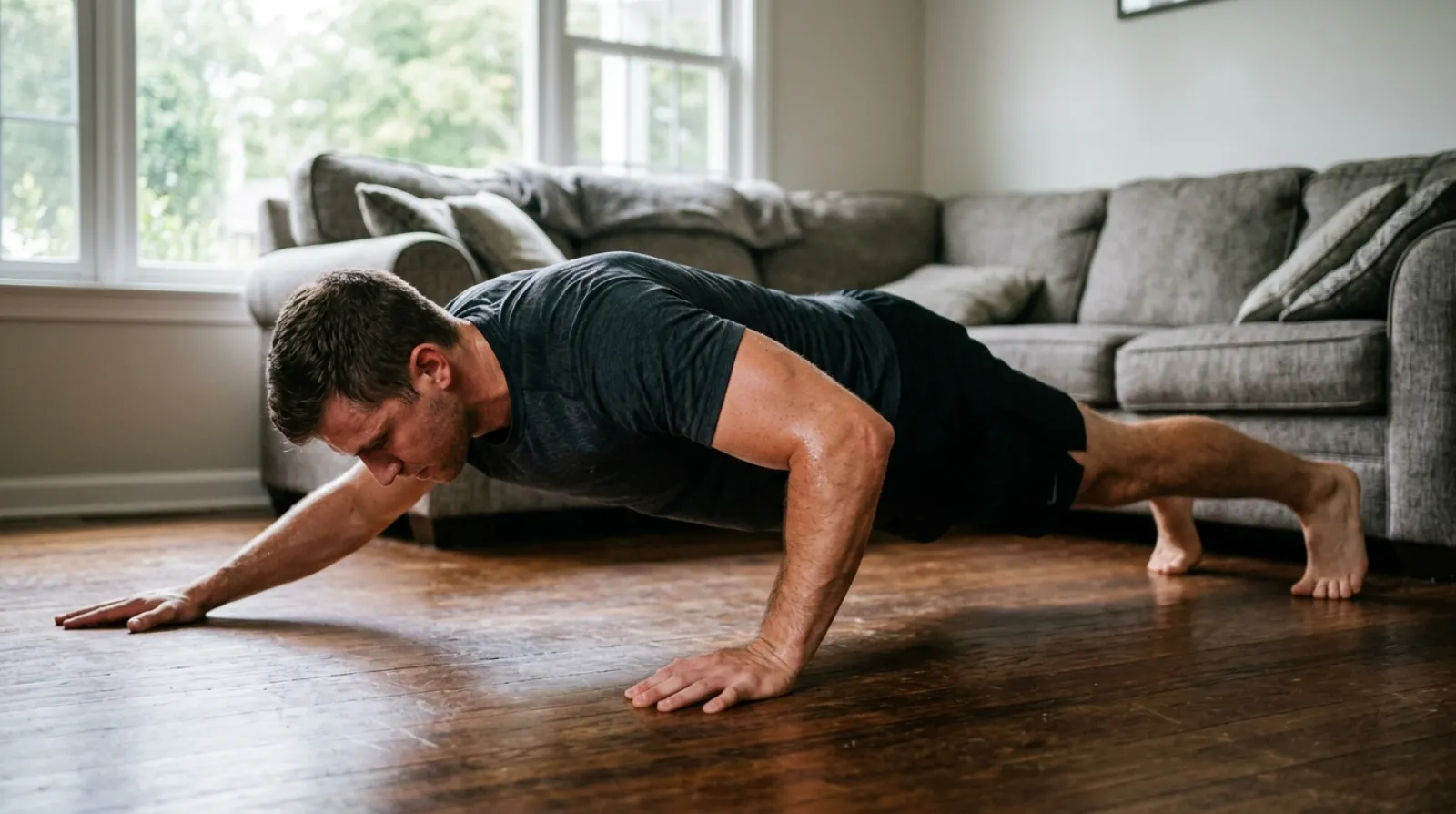
- Progress to harder exercise variations (knee push-up → full → archer → one-arm).
- Add reps, then add total weekly sets for the muscle.
- Slow the tempo — a 3–4 second lowering phase on every rep.
- Shorten rest between sets to raise the density of the work.
- Increase range of motion — go deeper, get a fuller stretch under load.
1. Harder exercise variations
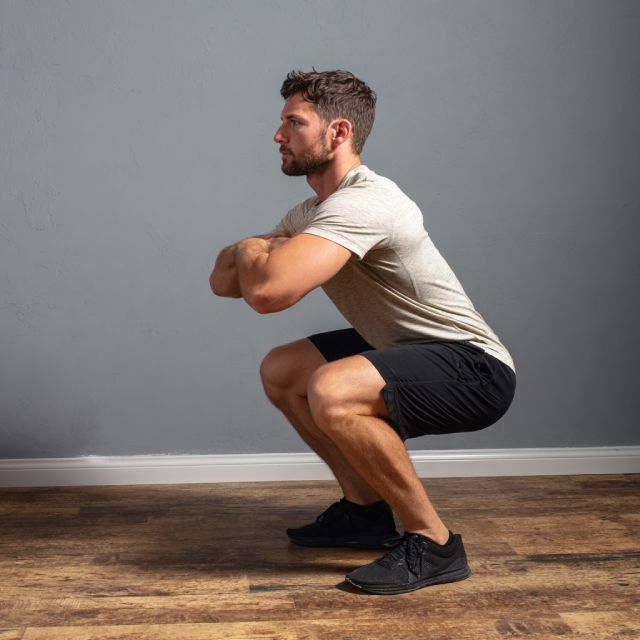
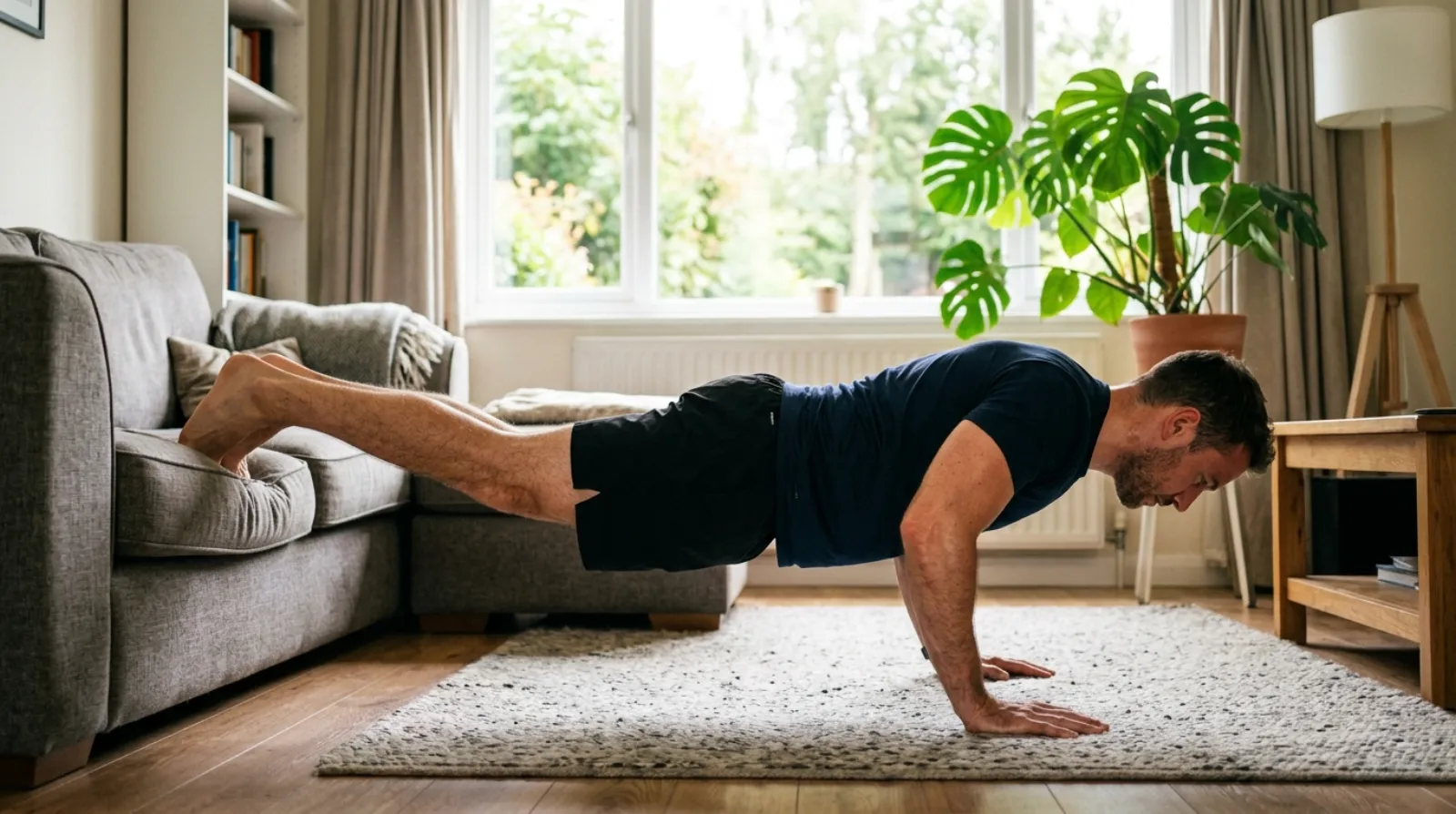
This is your main substitute for adding plates. Every movement pattern has a ladder of progressively tougher versions that load the muscle more by shifting leverage. Push-ups run from incline to flat to feet-elevated to archer to one-arm. Squats run from two-legged to split to pistol. When a variation gets easy for 20-plus clean reps, you don’t do 40 — you climb to the next rung, which drops you back to a hard 6–10.
2. More reps and weekly sets
Within a variation, add reps before you add difficulty, and add sets across the week to grow total volume. If week one is 3 sets of 12 push-ups, aim for 3×14, then 3×16, then jump variations. Weekly volume — sets per muscle, not per workout — is the number that correlates most tightly with growth, so track it.
3. Slower tempo
Slow the lowering phase to 3–4 seconds and your muscle spends far longer under tension per rep, which makes a “too easy” bodyweight move hard again with zero equipment. A push-up you can rep 30 times fast might cap at 12 with a four-second descent. Tempo is the cheapest way to re-load a movement you’ve outgrown.
4. Shorter rest
Trim rest between sets and you raise the metabolic demand, forcing the same work into less time. Going from 90 seconds to 45 between push-up sets turns a comfortable session into a hard one. Use this lever in waves — cut rest for a few weeks, then reset it longer and chase reps again.
5. Fuller range of motion
A deeper range loads the muscle through a longer, stretched position, and the stretched portion of a rep appears to drive a disproportionate share of growth. Push-ups on parallettes or with hands on books let your chest drop below your hands; deficit split squats let your back knee travel further. More honest range, more stimulus.
A bodyweight routine that builds mass (exercises + sets/reps)
Build the week around movement patterns, not body parts: push, pull, legs, hinge, and core, each hit two to three times. Train full-body three days a week (rest days between) or run an upper/lower split four days a week. Pick one variation per pattern at a difficulty where you hit failure inside the rep target, and apply the five levers over time.
The pull pattern is the one most home trainees botch, because pulling needs something to hang from. A sturdy table, a doorframe row, or a cheap pull-up bar solves it. Skip it and you build a front-heavy, injury-prone physique.
The exercise table
| Movement pattern | Primary exercise | Beginner variation | Harder progression | Sets × reps |
|---|---|---|---|---|
| Push | Push-up | Incline / knee push-up | Archer → decline → pseudo-planche | 3–4 × 8–15 |
| Pull | Inverted row | Door / table row | Feet-elevated row → pull-up | 3–4 × 6–12 |
| Legs (squat) | Bodyweight squat | Box / assisted squat | Bulgarian split squat → pistol / shrimp | 3–4 × 8–15 |
| Hinge | Glute bridge | Two-leg bridge | Single-leg RDL → Nordic curl regression | 3 × 8–12 |
| Core | Plank | Knee plank | Hollow hold → L-sit | 3 × 20–45 s |
Want it mapped out week by week? You can follow a structured calisthenics plan that scales from beginner to advanced.
How to schedule it (2–3× per muscle / week)
Hit each pattern two to three times a week — that frequency beats once-weekly training for growth when total volume is matched. A meta-analysis found training a muscle at least twice weekly produced more hypertrophy than once weekly (Source: Journal of Sports Sciences / Schoenfeld et al., 2019). Three full-body days (Mon/Wed/Fri) is the simplest setup that gets you there. If you’d rather, an upper/lower split across four days works just as well.
For variety on conditioning days, no-equipment military-style workouts layer in well without cutting into recovery.
Using resistance bands as a load proxy
Resistance bands are the missing rung between bodyweight leverage and external weights: they add measurable, adjustable tension you can dial up by switching to a thicker band. Reach for them when you’ve climbed a movement’s variation ladder but can’t yet manage the next bodyweight progression — an assisted pull-up is the classic case. Bands let you keep a hard movement in your true 6–12 rep range instead of stalling.
Two ways to use them. As assistance, loop a band over a bar and into your foot to take weight off a pull-up or dip you can’t yet do unassisted, then step down to a thinner band as you get stronger — a built-in progression in physical form. As added resistance, anchor a band under your hands for push-ups or around your hips for squats to make an easy bodyweight move genuinely hard again.
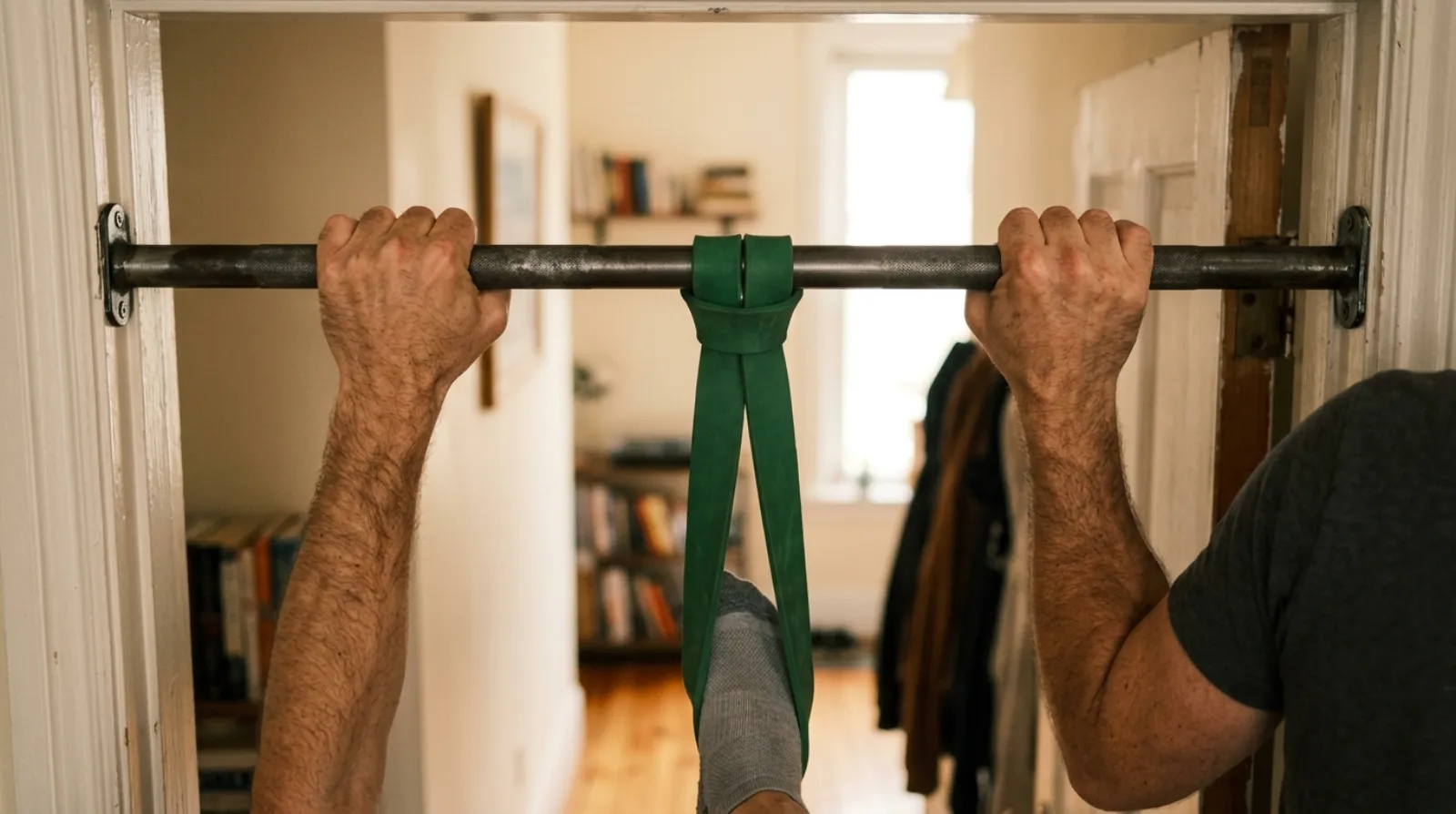
Progress band thickness the way you’d add plates. A typical loop set runs from roughly 5–30 lb of resistance up to 35–95 lb across four or five bands, so you move to a thinner assistance band (or thicker resistance band) as a step change in load. A full set costs around $18–35 — far less than dumbbells and impossible to outgrow for years. A budget set like the KAMIDA 6-piece resistance band set covers the full assistance-to-resistance range and packs into a drawer.
Disclosure: As an Amazon Associate, Gymstips earns from qualifying purchases. The link above is an affiliate link — if you buy through it, we may earn a small commission at no extra cost to you. We only recommend gear we’d use ourselves.
How long does it take to build muscle without weights?
Expect your first strength gains in about 2–4 weeks and your first visible muscle change around 8 weeks of consistent training. Most beginners see noticeable size in 6–10 weeks (Source: Healthline, 2024). The timeline stretches the more trained you are: early progress is fast because untrained muscle responds to almost any stimulus, then it slows as you approach your genetic ceiling.
These ranges assume you train each pattern 2–3 times a week, push sets near failure, eat enough protein, and sleep. Miss those and every number below moves right.
| Training level | First strength gain | First visible change | Plateau onset / add-load trigger |
|---|---|---|---|
| Beginner (0–1 yr) | ~2–4 weeks | ~6–10 weeks | ~6–12 months, when variations get easy fast |
| Intermediate (1–3 yr) | ~4–6 weeks | ~12 weeks | When you can’t find a hard-enough bodyweight variation |
| Advanced (3+ yr) | Mostly neural, slow | Minimal on bodyweight alone | Already at the ceiling — add bands, then weights |
Nutrition and recovery (the half everyone skips)
Training is the signal; food and sleep are what let your body act on it. To build muscle, eat enough protein (around 1.6 g per kg of bodyweight daily), keep calories at maintenance or a slight surplus, sleep 7–9 hours, and give each muscle 24–48 hours before you train it hard again. Skip any one of these and your sessions produce a fraction of what they should.
On protein, the evidence converges near 1.6 g/kg/day. A meta-analysis of 49 studies and 1,863 participants found protein intake beyond about 1.62 g/kg gave no further gains in lean mass (Source: British Journal of Sports Medicine / Morton et al., 2018). For a 70 kg person, that’s roughly 112 g a day — hit it with eggs, dairy, legumes, tofu, fish, or chicken, spread across meals.
Recovery is where growth actually happens. Muscle protein synthesis stays elevated for 24–48 hours after a hard session, which is the practical reason you don’t smash the same muscle two days running. Sleep is non-negotiable: short sleep blunts recovery and shifts your body toward losing muscle. If you’re sore, under-slept, and flat for a week, take a lighter “deload” week — back off volume, then come back stronger.
Where bodyweight training hits a ceiling — and what to do
Bodyweight training hits a ceiling when you run out of variations hard enough to keep your sets in the 6–12 rep range near failure — and that happens to trained lifters, not beginners. The fix is to add external load: bands first, then actual weight. There’s no trick that makes one-arm push-ups load your chest the way a heavy press does once you’re strong.
Here’s the mechanism. The five levers all work by making a movement harder without more weight, but each has a cap. You can only slow tempo so much, cut rest so far, or stretch range so deep before a movement becomes a balance-and-skill challenge rather than a strength one. Pistol squats and one-arm push-ups demand so much coordination that your limbs fail before the target muscle is maximally taxed. At that point the skill is the bottleneck, not the muscle — and skill practice isn’t hypertrophy training.
So the trigger is concrete: when you can’t find a bodyweight variation that brings a muscle to failure inside 6–12 reps, it’s time to add load. Start with bands for the smoothest jump, then graduate to weights — a weighted vest, a backpack full of books, or a barbell. This isn’t an admission of defeat. It’s the same progressive-overload logic you’ve been running all along, just with a new tool once leverage runs out. If you’re weighing the full switch, it’s worth seeing how bodyweight compares to lifting weights before you buy anything.
5 mistakes that stall bodyweight muscle growth
Most stalled progress traces to one of these five errors. Fix them in order.
- Not training near failure. Comfortable sets don’t grow muscle. Leave 1–2 reps in the tank, no more, on your working sets.
- No progression plan. Doing the same push-ups at the same reps forever is maintenance, not growth. Pick a lever each week and beat last week’s log.
- Ignoring legs and pulling. Push-ups are easy to default to. A program with no squats, hinges, or rows builds an unbalanced, injury-prone body.
- Too little protein. You can’t build tissue from a deficit of raw material. Hit ~1.6 g/kg/day before you blame your program.
- No deload, no sleep. Grinding hard with no recovery weeks and six hours of sleep is how you stall and stay stalled.
FAQ
Can you get muscular without weights?
Yes. Bodyweight training builds visible muscle when you apply progressive overload and take sets near failure. A controlled study found push-ups matched a 40%-1RM bench press for chest and triceps growth over eight weeks (Source: Journal of Exercise Science & Fitness, 2017). The limit shows up later: advanced lifters eventually need added load to keep growing.
How long does it take to build muscle without weights?
First strength gains come in about 2–4 weeks; visible muscle change typically shows around 6–10 weeks for beginners (Source: Healthline, 2024). Progress is fastest for untrained people and slows as you approach your genetic ceiling.
How many days a week should you train bodyweight for muscle?
Train each muscle 2–3 times a week. Twice-weekly training beats once-weekly for hypertrophy when volume is matched (Source: Journal of Sports Sciences / Schoenfeld et al., 2019). Three full-body sessions or a four-day upper/lower split both get you there.
Are push-ups as good as bench press for building muscle?
For chest and triceps growth, push-ups matched a 40%-1RM bench press over eight weeks in trained-matched men (Source: Journal of Exercise Science & Fitness, 2017). The bench group did add biceps thickness push-ups didn’t, so pair pushing with pulling work for balance.
Do you need resistance bands to build muscle without weights?
No — you can build plenty of muscle with pure bodyweight movements. Bands help once you’ve outgrown a movement’s variations and need a measurable load step, especially for assisted pull-ups and dips. They’re the cheapest way to extend progression before buying weights.
Is there a natural muscle ceiling with bodyweight training only?
Yes, for advanced trainees. Once you can’t find a bodyweight variation hard enough to reach failure inside 6–12 reps, leverage tricks turn into skill challenges and growth stalls. That’s the signal to add external load — bands first, then weight.
Sources
- Low-load bench press and push-up induce similar muscle hypertrophy and strength gain — Kikuchi & Nakazato, Journal of Exercise Science & Fitness, 2017 (PubMed)
- Resistance Training Load Effects on Muscle Hypertrophy and Strength Gain: Systematic Review and Network Meta-analysis, 2021 (PMC)
- Strength and Hypertrophy Adaptations Between Low- vs. High-Load Resistance Training — J Strength Cond Res, 2017
- How many times per week should a muscle be trained to maximize hypertrophy: a systematic review and meta-analysis — Schoenfeld, Grgic & Krieger, Journal of Sports Sciences, 2019 (PubMed)
- Protein supplementation meta-analysis (1.62 g/kg breakpoint) — Morton et al., Br J Sports Med, 2018 (PubMed)
- How long does it take to build muscle — Healthline