
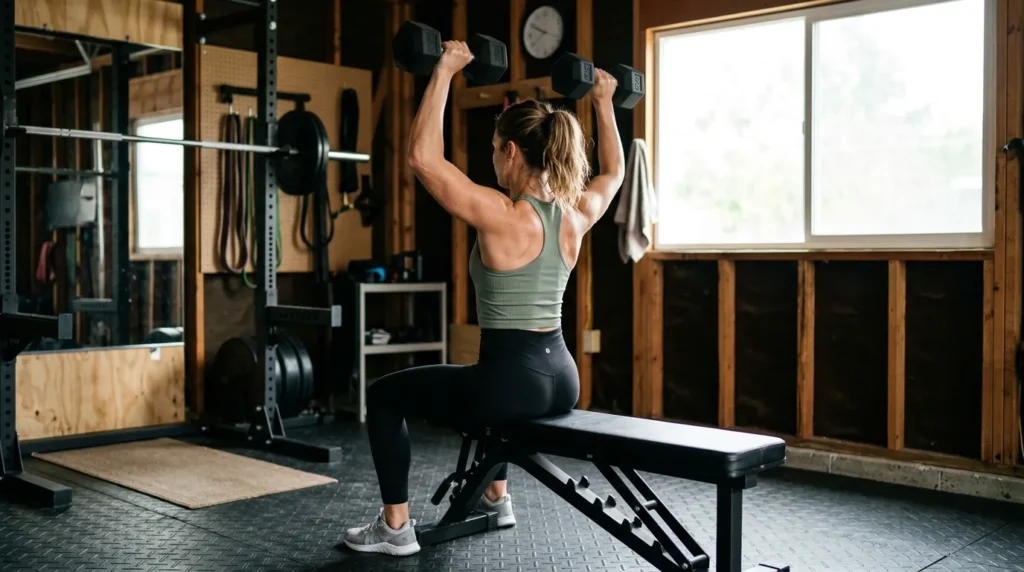
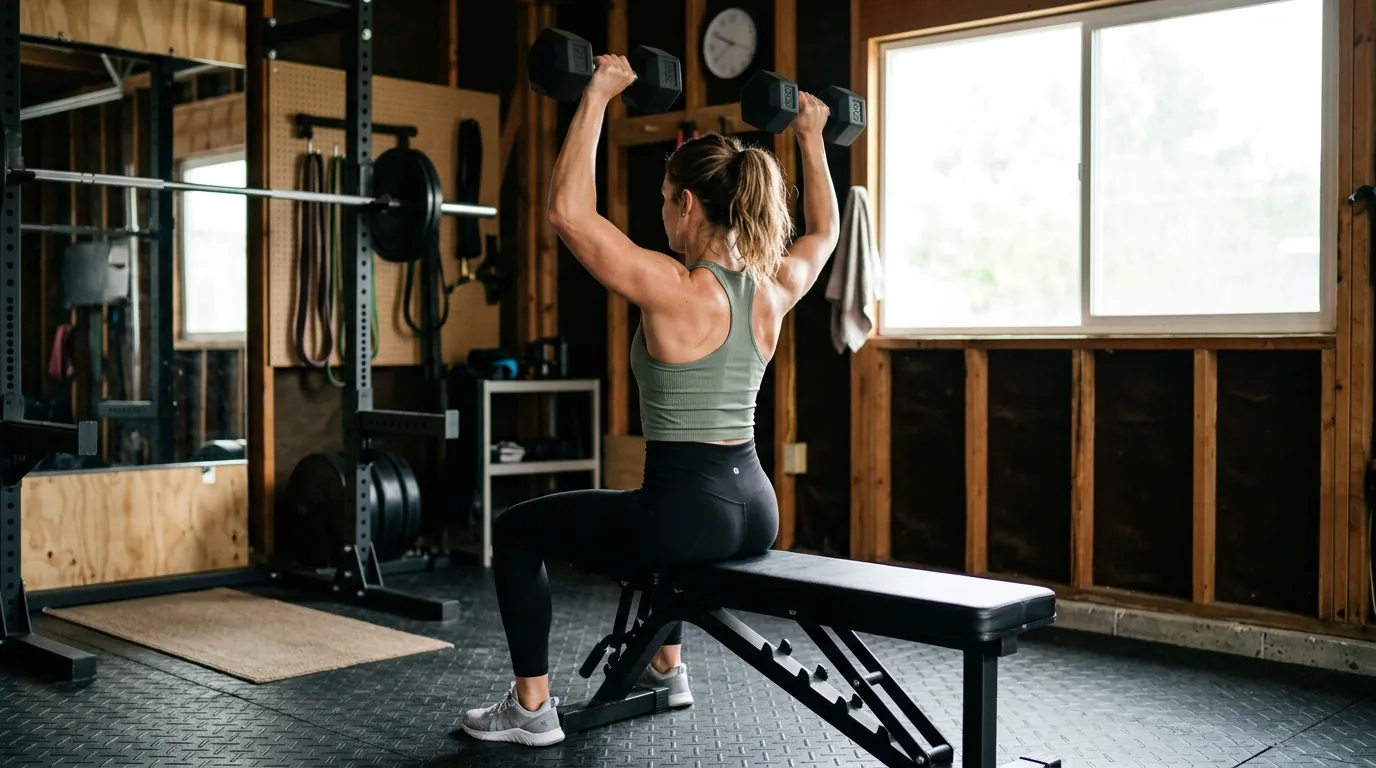
TL;DR — Can you build shoulders with just dumbbells at home?
Yes. This dumbbell shoulder workout needs nothing but a pair of dumbbells and zero bench to build all three deltoid heads. Train shoulders twice a week, roughly 48 hours apart, hitting 10–16 working sets per delt head across 8–15 reps. Use the 7 moves below, run the 4-week plan, and keep presses heavy, raises light. The most common home mistake? Swinging your lateral raises (more on that fix later).
Shoulder anatomy: the 3 delt heads you’re actually training
Your deltoid is one muscle split into three heads, and each pulls your arm in a different direction. The front (anterior) raises your arm forward and helps press overhead. The side (lateral or medial) lifts your arm out to the side and is what gives shoulders that capped, wide look. The rear (posterior) pulls your arm back and outward. Train all three or you get an unbalanced, front-heavy look.
Here’s how that breaks down move by move.
The front head does most of its work during pressing. Any overhead press already loads it hard, which is why dedicated front-raise volume should stay low for most people. Overdoing it is one of the easiest ways to round your shoulders forward over time.
The lateral head is the one most lifters actually want bigger, because width across the shoulders is what reads as “built.” It barely fires during pressing, so you target it directly with raises. This head responds well to lighter weight and clean, controlled reps.
The rear head is the most neglected of the three. It gets almost no work from pressing and very little from most pushing movements, so unless you train it on purpose, it stays small. A systematic review of deltoid activation found that horizontal abduction movements like the reverse fly recruit the posterior deltoid far better than pressing or upright rows (Source: Journal of Bodywork and Movement Therapies, 2022). Translation: you have to give it its own slot.
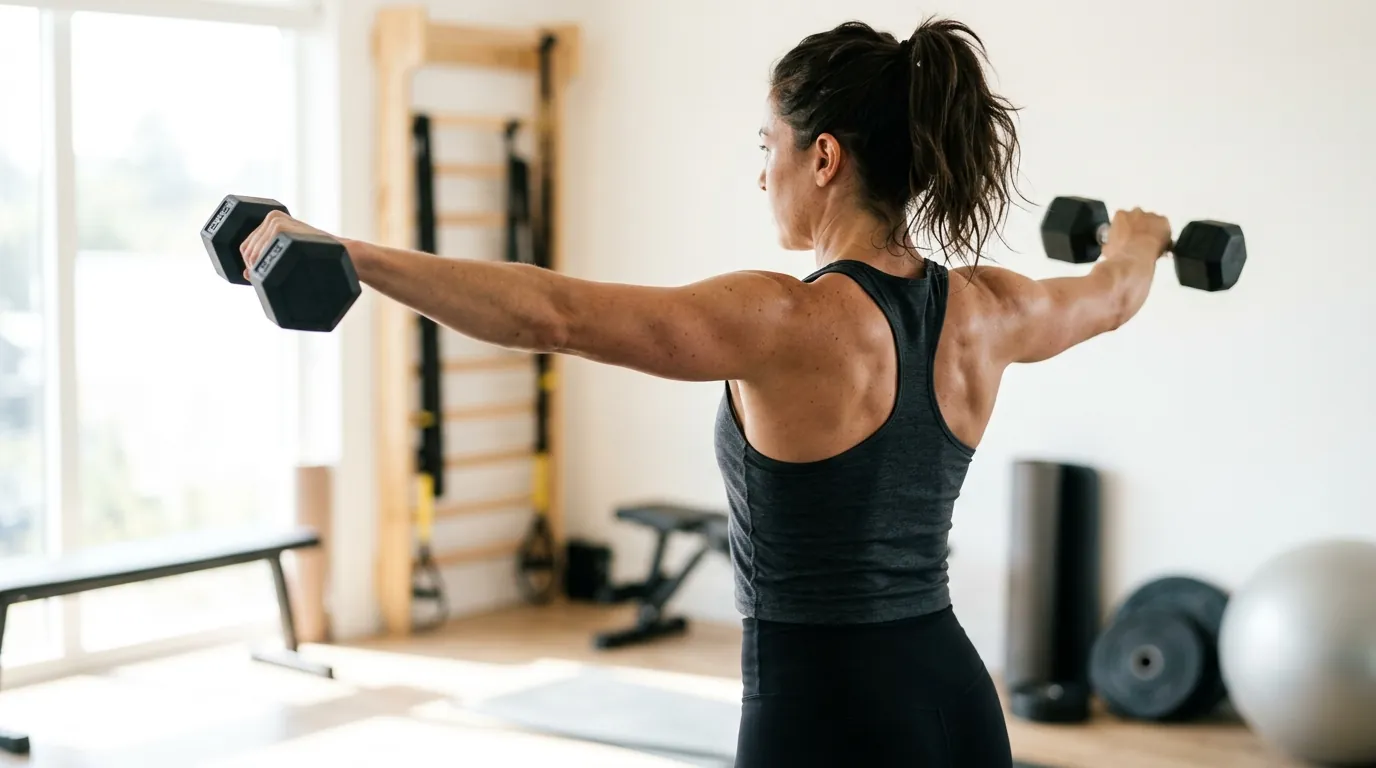
It pays to warm up your shoulders first before any of this, especially the overhead work.
The 7 best dumbbell shoulder exercises
This dumbbell shoulder workout’s seven moves cover all three delt heads with nothing but dumbbells. Lead with the two presses for mass, add three raise variations for width and rear-delt detail, and keep a heavier compound at the end. Every one has a standing, no-bench version.
- Dumbbell shoulder press
- Arnold press
- Dumbbell lateral raise
- Dumbbell front raise
- Bent-over rear delt fly
- Reverse fly (incline or seated variation)
- Dumbbell upright row or push press
Table A — the 7 moves at a glance
| Exercise | Primary delt head | Sets × reps | No-bench / home substitution |
|---|---|---|---|
| Dumbbell shoulder press | Front (lateral assists) | 3–4 × 8–12 | Standing strict press; brace your core hard |
| Arnold press | Front + lateral | 3 × 8–12 | Standing; sit on a sturdy chair if balance is an issue |
| Dumbbell lateral raise | Lateral | 3–4 × 12–15 | Already standing — no change |
| Dumbbell front raise | Front | 2 × 12–15 | Standing, alternating arms |
| Bent-over rear delt fly | Rear | 3 × 12–15 | Hinge at the hips, chest over knees — no bench |
| Reverse fly | Rear | 2–3 × 12–15 | Seated on a chair, chest on thighs |
| Upright row or push press | Lateral / whole delt | 3 × 8–12 | Standing; wide grip, lead with elbows |
1. Dumbbell shoulder press
The shoulder press is your main mass builder for the front delts, with the lateral head assisting. Press two dumbbells from shoulder height to overhead, keeping your wrists stacked over your elbows. Stand for the home version and squeeze your glutes and abs so you don’t arch your lower back. Stop just short of locking out to keep tension on the muscle.
No-bench note: standing makes this harder on your core, which is fine. Don’t let your ribs flare.
2. Arnold press
The Arnold press is a dumbbell overhead press that starts with your palms facing you at chin height, then rotates to palms-forward as you push overhead — hitting the front and lateral heads in one rep. That rotation adds range of motion the standard press skips. Go lighter than your normal press; the rotating portion is where shoulders feel vulnerable, so control it.
3. Dumbbell lateral raise
The lateral raise is the single best move for shoulder width, and it’s also where most home lifters go wrong. Hold a dumbbell in each hand, soft bend in the elbows, and lift out to the sides until your arms reach shoulder height. Lead with your pinkies slightly higher than your thumbs. Lower slow.
The #1 home mistake on this lift: going too heavy and swinging the weight up with momentum. When that happens, the movement turns into a half front-raise and a shrug, and the lateral head — the part you’re trying to build — barely works. It’s the most common error coaches see on this exercise. The fix is four parts: drop the weight, keep a soft elbow, pause for a beat at the top, and stop using your traps to heave. If you can’t pause at the top, the weight is too heavy.
4. Dumbbell front raise
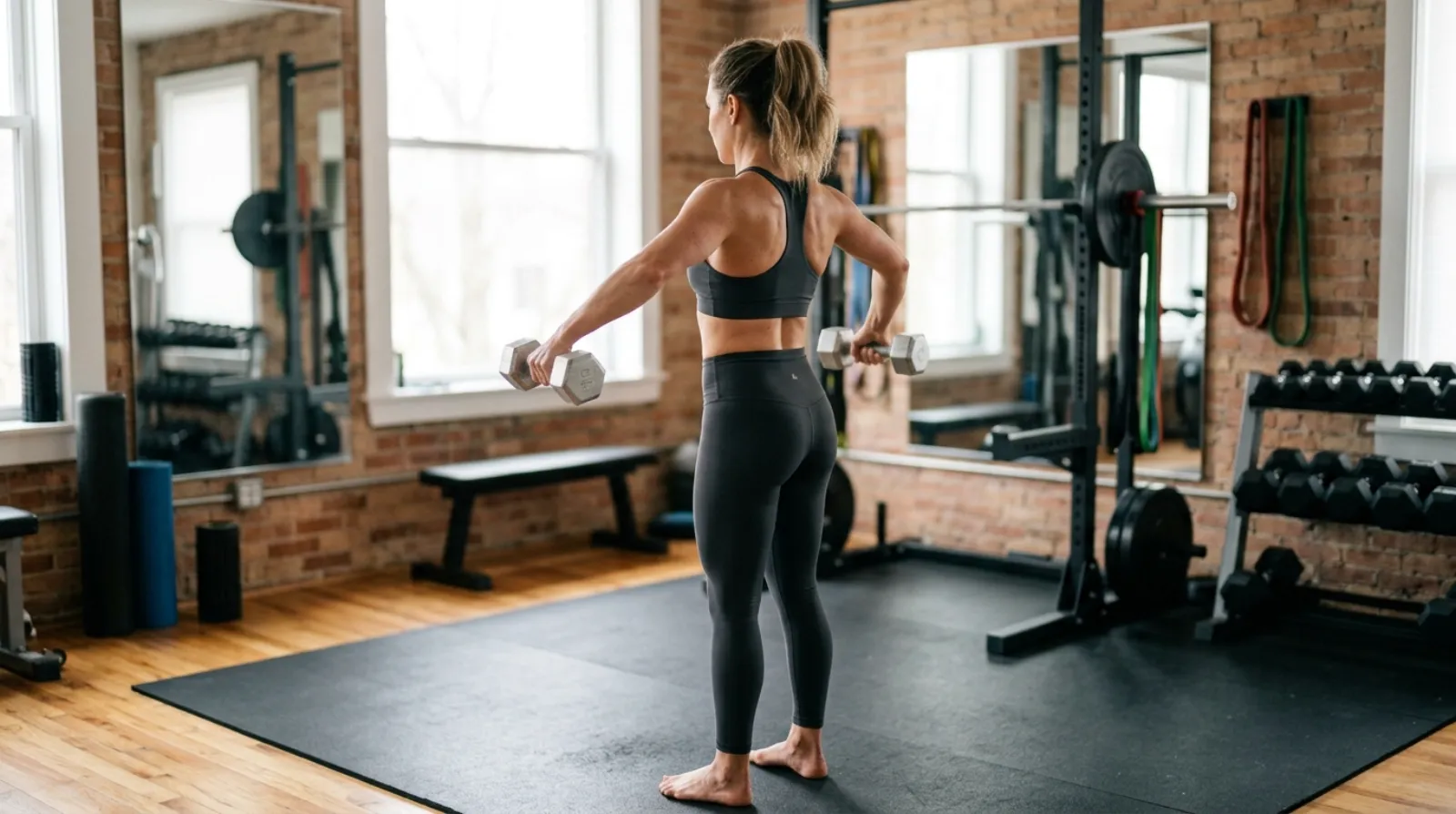
The front raise isolates the anterior delt, lifting a dumbbell straight in front of you to shoulder height. Here’s the honest take: your front delts already get hammered by every press, so most people need very little direct front-raise work — two sets is plenty. Skip it entirely if your shoulders already round forward. Alternate arms to keep your torso still.
5. Bent-over rear delt fly
The bent-over rear delt fly is your primary fix for the neglected posterior head. Hinge at your hips until your chest faces the floor, let the dumbbells hang, then raise them out to the sides with a soft elbow. Lead with your elbows, not your hands, and don’t let the weight drift behind you into a row. Light weight, high reps, clean form.
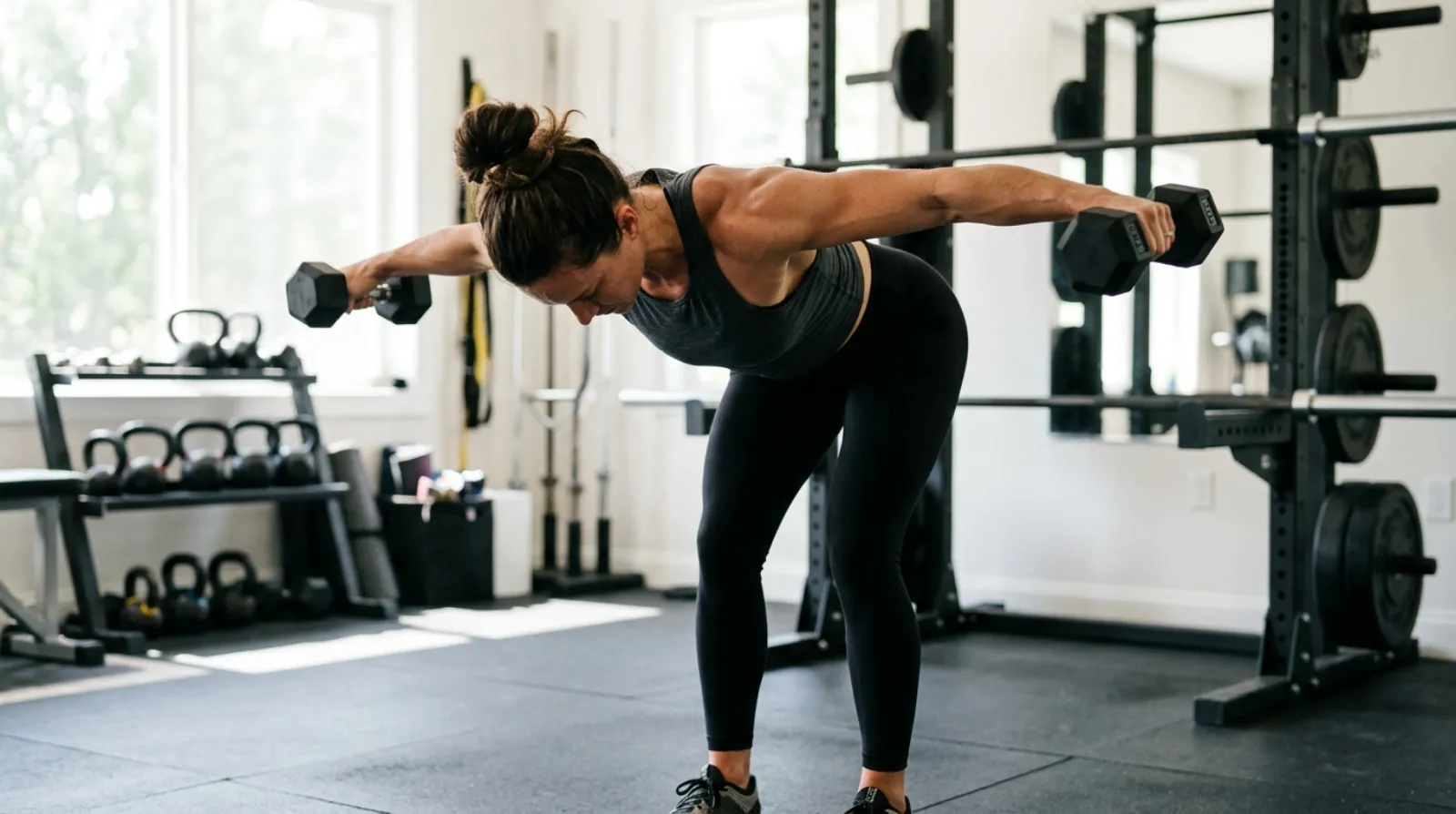
6. Reverse fly (incline or seated variation)
The reverse fly hits the rear delt from a second angle, which matters because this head responds to volume from multiple positions. Sit on a chair, lean your chest onto your thighs, and fly the dumbbells out and slightly up. Research on hand position found that a neutral or partially externally rotated grip drives more posterior deltoid activation than a pronated one (Source: Journal of Strength and Conditioning Research, 2013), so let your thumbs lead up at the top.
7. Dumbbell upright row or push press
Pick one heavier compound to finish. The upright row pulls two dumbbells up the front of your body, elbows leading wide, and trains the lateral delt plus traps. The push press uses a small leg drive to grind out heavier overhead reps when your shoulders are already tired. Form caveat on the upright row: keep the grip wide and stop at chest height. Pulling narrow and high into your chin is the classic shoulder-impingement setup, so don’t.
If you’d prefer no equipment at all, the same three delt heads can be trained with bodyweight progressions.
Do you need a bench for dumbbell shoulder workouts?
No. Every shoulder exercise worth doing has a standing or seated-on-a-chair version, and pressing on your feet actually builds more core stability than a bench does. A bench is convenient, not required. If all you own is a pair of dumbbells, you can train delts hard in the middle of your living room.
A complete standing-only session looks like this:
- Standing dumbbell shoulder press — 3 × 8–12 (front + lateral mass)
- Standing lateral raise — 3 × 12–15 (width)
- Standing bent-over rear delt fly — 3 × 12–15 (rear delt)
Three moves, three heads, zero furniture. If you’re curious how dumbbells compare to training with just your body, the trade-offs are worth knowing.
How to pick the right weight (a simple rule)
Pick a weight where the last 2 reps are genuinely hard but your form stays clean. If you could grind out 5 more, it’s too light. If your form breaks before you hit the target reps, it’s too heavy. That “2 reps left in the tank” feel keeps you close enough to failure to grow without wrecking your joints.
The right load is very different per move, because raises and presses aren’t in the same universe:
- Raises (lateral, front, rear): 5–12 lb per hand for most beginners. These are small muscles. Ego-lifting here is what creates the swing-and-shrug problem.
- Presses (shoulder press, Arnold, push press): 15–30 lb per hand for most beginners, and adjust up fast as you get stronger.
These are starting ranges, not rules. A stronger lifter scales up; someone brand new starts lighter. The last-2-reps-hard test always wins over any number on the dumbbell.
The 4-week dumbbell shoulder plan
Run this dumbbell shoulder workout twice a week and progress it for four weeks by adding reps first, then load. Unlike a calisthenics plan that climbs a skill ladder, dumbbell progression is load-based: you push the same moves a little harder each week. Keep presses heavy and low-rep, raises light and high-rep, and finish each set 1–2 reps shy of failure early on, closer to failure by week 4.
Table B — 4-week progression
| Week | Sets per move | Load / progression | Target RPE | Note |
|---|---|---|---|---|
| Week 1 | 3 | Conservative — find your working weights | RPE 7 (3 reps in reserve) | Groove the form, especially lateral raises |
| Week 2 | 3 | Add 1–2 reps per set at the same load | RPE 7–8 | Same weights, more reps |
| Week 3 | 4 | Add a 4th set to presses and lateral raise | RPE 8 | Volume bumps toward the top of the range |
| Week 4 | 4 | Add load once you hit the top of each rep range | RPE 8–9 (last 2 reps hard) | Peak week; then deload or restart heavier |
The full twice-weekly session: shoulder press, Arnold press, lateral raise, front raise (2 sets only), bent-over rear delt fly, reverse fly, and one finisher (upright row or push press). That lands you inside the 10–16 sets per delt head target across the week.
How to progress week to week
Run the same dumbbell shoulder session twice a week and progress it over four weeks by adding reps first, then load.
Week 1 — groove the form
Do 3 sets per move at a conservative weight and find your working loads. Keep it at RPE 7 (about 3 reps in reserve) and pay special attention to clean lateral raises.
Week 2 — add reps, same load
Keep the same weights but add 1–2 reps per set, pushing to RPE 7–8. More reps at the same load is your first lever before touching weight.
Week 3 — add volume
Add a 4th set to your presses and lateral raise at RPE 8 to bump weekly volume toward the top of the range.
Week 4 — add load (double progression)
Once you hit the top of each rep range with good form, increase the load, then drop back to the bottom of the rep range at the new weight and climb again. Push to RPE 8–9 (last 2 reps hard), then deload or restart heavier. Bump raises by the smallest increment you own.
This double progression keeps you moving forward for months without guessing. Want to pair this with arm work? Slot it on a separate day so your shoulders recover.
How often should you train shoulders?
Twice a week is the sweet spot for a dumbbell shoulder workout. A single hard session elevates muscle protein synthesis for about 24–48 hours before it returns toward baseline (Source: American Journal of Physiology, 2019), so a second session mid-week catches that window again. A meta-analysis in Sports Medicine found that training a muscle twice per week produced superior hypertrophy compared with once per week (Source: Schoenfeld et al., Sports Medicine, 2016).
Train your deltoids twice per week, leaving about 48 hours between sessions. Aim for 10–16 working sets per delt head each week across 8–15 reps — keep presses heavier and lower-rep, raises lighter and higher-rep. This volume is enough to grow all three heads with dumbbells alone, without overtraining the front delts that pressing already hammers.
The 10–20 sets-per-week range comes from volume research showing weekly set count is a primary driver of growth (Source: Schoenfeld et al., 2017, via systematic review). For shoulders trained with dumbbells, 10–16 keeps the front delts from getting fried by all the pressing.
How long should a dumbbell shoulder workout take?
About 30–45 minutes, warm-up included. Shoulders are small and fatigue fast, so you don’t need a marathon session. Spend 5 minutes warming up the joint with arm circles and band or light-dumbbell raises, then move through your working sets with 60–90 seconds of rest between them. If you’re past 45 minutes, you’re either resting too long or doing too much volume for one muscle.
Worth a minute: spend five minutes on shoulder mobility first so the overhead work feels smooth.
Front vs lateral vs rear delts: where to focus
Prioritize your lateral and rear delts — they’re what most people are missing. The front head already gets plenty of work from pressing (and your chest work hits them too if you train push-ups or bench), so adding heavy front-raise volume usually creates imbalance, not size. The capped, 3D shoulder look comes from a developed lateral head and a rear head that actually exists. If you only had time for two things, it’d be lateral raises and rear delt flies, not more pressing.
Frequently asked questions
Can you build shoulders with only dumbbells?
Yes. Dumbbell presses build the front head, lateral raises build the side head, and rear delt flies build the back head — no barbell or machine required.
How many sets and reps should I do?
Aim for 10–16 working sets per delt head per week, in the 8–15 rep range. Keep presses heavier and lower-rep, raises lighter and higher-rep.
Do I need a bench?
No. Every shoulder move has a standing or seated-on-a-chair version, and pressing on your feet adds core work a bench can’t.
How often should I train shoulders?
Twice a week, about 48 hours apart. That hits the muscle-building window twice and beats training once a week.
What weight should I use?
A weight where the last 2 reps are hard with clean form. Most beginners start around 5–12 lb per hand for raises and 15–30 lb for presses, then adjust.
How long should the workout take?
30–45 minutes including warm-up. Shoulders fatigue quickly, so longer isn’t better.
What is the Arnold press?
A dumbbell press that starts with palms facing you at chin height and rotates to palms-forward as you push overhead. It works the front and lateral delts in one movement.
Sources
- Deltoid head activation across exercises (rear delt and reverse fly): Activation of the three deltoid muscle portions during common strengthening exercises: a systematic review — Journal of Bodywork and Movement Therapies, 2022
- Hand position and posterior deltoid activation: Effect of hand position on EMG activity of the posterior shoulder musculature during a horizontal abduction exercise — Journal of Strength and Conditioning Research, 2013
- Muscle protein synthesis 24–48h window: Revisiting the roles of protein synthesis during skeletal muscle hypertrophy — American Journal of Physiology, 2019
- Training frequency twice per week: Schoenfeld, Ogborn & Krieger — Effects of Resistance Training Frequency on Measures of Muscle Hypertrophy, Sports Medicine, 2016
- Weekly volume dose-response: Schoenfeld et al. — dose-response relationship between weekly resistance training volume and muscle hypertrophy, systematic review (2017)
- Rep range for hypertrophy: The hypertrophy rep range — fact or fiction (review of evidence), Stronger by Science