
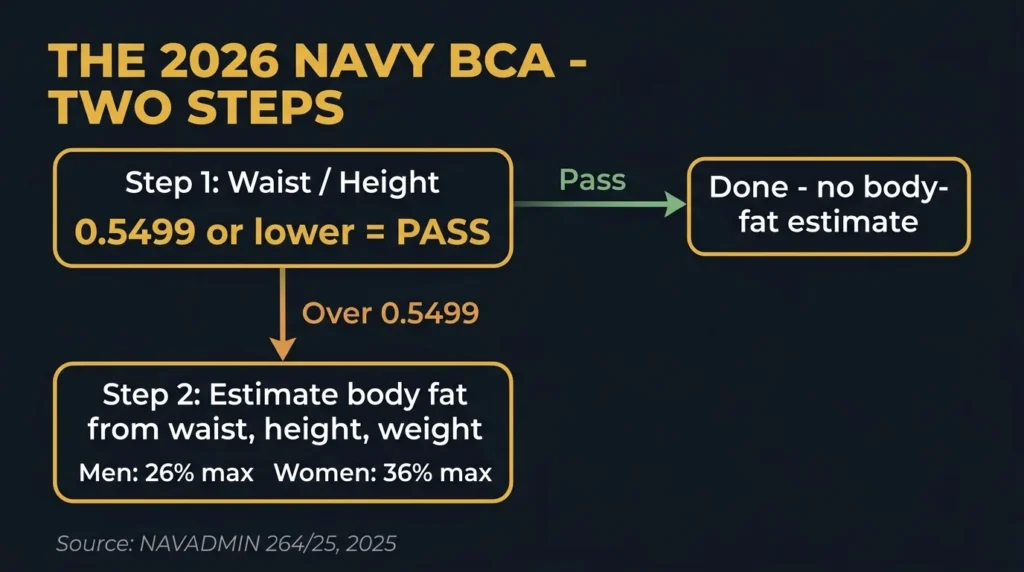
This navy body fat calculator runs the 2026 Body Composition Assessment (BCA) the same way a Command Fitness Leader does: it screens your waist-to-height ratio first, and it only estimates body fat if you miss that cutoff. You pass step one the moment your waist circumference divided by your height is 0.5499 or lower — no percentage, no neck tape, no age brackets. Enter your numbers below, then read on for the exact measurement protocol and the max-waist chart for your height.
TL;DR — How do you pass the 2026 Navy body fat test?
The 2026 navy body fat calculator is a two-step BCA. Step one is a sex-neutral waist-to-height screen: pass if your waist ÷ height is 0.5499 or lower, and you’re done. Only if you exceed it does step two estimate body fat from waist, height, and weight against a flat limit of 26% for men and 36% for women. The neck measurement and age brackets are gone.
Table of Contents
How the 2026 Navy BCA works
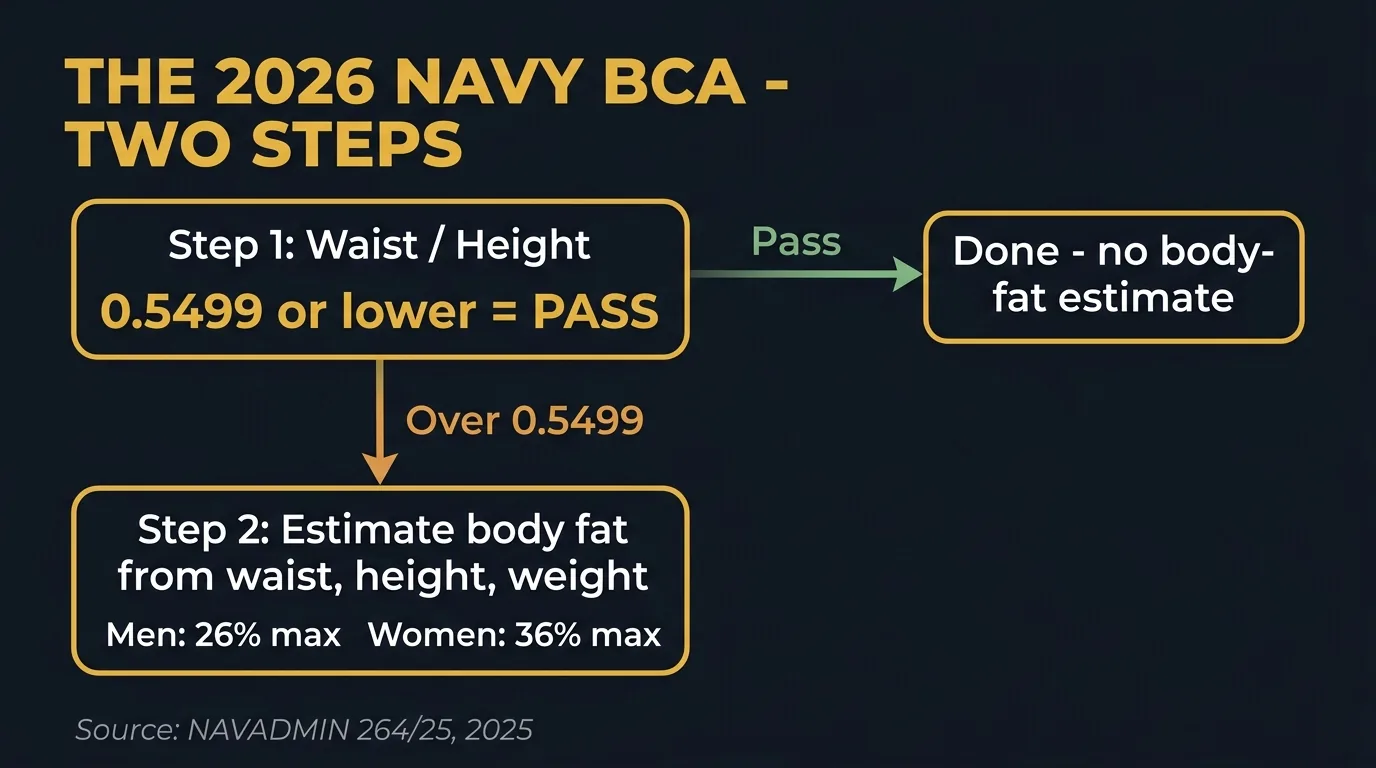
The 2026 Navy BCA runs in two steps. Step one is a sex-neutral waist-to-height ratio (WHtR) screen: you pass if your waist circumference divided by your height is 0.5499 or lower. Clear it and you’re done — no body-fat estimate, no percentage. Step two only happens if you exceed 0.5499, and it estimates your body fat from waist, height, and weight against a flat limit of 26% for men and 36% for women (Source: MyNavyHR Guide-4, 2025; NAVADMIN 264/25, 2025).
Two changes matter most. The neck measurement is gone — the old circumference formula that subtracted neck from waist is retired. And the age brackets are gone: a 45-year-old man used to get more headroom (up to 26%) than a 22-year-old (18%). Now everyone works to the same limit regardless of age (Source: MyNavyHR Guide-4, 2025).
This all comes from OPNAVINST 6110.1L, the instruction governing the Physical Readiness Program, rolled out through NAVADMIN 264/25 and the Physical Readiness Program guides effective January 2026. If you want the wider picture of how these body standards sit alongside the service’s toughest fitness benchmarks, see our breakdown of the Navy’s overall fitness and body-composition standards (Source: NAVADMIN 264/25, 2025).
Step one: the waist-to-height screen
What is the Navy waist-to-height pass threshold? You pass the 2026 Navy BCA if your waist-to-height ratio is 0.5499 or lower. Divide your waist circumference (inches, measured at the navel) by your height (inches). A ratio of 0.5500 or higher sends you to step two, the body-fat estimate. Example: a 34.5-inch waist at 70 inches tall is 34.5 ÷ 70 = 0.4929 — a clear pass.
The ratio is calculated to four decimal places, and the cutoff is exact. A 0.5499 passes. A 0.5500 does not. There’s no rounding in your favor at the line, so if you’re close, the measurement technique below is what decides your test.
How to measure yourself like a CFL
Command Fitness Leaders follow a fixed protocol, and you can replicate it at home with a cloth tape measure and a mirror or a helper. Getting your own numbers first means test day holds no surprises.
- Height. Stand straight against a wall, heels together, looking level. Measure to the top of your head and round up to the nearest half inch. If you measure 69.25 inches, you record 69.5.
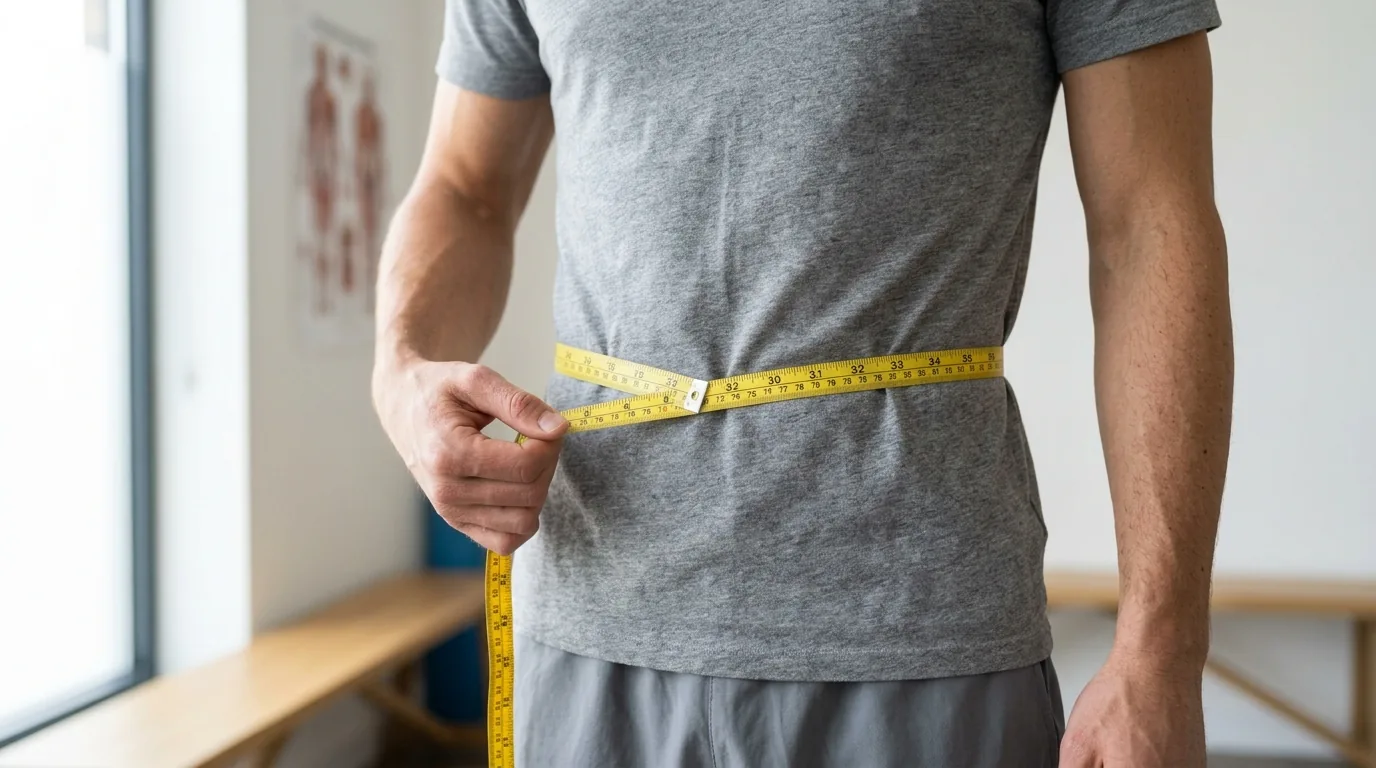
- Waist. Wrap the tape horizontally around your abdomen at the level of your navel, over bare skin. Keep it snug but not compressing, parallel to the deck all the way around. Take the reading at the end of a normal exhale — don’t suck in, don’t push out. Record to the nearest half inch.
- Do the math. Divide waist by height to four decimals.
Worked example: you measure a 37-inch waist and stand 70 inches tall. 37 ÷ 70 = 0.5286. That’s under 0.5499, so you pass step one and skip the body-fat estimate entirely.
Now flip it. Same 70-inch height, but a 39-inch waist: 39 ÷ 70 = 0.5571. Over the line — you’d move to step two. The gap between passing and not was two inches of waistline, which is why measurement precision and where you carry weight both matter.
A practical note on the exhale: sucking in your stomach doesn’t help the way people assume, because CFLs are trained to spot it and re-measure. Breathe normally.
Your max waist by height (quick reference)
Because step one is pure geometry, you can work out the exact waist that keeps you under 0.5499 for your height. This is the number to train toward — clear it and the body-fat estimate never comes into play. The table below is computed from the 0.5499 threshold, rounded to the practical half-inch the tape reads.
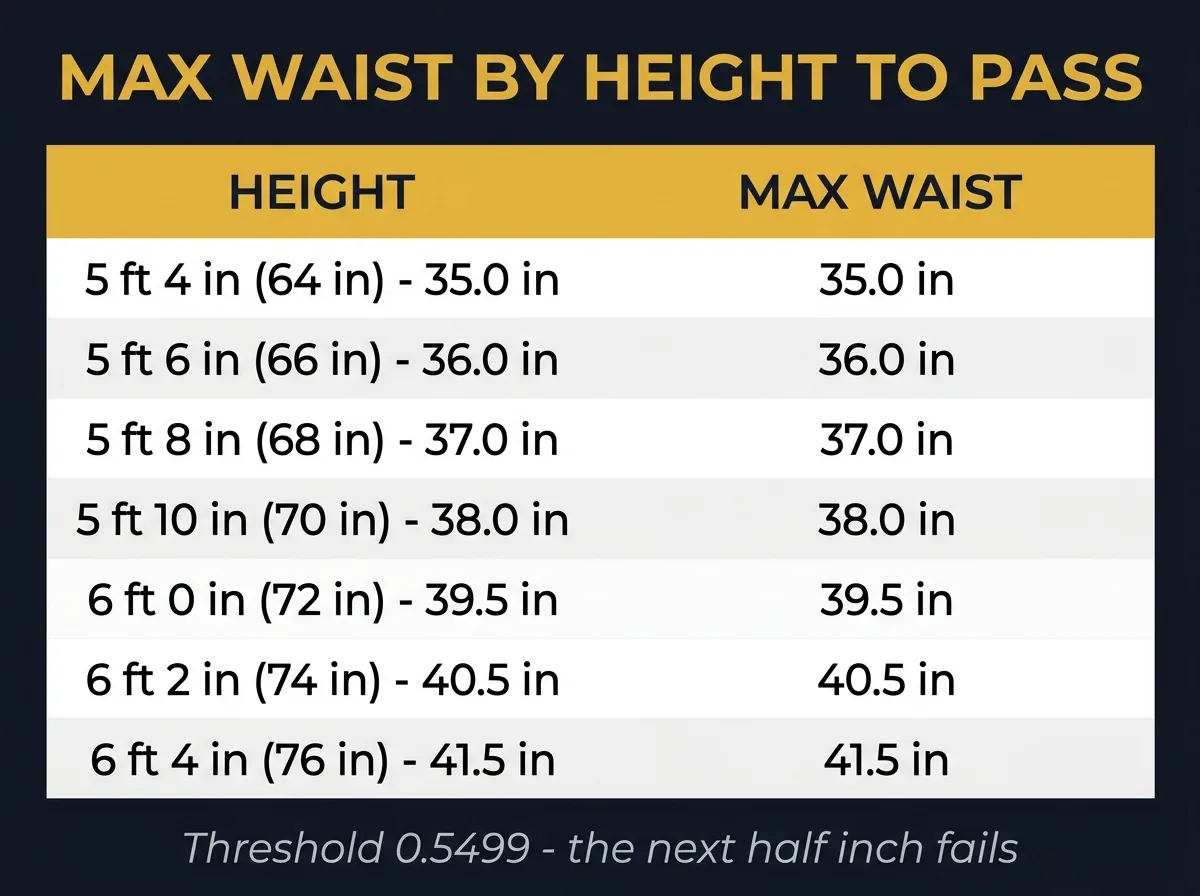
| Height | Max waist to pass step one | Ratio at that waist |
|---|---|---|
| 64 in (5’4″) | 35.0 in | 0.5469 |
| 66 in (5’6″) | 36.0 in | 0.5455 |
| 68 in (5’8″) | 37.0 in | 0.5441 |
| 70 in (5’10”) | 38.0 in | 0.5429 |
| 72 in (6’0″) | 39.5 in | 0.5486 |
| 74 in (6’2″) | 40.5 in | 0.5473 |
| 76 in (6’4″) | 41.5 in | 0.5461 |
The body-fat limits (step two)
If you land in step two, the Navy estimates your body-fat percentage from your waist, height, and weight, then checks it against a single flat limit.
| Category | Maximum body fat |
|---|---|
| Male | 26% |
| Female | 36% |
BCA vs. the full PFA: where the PRT fits
The BCA is only half of the Physical Fitness Assessment (PFA). To be in full compliance you also have to pass the Physical Readiness Test (PRT) — the graded events. The Navy runs the whole PFA twice a year (Source: OPNAVINST 6110.1L / NAVADMIN 264/25, 2025).
The PRT is three scored events, each worth up to 100 points for a 300-point maximum, with passing thresholds set by age and sex:
- Push-ups — max reps in two minutes, on a two-minute clock.
- Forearm plank — replaced curl-ups in 2023. You hold a straight line from shoulders to ankles on forearms and toes, elbows stacked under the shoulders. The clock stops the instant your form breaks or anything but forearms and toes touches the deck. If you’re not sure how long you can hold a plank, train it before test day (Source: MyNavyHR Guide-5A, 2025).
- Cardio — the 1.5-mile run/walk is the default, but commands may approve a 2,000-meter row, a 500-yard/450-meter swim, or the 12-minute stationary bike (Source: Military.com; MyNavyHR Guide-5A, 2025).
How the PRT bike scoring works
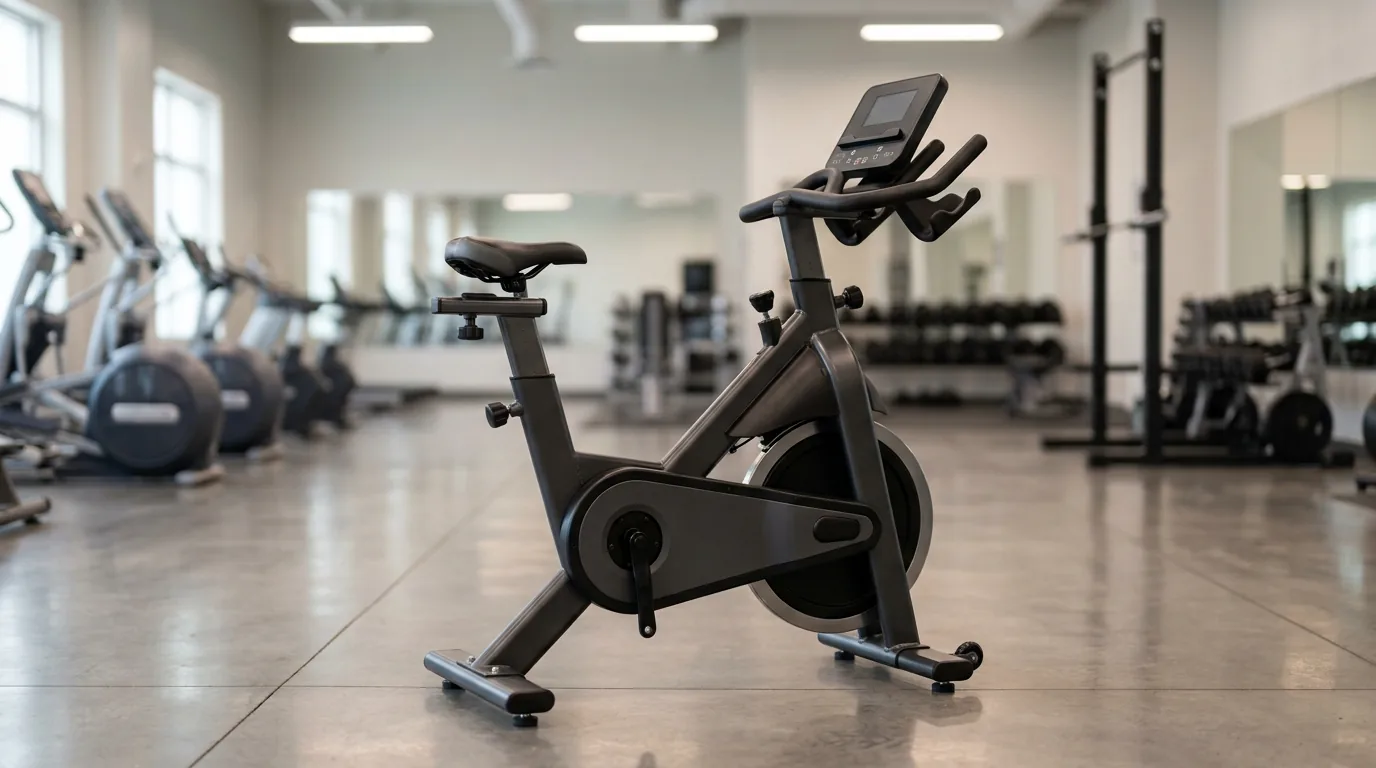
The stationary-bike option is the one people misjudge, so it’s worth spelling out. You ride a 12-minute test on an approved Life Fitness machine, and your score is the calories burned, weighted against your body weight — not distance or speed. The CFL reads the calorie display at exactly the 12-minute mark; the cooldown adds nothing (Source: aftcalculatorscore.com; Cartwright Fitness, 2026).
The catch that costs people points: enter your body weight into the machine before you start. If you skip it, the bike falls back to a preset default and calculates calories off that number, which can throw your score off in either direction. Higher resistance plus a faster cadence produces more calories, so a heavier Sailor generally has to move real wattage to hit the same weight-adjusted target as a lighter one.
What happens if you fail the BCA
Failing a PFA — whether it’s the BCA, the PRT, or both — carries administrative weight that compounds over time.
| Situation | What it means |
|---|---|
| One BCA/PFA failure | Placed on report; enrolled in the Fitness Enhancement Program (FEP) for supervised remediation. |
| Career impact | A PFA failure blocks advancement and can affect evaluations and certain assignments. |
| Three failures in four years (non-consecutive) | Triggers mandatory administrative separation processing — the Navy begins the process to separate you (Source: OPNAVINST 6110.1L / NAVADMIN 264/25, 2025). |
The four-year, three-strike window is the one to internalize: the failures don’t have to be back-to-back to stack up. Two cycles a year means the clock moves quickly, and FEP enrollment is designed to catch you before the third strike.
Safe fat loss before a cycle
If your test is weeks out and you’re over the waist number, the honest answer is that you can’t out-crash-diet biology safely, but you can make real progress. Aim for a rate that protects muscle and doesn’t wreck your run.
- Target about 1% of body weight per week. For a 190-lb Sailor that’s roughly 1.5–2 lbs, which usually means a daily deficit of 500–750 calories. Faster than that and you start shedding the lean mass that helps you on the plank and push-ups.
- Cut liquid calories and refined carbs first. These are the fastest wins for abdominal circumference specifically, and waist is the measurement that decides step one.
- Keep protein high — roughly 0.7–1 g per pound of body weight — to hold onto muscle in a deficit.
- Don’t stop training cardio. Cutting weight while neglecting your 1.5-mile pace trades a BCA problem for a PRT problem. You need both.
- Manage sleep and salt in the final days. Poor sleep and high sodium bloat the waistline temporarily; neither reflects real fat, but both show up on the tape.
The durable move is starting early enough that 1% a week gets you under the line without a scramble. A last-week water cut might buy half an inch, but it won’t fix a ratio that’s genuinely over.
Frequently asked questions
What is a Navy PRT calculator?
A Navy PRT calculator estimates your Physical Readiness Test score from your push-ups, plank hold, and cardio time, matched against the current age-and-sex standards. It tells you whether each event passes and what overall category (Outstanding through Probationary) you’d earn, so you can find weak events before test day.
How does the Navy PFA calculator differ from the BCA calculator?
The BCA calculator only handles body composition — your waist-to-height ratio and, if needed, estimated body fat. A full PFA calculator combines that BCA result with your PRT event scores, since the PFA is both halves together. You have to pass the BCA and the PRT to pass the PFA.
How do I calculate body fat percentage for the Navy in 2026?
Only if you fail step one. First check your waist-to-height ratio; pass at 0.5499 or lower and no body-fat number is calculated. If you exceed it, the Navy estimates body fat from your waist, height, and weight, with limits of 26% for men and 36% for women. The old neck-measurement formula is no longer used.
Does the Navy still use the neck measurement?
No. As of January 2026 the neck circumference is dropped entirely. Step one is waist-to-height, and step two (if you reach it) uses waist, height, and weight — the neck plays no part in the current standard.
How does the Navy PRT bicycle calculator work?
It converts your 12-minute stationary-bike calorie count, adjusted for your body weight, into a PRT cardio score. Enter your weight into both the machine and the calculator, ride for the full 12 minutes, and the calorie total at the 12-minute mark is what scores. Distance and speed don’t factor in directly — only weight-adjusted calories.
How often does the Navy run the PFA?
Twice per year. Both the BCA and the PRT are assessed each cycle, and three failures within any four-year period — even non-consecutive ones — start mandatory separation processing.
Sources and verification
- NAVADMIN 264/25 (Revised Fact Sheet), MyNavyHR, 2025
- NAVADMIN 264/25 full message, MyNavyHR, 2025
- Guide-4 Body Composition Assessment (Dec 2025), MyNavyHR
- Guide-5A Physical Readiness Test (Dec 2025), MyNavyHR
- Navy BCA Standards & 2026 Guide, CombatFitness
- On-Ship Navy PRT Training Options, Military.com
- Navy PRT Bike Calculator mechanics, AFT Calculator Score
- Navy PRT Standards Bike 2026 Guide, Cartwright Fitness