
Last updated: May 2026 — written by the Gymnase Tips training team.
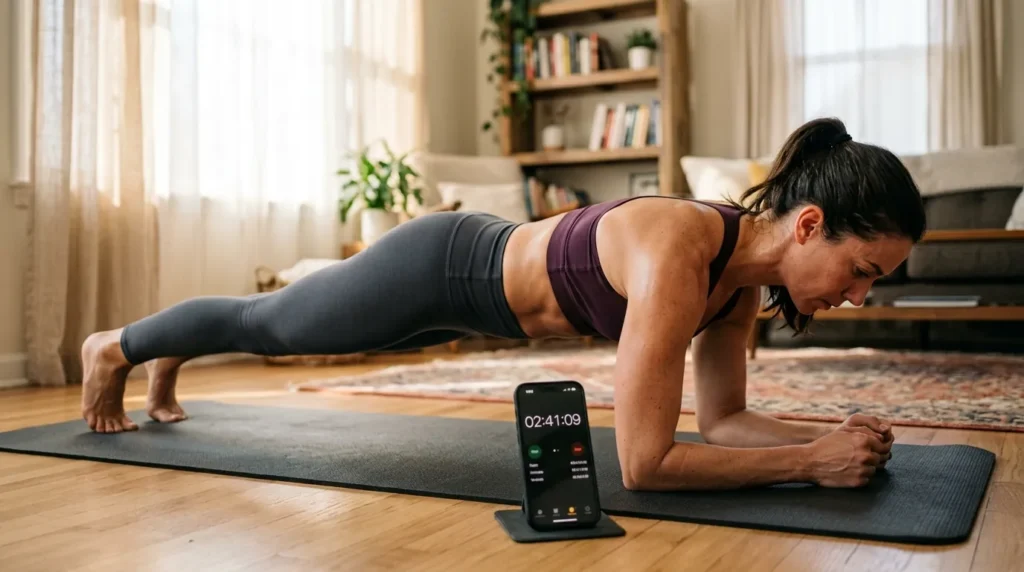
Most healthy adults should be able to hold a forearm plank for 60 to 90 seconds with good form, which represents solid baseline core endurance. The military fitness tests that score the plank set thresholds in this same range: the Marine Corps PFT requires 1:10 minimum and rewards 3:45 for max points, the Army Fitness Test (AFT) requires 1:30 minimum and rewards roughly 4:20 for the youngest age band, and the Air Force PFRA uses the plank as one of three core options with thresholds in the same band. Past 2 to 3 minutes, plank holds produce diminishing returns — the core endurance gain per additional 30 seconds shrinks dramatically and the form breakdown that compromises the spine becomes more likely. The right plank duration depends on your goal: 60 seconds is solid baseline fitness, 2 minutes is excellent core endurance, 3+ minutes is competitive military-test territory, and beyond 5 minutes is mostly a willpower test rather than a fitness test. This guide covers the standards, the science, and how to train.
Table of Contents
- Plank Standards by Goal
- Military Test Thresholds
- Standards by Age & Gender
- Why Past 2 Minutes Has Diminishing Returns
- Proper Plank Form
- How to Train Plank Endurance
- FAQ
Plank Standards by Goal
| Hold Time | Classification | What it signals |
|---|---|---|
| 0–30 sec | Below baseline | Untrained core; significant room for improvement |
| 30–60 sec | Beginner | Foundational core endurance forming |
| 60–90 sec | Solid baseline | Healthy adult standard |
| 90–120 sec | Above average | Strong general fitness |
| 2–3 min | Excellent | Trained core endurance; competitive on most fitness tests |
| 3–4 min | Elite/Military max | Top-end military test scoring |
| 4+ min | Specialist | Diminishing returns; mostly mental/willpower |
The 60–90 second band is where most general-fitness training should target. Below it, you have core endurance gaps worth addressing. Above it, the marginal fitness benefit per additional 30 seconds shrinks rapidly.
Military Test Thresholds
Military fitness tests scoring the plank set hard thresholds for pass/competitive/max performance. The data below reflects current scoring as of 2026:
Marine Corps PFT
- Minimum (40 points): 1:10
- Maximum (100 points): 3:45
- Note: Plank scoring is identical across all genders and age bands — the only event in any US military test with this property.
See our Marine Corps PFT guide for the full scoring breakdown.
Army Fitness Test (AFT)
- Minimum (60 points): ~1:30 depending on age band
- Competitive (80 points): ~3:00
- Maximum (100 points): ~4:20 for the youngest combat-MOS band
See our AFT score chart for the full scoring framework and age-banded standards.
Air Force PFRA
The plank is one of three core endurance options on the new Air Force PFRA (alongside 1-minute sit-ups and 2-minute cross-leg reverse crunches). Plank thresholds are based on percentage of the maximum points possible, scaled by age and gender. Most Airmen aiming for max core points need to hold roughly 2:30–4:00. See our Air Force PT test guide for the full PFRA breakdown.
Standards by Age & Gender (General Fitness)
For non-military fitness contexts, age-adjusted plank standards from sports medicine and physical education research roughly track:
| Age | Below average | Average | Good | Excellent |
|---|---|---|---|---|
| 20–29 | <30s | 30–60s | 60–120s | 120s+ |
| 30–39 | <30s | 30–50s | 50–90s | 90s+ |
| 40–49 | <20s | 20–40s | 40–75s | 75s+ |
| 50+ | <15s | 15–30s | 30–60s | 60s+ |
These are general fitness benchmarks, not test scoring. Athletic populations and those who train core deliberately will exceed these consistently.
Why Past 2 Minutes Has Diminishing Returns
Past 2–3 minutes, several things change:
- The core works isometrically. Beyond the 90-second mark, the limiting factor often shifts from core endurance to shoulder, neck, or forearm fatigue — none of which is what the test is measuring.
- Form breakdown becomes inevitable. Most untrained athletes start sagging hips or piking at 60–90 seconds. Trained athletes can hold form longer, but past 3 minutes, even trained athletes show micro-shifts that compromise the spine if not deliberately corrected.
- The strength stimulus saturates. Time-under-tension benefits flatten after 2 minutes. The 3rd, 4th, and 5th minutes provide less strength adaptation than the first two — and add disproportionate joint loading.
- Marginal core fitness gain shrinks. Going from 30 seconds to 60 seconds is a 100% improvement in endurance. Going from 240 seconds to 270 seconds is a 12.5% improvement — and adds 30 more seconds of cumulative spinal loading.
This is why the world record plank holds (~9+ hours) are mostly tests of mental endurance, body composition, and skeletal anatomy — not core fitness. For functional core development, the time-and-effort allocation past 2 minutes is better spent on dynamic core work (hanging leg raises, hollow body holds, dead bugs).
Proper Plank Form
The plank scoring you’ll see in any test or fitness benchmark assumes proper form. Form-breakdown holds don’t count.
Setup
- Forearms on the ground, elbows directly under shoulders
- Hands flat or in fists; palms-down or fists are both standard
- Feet hip-width apart, on toes
- Body forms a straight line from heels to head
Active form cues
- Squeeze glutes. Active glute engagement prevents lumbar over-extension.
- Brace abs. Imagine pulling your belly button toward your spine without sucking in air.
- Squeeze quads. Active leg engagement keeps the hips up and the line straight.
- Press the floor away. Active shoulder protraction prevents the chest from sinking between the elbows.
- Neck neutral. Look at a point on the floor 6–8 inches in front of your hands, not forward (which extends the neck).
Form breakdown signals (when to stop)
- Hips sagging below shoulder-heel line
- Hips piking above shoulder-heel line
- Shoulders sinking between elbows (chest hits floor)
- Neck dropping below shoulders or extending up
- Body shaking violently (controlled shake is fine; loss-of-control shake is not)
How to Train Plank Endurance
Plank improves under daily, frequent stimulus. Three holds per day for 60–90 seconds beats one max-effort hold three times per week.
Daily protocol
- Three sub-max holds per day. 60–90 seconds each, with focus on perfect form.
- One max-effort attempt per week. Track time and form quality. Note where breakdown occurs.
- Pair with hollow body holds and dead bugs. Both train the same anti-extension core demand the plank requires, but with different loading patterns.
Why daily works
The plank is an isometric hold — a much smaller recovery demand than dynamic core work like sit-ups or weighted ab movements. Daily moderate-volume plank work doesn’t accumulate the way concentric-eccentric strength work does, and the frequency of practice accelerates skill acquisition (form retention under fatigue) faster than less-frequent sessions.
4-week build to 2 minutes
| Week | Daily holds | Weekly test |
|---|---|---|
| 1 | 3 × 30 seconds | 1 × max time (target 60s) |
| 2 | 3 × 45 seconds | 1 × max time (target 75s) |
| 3 | 3 × 60 seconds | 1 × max time (target 90s) |
| 4 | 3 × 75 seconds | 1 × max time (target 120s) |
Most adults who run this protocol consistently hit a 2-minute plank in 4 weeks. From 2 minutes, building to 3 typically takes another 4–6 weeks; building to 4+ requires meaningful programming and is generally only worth pursuing for military-test prep.
FAQ
Is a 1-minute plank good?
Yes — a clean 1-minute forearm plank is solid baseline fitness for most healthy adults. It exceeds the average person’s untrained capacity and represents a foundation strong enough to support most other training. For competitive fitness contexts (military tests, athletic performance), aim for 2+ minutes.
Should I plank every day?
Yes for moderate volume (3 × 30–90 seconds daily). The plank’s isometric nature creates much lower recovery demand than dynamic core work. Daily plank work for 4–8 weeks is one of the cleanest paths to meaningful core endurance gains. The exception is when shoulders or wrists signal overuse — back off for 24–48 hours.
How long is the world record plank?
The current world record exceeds 9 hours. These records are mostly tests of mental endurance, body composition, and individual skeletal anatomy rather than core fitness — the strength stimulus saturates well before the 1-hour mark.
What’s better — plank or sit-ups?
Different. Plank trains anti-extension and isometric core endurance; sit-ups train spinal flexion and dynamic core strength. Most well-rounded core programs include both. Plank has lower lower-back injury risk for most adults, which is why it’s replacing sit-ups in most modern military fitness tests (Marine PFT, Army AFT, and Air Force PFRA all include or default to the plank).
Can I plank if I have a bad back?
The plank is generally lower-risk for the lower back than sit-ups, but specific conditions (disc herniations, spondylolisthesis, recent surgery) may contraindicate plank work entirely. Check with a qualified sports medicine professional before adding the plank to your training if you have a known back injury.
What if my shoulders fail before my core?
Common — shoulder endurance is often the limiting factor for athletes new to forearm planks. Train shoulder stability separately (band pull-aparts, scapular pulls, dead hangs) and the issue typically resolves in 4–6 weeks. In the meantime, you can use a forearm-supported plank with elbows on a pad or yoga mat to reduce contact-pressure discomfort.
Bottom Line
Most healthy adults should target a 60-to-90-second plank as solid baseline fitness, with 2 minutes representing genuinely strong core endurance. Past 2–3 minutes, the strength stimulus saturates and the marginal fitness benefit shrinks. For military-test prep, train to 3–4 minutes with deliberate progression. For general fitness, daily 60–90 second holds for 4–8 weeks build durable core endurance with low injury risk. For broader core and military fitness training, see our military calisthenics workout guide, Marine Corps PFT, AFT score chart, and Air Force PT test guides.

Pingback: Coast Guard PFT 2026: New Service-Wide Test Standards & Training
Pingback: Plank World Record: Current Holders and Times (2026)
Pingback: How to Do a Plank: Proper Form, Steps and Times by Age