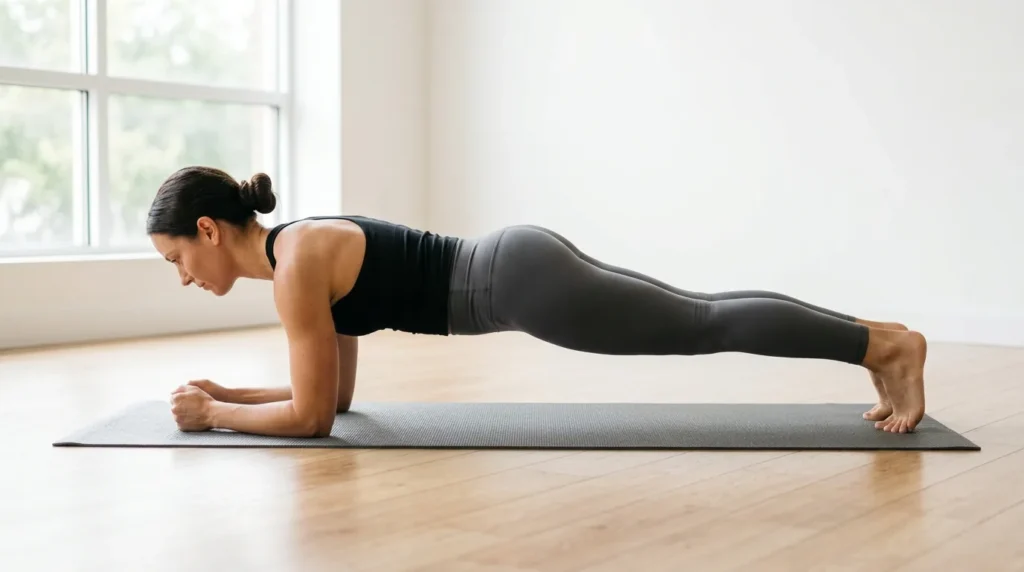
To do a plank, place your forearms on the floor with your elbows stacked directly under your shoulders, step your feet back, and hold your body in one straight line from head to heels. Squeeze your glutes, brace your abs like you are about to take a punch, and breathe normally. Hold only while the line stays perfect: the moment your hips sag or pike, the rep is over.
That is the whole exercise. The reason a move this simple attracts roughly 135,000 searches a month is that most people hold a plank shape without doing plank work. Sagging hips, a craned neck, held breath, and a timer running long past the point where the core gave up add up to a stall, not a plank.
This guide covers execution: setup, alignment cues, breathing, the faults that ruin most planks, and how to progress. If you are chasing hold-time targets specifically, we broke those down separately in how long you should hold a plank. Here we stick to averages for context and spend the word count on form.
TL;DR — How Do You Do a Plank?
How to do a plank: rest your forearms on the floor with elbows under your shoulders, step your feet back, and hold one straight line from head to heels. Squeeze your glutes, brace your whole abdominal wall like bracing for a punch, keep breathing in short controlled breaths, and stop the instant your hips sag or pike. Ten tense seconds beat sixty sloppy ones.
Table of contents
Why the Plank Earned Its Spot
Planks recruit muscle on the front, sides, and back of your trunk at once, which is how your core actually works when you lift, run, or carry something. Sit-ups, by contrast, hammer a couple of muscles and press your curved spine into the floor while your hip flexors tug on your lumbar vertebrae, one reason Harvard’s physicians now call planks the gold standard and tell readers to skip sit-ups (Source: Harvard Health Publishing).
EMG research backs the whole-trunk claim: during a front plank, the rectus abdominis, external obliques, and internal obliques together account for the large majority of measured core activation, with the erector spinae working underneath to keep the spine from folding (Source: Journal of Physical Education and Sport, 2025).
The plank is also nearly injury-proof when done right, needs zero equipment, and scales from post-rehab to loaded holds. That combination is why it anchors military PT programs: the US Army swapped sit-ups for the plank in the ACFT for exactly the spine-safety reasons above.
Plank Exercise Proper Form: Step by Step
This is the forearm (front) plank, the default version and the one used in most fitness tests.
Step 1: Set Your Base
Kneel on a mat and place your forearms on the floor, elbows directly under your shoulders. Keep your forearms parallel, palms flat or hands lightly fisted. If your elbows drift forward of your shoulders, your shoulders and lower back take load your core should be taking.
Step 2: Step Back Into Position
Extend one leg back, then the other, so you are on forearms and toes. Feet roughly hip-width. Wider feet mean more stability (easier); feet together mean less stability (harder). Start hip-width.
Step 3: Build the Straight Line
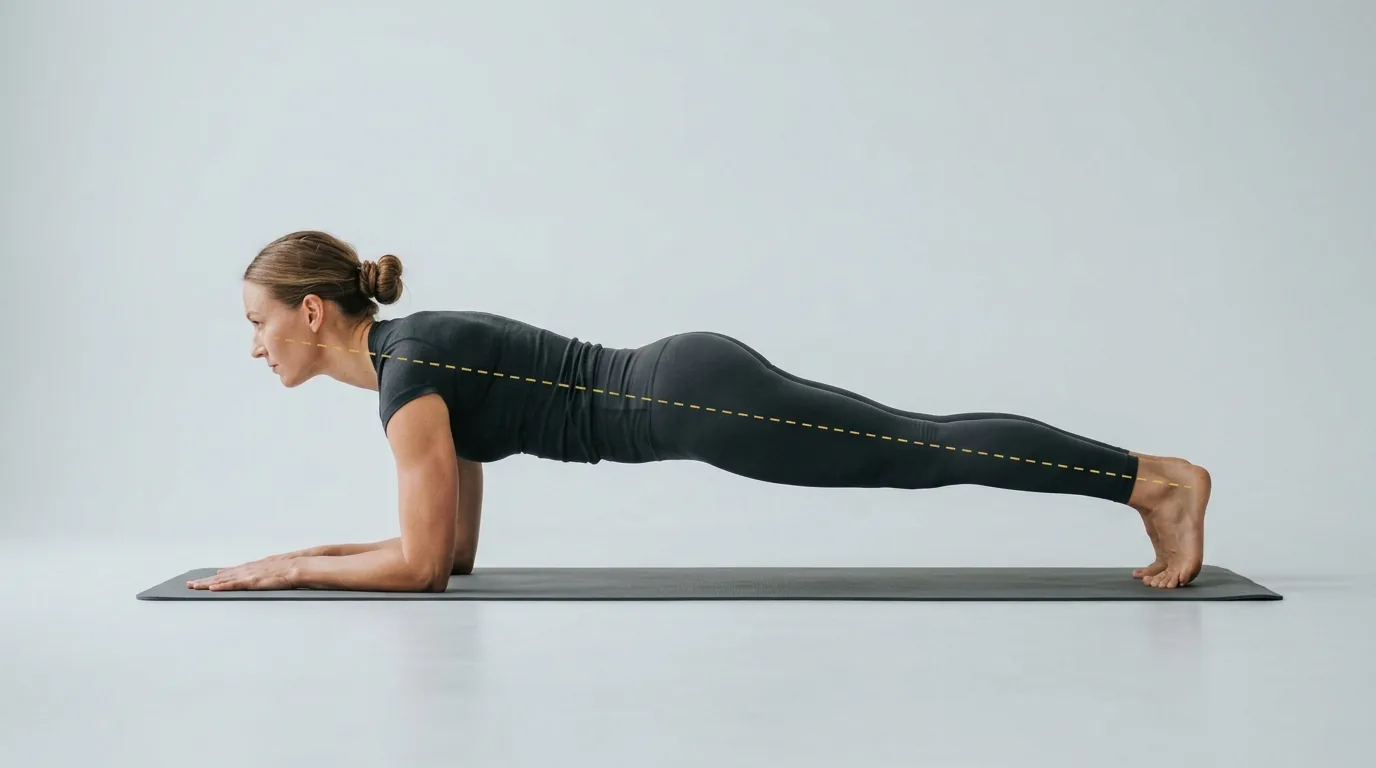
The correct posture of a plank is one unbroken line from the back of your head through your shoulders, hips, knees, and ankles. Run this checklist top to bottom:
- Head: neutral, eyes on the floor about a foot in front of your hands, not up at the wall.
- Shoulders: pushed away from the floor slightly, so your chest does not hang between your shoulder blades.
- Ribs: pulled down toward your hips, not flared.
- Hips: level with the shoulder-to-ankle line, not sagging and not tented upward.
- Glutes: squeezed hard. This one cue fixes half of all sagging hips on its own.
- Knees: locked, quads tight.
Step 4: Brace, Do Not Suck In
Tighten your abs the way you would if someone were about to poke you in the stomach: a 360-degree stiffening, not pulling your navel to your spine. Bracing (co-contracting the whole abdominal wall) is what stabilizes the trunk under load; hollowing your stomach actually reduces the base of support.
Step 5: Breathe
Keep breathing in short, controlled breaths behind the brace, in through the nose and out through pursed lips, without letting the abdominal tension drop. Holding your breath spikes blood pressure and guarantees you fold the second you finally exhale. If you cannot breathe, you have stopped bracing and started just holding air.
Step 6: Hold With Full Tension, Then Stop
Hold only as long as the straight line survives. When your hips start to drift, drop your knees, rest, and go again. Ten quality seconds beat sixty sloppy ones, and there is research behind that math.
Average Plank Time by Age: Where Do You Stand?
Honest caveat first: there is no large government normative dataset for plank holds the way there is for push-ups. The best peer-reviewed number comes from a Linfield University study of college-age adults, which found an average front plank hold of 1.50 minutes for women and 1.77 minutes for men (Source: Brigham & Chase, Linfield University, 2014). Around that anchor, coaching standards published by fitness outlets converge on the ranges below.
| Age group | Average (men) | Average (women) | “Good” benchmark |
|---|---|---|---|
| Under 20 | 90–110 sec | 75–90 sec | 120+ sec |
| 20–29 | 100–110 sec | 90–95 sec | 120+ sec |
| 30–39 | 90–120 sec | 85–100 sec | 90+ sec |
| 40–49 | 60–100 sec | 60–85 sec | 75+ sec |
| 50–59 | 40–60 sec | 30–60 sec | 60+ sec |
| 60+ | 25–40 sec | 20–30 sec | 30+ sec |
Read the table loosely. Plank endurance declines roughly 10–15% per decade after the mid-30s in untrained people, but trained 50-year-olds routinely out-hold sedentary 25-year-olds (Source: Fitness Drum, 2024). What a good plank time means for your goal, whether that is general fitness, a military test, or back rehab, is a bigger question than one table, and it is the entire subject of our plank hold standards by age and goal guide.
One more reframe before you chase the numbers: Stuart McGill, the University of Waterloo spine researcher whose lab produced much of modern core-training doctrine, argues that max-duration holds past short intervals have “no utility… other than claiming a record.” As fatigue sets in, your nervous system offloads work onto ligaments and spinal joints, the opposite of training (Source: Women’s Health Australia, citing McGill). The table above measures endurance. It does not measure whether your plank is any good.
How Many Planks Should I Do?
Short answer: 3–5 sets, 10–30 seconds each at maximal tension, 3–4 days per week. Total quality time under tension matters more than any single hold.
Here is the programming logic, split by goal:
- Beginner or returning from a layoff: 3 sets of 10–15 seconds (knee plank if needed), rest 30–60 seconds between sets, every other day. Add about 5 seconds per set each week.
- General fitness: 3–4 sets of 20–30 seconds with hard glute and ab tension, 3–4 days per week. When 30 seconds feels routine, do not add time, add difficulty (see the ladder below).
- Spine health or rehab-style training: McGill’s own protocol is 10-second maximal holds, 5–10 seconds rest, 3–6 rounds. His research suggests three sets of 10 seconds build core stiffness more effectively than a single 60-second grind, at half the total time (Source: BodySpec, 2024).
- Test prep (ACFT, police, and similar): you do need duration here, so build one longer goal-pace hold per session on top of the quality sets, but form standards still apply, because testers no-rep sagging hips too.
Daily planking is fine at low volumes; the core recovers fast. What you should not do daily is max-effort duration attempts. Treat those like a 1RM: test every few weeks, train in between.
Planks also slot naturally into bigger bodyweight sessions. In our military calisthenics workout guide they show up as the core block between push and pull work, which is exactly where they fit best in a weekly split.
The Plank Variations Ladder
Progress by making the hold harder, not just longer. Move up a rung when you can hold the current variation for 30 clean seconds across 3 sets.
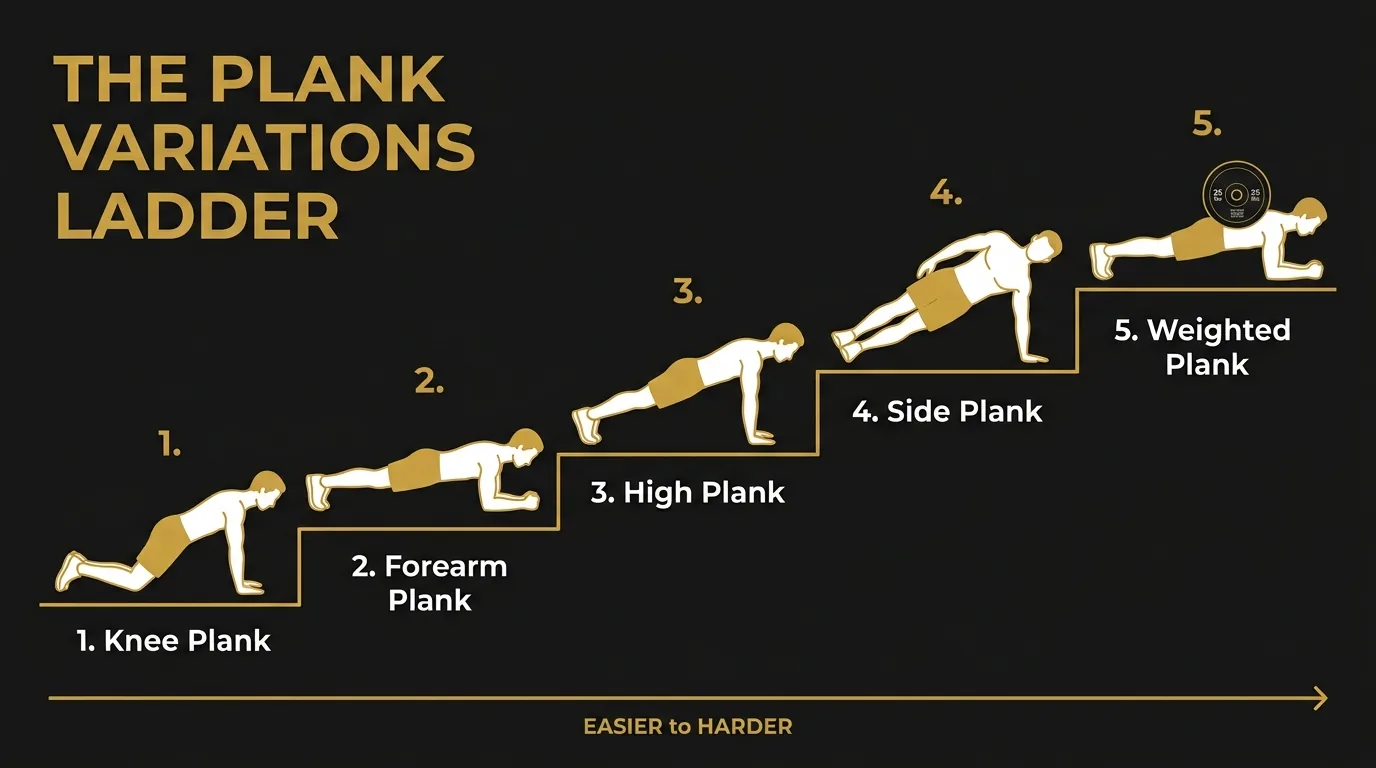
Rung 1: Knee Plank
Same setup, knees on the mat, straight line from head to knees. Glutes still squeezed, ribs still down; shortening the lever does not excuse dropping the tension. Hands-elevated planks on a bench work as an alternative first rung and are easier on sensitive knees.
Rung 2: Forearm Plank
The standard described above. Own it before moving on; most people leave this rung too early.
Rung 3: High Plank
Hands under shoulders, arms locked. Slightly less core demand than the forearm version for most people, but it loads the shoulders, wrists, and serratus, and it is the position push-ups, burpees, and mountain climbers start from, so it earns its rung. Grip the floor with your fingers and push it away from you.
Rung 4: Side Plank
Elbow under shoulder, feet stacked, hips lifted until you are a straight line viewed from the front. This shifts the work to the obliques and quadratus lumborum, which the front plank undertrains, and it is one of McGill’s “Big 3” for back health for that reason. Train both sides; a big left-right gap is worth fixing before it shows up as a back tweak.
Rung 5: Loaded and Reduced-Support Planks
Once 30-second holds everywhere feel easy, pick your poison:
- Weighted plank: a plate on your mid-back (have someone place it, or use a backpack). Add 5–10 lb at a time.
- Feet-elevated plank: toes on a bench, shoulders below hips.
- Plank shoulder taps or arm reach: lift one point of contact without letting the hips rotate. This trains anti-rotation, the skill most people’s cores are actually missing.
- Body saws: rock forward and back on your forearms a few inches. Brutal, and the strongest of the four for pure ab work per second.
Common Plank Mistakes and the Fix for Each
Four faults account for nearly every failed plank. Each has a one-cue fix.
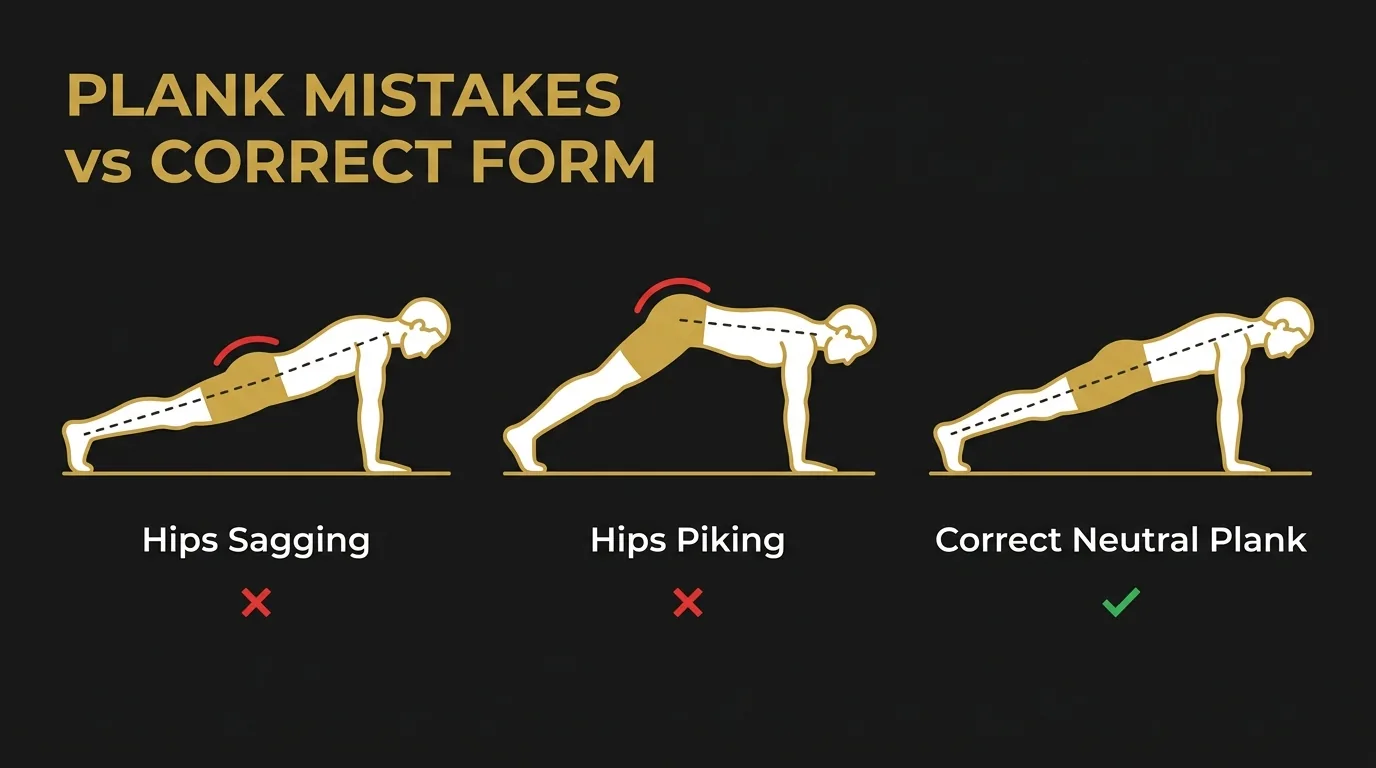
Hips Sagging
The lower back dips into extension, the abs go slack, and the lumbar spine takes the load. This is the fault that turns planks into a back-pain generator.
Fix: squeeze your glutes as hard as you can and tuck your pelvis slightly (think “belt buckle toward ribs”). If the sag returns within seconds, the set is over; drop to knees.
Hips Piking
Butt in the air, body folded like a tent. It feels easier because it is easier; you have unloaded the abs almost entirely.
Fix: lower the hips until someone could rest a broomstick flat along your head, upper back, and glutes with no daylight underneath. Filming one set from the side beats any cue; most pikers genuinely believe they are flat.
Craning the Neck
Looking up at a mirror or TV hyperextends the cervical spine and feeds tension into the traps.
Fix: eyes down, chin gently packed, back of the neck long. Your head is part of the plank line, not a periscope.
Holding Your Breath
Common in beginners who confuse bracing with breath-holding. Blood pressure climbs, and the plank collapses on the first exhale.
Fix: count your breaths out loud-ish, a short inhale through the nose and an audible exhale through pursed lips, tension constant. If you cannot speak a word or two mid-hold, you are breath-holding.
A fifth, subtler one: elbows creeping forward of the shoulders as you fatigue, which shifts load into the shoulders and lower back. Re-stack elbows under shoulders between sets.
Frequently Asked Questions
What is the correct posture for a plank?
Elbows under shoulders, one straight line from head to heels, glutes squeezed, ribs pulled down, neck neutral with eyes on the floor. Brace the abs 360 degrees and keep breathing. Any visible dip or peak at the hips means the posture is broken.
What is a good plank time?
For most adults under 40, 60 seconds with faultless form is solid and 120 seconds is very good; benchmarks drop by roughly 10-15% per decade after the mid-30s (Sources: Fitness Drum, 2024; Marathon Handbook, 2024). Quality caps the value of duration, though, since a tense 30 seconds beats a saggy 3 minutes. Full standards by age and goal are in our plank hold guide.
What is the average plank time by age?
College-age adults average about 90-106 seconds (1.50 min for women, 1.77 min for men in the best available study, per Linfield University, 2014). Typical holds slide to roughly 60-100 seconds in the 40s and 20-40 seconds past 60, with wide individual variation driven mostly by training status, not birthdays.
How many planks should I do a day?
Three to five sets of 10-30 seconds at full tension covers most goals; 3-4 sessions a week is plenty, though daily low-volume planking is safe. Skip daily max-duration attempts and treat those as an occasional test, not a workout.
Are 10-second planks really enough?
For core stiffness and spine health, yes: spine researcher Stuart McGill recommends repeated maximal 10-second holds with short rests over long grinds, because fatigue shifts load from muscle onto passive spinal structures (Source: Women’s Health Australia). If you are prepping for a timed test, you will still need to build duration on top.
Should I do planks or sit-ups?
Planks. They work the front, sides, and back of the trunk together while keeping the spine neutral, whereas sit-ups isolate a few muscles and press a flexed spine into the floor, the reason Harvard Health advises skipping sit-ups in favor of planks (Source: Harvard Health Publishing).
Sources and Verification
- Harvard Health Publishing — Want a stronger core? Skip the sit-ups: planks vs sit-ups, hip-flexor and lumbar strain.
- Brigham and Chase — Fitness Norms for the Plank Exercise (Linfield University, 2014): 1.50 min female / 1.77 min male averages.
- Journal of Physical Education and Sport (2025) — EMG analysis of core muscle activity: rectus abdominis and obliques dominance during the plank.
- Women’s Health Australia — McGill on 10-second plank intervals: “no utility… other than claiming a record”; passive-structure loading under fatigue.
- BodySpec — McGill Big 3 routine: 3×10 sec vs 1×60 sec comparison.
- Fitness Drum — Average plank time standards by age: age-band benchmarks, about 10-15% per decade decline.
- Marathon Handbook — What a good plank time reveals: age and sex averages for context.