Gymnase Tips is reader-supported. Some links may be Amazon affiliate links; if you buy through them we may earn a small commission at no extra cost to you.
TL;DR — Can You Get a Full Body Workout With Just One Kettlebell?
This full body kettlebell workout uses 6 exercises across all 5 movement patterns (hinge, squat, press, pull, and carry) with a single kettlebell. Do 3 rounds of 40 seconds work / 20 seconds rest, with 1 minute between rounds. Total time: 25-30 minutes including warm-up and cool-down. Beginners drop to 2 rounds.
Table of contents
What You Need Before You Start
You need one kettlebell and roughly 6 feet of open floor space. No bench, rack, or gym membership required. An exercise mat helps if you’re training on hard flooring, but it’s optional.
That’s the full equipment list. Pick a weight you can press overhead for 8 clean reps. If you’re unsure, the weight table below will narrow it down.
How to Pick the Right Kettlebell Weight
Most men start with a 16 kg (35 lb) kettlebell for swings and squats, dropping to 12 kg (26 lb) for presses. Most women start at 8-12 kg (18-26 lb). The gap exists because your hips and legs handle far more load than your shoulders, so a weight that challenges your press will feel light on swings.
If you train at home and don’t want three different bells sitting around, an adjustable kettlebell solves that problem.

Weight Recommendation Table
| Exercise Type | Beginner Men | Intermediate Men | Beginner Women | Intermediate Women |
|---|---|---|---|---|
| Swing / Hinge | 16 kg (35 lb) | 20-24 kg (44-53 lb) | 8-12 kg (18-26 lb) | 16 kg (35 lb) |
| Goblet Squat | 12-16 kg (26-35 lb) | 20 kg (44 lb) | 8 kg (18 lb) | 12-16 kg (26-35 lb) |
| Press | 8-12 kg (18-26 lb) | 16 kg (35 lb) | 4-8 kg (9-18 lb) | 8-12 kg (18-26 lb) |
| Row | 12-16 kg (26-35 lb) | 20 kg (44 lb) | 8 kg (18 lb) | 12-16 kg (26-35 lb) |
| Carry | 16 kg (35 lb) | 24 kg (53 lb) | 8-12 kg (18-26 lb) | 16 kg (35 lb) |
Own one kettlebell? Pick the weight that matches your press range. You’ll use it for everything else too. It just won’t be as challenging on swings and squats, which is fine for circuit work where fatigue accumulates across rounds.
The Full Body Kettlebell Workout at a Glance
This circuit hits all 5 movement patterns in 6 exercises. Do 3 rounds of 40 seconds work / 20 seconds rest, with 1 minute between rounds. Total time: 25-30 minutes including warm-up and cool-down. Beginners: start with 2 rounds.
| # | Exercise | Movement Pattern | Work / Rest | Beginner Modification | Primary Muscles |
|---|---|---|---|---|---|
| 1 | Kettlebell Swing | Hinge | 40s / 20s | KB Deadlift | Glutes, hamstrings, core |
| 2 | Goblet Squat | Squat | 40s / 20s | BW Squat holding KB at chest | Quads, glutes, core |
| 3 | Single-Arm OH Press | Push | 40s / 20s (switch arms each round) | Floor Press | Shoulders, triceps, core |
| 4 | Single-Arm Row | Pull | 40s / 20s (switch arms each round) | Supported Bent-Over Row | Lats, biceps, rear delts |
| 5 | Turkish Get-Up to Knee | Full-Body Hybrid | 3 reps per side | Half Get-Up (to elbow) | Shoulders, core, hips |
| 6 | Farmer’s Carry (Suitcase) | Carry | 40s / 20s (switch sides halfway) | Shorter distance | Grip, core, traps |
Structure: 3 rounds (beginners: 2). Rest 1 minute between rounds. The Turkish get-up runs on reps, not the clock, so take your time with each rep.
Warm-Up (5 Minutes)
Spend 5 minutes on these bodyweight movements to raise your heart rate and prep your hips, shoulders, and thoracic spine for loaded work.
- Arm circles: 30 seconds each direction
- Bodyweight squats: 10 reps, slow on the way down
- Hip hinges (no weight): 10 reps, hands on the crease of your hips
- Inchworms: 5 reps, pause in the push-up position
- Kettlebell halos (light or same KB): 8 reps each direction
The halos double as a shoulder warm-up and grip primer. Keep them slow and controlled.
The 6 Exercises: Form Cues and Beginner Swaps
Each exercise below targets one of the five fundamental movement patterns. Form cues are brief. For full video breakdowns of each movement, see our kettlebell exercises guide.
Kettlebell Swing (Hinge)
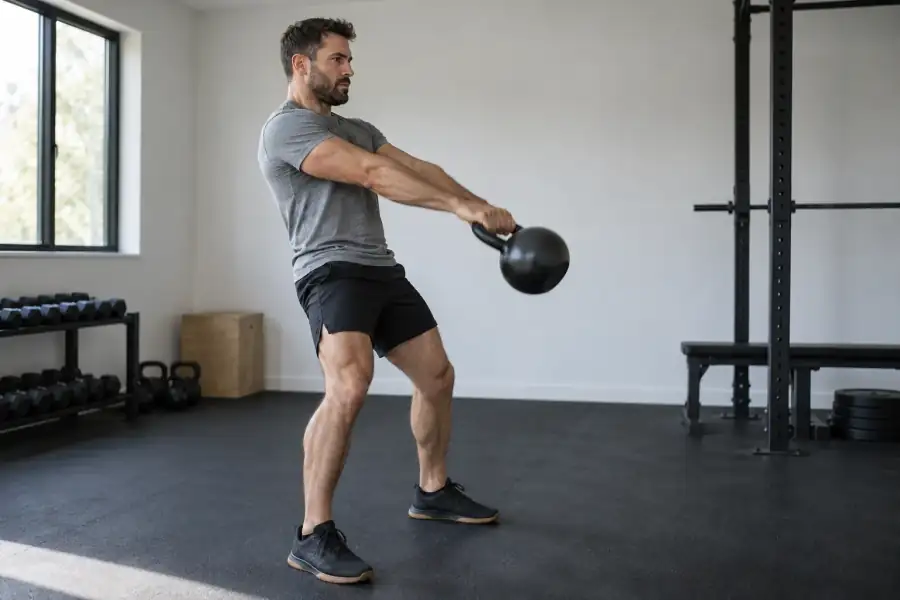
Pattern: Hinge. Muscles: Glutes, hamstrings, core.
Drive through your hips, not your arms. The bell floats because your hips snap forward. Think “standing plank at the top.” Keep your lats engaged so the bell stays close to your body on the downswing.
Beginner swap: Kettlebell deadlift. Same hip hinge pattern without the ballistic element. Graduate to swings once your hinge feels automatic.
Goblet Squat (Squat)
Pattern: Squat. Muscles: Quads, glutes, core.
Hold the kettlebell at your chest with both hands, elbows pointing down. Push your knees out over your toes and sit between your legs, not behind them. Your torso stays more upright here than in a barbell squat, because the front load forces that naturally.
Beginner swap: Same movement, lighter weight. The goblet position actually teaches good squat mechanics, so there’s no reason to ditch it.
Single-Arm Overhead Press (Push)
Pattern: Push. Muscles: Shoulders, triceps, core.
Start with the bell in rack position: wrist straight, elbow tight to your ribs, forearm vertical. Press straight up until your bicep is next to your ear. Brace your abs hard; with one arm loaded, your core works overtime to prevent lateral lean. Switch arms each round.
Beginner swap: Floor press. Lying on your back removes the stability demand and limits range of motion, which helps if overhead mobility is limited.
Single-Arm Row (Pull)
Pattern: Pull. Muscles: Lats, biceps, rear delts.
Hinge forward at the hips to about 45 degrees, free hand on your thigh or a chair for support. Pull the bell to your lower ribcage, squeezing your shoulder blade back at the top. Lower under control. Don’t let gravity do the work. Switch arms each round.
Beginner swap: Same movement with a lighter bell, or place your free hand on a sturdy chair for extra stability.
Note: some “single kettlebell” workouts call for renegade rows, which actually require two kettlebells to perform. This row variation needs one bell. Period.
Turkish Get-Up to Knee (Full-Body Hybrid)
Pattern: Full-body hybrid (hinge + press + rotation). Muscles: Shoulders, core, hips.
This one runs on reps, not the clock: 3 reps per side. Start flat on your back, bell locked out overhead. Roll to your elbow, then your hand, bridge your hips, sweep your leg back to a kneeling position. Reverse every step on the way down. Eyes on the bell the entire time.
Beginner swap: Half get-up (stop at the elbow or hand). The full get-up has multiple stages, and cutting it short is safer than rushing through sloppy reps. Do not compress this movement into two quick steps.
Farmer’s Carry (Suitcase Carry)
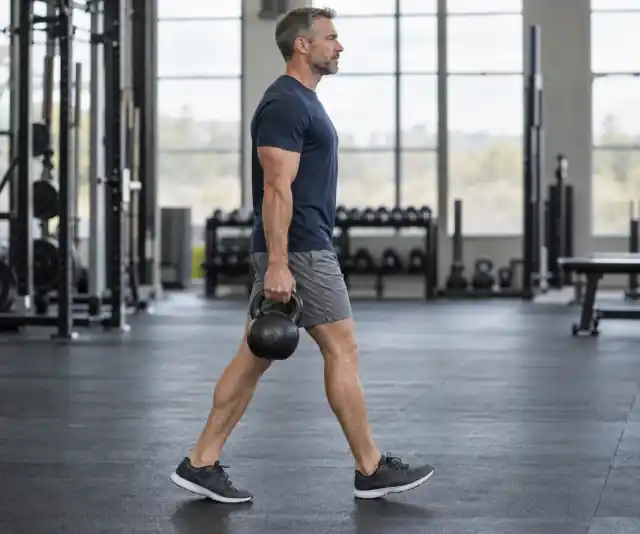
Pattern: Carry. Muscles: Grip, core, traps, full-body stabilization.
Hold the bell in one hand at your side. Walk in a straight line: tall spine, shoulders level, no leaning toward the loaded side. Switch hands at the halfway mark. This looks easy on paper. Three rounds in, your grip and obliques will disagree.
Beginner swap: Shorter walking distance or a lighter bell.
Cool-Down (5 Minutes)
Five minutes of static stretching after the circuit helps you wind down and maintain flexibility in your hips, hamstrings, and shoulders.
- Hip flexor stretch: 30 seconds each side (half-kneeling lunge)
- Standing hamstring stretch: 30 seconds each leg
- Doorway or band shoulder stretch: 30 seconds each arm
- Child’s pose: 45 seconds, arms extended
- Deep breathing: 60 seconds, lying flat, 4-count inhale / 6-count exhale
Don’t skip this. The swings and get-ups load your posterior chain hard, and a few minutes of stretching pays off by the next session.
How Often Should You Do This Workout?
Two to three sessions per week, with at least one rest day between them. Full-body compound movements tax multiple muscle groups at once, and spacing sessions across the week gives your body time to recover and adapt. The ACSM’s 2026 position stand on resistance training recommends training all major muscle groups at least twice per week (Source: ACSM, 2026).
A simple weekly layout:
- Option A: Monday / Wednesday / Friday
- Option B: Tuesday / Thursday / Saturday
On off days, walk, do mobility work, or try a bodyweight circuit. Stacking two full-body kettlebell sessions back-to-back doesn’t accelerate progress. It just extends recovery. If you’re building a broader training plan, our calisthenics workout plan pairs well on alternate days.
Progression: When and How to Make It Harder
Progress when you consistently finish all 3 rounds with reps to spare. Add a fourth round first; increase kettlebell weight only after you can complete 4 rounds cleanly.
Three levers, in order of priority:
- Add a round. Go from 3 to 4, then 4 to 5. This builds work capacity and conditioning before you add load.
- Increase the work interval. Shift from 40 seconds on / 20 seconds off to 45/15, then 50/10.
- Move up in weight. Jump by 4 kg (roughly 8 lb) for swings and squats, 2-4 kg for presses.
Add rounds before adding weight. It’s safer, it builds the conditioning base your joints need for heavier loads, and it keeps you honest about form under fatigue. Chasing heavier bells before your work capacity supports them is how shoulders and lower backs get angry.
Frequently Asked Questions
Can you get a full body workout with just a kettlebell?
Yes. A single kettlebell can load all five fundamental movement patterns: hinge, squat, press, pull, and carry. That covers your posterior chain, quads, shoulders, back, and core. The workout above uses six exercises to hit every pattern in one session. For more exercise options with a single bell, check out our full kettlebell exercises guide (linked in the exercises section above).
Is a 20-minute kettlebell workout enough?
For maintenance, yes. Twenty minutes of focused circuit work delivers meaningful cardiovascular and muscular stimulus. An ACE-funded study at the University of Wisconsin found that kettlebell snatch intervals burned roughly 20.2 calories per minute when combining aerobic and anaerobic expenditure (Source: ACE Fitness, 2010). For building strength over time, budget 25-30 minutes to include warm-up and cool-down.
What is the 7-7-7 kettlebell workout?
Seven exercises, 7 reps each, 7 rounds. It’s a high-volume conditioning format that emphasizes endurance over load. The exercise selection varies by source, but it typically includes swings, goblet squats, cleans, presses, rows, lunges, and snatches. It’s a different approach than the timed-interval circuit above.
Can you build a physique with just kettlebells?
Yes, up to a point. Kettlebells build muscle effectively through compound movements and high time under tension. Where they hit a ceiling is maximal hypertrophy: once you need loads above 32 kg for upper body movements, barbells become more practical. For most people training for general fitness and a lean, athletic build, kettlebells are more than enough. Our kettlebell exercises guide covers 15+ movements to keep variety high.
How long should a full body kettlebell workout be?
It depends on the goal. Fat loss and conditioning: 20-25 minutes of circuit work is plenty. Strength and muscle building: 25-35 minutes, including warm-up and cool-down, gives you enough volume per movement pattern. The workout in this guide runs 25-30 minutes total. That covers strength, conditioning, and all five patterns without dragging.
Want more movements to rotate in? Our full kettlebell exercises guide covers 15+ exercises with form tutorials.
Sources
- ACSM 2026 Position Stand on Resistance Training (Currier et al., Medicine and Science in Sports and Exercise, 2026). DOI: 10.1249/MSS.0000000000003897. acsm.org/resistance-training-guidelines-update-2026
- ACE-Sponsored Kettlebell Study (Schnettler, Porcari et al., 2010). ACE Fitness. acefitness.org: Kettlebells, Twice the Results in Half the Time