

Gymnase Tips is reader-supported. When you buy through links on our site, we may earn an affiliate commission at no extra cost to you.
TL;DR — Which Vitamins Actually Help Menopause Hair Loss?
The vitamins for menopause hair loss with the strongest evidence are vitamin D, iron, and zinc, but only when blood levels are low. About 52% of postmenopausal women experience noticeable thinning (Source: Chaikittisilpa et al., Menopause, 2022). B-complex vitamins play a supporting role, and biotin is overhyped without a confirmed deficiency. Test your blood before you buy supplements.
Table of contents
Why Menopause Causes Hair Thinning
Falling estrogen shortens the hair growth phase while rising androgens miniaturize follicles. About 52% of postmenopausal women experience noticeable thinning (Source: Chaikittisilpa et al., Menopause, 2022). The pattern is usually diffuse, with all-over thinning rather than the receding hairline men get.
This matters for vitamins because several nutrient deficiencies accelerate the process. Estrogen decline alone triggers follicle changes, but low iron, vitamin D, or zinc compound the damage by starving follicles of the raw materials they need to cycle through growth phases. Perimenopause can start the thinning years before your last period, and it often worsens in the first few postmenopausal years as hormones settle into their new baseline.
The 7 Best Vitamins and Minerals for Menopause Hair Loss
The strongest evidence supports vitamin D, iron, and zinc, but only when blood levels are low. B-complex vitamins (B12, folate, niacin) support the hair cycle. Biotin is widely marketed, but the evidence is weak unless you have a confirmed deficiency. Omega-3s and vitamin C play supporting roles.
Here is every nutrient graded by evidence quality:
| Vitamin | Evidence | Only If Deficient? | RDA (Post-Menopause) | Upper Limit | Top Food Sources |
|---|---|---|---|---|---|
| Vitamin D | Strong | Yes | 600–800 IU | 4,000 IU | Fatty fish, fortified milk, sunlight |
| Iron | Strong | Yes, test first | 8 mg | 45 mg | Red meat, lentils, spinach |
| Zinc | Strong | Yes | 8 mg | 40 mg | Oysters, beef, pumpkin seeds |
| B12 | Moderate | Yes | 2.4 mcg | None set | Meat, eggs, fortified cereals |
| Folate | Moderate | Yes | 400 mcg DFE | 1,000 mcg | Leafy greens, legumes |
| Biotin | Weak | Yes, and overhyped | 30 mcg | None set | Eggs, nuts, sweet potato |
| Omega-3 | Moderate | General benefit | 1.1 g ALA | None set | Salmon, walnuts, flaxseed |
(RDA and Upper Limit values from the NIH Office of Dietary Supplements, 2024)
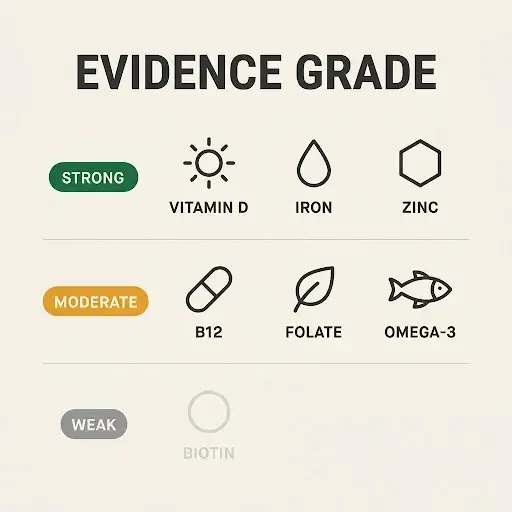
- Vitamin D: strong evidence; supports follicle cycling; aim for at least 30 ng/mL
- Iron: strong evidence; ferritin above 70 ng/mL for hair; post-menopausal RDA = 8 mg
- Zinc: strong evidence; supports keratin production; test before supplementing
- B12: moderate; absorption declines after 50
- Folate: moderate; works with B12 for red blood cell production
- Biotin: weak unless deficient; overhyped by supplement brands
- Omega-3: moderate; anti-inflammatory, supports scalp health
Vitamin D
Vitamin D receptors sit in hair follicles and regulate the growth cycle. A 2025 study of 200 women with hair loss found significantly reduced vitamin D levels compared to controls, averaging 26.3 ng/mL versus 32.2 ng/mL in healthy women (Source: PMC, 2025). Aim for at least 30 ng/mL on blood work; some hair specialists target 40–60 ng/mL (Source: Endocrine Society, 2011). Most postmenopausal women need 1,500–2,000 IU of vitamin D3 daily to reach adequate levels (Source: Endocrine Society, 2011).
D3 is the form you want. A 2012 meta-analysis of seven trials found D3 was significantly more effective than D2 at raising blood levels (Source: Tripkovic et al., American Journal of Clinical Nutrition, 2012).
Watch for stacking. A 2025 case report described a 72-year-old woman whose vitamin D level hit 121.8 ng/mL, well above the safe range, because she was taking a standalone vitamin D supplement alongside Nutrafol, which contains 2,500 IU of vitamin D per dose (Source: JAAD Case Reports, 2025). She did not realize both contained it. Always total up vitamin D from every supplement you take. The tolerable upper limit is 4,000 IU daily from all sources combined (Source: NIH ODS, 2024).
Iron: Why Post-Menopausal Women Need Less
Iron deficiency is the most common nutritional cause of hair loss in women. But after menopause your iron needs drop sharply, from 18 mg to 8 mg daily, because you no longer lose iron through menstruation (Source: NIH ODS, 2024). Supplementing iron without testing ferritin levels risks iron overload, which carries serious health consequences including hemochromatosis.
The hair-specific ferritin target is above 70 ng/mL, a threshold proposed in trichology research (Source: Rushton, Clinical and Experimental Dermatology, 2002). That is well above the standard lab “normal” floor of around 12 ng/mL. Many women sit in a gray zone between 30 and 70 where standard labs read “normal” but hair follicles are starving. Ask for a serum ferritin test specifically.
Pair iron-rich foods with vitamin C to boost absorption. Red meat, lentils, and spinach are good sources. Do not supplement iron without a blood test first. That point is worth repeating.
Zinc
Zinc supports keratin production and hair follicle health. Low zinc levels are associated with telogen effluvium, the diffuse shedding pattern common in menopause. The 2025 biomarker study found lower zinc levels in hair loss patients compared to controls, though zinc did not emerge as a statistically significant independent predictor after adjusting for other factors (Source: PMC, 2025).
The RDA for women is 8 mg, with a 40 mg upper limit (Source: NIH ODS, 2024). Excess zinc blocks copper absorption, so do not megadose. Oysters, beef, and pumpkin seeds cover most women’s needs. Test your levels before reaching for a supplement.
B-Complex Vitamins (B12, Folate, Niacin)
B12 and folate fuel red blood cell production, and red blood cells deliver oxygen to hair follicles. After 50, stomach acid drops and B12 absorption declines. B12 deficiency is common in older adults, with prevalence estimates ranging from 15 to 40% depending on definition and population studied (Source: Mouchaileh, Journal of Pharmacy Practice and Research, 2023). Niacin (B3) supports scalp blood flow. A simple blood test checks all three.
If your B12 is low, a sublingual B12 supplement bypasses the gut absorption issue. Food sources include meat, eggs, and fortified cereals. Vegetarians and vegans should pay particular attention here.
Does Biotin Live Up to the Hype?
Probably not, unless you are actually deficient. A 2026 systematic review found insufficient evidence that biotin supplementation improves hair in women with normal biotin levels (Source: Dermato, 2026). True biotin deficiency is rare in people eating a varied diet.
So why do supplement brands lead with biotin? It is cheap and carries a health halo that sells product. That does not make the science strong.
Biotin can also interfere with lab results for cardiac troponin and thyroid tests, potentially causing false readings (Source: FDA Safety Communication, 2017). If you are taking a biotin supplement, tell your doctor before any blood work. The situations where biotin genuinely helps hair are specific: biotinidase deficiency, certain anticonvulsant medications, and prolonged IV nutrition. Outside those scenarios, your money is better spent testing for the deficiencies that actually have strong evidence behind them.
Omega-3 Fatty Acids
Omega-3 fatty acids reduce scalp inflammation that can accelerate hair thinning. They also support the lipid layer that keeps hair shafts flexible and less prone to breakage. Food sources beat most supplements here. Fatty fish twice a week, walnuts, and flaxseed cover most people’s needs.
If you dislike fish, an algae-based omega-3 supplement is a reasonable alternative.
Vitamin C (The Absorption Multiplier)
Vitamin C does not directly regrow hair. It does multiply how much plant-based (non-heme) iron you absorb: several-fold at typical dietary intakes, and up to about 5.5x with high-dose supplementation (Source: Lynch & Cook, Annals of the New York Academy of Sciences, 1980). It is also essential for collagen production in the hair follicle.
Pair vitamin C-rich foods with iron sources at the same meal. Bell peppers, citrus, and strawberries all work. No supplement needed for most women.
Test First, Supplement Second: Your Blood Work Checklist
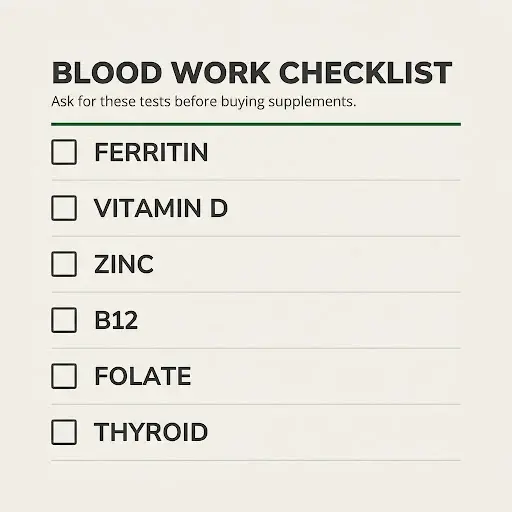
Before spending money on supplements, ask your doctor for a blood panel covering ferritin, vitamin D (25-OH), zinc, B12, folate, and thyroid function (TSH, free T4). Hair-specific targets can be tighter than standard lab “normal” ranges. Supplementing without testing wastes money at best and risks toxicity at worst.
Print this table and bring it to your appointment:
| Nutrient | Blood Test to Request | Target Range | Retest After |
|---|---|---|---|
| Iron | Serum ferritin | >70 ng/mL* | 3 months |
| Vitamin D | 25-hydroxyvitamin D | ≥30 ng/mL** | 3 months |
| Zinc | Serum zinc | 70–120 mcg/dL | 3 months |
| B12 | Serum B12 | ≥300 pg/mL (above borderline) | 6 months |
| Folate | Serum folate | ≥4 ng/mL (above deficiency) | 6 months |
| Thyroid | TSH + free T4 | Standard range (typically 0.5–4.5 mIU/L) | 6–12 months |
* Hair-specific target from trichology research (Rushton, 2002). Standard lab “normal” starts much lower.
** Endocrine Society minimum. Some hair specialists target 40–60 ng/mL.
Discuss your results with your dermatologist for hair-specific interpretation. A ferritin of 15 ng/mL reads as normal on most lab reports. Your hair disagrees.
Thyroid is on this list because hypothyroidism causes hair loss that mimics nutrient deficiency. Correcting vitamins will not help if an underactive thyroid is the real driver. The 2025 biomarker study found that TSH levels were lower in hair loss patients, though still within normal range (Source: PMC, 2025).
How Exercise Supports Hair Growth During Menopause
Regular exercise increases scalp blood flow, delivering more oxygen and nutrients to hair follicles. A 2021 study found that aerobic exercise was associated with a 5.4-fold improvement in androgenic alopecia severity compared to only performing light daily activities (Source: Journal of Central South University, 2021). Sessions exceeding 60 minutes showed a 3.1-fold improvement over sessions under 30 minutes.
Strength training helps too. It improves hormonal balance and reduces cortisol, a stress hormone that pushes hair follicles into the shedding phase. If you are new to resistance training, see our guide to strength training for women over 50.
Yoga and walking count. You do not need to train like an athlete. Consistent moderate activity, at least 150 minutes a week per WHO guidelines (Source: WHO, 2020), supports both your hair and your overall menopause symptoms. The point is circulation and stress reduction, not intensity.
What About Nutrafol, Viviscal, and Other Hair Supplements?
Branded menopause hair supplements like Nutrafol and Viviscal combine several of the vitamins above with proprietary blends. They can work, but mostly because they correct the same deficiencies you could address with individual supplements at a lower cost.
A month of Nutrafol runs roughly $79–88 at retail (as of November 2026) (Source: Nutrafol.com, 2026). Individual vitamin D, iron, and zinc supplements together cost considerably less for the same period. Check the label against your blood work results before buying.
The real risk with these products is stacking, as discussed in the vitamin D section. Many contain vitamin D, biotin, and iron in doses that overlap with other supplements you may already take. Read every label. If you are interested in a broader approach, our guide to hormone balance supplements covers other options.
Collagen supplements are heavily marketed for hair, but evidence for oral collagen reaching hair follicles is limited. Saw palmetto blocks DHT (the androgen that miniaturizes follicles), but data in women specifically is thin.
When to See a Doctor About Menopause Hair Loss
Supplements help when a deficiency is driving hair loss, but they cannot reverse every type. See a dermatologist if you notice sudden patchy loss, visible scalp through your hair, or thinning that does not respond after 6 months of correcting confirmed deficiencies.
Prescription options include minoxidil (topical, applied to the scalp) and spironolactone (oral, blocks androgens). Hormone replacement therapy (HRT) may also slow hair loss as part of broader menopause management. These work through different mechanisms than vitamins and are worth discussing if supplements alone are not enough.
For a wider look at non-supplement approaches, see our guide to natural menopause treatments.
FAQ: Vitamins for Menopause Hair Loss
What vitamins are good for hair loss during menopause?
Vitamin D, iron, and zinc have the strongest evidence, and B-complex vitamins play a supporting role, but only when blood levels are below optimal. No vitamin will help hair loss if your levels are already adequate. See the evidence table above for a grade-by-grade breakdown of each nutrient.
Does biotin help with menopause hair loss?
For most women, no. A 2026 systematic review found insufficient evidence that biotin supplementation improves hair in women with normal biotin levels (Source: Dermato, 2026). True biotin deficiency is rare. Save your money unless a blood test confirms you are actually deficient.
Can vitamin D deficiency cause hair loss in menopause?
Yes. Vitamin D receptors in hair follicles regulate the growth cycle, and deficiency disrupts it. The minimum clinical target is 30 ng/mL, with some hair specialists recommending 40–60 ng/mL. Most postmenopausal women fall short without supplementation.
How long does it take for vitamins to help menopause hair loss?
Expect 3–6 months for blood levels to normalize once you start supplementing, and 6–12 months before you see visible improvement in hair density. Hair grows about half an inch per month on average (Source: AAD). There are no shortcuts. If you see no improvement after 6 months of confirmed-adequate levels, the cause may not be nutritional.
Is menopause hair loss reversible with supplements?
Partially, if a deficiency is driving the loss. Correcting low iron, vitamin D, or zinc can slow shedding and support regrowth. But if the hair loss is primarily genetic or androgenic (driven by DHT sensitivity), supplements alone will not fully reverse it. That is when prescription treatments and a dermatologist visit make sense.
What deficiency causes hair loss during menopause?
Iron (measured as ferritin), vitamin D, zinc, and B12 are the most common deficiency-driven causes. A 2025 study of 200 women found significantly lower vitamin D in hair loss patients than in healthy controls, and lower zinc without a significant independent link (Source: PMC, 2025). See the blood work checklist above for exact tests and target ranges to request.
Sources
- NIH Office of Dietary Supplements (2024)
- Menopause journal (2022)
- PMC, biomarker study (2025)
- JAAD Case Reports (2025)
- MDPI, Dermato biotin review (2026)
Key sources shown. Every other study is named inline where it is cited.
This article provides general educational information and does not replace individual medical advice, diagnosis, or treatment. Speak with a qualified healthcare professional about your symptoms and circumstances.
Claire Morgan is a fictional editorial persona. The profile portrait is AI-generated.