

Will HRT Help You Lose Weight? What the Evidence Actually Shows
By Claire Morgan, Women’s Health Writer & Blogger. Last updated 8 November 2026.
This article provides general educational information and does not replace individual medical advice, diagnosis or treatment. Speak with a qualified healthcare professional about your symptoms and circumstances.
TL;DR — Does HRT Actually Help with Weight Loss?
Will HRT help you lose weight? HRT is not a weight loss drug and will not move the scale by itself, but it can reduce visceral belly fat, preserve lean muscle, and improve insulin sensitivity after menopause. A 2026 Lancet study found HRT users on tirzepatide lost 19.2% of body weight, versus 14.0% of non-users (Source: Castaneda et al., 2026).
Table of contents
Why Menopause Changes Where You Store Fat
Declining estrogen after menopause redirects fat storage toward the abdomen and accelerates muscle loss. These two shifts make the scale misleading and body composition a far better measure of what is actually happening.
Before menopause, estrogen encourages fat storage around the hips and thighs (subcutaneous fat). When estrogen drops, the body pivots to storing fat viscerally, around the organs in the abdominal cavity. One review estimated visceral fat rises from roughly 5-8% of total body fat before menopause to 15-20% afterward (Source: Kodoth et al., 2022). A 2026 clinical review found that the menopausal transition is associated with significant visceral fat accumulation independent of chronological age (Source: Younglove, Obesity Pillars, 2026). That matters because visceral fat is more strongly linked to insulin resistance, inflammation, and cardiovascular risk than subcutaneous fat.
If you are unsure which stage you are in, our perimenopause vs menopause stages guide explains the difference.
Muscle loss compounds the problem. Adults lose approximately 3-8% of muscle mass per decade after age 30, and menopause accelerates this decline (Source: Volpi et al., Current Opinion in Clinical Nutrition, 2004). Less muscle means a lower resting metabolic rate, so the same calorie intake produces gradual fat gain.
Sleep disruption from hot flashes and night sweats adds a third layer. Poor sleep raises cortisol, increases hunger hormones, and saps the energy needed for exercise. It is a cascade: less estrogen, more visceral fat, less muscle, worse sleep, more fat gain.
What HRT Can Do for Body Composition
HRT can improve body composition by reducing visceral belly fat and preserving muscle, even when total scale weight barely moves. The distinction between body recomposition and weight loss is the single most important thing to understand about HRT and the scale.
Research supports four mechanisms:
- Reduces visceral fat accumulation. A 2026 clinical review found that HRT attenuates central fat accumulation. In the OsteoLaus cohort of more than 1,000 women aged 50 to 80, hormone therapy users had significantly lower visceral fat than never-users (Source: Younglove, Obesity Pillars, 2026). Earlier work by Davis et al. (2012) in Climacteric reported similar findings across 28 randomized trials.
- Preserves lean muscle mass. Estrogen supports muscle protein synthesis. Maintaining muscle keeps resting metabolic rate higher, which helps with long-term weight management.
- Improves insulin sensitivity. A 2026 review confirmed that HRT reduces insulin resistance, citing a 2006 meta-analysis of 107 RCTs that found a 13% drop in HOMA-IR in non-diabetic women. A 2025 meta-analysis of 17 RCTs corroborated HOMA-IR reductions with estrogen therapy (Source: Younglove, 2026; original data from Salpeter et al., 2006). Better insulin sensitivity means the body handles carbohydrates more efficiently and stores less fat.
- Removes sleep and energy barriers. HRT reduces hot flashes and night sweats, improving sleep quality. Better sleep lowers cortisol and makes consistent exercise realistic rather than aspirational.
The scale may not budge. Waist circumference and body fat percentage are better metrics. A woman whose weight stays flat but loses two inches around the waist and gains visible muscle tone has had a meaningful body composition shift.

The Role of Testosterone in Menopause Body Composition
Testosterone also declines during menopause, contributing to muscle loss and a slower metabolism. Many HRT discussions cover only estrogen and progesterone, and leave this out.
Lower testosterone reduces the capacity to build and maintain muscle. Some clinicians prescribe low-dose testosterone alongside estrogen and progesterone, primarily for sexual function but with potential body composition benefits. The British Menopause Society notes that testosterone is not a standard third component of HRT but may be considered in specific cases (Source: BMS, 2023). Evidence on testosterone for body composition specifically (rather than libido) remains limited. This is an area worth discussing with your prescriber.
Which Type of HRT Has the Best Evidence for Weight?
Transdermal estrogen (patches or gel) paired with micronized progesterone shows the most favorable metabolic evidence. Not all HRT formulations perform the same on body composition, and the delivery route matters more than most people realize.
Oral estrogen passes through the liver first (hepatic first-pass metabolism), which raises triglycerides and can worsen certain metabolic markers. Transdermal estrogen bypasses the liver entirely, delivering estradiol directly into the bloodstream. NICE guideline NG23 recommends considering transdermal rather than oral HRT for people at increased risk of venous thromboembolism, including those with a BMI over 30 (Source: NICE, 2015, updated 2026).
On the progesterone side, micronized progesterone (sometimes called body-identical progesterone) is metabolically neutral. Synthetic progestins like medroxyprogesterone acetate (MPA) may promote fat storage and worsen insulin resistance.
| HRT Type | Delivery | Body Composition Evidence | Metabolic Effects | Clinical Notes |
|---|---|---|---|---|
| Transdermal estradiol | Patch or gel | Favorable: lower visceral fat, better lipid profile | Improved insulin sensitivity | Preferred route per NICE, NAMS |
| Oral estradiol | Pill | Mixed: hepatic first-pass may raise triglycerides | Mixed insulin effects | Use if patch not tolerated |
| Oral conjugated estrogens | Pill | Less favorable than bioidentical estradiol | Mixed | Older formulation, less prescribed now |
| Micronized progesterone | Capsule | Metabolically neutral | Neutral | Preferred progesterone per BMS |
| Synthetic progestins (MPA) | Pill | May promote fat storage | May worsen insulin resistance | Associated with more side effects |
This table summarizes published evidence and is not a prescribing guide. Discuss options with your doctor. Sources: NAMS 2022 position statement, NICE NG23, BMS tools for clinicians.
Will HRT Help You Lose Weight on Tirzepatide? The 2026 Lancet Data
A January 2026 Lancet study found that postmenopausal women using systemic HRT lost 19.2% of body weight on tirzepatide, compared to 14.0% for those not on HRT, roughly 35% greater weight loss (Source: Castaneda et al., 2026).
The study, first author Regina Castaneda, analyzed 120 postmenopausal women with BMI of 27 or higher who used tirzepatide for at least 12 months. Among HRT users, 45% achieved 20% or greater weight loss, compared to 24% of non-users.
Two important caveats. This was a retrospective cohort study, not a randomized controlled trial. Confounders may exist despite propensity matching, and the sample size was small (40 HRT users, 80 non-users). Second, tirzepatide is a prescription GLP-1 medication, not an over-the-counter supplement. This data is emerging evidence, not a treatment recommendation. But it signals that HRT may amplify the metabolic benefits of other interventions, which is worth watching.
What to Expect: A Realistic Month-by-Month Timeline
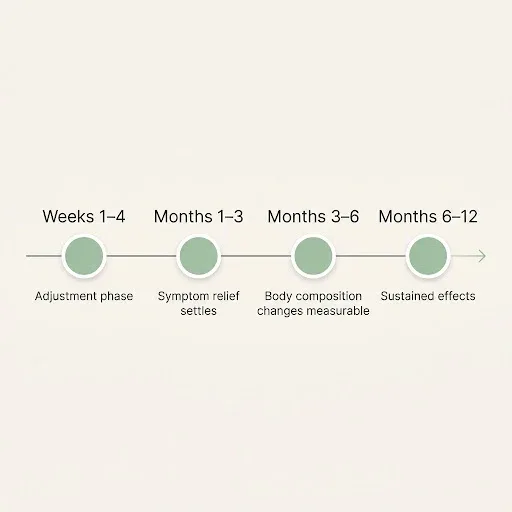
Most women notice body composition changes between three and six months on HRT. Symptom relief starts earlier and indirectly supports weight management from the first weeks.
For context on the transition itself, see how long menopause lasts.
Individual timelines vary, and the table below is an editorial estimate, not a clinical guarantee.
| Period | What to Expect |
|---|---|
| Weeks 1-4 | Adjustment phase. Possible water retention or bloating, especially with progesterone. Hot flash reduction begins. Sleep may improve. The scale may go up slightly. Do not panic. |
| Months 1-3 | Symptom relief stabilizes. Better sleep and energy make exercise more feasible. Indirect weight effects begin. Waist circumference may start to decrease even if the scale is flat. |
| Months 3-6 | Body composition changes become measurable. Visceral fat reduction is visible on DEXA scans or waist measurements. Muscle preservation is noticeable with strength training. |
| Months 6-12 | Sustained effects. Body fat redistribution continues. Combined with a strength training plan for women over 50 and adequate protein, the recomposition effect is most visible here. |
What HRT Cannot Do
HRT is not a weight loss drug, is not approved for weight loss by the FDA or any major regulator, and will not overcome a caloric surplus or replace exercise. Its value is body composition support, and the scale may not change (Source: ACOG).
That needs saying plainly.
HRT will not reduce your calorie needs. It will not burn fat directly. It will not compensate for a sedentary lifestyle or poor nutrition. If you eat more calories than you expend, you will gain fat regardless of your hormone status.
The lifestyle fundamentals still apply: calorie management, strength training, adequate protein, and consistent sleep. HRT supports those efforts by improving the hormonal environment, but it does not replace them. For the full action plan, see our menopause weight loss guide.
Frequently Asked Questions
Does HRT Cause Weight Gain?
No. According to ACOG, hormone therapy by itself will not lead to weight loss, and it is not associated with independent weight gain (Source: ACOG). Some women notice temporary water retention or bloating when they start progesterone, which typically settles within weeks.
What Is the Best Type of HRT for Weight Loss?
Transdermal estrogen (patch or gel) paired with micronized progesterone has the most favorable metabolic evidence. Transdermal delivery avoids liver first-pass metabolism and shows better outcomes for insulin sensitivity and lipid profiles. See the comparison table above for a full breakdown by HRT type.
How Long Does It Take to Lose Weight on HRT?
Body composition changes typically become measurable at three to six months. Symptom relief (better sleep, fewer hot flashes) starts within weeks and indirectly supports weight management earlier. The month-by-month timeline above maps out realistic expectations at each stage.
Does HRT Help with Menopause Belly Fat?
Yes. Estrogen replacement reduces visceral abdominal fat accumulation. A 2026 clinical review found that HRT attenuates central fat gain, and in the OsteoLaus cohort, hormone therapy users had significantly lower visceral fat than never-users (Source: Younglove, 2026). The effect is on fat distribution rather than total body weight, so waist circumference is a better metric than the scale.
Will I Gain Weight Back If I Stop HRT?
Visceral fat redistribution may resume after stopping HRT, especially without maintained exercise and nutrition habits. The body returns to a low-estrogen metabolic state, which favors abdominal fat storage. Continuing strength training and adequate protein intake can partially offset this effect, but the hormonal support is no longer there.
Can You Lose Weight During Menopause Without HRT?
Yes. Calorie management, strength training, protein intake, and sleep are the primary drivers of weight management during menopause. HRT supports these efforts but is not required. Many women manage their weight effectively through lifestyle changes alone. See our menopause weight loss guide and natural menopause treatments for the full approach.
Sources
- NICE NG23. Menopause guideline, 2015, updated 2026.
- ACOG. “Can hormone therapy help me lose weight?” American College of Obstetricians and Gynecologists.
- NAMS 2022 position statement. The 2022 hormone therapy position statement of The North American Menopause Society. Menopause. 2022;29(7):767-794.
- British Menopause Society testosterone statement. March 2023.
- Castaneda et al., 2026. Castaneda R, Bechenati D, Tama E, et al. The role of menopause hormone therapy in modulating tirzepatide-associated weight loss in postmenopausal women with overweight or obesity: a retrospective cohort study. Lancet Obstet Gynaecol Womens Health. 2026;2(2):e118-e128.
Key sources shown. Every other study is named inline where it is cited.