TL;DR — What Are the Best Dumbbell Back Exercises?
The core dumbbell back exercises in this guide are the bent-over row, single-arm row, chest-supported row, dumbbell pullover, reverse fly, and shrug. Together they train the lats, traps, rhomboids, and rear delts. For erector spinae, add the dumbbell Romanian deadlift. The page adds a comparison table, starting weights by experience level, and three routines (gym, upper-back focus, and no-bench).
What sets this list apart:
- A side-by-side exercise comparison table so you can pick movements by muscle target, equipment, and difficulty in seconds.
- Starting weight ranges for each exercise category, with men and women split out at beginner, intermediate, and advanced levels.
- Every exercise tagged as bench-required, bench-optional, or standing/floor so you can build a home workout without guessing.
Table of contents
Gymnase Tips is reader-supported. When you buy through links on our site, we may earn an affiliate commission at no extra cost to you.
Back Muscles You Can Train With Dumbbells
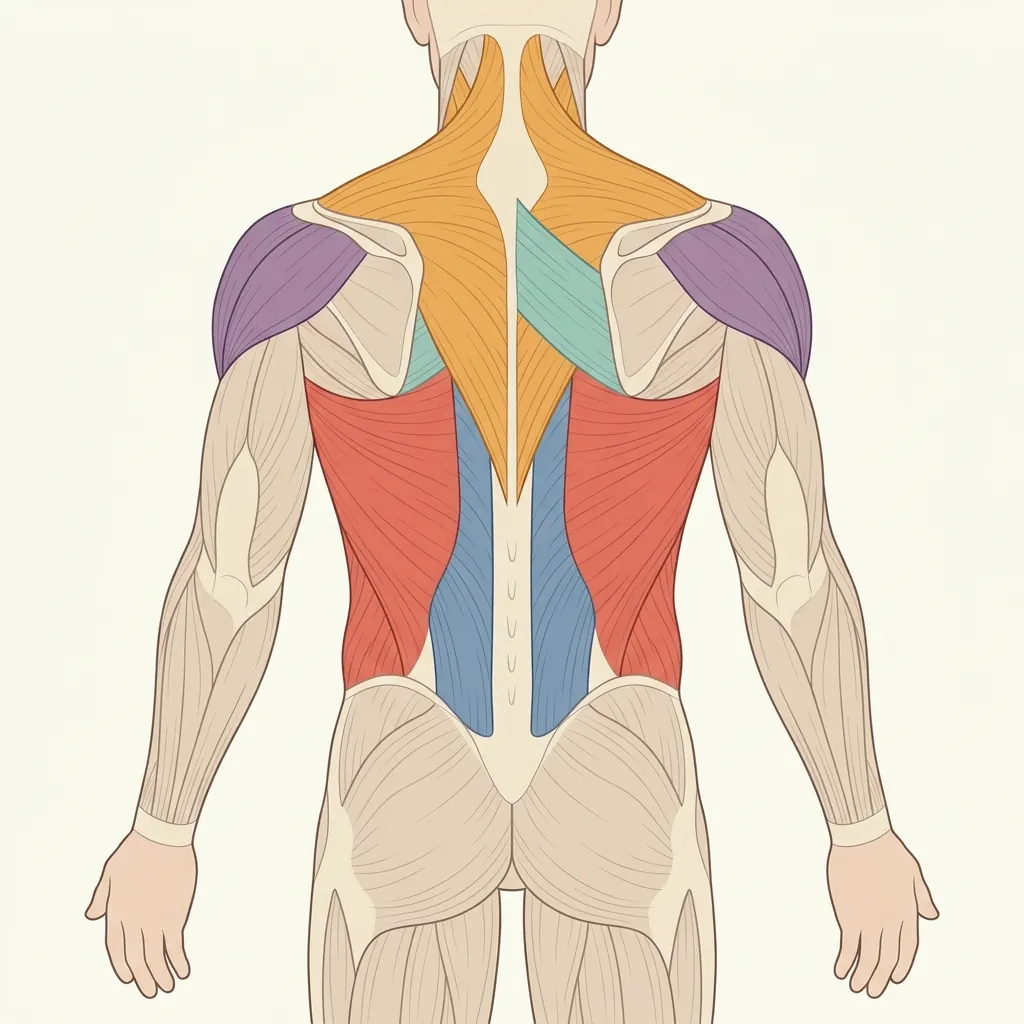
Dumbbells can train the main back muscles. The latissimus dorsi pulls your arms down and back. The trapezius (upper, mid, and lower fibers) controls scapular elevation, retraction, and depression. Rhomboids squeeze the shoulder blades together. Rear deltoids pull the arm backward. The erector spinae run along the spine and keep your torso upright under load.
Here is how those muscles map to training goals:
| Goal | Muscles | Best dumbbell exercises |
|---|---|---|
| Width | Latissimus dorsi | Rows, pullovers |
| Thickness | Traps, rhomboids | Shrugs, reverse flyes, seal rows |
| Rear-shoulder work | Rear delts, mid/lower traps | Y-raises, reverse flyes |
| Lower-back strength | Erector spinae | Romanian deadlifts |
For shoulder work to pair with a back session, see dumbbell shoulder exercises.
Exercise Comparison Table
This table sorts all 12 exercises by primary muscle, equipment needed, and difficulty so you can build a routine fast.
| # | Exercise | Primary Muscles | Secondary Muscles | Equipment | Difficulty |
|---|---|---|---|---|---|
| 1 | Bent-Over Dumbbell Row | Lats, rhomboids | Biceps, rear delts | Standing — no bench | Beginner |
| 2 | Single-Arm Dumbbell Row | Lats, rhomboids | Biceps, core (anti-rotation) | Bench optional | Beginner |
| 3 | Chest-Supported Dumbbell Row | Lats, rhomboids, mid-traps | Biceps, rear delts | Bench required | Beginner |
| 4 | Dumbbell Pullover | Lats | Chest, triceps (long head) | Bench required | Intermediate |
| 5 | Dumbbell Reverse Fly | Rear delts, mid-traps | Rhomboids | Standing — no bench | Beginner |
| 6 | Dumbbell Shrug | Upper traps | Levator scapulae | Standing — no bench | Beginner |
| 7 | Dumbbell Romanian Deadlift | Erector spinae, glutes | Hamstrings | Standing — no bench | Intermediate |
| 8 | Dumbbell Y-Raise | Lower/mid-traps | Rear delts | Bench optional | Intermediate |
| 9 | Seal Row (Dumbbell) | Lats, rhomboids, mid-traps | Biceps | Bench required | Intermediate |
| 10 | Renegade Row | Core (anti-rotation) | Lats, biceps | Floor — no bench | Advanced |
| 11 | Dumbbell High Pull | Upper traps, rear delts | Biceps, forearms | Standing — no bench | Intermediate |
| 12 | Prone Dumbbell Row (Floor) | Lats, rhomboids | Biceps, rear delts | Floor — no bench | Beginner |
The 12 Exercises
These 12 movements cover lats, traps, rhomboids, rear delts, and erector spinae with just a pair of dumbbells and an optional adjustable bench.
1. Bent-Over Dumbbell Row
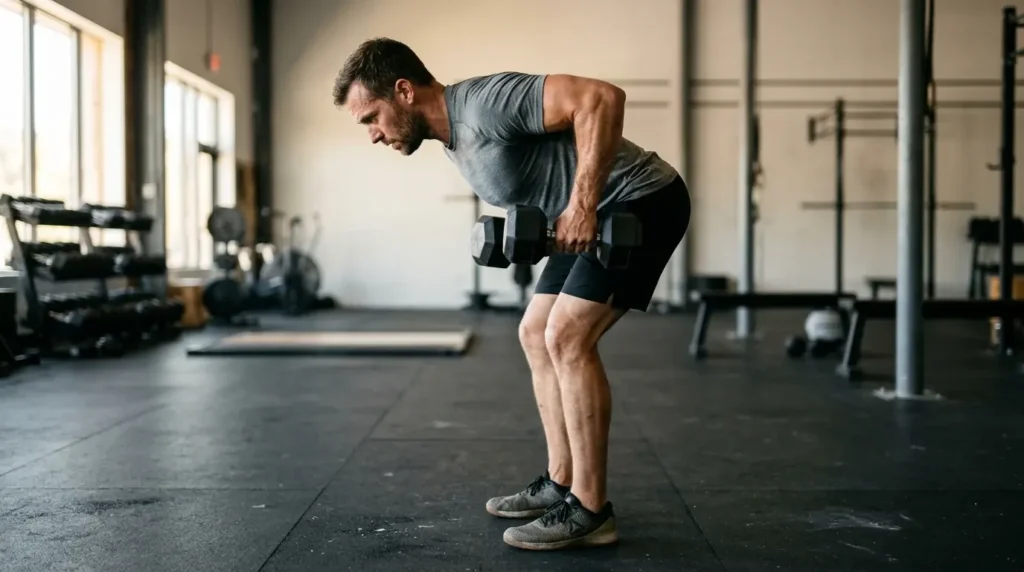
The bent-over row works the lats, rhomboids, and mid-traps while standing, which makes it a practical first choice for most dumbbell back work.
- Stand with feet hip-width apart, hinge at the hips until your torso is roughly 45 degrees from the floor, and let the dumbbells hang at arm’s length with a neutral grip.
- Drive your elbows straight back, squeezing your shoulder blades together at the top.
- Lower under control for a two-count eccentric.
- Reset your brace at the bottom before the next rep.
Muscles worked: Latissimus dorsi, rhomboids, mid-traps, biceps, rear delts.
Think “elbow drive,” not “hand pull.” The cue keeps your attention on the elbows and back rather than the grip. An overhand (pronated) grip is a valid variation if you want to try a different feel.
No bench needed. Standing only. Want the full picture? See our breakdown of the muscles the dumbbell row targets.
2. Single-Arm Dumbbell Row
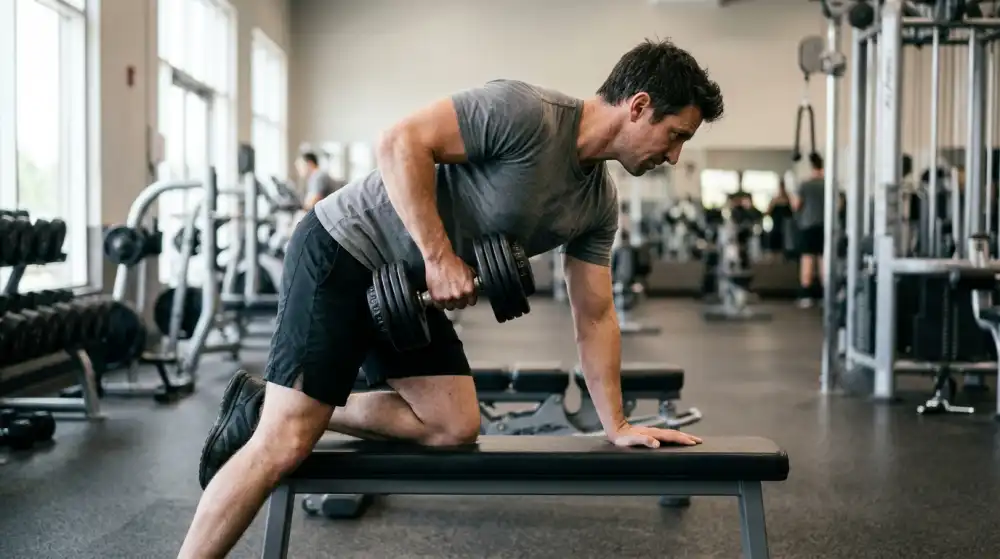
The single-arm row works one side at a time, which makes it easy to see which side is weaker. That is the main reason to include it alongside bilateral rows.
- Place your free hand and same-side knee on a bench (or brace against a wall if no bench is available).
- Row the dumbbell toward your hip, leading with the elbow.
- Pause briefly at the top, then lower for 2–3 seconds.
- Complete all reps on one side before switching.
Muscles worked: Lats, rhomboids, biceps. The offset load also asks your core to resist rotation.
Start with your weaker side and match its rep count on the stronger side. This is a coaching default, not a rule.
Bench optional. Works fine braced against any stable surface.
3. Chest-Supported Dumbbell Row
Lying chest-down on an incline bench takes momentum out of the rep, which makes this a strict way to row.
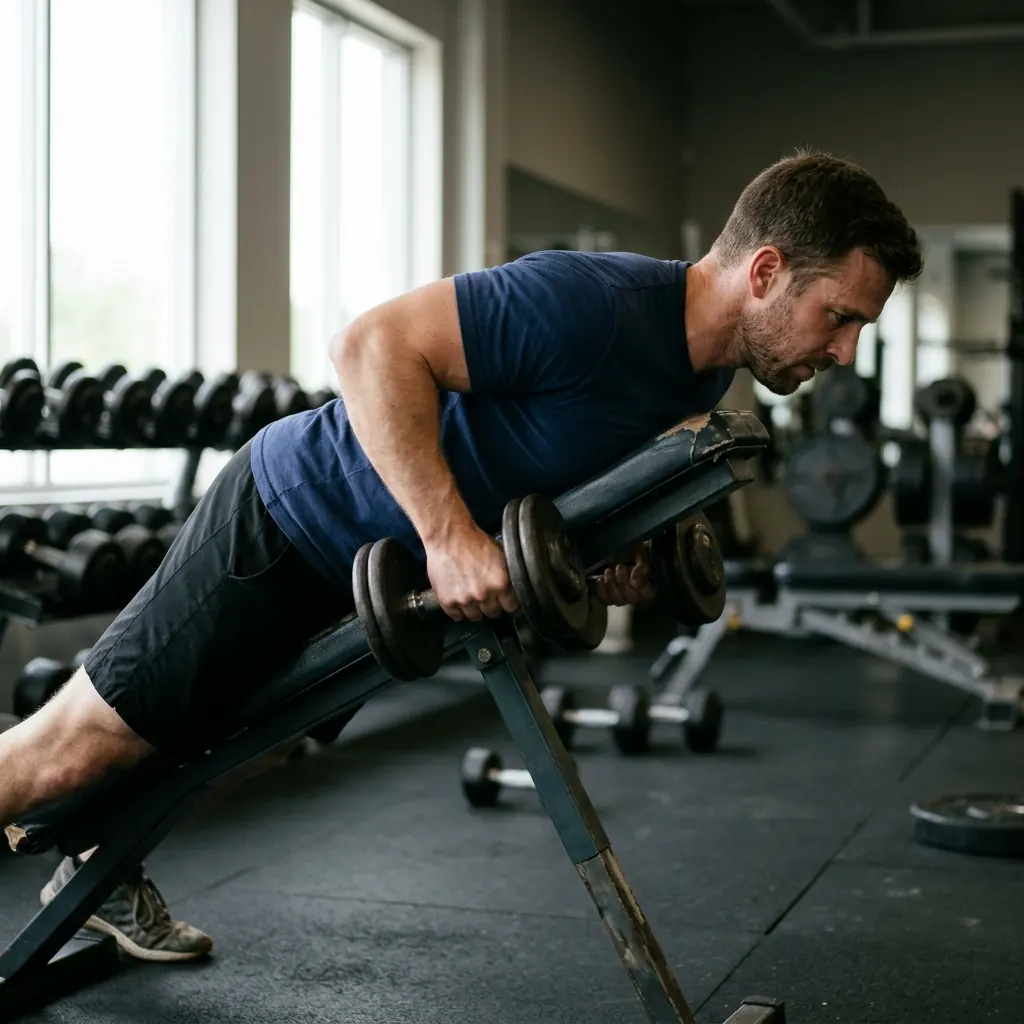
- Set an adjustable bench to roughly 30–45 degrees.
- Lie face-down with your chest against the pad, arms hanging straight, dumbbells in a neutral grip.
- Row both dumbbells until your upper arms are parallel with your torso.
- Squeeze for a one-count at the top. Lower slowly.
Muscles worked: Lats, rhomboids, mid-traps, rear delts, biceps.
The pad supports your torso, so this is a practical pick late in a session, when your lower back is already tired from heavy hinges or squats.
Bench required.
4. Dumbbell Pullover
The pullover is one of the few dumbbell exercises that trains the lats through shoulder extension rather than elbow flexion, making it a useful complement to rows.
- Lie face-up on a flat bench with feet planted on the floor.
- Hold one dumbbell with both hands above your chest, arms slightly bent.
- Lower the dumbbell behind your head in an arc until you feel a deep stretch through the lats.
- Pull the weight back to the start using your lats, not your arms.
Muscles worked: Lats (primary), chest (secondary), triceps long head.
Keep a slight elbow bend throughout, and pull with the lats rather than the arms.
Bench required.
5. Dumbbell Reverse Fly
The reverse fly targets the rear delts and mid-traps.
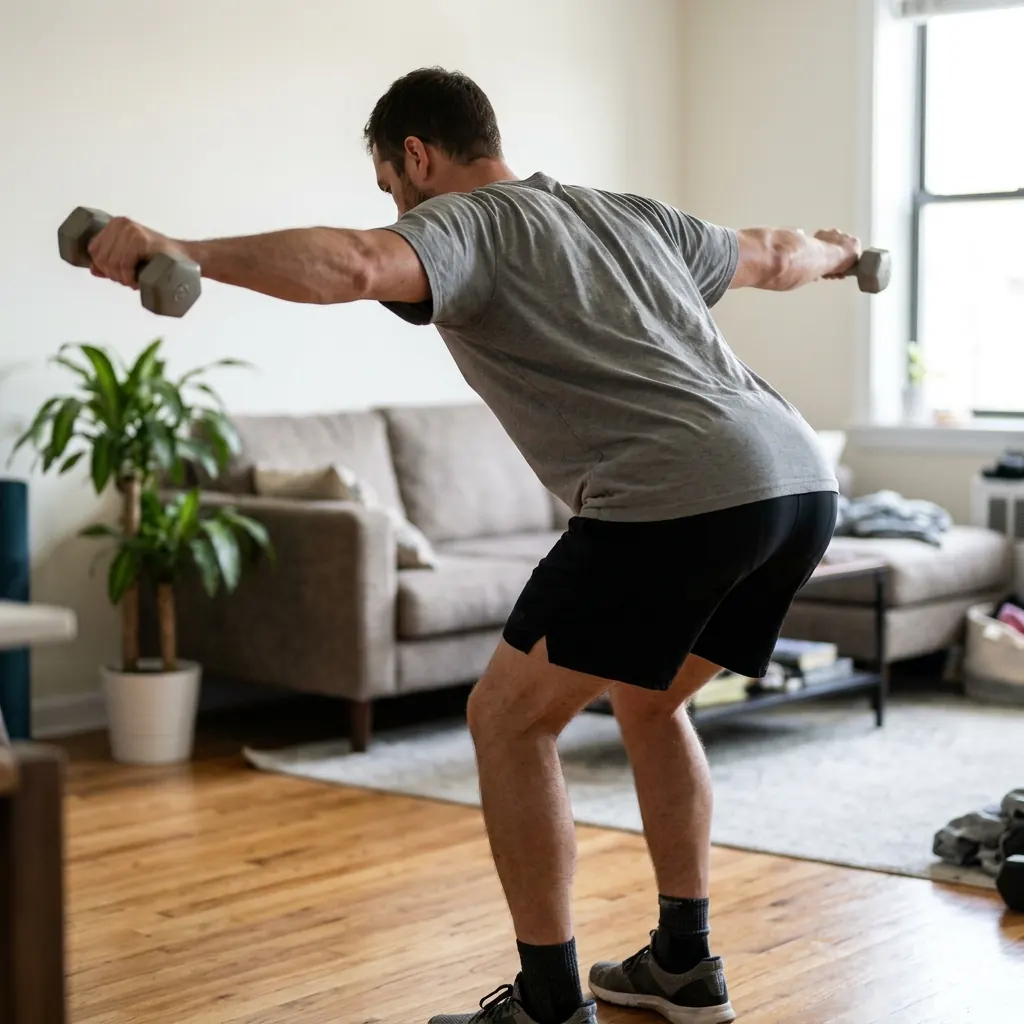
- Hinge forward at the hips with a slight knee bend, torso close to parallel with the floor.
- With a slight elbow bend, raise both dumbbells out to the sides until your arms are roughly level with your shoulders.
- Hold the top for one second. Lower under control.
Muscles worked: Rear deltoids, mid-traps, rhomboids.
Use light weight. A heavy set quickly turns into a body swing, so pick a weight you can control through the whole arc. If your traps cramp at the top, go lighter and focus on the squeeze.
No bench needed. Can also be done face-down on an incline bench.
6. Dumbbell Shrug
The shrug targets the upper traps directly, along a straight vertical path.
- Stand tall with a dumbbell in each hand at your sides, arms straight.
- Shrug your shoulders straight up toward your ears. No rolling.
- Hold the top for two seconds, then lower slowly.
Muscles worked: Upper trapezius, levator scapulae.
Skip the shoulder roll. Keep the path straight up and straight down so each rep is easy to judge. If grip gives out before the traps fatigue, add lifting straps.
No bench needed. Standing only.
7. Dumbbell Romanian Deadlift
The dumbbell RDL trains the erector spinae and posterior chain through a hip-hinge pattern.
- Hold dumbbells in front of your thighs, feet hip-width apart.
- Push your hips back while keeping a neutral spine. Let the dumbbells travel close to your legs.
- Lower until you feel a strong hamstring stretch — usually just below the knee.
- Drive the hips forward to stand.
Muscles worked: Erector spinae, glutes, hamstrings.
One honest take: if your gym has a barbell, a barbell RDL is a reasonable choice for heavier work. The dumbbell version suits home setups and lighter accessory work.
No bench needed. Standing only.
8. Dumbbell Y-Raise
The Y-raise targets the lower and mid-traps and the rear delts.
- Lie face-down on an incline bench set to about 30 degrees, or bend over at the hips while standing.
- With thumbs pointing up, raise the dumbbells forward and slightly outward to form a Y shape overhead.
- Hold the top for one second. Lower slowly.
Muscles worked: Lower traps, mid-traps, rear delts.
These are humbling. Start light, and use the “Flyes and raises” row in the starting weight table below as your guide.
Bench optional. Works standing in a bent-over position. The bench version fixes your torso in place, which makes the form easier to keep honest.
9. Seal Row (Dumbbell)
The seal row is a chest-supported row with your feet off the ground, so there is no leg drive to help the rep.
- Set a flat bench high enough that your arms can hang straight without the dumbbells touching the floor. Stack plates or blocks under the bench legs if needed.
- Lie face-down, arms hanging, dumbbells in a neutral grip.
- Row both dumbbells to the sides of your ribcage.
- Pause at the top. Lower for a two-count.
Muscles worked: Lats, rhomboids, mid-traps, biceps.
The setup is the main downside. You need a bench that is high enough, or something to elevate it. Worth the hassle if you find yourself cheating on standard rows.
Bench required.
10. Renegade Row
The renegade row is a plank-style core exercise that also works the lats and biceps. Keep the weight modest and the hips square. If the hips start to rotate, the weight is too heavy.
- Get into a push-up position with hands on hex dumbbells, feet slightly wider than hip-width.
- Row one dumbbell to your hip while resisting the urge to rotate through the hips.
- Place it down. Row the other side.
- Keep the hips square throughout.
Muscles worked: Core (anti-rotation), lats, biceps.
Treat this as a core drill that also works the back, not as a main back exercise. It fits a short home session when time is tight.
Floor only — no bench needed.
11. Dumbbell High Pull
The high pull is an explosive upper-back movement that hits the upper traps and rear delts at a fast tempo. Good finisher.
- Stand with dumbbells in front of your thighs, slight knee bend.
- In one explosive movement, shrug and pull the dumbbells up toward your chin, leading with the elbows.
- Elbows should finish above shoulder height. Dumbbells stay close to the body.
- Lower under control.
Muscles worked: Upper traps, rear delts, biceps, forearms.
Keep the reps moderate (6–8) and the pulls fast and clean. This is a movement to finish with, not a burnout set.
No bench needed. Standing only.
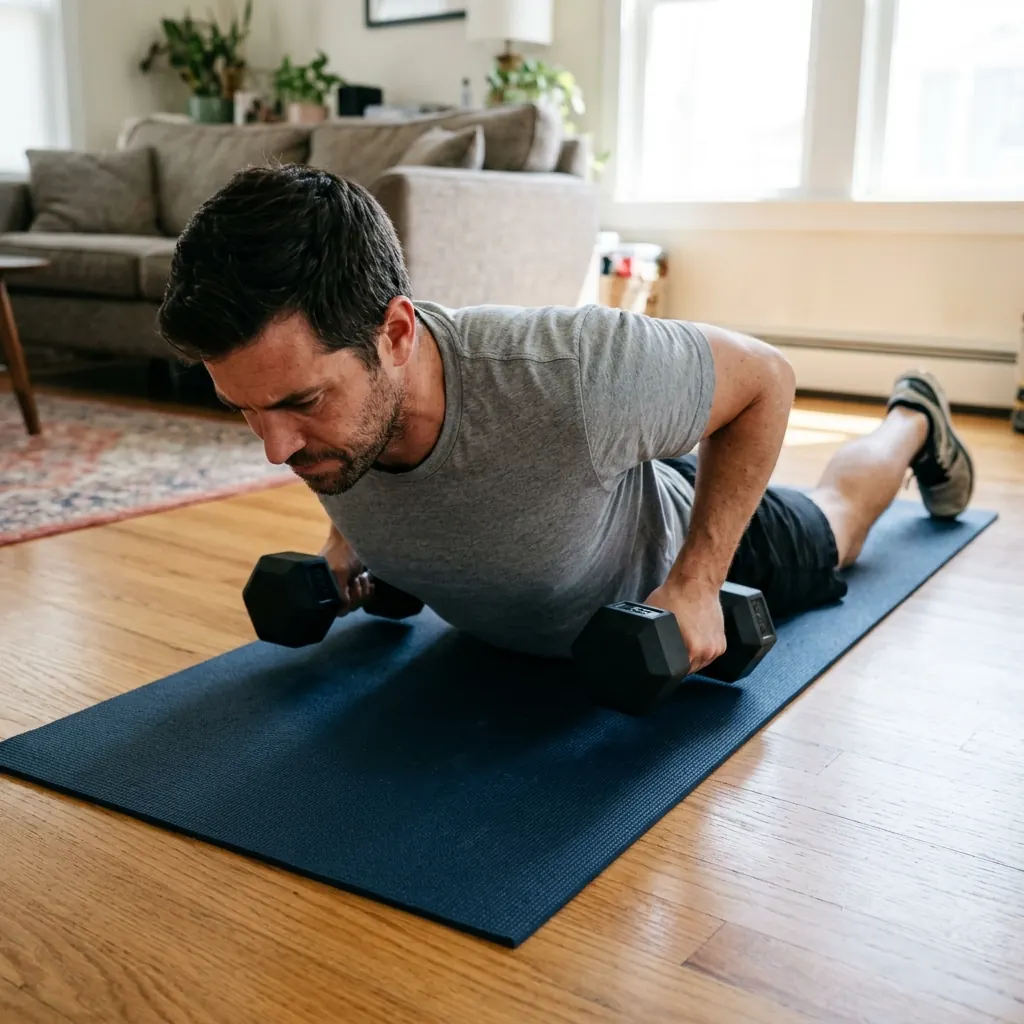
12. Prone Dumbbell Row (Floor)
Lying face-down on the floor needs no bench, so it is a practical home option when you do not have one.
- Lie face-down on the floor with a dumbbell in each hand, arms extended in front of you or to the sides.
- Row the dumbbells toward your ribcage, squeezing the shoulder blades together.
- Hold the top position for one second.
- Lower back to the floor. Let the dumbbells touch down briefly to reset each rep.
Muscles worked: Lats, rhomboids, rear delts, biceps.
Range of motion is shorter than a bench row because the floor is in the way. Accept it. The trade-off is that you need nothing beyond the dumbbells and floor space.
Floor only — no bench needed.
Starting Weight Guide by Exercise
The ranges below are practical heuristics based on common training loads, not sourced from a single study. For a reference point, the ACSM’s 2026 position stand on resistance training recommends at least 80% of 1RM for strength goals (Source: ACSM, 2026).
Adjust based on your 8–12 rep capacity: if you cannot complete 8 reps with good form, the weight is too heavy. If you can do more than 12 comfortably, go heavier.
Per-hand weight ranges (kg / lb):
| Exercise Category | Beginner (Men) | Beginner (Women) | Intermediate (Men) | Intermediate (Women) | Advanced (Men) | Advanced (Women) |
|---|---|---|---|---|---|---|
| Rows (bent-over, single-arm, chest-supported) | 8–12 kg (18–26 lb) | 4–8 kg (9–18 lb) | 14–20 kg (30–44 lb) | 8–12 kg (18–26 lb) | 22–34 kg (48–75 lb) | 14–20 kg (30–44 lb) |
| Romanian deadlift | 10–14 kg (22–30 lb) | 6–10 kg (13–22 lb) | 16–24 kg (35–53 lb) | 10–16 kg (22–35 lb) | 26–40 kg (57–88 lb) | 16–24 kg (35–53 lb) |
| Flyes and raises (reverse fly, Y-raise) | 2–4 kg (4–9 lb) | 1–3 kg (2–7 lb) | 5–8 kg (11–18 lb) | 3–5 kg (7–11 lb) | 8–14 kg (18–30 lb) | 5–8 kg (11–18 lb) |
| Shrugs | 12–16 kg (26–35 lb) | 6–10 kg (13–22 lb) | 18–26 kg (40–57 lb) | 10–16 kg (22–35 lb) | 28–40+ kg (62–88+ lb) | 16–26 kg (35–57 lb) |
These are starting points. Your actual working weight depends on training history, body weight, and the specific rep scheme you are using. Pick a weight where reps 8–10 feel challenging but form stays clean.
For a more flexible home setup, a pair of adjustable dumbbells can cover many of the ranges in the table above without a full dumbbell rack.
3 Dumbbell Back Workouts
Pick one of these three routines based on your goal and equipment. Each follows the same progression rule: when you can complete the top of the rep range with clean form for all sets, add 1–2 kg (2–5 lb) next session.
For a complete program beyond these three, see the full dumbbell workout plan.
General Back Workout (Gym)
A balanced routine that covers width, thickness, and lower back. Expect about 35–45 minutes with the rest periods below.
| Exercise | Sets | Reps | Rest |
|---|---|---|---|
| Bent-Over Dumbbell Row | 4 | 8–10 | 90 sec |
| Chest-Supported Dumbbell Row | 3 | 10–12 | 75 sec |
| Dumbbell Pullover | 3 | 10–12 | 75 sec |
| Dumbbell Reverse Fly | 3 | 12–15 | 60 sec |
| Dumbbell Shrug | 3 | 10–12 | 60 sec |
| Dumbbell Romanian Deadlift | 3 | 8–10 | 90 sec |
Total: 19 sets. That puts you at roughly 10+ working sets for the lats and solid coverage of traps, rear delts, and erector spinae — well within the dose-response range identified by Schoenfeld et al., where 10 or more weekly sets per muscle group produced the largest hypertrophy gains (Source: Schoenfeld, Ogborn & Krieger, Journal of Sports Sciences, 2017).
For how rep ranges fit into a hypertrophy plan, read rep ranges for hypertrophy.
Upper-Back Focus Routine
Emphasizes traps, rhomboids, and rear delts. Pick it when you want more work for the upper back. Expect about 25–35 minutes with the rest periods below.
| Exercise | Sets | Reps | Rest |
|---|---|---|---|
| Seal Row | 4 | 8–10 | 90 sec |
| Dumbbell Reverse Fly | 3 | 12–15 | 60 sec |
| Dumbbell Y-Raise | 3 | 12–15 | 60 sec |
| Dumbbell Shrug | 3 | 10–12 | 60 sec |
| Dumbbell High Pull | 3 | 6–8 | 75 sec |
At-Home / No-Bench Workout
Every exercise here works with a pair of dumbbells and floor space. No bench. Expect about 25–35 minutes with the rest periods below.
| Exercise | Sets | Reps | Rest | Position |
|---|---|---|---|---|
| Bent-Over Dumbbell Row | 4 | 8–10 | 90 sec | Standing |
| Prone Dumbbell Row (Floor) | 3 | 10–12 | 75 sec | Floor |
| Dumbbell Reverse Fly | 3 | 12–15 | 60 sec | Standing |
| Dumbbell Romanian Deadlift | 3 | 8–10 | 90 sec | Standing |
| Dumbbell Shrug | 3 | 10–12 | 60 sec | Standing |
Want to add bodyweight moves? Try the dumbbell and bodyweight combo workout, or go fully bodyweight with the calisthenics back workout.
How Many Back Exercises Should You Do Per Workout?
The routines in this guide use five or six exercises per session, which keeps each one short enough to finish with clean form. The research supports at least 10 direct sets per muscle group per week for hypertrophy, which a Schoenfeld et al. meta-analysis established as a graded dose-response relationship (Source: Schoenfeld, Ogborn & Krieger, Journal of Sports Sciences, 2017). The ACSM’s 2026 resistance training position stand recommends at least 10 sets per muscle group per week for hypertrophy and, as a general guideline, training at least twice per week (Source: ACSM, 2026).
If you are new to this, start with three or four compound movements, such as a row and an RDL, and add more once the session feels easy to finish. If you have trained consistently for a while, five or six exercises with varied grips and angles (pronated, neutral, supinated) give you more variety within the same muscle group.
If you want more weekly volume, split the sets across two sessions rather than running all 19 in one marathon workout.
FAQ
Can you train your whole back with just dumbbells?
Yes. Rows cover the lats and rhomboids. Reverse flyes and Y-raises hit the rear delts and mid-traps. Shrugs target the upper traps. Romanian deadlifts work the erector spinae. The main gap is heavy vertical pulling — pull-ups and lat pulldowns are hard to match with dumbbells. Dumbbell pullovers partially fill that gap by training the lats through shoulder extension, but they are not a perfect substitute.
How do you build a wide back with dumbbells?
The lats are the muscles behind back width, so build the program around pulling movements such as bent-over rows, single-arm rows, and dumbbell pullovers. Keep a slight forward lean through the row, let the arms reach fully at the bottom of each rep, and lower for two to three seconds on the way down.
Are dumbbell rows enough for back?
Rows are the foundation, but they mainly train the lats and rhomboids. If rows are all you do, add reverse flyes or Y-raises for the rear delts and mid-traps, shrugs for the upper traps, and an RDL for the erector spinae. Those are the exercises this guide uses to cover the full back.
What dumbbell exercises target the upper back?
Reverse flyes, Y-raises, and seal rows are good picks when the goal is the mid-traps, rhomboids, and rear delts. Shrugs target the upper traps specifically. For more trap work, browse trapezius exercises.
Sources
- Schoenfeld, Ogborn & Krieger (2017). Dose-response relationship between weekly resistance training volume and increases in muscle mass: A systematic review and meta-analysis. Journal of Sports Sciences, 35(11), 1073–1082.
- ACSM (2026). Resistance Training Prescription for Muscle Function, Hypertrophy, and Physical Performance in Healthy Adults: An Overview of Reviews. Medicine & Science in Sports & Exercise, 58(4), 851–872.