
Gymnase Tips is reader-supported. Some links may be Amazon affiliate links; if you buy through them we may earn a small commission at no extra cost to you.
TL;DR — What Muscles Do Dumbbell Rows Work?
The dumbbell row muscles worked span three tiers. Primary movers are the latissimus dorsi, rhomboids, middle and lower trapezius, and posterior deltoids. Secondary muscles include the biceps brachii, teres major, teres minor, and forearm flexors. The erector spinae and core stabilize throughout. Grip position and row angle shift which muscles work hardest.
| Tier | Muscles | Role |
|---|---|---|
| Primary | Latissimus dorsi, rhomboids, mid/lower trapezius, posterior deltoids | Drive the pull |
| Secondary | Biceps brachii, teres major, teres minor, forearm flexors | Assist the pull |
| Stabilizer | Erector spinae, rectus abdominis, obliques | Maintain posture |
That is eleven muscles in a single compound exercise. Few back movements hit that many in one rep (Source: Cleveland Clinic, 2025). Below you will find exactly where each muscle fires, how grip and angle shift the emphasis, and which variation fits your goal.
Table of contents

Primary Muscles Worked in the Dumbbell Row
Four muscles do the heavy pulling: the latissimus dorsi drives shoulder extension, the rhomboids and middle/lower trapezius retract the scapula, and the posterior deltoids assist at the top of each rep. Together they produce both the “pull” and the “squeeze” you feel during every set.
Latissimus Dorsi
The lats are the largest muscle in the back, spanning from the lower thoracic spine and iliac crest up to the humerus. During a dumbbell row, they drive shoulder extension — pulling the upper arm from a stretched position at the bottom to full contraction at the top.
The stretch at the bottom of the range of motion (ROM) matters. A full eccentric lengthens the lat under load, and a 2017 meta-analysis of 15 studies found eccentric actions produced a mean muscle growth of 10.0% versus 6.8% for concentric-only actions (Source: Schoenfeld et al., JSCR, 2017). If you cut the bottom range short, you leave lat work on the table.
Rhomboids
The rhomboid major and minor sit between the spine and the medial border of the scapula. Their job during a row is scapular retraction — pulling the shoulder blade toward the midline. You feel them most at the very top, when you squeeze the blade inward. Weak rhomboids show up as rounded shoulders and poor posture. Rows are one of the most direct ways to load them.
Middle and Lower Trapezius
The middle and lower trap fibers depress and retract the scapula, working alongside the rhomboids. They are not the upper traps — those fire when you shrug. If your upper traps burn during rows, you are likely hiking the shoulder instead of driving the elbow back. Keep the shoulder packed down and let the mid/lower fibers do their job. For more trap-building moves, see our full trapezius exercises guide.
Posterior Deltoids
The rear delts assist shoulder extension at the back of the movement. They fire harder with two specific adjustments: flaring the elbow wider and using a pronated (overhand) grip. A standard row with the elbow tucked hits rear delts, but not as aggressively as a wide-elbow variation.
Secondary and Stabilizer Muscles
Secondary muscles assist the pull but are not the main drivers. Stabilizers keep your spine neutral and prevent rotation. Both groups fatigue during heavy sets, and either can become the weak link that limits your working weight.
Biceps Brachii
The biceps flex the elbow, which happens during every row rep. They are secondary movers, but beginners often feel them more than the lats. That usually comes down to technique: gripping too hard, curling the wrist, or initiating the pull with the hand instead of the elbow. All three shift load to the biceps. Cue “drive the elbow to the ceiling” and the lat takes over.
Teres Major and Minor
Teres major sits just above the lat and assists shoulder extension. It is sometimes called the “lat’s little helper” because it mirrors lat function on a smaller scale. Teres minor, part of the rotator cuff, assists with external rotation and shoulder stability during the row. Most guides skip both, but they do measurably contribute to the pulling force.
Forearm Flexors and Grip
Your wrist flexors and brachioradialis grip the dumbbell throughout the set. On heavy or high-rep sets, grip often fails before the back does. That is normal. When grip becomes the limiting factor, lifting straps let you keep loading the back without the forearms cutting the set short. Use them on your heaviest sets; ditch them on lighter work to build grip endurance over time.
Erector Spinae and Core
In a bent-over or one-arm row, the erector spinae resist spinal flexion (rounding), while the rectus abdominis and obliques resist rotation — especially during single-arm work. Fenwick et al. (2009) found that one-arm cable rows produced significantly higher internal oblique activation (20.8% MVC) compared to bilateral bent-over rows (13.3% MVC) (Source: Fenwick et al., JSCR, 2009). That anti-rotation demand is a genuine core training stimulus, and it transfers directly to the dumbbell version of the movement.
Chest-supported rows remove this demand almost entirely. That is their trade-off: zero lower-back stress, but also zero core work.
How Grip and Angle Change Which Muscles Work Hardest
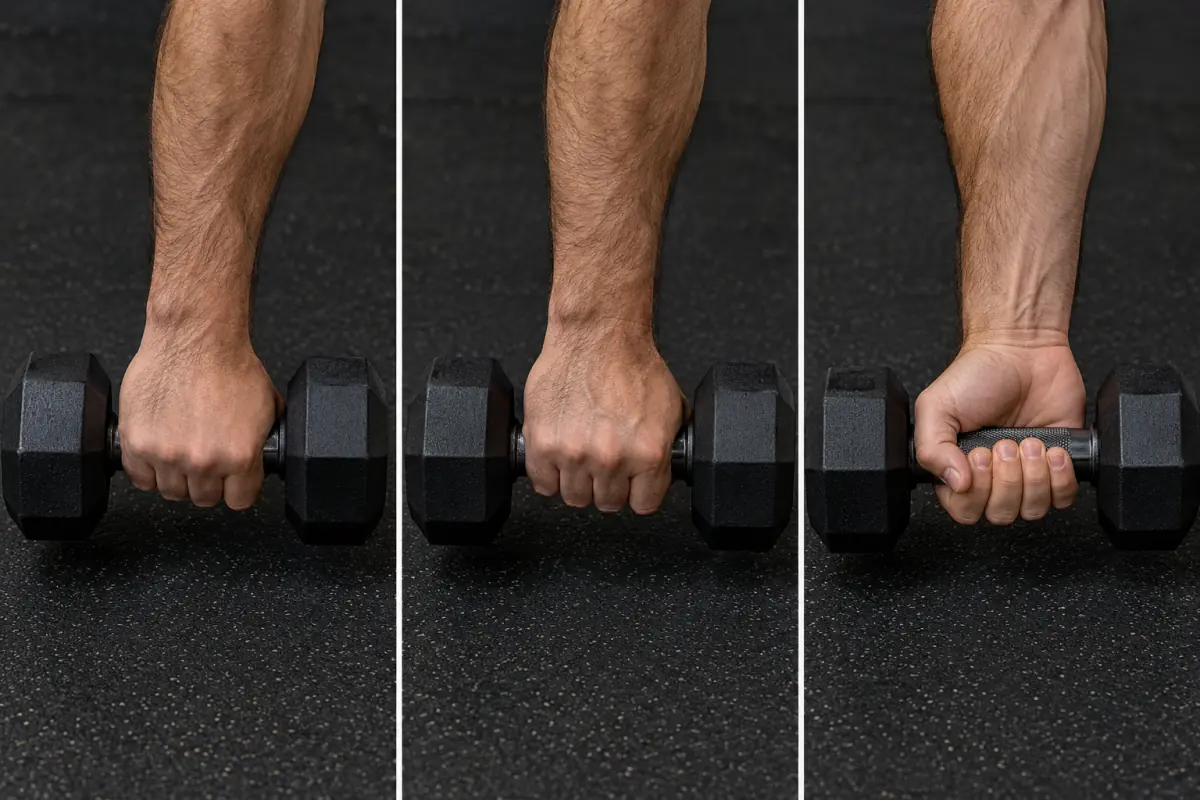
Switching grip — neutral, pronated, or supinated — and changing pull direction (toward the hip or toward the chest) shifts which secondary and stabilizer muscles fire hardest. Lat activation stays surprisingly stable across grips; Lehman et al. (2004) found no significant difference in latissimus dorsi EMG between pronated and supinated grips during pulling exercises (Source: Lehman et al., Dynamic Medicine, 2004). The real shift happens in the biceps, rear delts, and mid-back.
| Grip | Pull Direction | Primary Emphasis | Secondary Emphasis | Best For |
|---|---|---|---|---|
| Neutral | Row to hip | Lats (lower fibers) | Teres major, biceps | Back width |
| Neutral | Row to chest | Mid-traps, rhomboids | Rear delts, lats | Back thickness |
| Pronated (overhand) | Row to chest | Rear delts, rhomboids | Mid-traps, forearms | Rear delt focus |
| Supinated (underhand) | Row to hip | Lats, biceps | Teres major, forearms | Lat + bicep combo |
Neutral vs Pronated vs Supinated Grip
A neutral grip (palms facing the body) keeps the elbow path tight to the torso, biasing the pull toward the lats and teres major. Pronating (overhand) forces the elbow outward, which shortens the posterior deltoid’s line of pull and increases rear delt contribution. EMG research on inverted rows shows pronated grip produces significantly higher posterior deltoid activation and lower biceps activation than supinated grip (Source: Youdas et al., JSCR, 2016). Supinating (underhand) puts the biceps in its strongest mechanical position, increasing elbow flexor contribution to the pull.
Row to Hip vs Row to Chest
Pulling toward the hip extends the shoulder through a longer arc, favoring the lower lat fibers and teres major. Pulling toward the lower chest shortens the arc and widens the elbow angle, which shifts emphasis to the rhomboids and middle trapezius. Think of it this way: hip pull = width work, chest pull = thickness work. Neither is better. Pick based on what your back needs.
Torso Angle Effects
A more horizontal torso (close to parallel with the floor) maximizes lat stretch and loading. A more upright angle — around 45 degrees — reduces lat involvement and increases trap and rear delt contribution. The bent-over row at near-parallel torso angle produced the highest lumbar spine loading at 3,576 N, compared to 2,339 N in the inverted row position (Source: Fenwick et al., JSCR, 2009). More bend = more lat, but also more low-back demand.
Muscles Worked by Dumbbell Row Variation
Each variation shifts the muscle emphasis map. One-arm rows add anti-rotation core demand. Chest-supported rows isolate the mid-back. Incline rows increase the lat stretch. The table below compares all six at a glance.
| Variation | Primary Target | Secondary | Unique Benefit | Best For |
|---|---|---|---|---|
| One-arm row | Lats, rhomboids | Core (anti-rotation), biceps | Unilateral balance correction | General back development |
| Bent-over two-arm | Lats, mid-traps | Erector spinae, biceps | Heavier loading | Strength |
| Chest-supported | Mid-traps, rhomboids | Rear delts, lats | Zero low-back stress | Isolation / injury history |
| Incline row | Lower lats, teres major | Rear delts, biceps | Greater ROM | Lat stretch emphasis |
| Renegade row | Lats, obliques | Core (anti-rotation), shoulders | Full-body integration | Conditioning |
| Reverse-grip | Lats, biceps | Teres major, forearms | Maximum bicep involvement | Lat + bicep training |
One-Arm Dumbbell Row
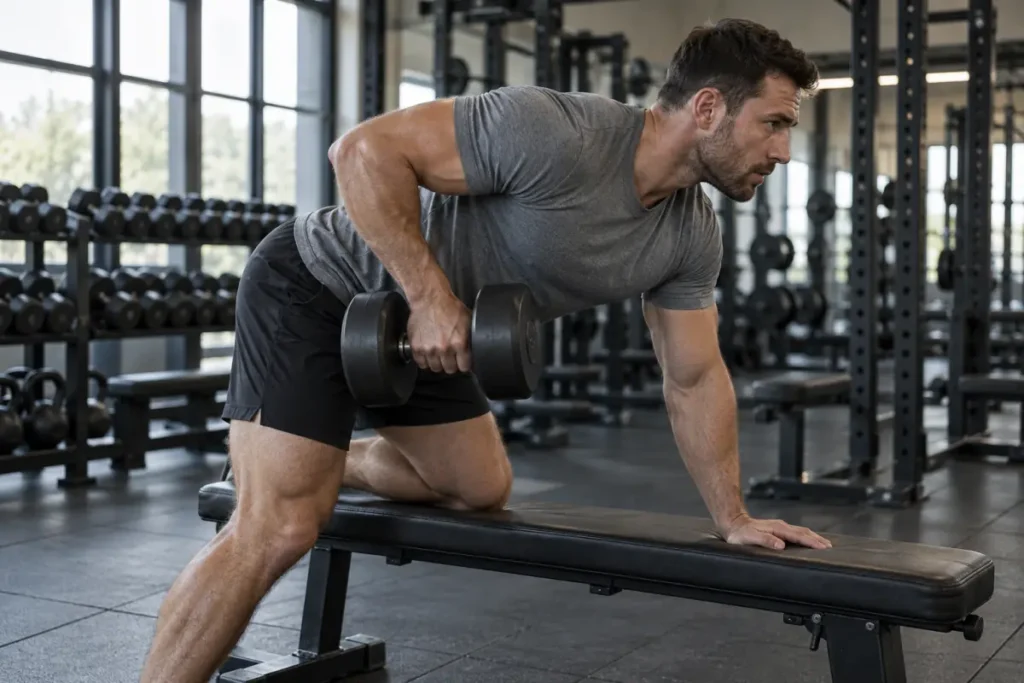
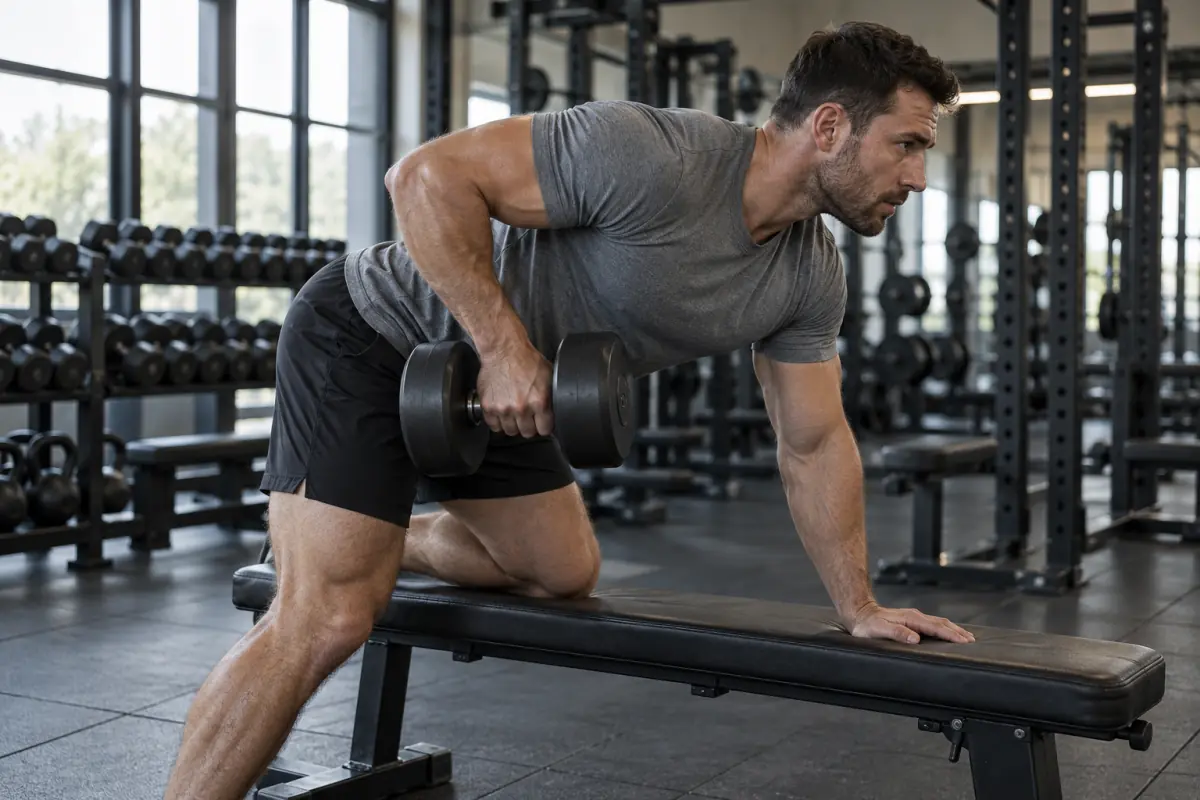
The single-arm dumbbell row is the most popular variation for good reason. One hand and knee on a flat bench, the other arm rows the dumbbell. This setup trains anti-rotation: your obliques fire at roughly 20% MVC to prevent the torso from twisting toward the weight (Source: Fenwick et al., JSCR, 2009).
It also corrects left-right imbalances. You cannot hide a weak side when each arm works alone. Program equal sets per side, let the weaker arm dictate the load, and the gap closes over weeks. For bench setup options, check our bench exercises guide.
Bent-Over Dumbbell Row
Both arms row simultaneously from a hip-hinge position. You can load heavier than the single-arm version because both hands share the balance work. The trade-off is higher erector spinae demand — the standing bent-over row produced the highest lumbar spine compression among rowing variations studied by Fenwick et al. (Source: Fenwick et al., JSCR, 2009). Keep the hip hinge tight and the lower back flat. If your back rounds, the weight is too heavy.
Chest-Supported Dumbbell Row
Set an adjustable bench to 30–45 degrees. Lie face down and row both dumbbells. The bench supports your torso, removing the erector spinae and core from the equation entirely. This shifts the work to the mid-traps, rhomboids, and rear delts.
Best for: lifters with lower back issues, anyone managing fatigue in a high-volume program, and those who want pure mid-back isolation. If you are transitioning from machine rows, this variation bridges the gap. See our upper body machine workout for the progression.
Incline Dumbbell Row
Set the bench to 30–45 degrees and let your arms hang straight down. This position creates a deeper lat stretch at the bottom of the ROM than a standard row. Teres major gets more work here because the shoulder starts in a more flexed position. The reduced torso angle compared to a bent-over row means less low-back stress, though not zero.
Renegade Row
A row performed from a push-up position: one arm rows while the other supports your bodyweight. Skip this one for back hypertrophy. The load is limited by core and shoulder stability, not back strength, so the lats never get close to failure. It is a conditioning tool and a core exercise that happens to involve a row. Use it on metabolic circuits, not back day.
Reverse-Grip Dumbbell Row
A supinated (underhand) grip maximizes biceps involvement. It also biases the pull toward the lower lat fibers. If you want to train lats and biceps in one movement, this is the most efficient option. Refer to the grip matrix table above — supinated grip to the hip is the highest-bicep-involvement combination.
How to Do a Dumbbell Row with Proper Form
Set up with a flat back, hinge at the hips, pull the dumbbell to your hip with the elbow close to the body, squeeze the shoulder blade at the top, and lower under control. That is the entire movement. Details matter, though, so here is the step-by-step.
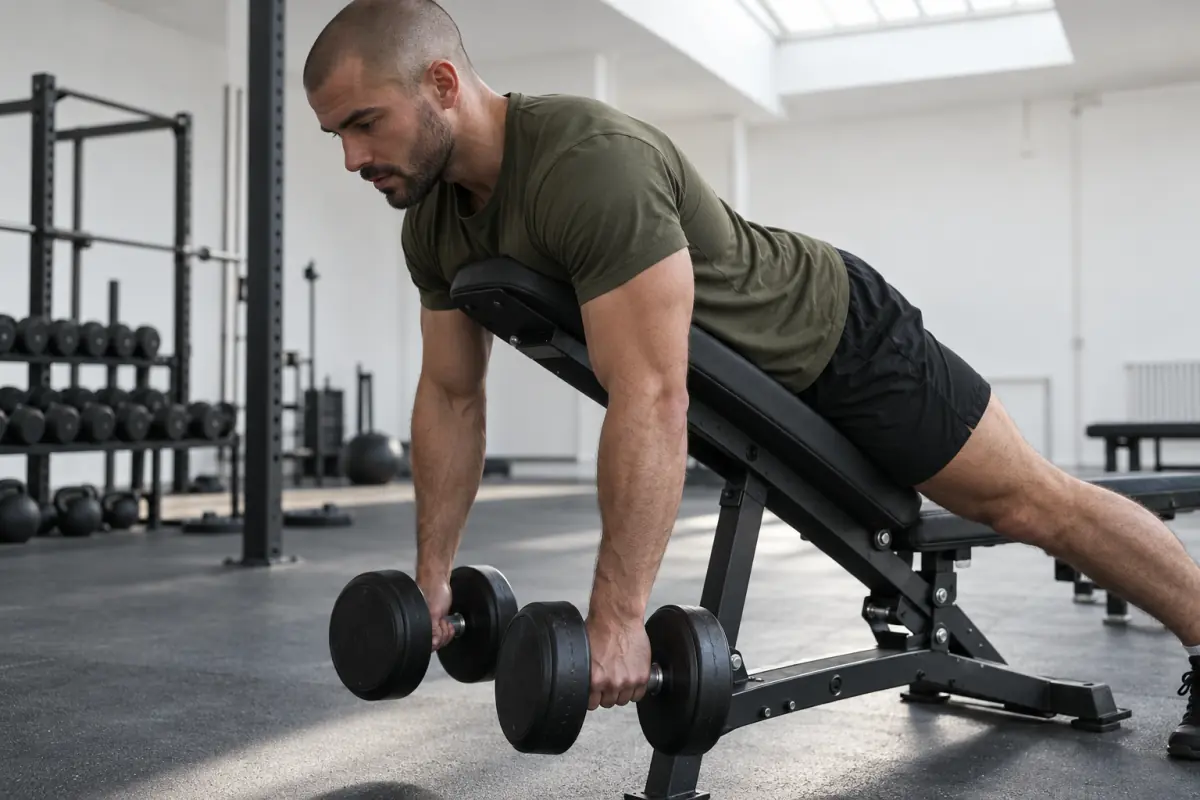
Step-by-Step Setup and Execution
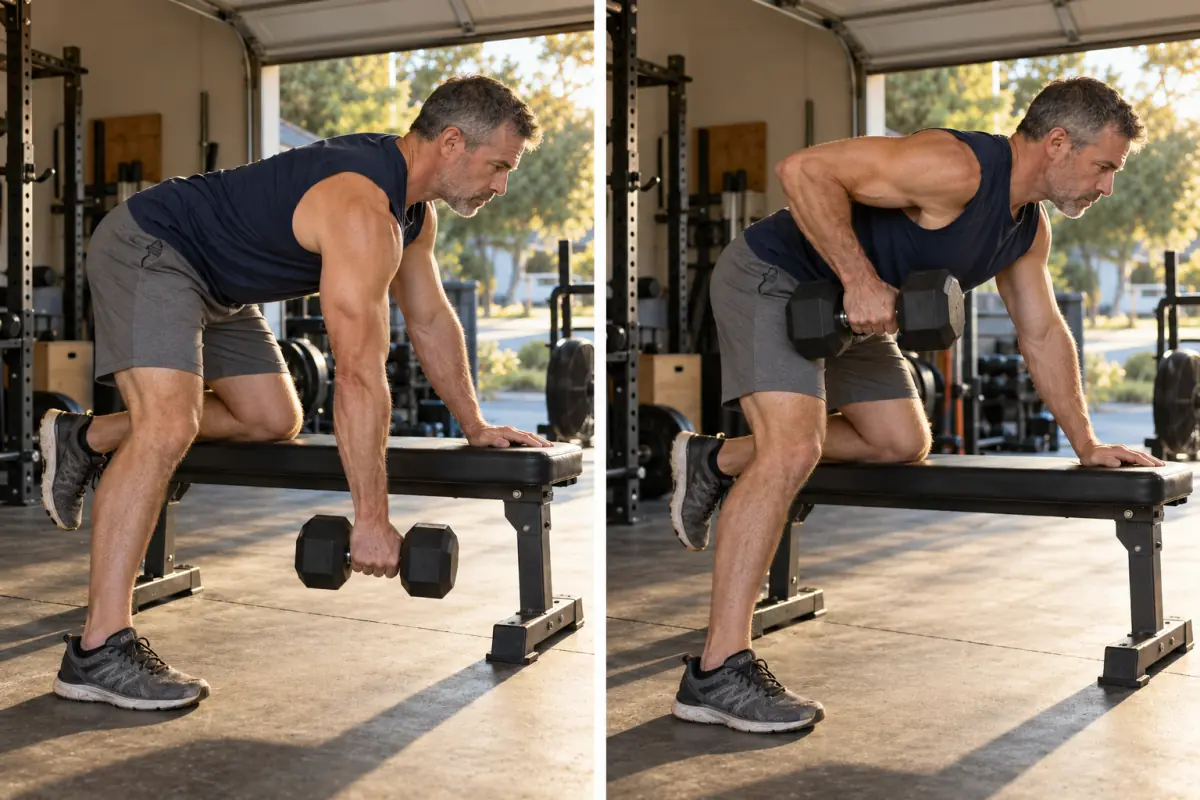
- Place your left knee and left hand on a flat bench. Right foot stays on the floor, slightly behind the hip. Your torso should form a line roughly parallel to the ground.
- Pick up the dumbbell with your right hand, arm hanging straight down, neutral grip. Pull your shoulder blade slightly down and back — this “sets” the scapula.
- Inhale. Drive your right elbow toward the ceiling, keeping it close to the ribs. Think “elbow,” not “hand.” The hand just holds the weight.
- At the top, squeeze the shoulder blade toward the spine. Hold for a one-count.
- Lower the dumbbell under control over two seconds. Let the arm fully extend at the bottom to get a full lat stretch. That is one rep.
- Breathe out at the top or during the pull — either works. Keep your gaze on the floor about one meter ahead to maintain a neutral neck.
Aim for a 2-1-2 tempo: two seconds up, one-second squeeze, two seconds down. You can also warm up with resistance band exercises before loading up.
Common Mistakes That Shift Muscles
Form errors do not just reduce effectiveness — they redirect the load to the wrong muscle.
| Mistake | What Happens | Muscle Consequence |
|---|---|---|
| Shrugging the weight | Shoulder hikes toward the ear | Upper trap dominates; lat activation drops |
| Torso rotation | Chest opens toward the ceiling | Obliques compensate; rhomboid engagement falls |
| Pulling with the bicep | Elbow leads forward instead of driving back | Biceps overloaded; lat gets a shortened ROM |
| Rounding the lower back | Spine flexes under load | Erector spinae overloaded; disc injury risk increases |
If you catch yourself shrugging, drop the weight by 20%. Seriously. A lighter row that hits the lats beats a heavier one that trains the traps.
Dumbbell Row vs Barbell Row — Which Builds More Back?
Dumbbell rows offer greater ROM, unilateral correction, and less low-back stress. Barbell rows allow heavier loading and more total-body stimulus. Neither is universally better — the right pick depends on your goal and injury history.
| Factor | Dumbbell Row | Barbell Row |
|---|---|---|
| ROM | Full (no bar contact limit) | Limited by torso contact |
| Unilateral correction | Yes (one-arm) | No |
| Core anti-rotation | High (one-arm) | Moderate |
| Lower back stress | Lower (bench support option) | Higher |
| Max load potential | Lower | Higher |
| Muscle emphasis | Lats, rhomboids | Lats, erectors, traps |
Here is the stance: for most recreational lifters, the dumbbell row wins. The full ROM hits more lat fibers, the single-arm option corrects imbalances, and the bench-supported setup protects the lower back. Barbell rows suit strength athletes who need to pull the absolute heaviest load — powerlifters, strongmen, competitive rowers. If you are not in that camp, dumbbells cover you.
Sets, Reps, and a 4-Week Progression Plan
For hypertrophy, start with 3–4 sets of 8–12 reps at RPE 7–8. For strength, go heavier: 4–5 sets of 5–8 reps. The NSCA recommends 65–85% of 1RM for hypertrophy in compound exercises (Source: NSCA, Essentials of Strength Training and Conditioning, 4th ed.).
| Goal | Sets | Reps | Rest | Intensity |
|---|---|---|---|---|
| Strength | 4–5 | 5–8 | 2–3 min | RPE 8–9 |
| Hypertrophy | 3–4 | 8–12 | 60–90 sec | RPE 7–8 |
| Endurance | 2–3 | 15–20 | 30–60 sec | RPE 6–7 |
4-Week Progression Protocol
- Week 1: Find your working weight. Pick a dumbbell where you hit RPE 7 at the bottom of your target rep range. If you are training for hypertrophy and can get 8 reps with good form before it feels hard, that is your starting weight.
- Week 2: Same weight. Add 1 rep per set. So if you did 3 x 8 last week, aim for 3 x 9.
- Week 3: Add 2.5 kg (5 lb). Drop back to the bottom of the rep range (3 x 8 again).
- Week 4: Deload. Cut volume to 60% — so 2 x 8 at last week’s weight. Let the tendons and nervous system catch up.
Then restart the cycle with Week 3’s weight as your new baseline. This is textbook progressive overload, and it works for months before you need a fancier periodization scheme.
For deeper rep range science, read our hypertrophy rep range breakdown. To see dumbbell rows programmed into a full session, check our dumbbell and bodyweight workout or hybrid training program.
Check dumbbell set prices on Amazon →
FAQ
Is a 35 lb Dumbbell Row Good?
A 35 lb (16 kg) dumbbell row is a solid working weight for most intermediate lifters doing 8–12 reps. Beginners typically start at 15–25 lb. The weight is “good” if you complete your target reps with strict form and feel the lats working — not the biceps taking over. Progression matters more than any single number.
Which Dumbbell Row Variation Is Most Effective?
The one-arm dumbbell row is the most effective all-around variation. It allows full ROM, corrects left-right imbalances, and trains core anti-rotation in every rep. For pure mid-back isolation, the chest-supported row wins because it removes lower back fatigue from the equation.
Can You Build a Big Back with Just Rows?
Rows alone build back thickness (rhomboids, mid-traps) effectively. For complete back development you also need a vertical pull — pull-ups or lat pulldowns — to emphasize lat width through full overhead shoulder flexion. Pair rows with a pull-up bar workout or work toward them with assisted pull-ups.
Do Dumbbell Rows Work Glutes?
No. Dumbbell rows do not meaningfully activate the glutes. The glutes may fire isometrically in a bent-over stance to stabilize the hips, but the activation is negligible — nowhere near enough to drive growth. If your glutes are fatiguing during rows, your hip hinge setup needs work.
Are Dumbbell Rows Good for Back?
Yes. Dumbbell rows are one of the best compound back exercises available. They hit the lats, rhomboids, traps, and rear delts in a single movement, and the unilateral option corrects imbalances that barbell rows cannot address. Cleveland Clinic lists them as a top exercise for back strength and posture improvement (Source: Cleveland Clinic, 2025).
Sources
- Cleveland Clinic. “Dumbbell Rows: Proper Form and Muscles Worked.” April 16, 2025. https://health.clevelandclinic.org/dumbbell-rows
- Lehman GJ, Buchan DD, Lundy A, Myers N, Nalborczyk A. “Variations in muscle activation levels during traditional latissimus dorsi weight training exercises: An experimental study.” Dynamic Medicine. 2004;3:4. https://pmc.ncbi.nlm.nih.gov/articles/PMC449729/
- Fenwick CMJ, Brown SHM, McGill SM. “Comparison of Different Rowing Exercises: Trunk Muscle Activation and Lumbar Spine Motion, Load, and Stiffness.” Journal of Strength and Conditioning Research. 2009;23(5):1408-1417. https://pubmed.ncbi.nlm.nih.gov/19620925/
- NSCA. Essentials of Strength Training and Conditioning. 4th Edition. Champaign, IL: Human Kinetics. Chapter 17: Program Design for Resistance Training.
- Youdas JW, et al. “Activation of Spinal Stabilizers and Shoulder Complex Muscles During an Inverted Row Using a Portable Pull-up Device and Body Weight Resistance.” Journal of Strength and Conditioning Research. 2016;30(7):1933-1941. https://pubmed.ncbi.nlm.nih.gov/26670988/
- Schoenfeld BJ, Ogborn DI, Vigotsky AD, Franchi MV, Krieger JW. “Hypertrophic Effects of Concentric vs. Eccentric Muscle Actions: A Systematic Review and Meta-analysis.” Journal of Strength and Conditioning Research. 2017;31(9):2599-2608. https://journals.lww.com/nsca-jscr/fulltext/2017/09000/hypertrophic_effects_of_concentric_vs__eccentric.31.aspx
