

TL;DR
Creatine helps the short-burst, strength-and-power side of military fitness — the 3-rep max deadlift, the sprint-drag-carry, and the last hard push of a set of push-ups — because it recharges the ATP-PCr energy system that fuels maximal efforts under roughly 10-15 seconds. It does not meaningfully improve pure aerobic endurance. A multi-mile ruck or a timed 2-mile run draws mostly on a different energy system that creatine barely touches. It can also add roughly 0.5-1.5 kg (about 1-3 lb) of water weight in the first few weeks, which is irrelevant to a max-effort lift but a real, if small, handicap when you are carrying that extra mass over two miles on the clock. The Human Performance Resource Center (HPRC), the Department of Defense-affiliated performance nutrition office, states directly that creatine “will not help develop military skill, endurance, or agility.”
Table of contents

What Creatine Actually Does
Creatine is stored in muscle mostly as phosphocreatine, a fast-access fuel reserve that regenerates ATP through the ATP-PCr energy system. This system is your body’s first responder for maximal effort: it dominates during the first roughly 8-15 seconds of an all-out muscular contraction, and it’s what lets you recover between short, repeated bursts, like sets in the gym or successive sprints in a shuttle run. Supplementing with creatine raises the size of that phosphocreatine pool, which is why its clearest, most repeatable effect in the research is on strength and short, high-intensity work — not on sustained aerobic output.
The gold-standard summary of this evidence is the International Society of Sports Nutrition (ISSN) 2017 position stand on creatine, which states that creatine monohydrate is “the most effective ergogenic nutritional supplement currently available to athletes” for increasing high-intensity exercise capacity and supporting gains in strength and lean mass during training. The position stand also notes ancillary benefits, like faster recovery between hard training sessions and better performance across repeated sprint efforts with short rest — both relevant to how the events on a military fitness test are actually structured.
What the ISSN position stand does not claim is that creatine boosts pure aerobic endurance. It’s a distinct mechanism: sustained running or rucking is powered mainly by oxidative (aerobic) metabolism once you’re past the first couple of minutes, and phosphocreatine stores play a minimal role in that system. That distinction is the entire reason a flat “yes it works” or “no it doesn’t” answer misleads people training for a military fitness test, where some events are short-burst and one is not.
Does Creatine Help the AFT Events?
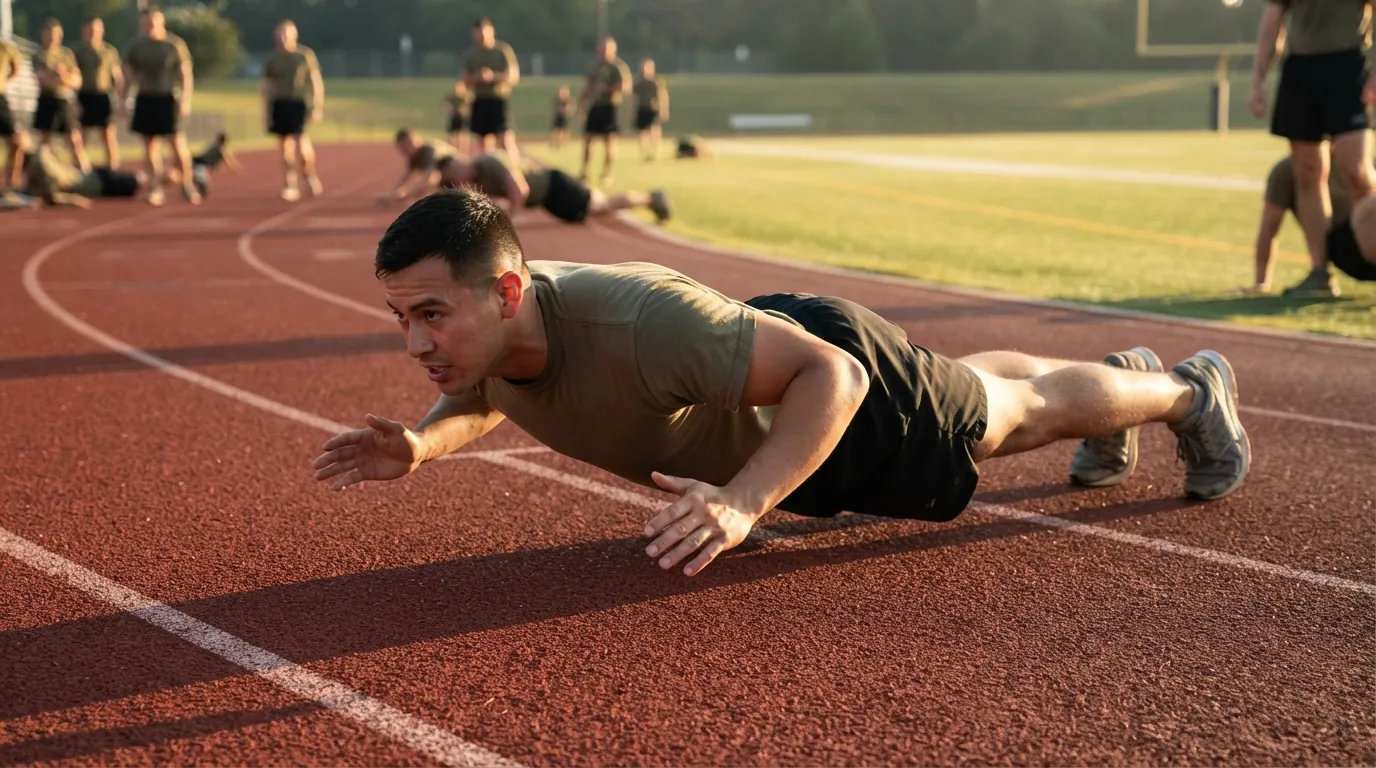
The Army Fitness Test (AFT) has five events: the 3-Repetition Maximum Deadlift (MDL), the Hand-Release Push-Up (HRP, max reps in 2 minutes), the Sprint-Drag-Carry (SDC), the Plank (PLK), and the 2-Mile Run (2MR). Each one leans on a different energy system, so creatine’s payoff varies event by event rather than applying uniformly across the test.
| AFT Event | Primary Energy System | Creatine’s Likely Effect |
|---|---|---|
| 3-Rep Max Deadlift (MDL) | ATP-PCr, single maximal effort | Indirect but real: creatine improves training-session output, which compounds into higher strength over weeks of training, per the ISSN position stand. |
| Hand-Release Push-Up (HRP) | Mixed anaerobic/glycolytic over 2 minutes | Some benefit in the early, higher-intensity reps from faster phosphocreatine resynthesis; less influence once the set shifts to muscular endurance and lactate tolerance in later reps. |
| Sprint-Drag-Carry (SDC) | Repeated maximal efforts, ~50m each, brief recovery | This is where creatine’s evidence is strongest — repeated short, maximal efforts with short rest is exactly the profile the ISSN review credits it for. |
| Plank (PLK) | Isometric core endurance | No established mechanism; this is a sustained-endurance test, not a power test. |
| 2-Mile Run (2MR) | Aerobic endurance | No consistent benefit on time-trial performance beyond about 3 minutes of continuous effort; added water weight is a possible net negative (see below). |
Older versions of the Army test (the APFT) included sit-ups, which behave similarly to the hand-release push-up here: some early-rep benefit from anaerobic power, diminishing as the set becomes an endurance grind. The pattern holds across all of these: the more a task resembles a single maximal or repeated-sprint effort, the more creatine is likely to help; the more it resembles sustained pacing, the less it matters.
Does Creatine Help Rucking Specifically?
Rucking doesn’t fit the pattern that makes creatine effective. A ruck march is sustained, weight-bearing, aerobic-dominant work lasting anywhere from 30 minutes to several hours, with no maximal-sprint component to recharge. That’s precisely the profile HPRC is describing when it states creatine “will not help develop military skill, endurance, or agility,” and it lines up with a 2023 review in the Journal of the International Society of Sports Nutrition, “Creatine supplementation and endurance performance: surges and sprints to win the race,” which found creatine’s measurable benefit in endurance-adjacent events is concentrated in races with repeated surges or an end-of-race sprint kick, not in steady, continuous pacing under a fixed load.
There is one legitimate indirect pathway worth naming honestly: creatine improves the quality of your resistance-training sessions, and stronger hips, glutes, and posterior chain make carrying a 35-plus pound ruck feel more manageable over a training cycle. That’s a real, if delayed, transfer effect from months of better-supported strength work — not a direct ergogenic boost to the ruck itself. If your primary goal is ruck time or ruck endurance, your training volume, load progression, and footwear will move the needle far more than creatine will. If our full beginner ruck guide is not something you’ve built your program around yet, that’s a better first investment than a creatine tub.
Water Weight and Why That Might Matter for a Timed Run
The ISSN position stand describes creatine loading as producing “short-term fluid retention (e.g., about 0.5-1.0 L),” which shows up on the scale as the acute weight gain most new users notice in the first one to two weeks. Independent reviews of creatine and running performance put the practical range at roughly 0.8-1.5 kg (about 2-3 lb) of added body mass over the first month of use, driven by water pulled into muscle tissue, not fat gain.
For a maximal lift like the deadlift, extra body mass isn’t a cost — it may even help stability. For a timed, weight-bearing endurance event like the 2-mile run or a ruck march, it’s a genuine trade-off: you are asking your aerobic system to move more mass over the same distance, with no offsetting anaerobic benefit to cash in during that event. It’s a small effect, not a dramatic one, but it’s the reason the honest answer to “does creatine help my run time” leans toward no rather than a cautious maybe.
Side Effects and Who Should Be Cautious
The ISSN position stand reviewed decades of research, including long-term use of up to 30 grams per day for five years in some cohorts, and reported no compelling evidence that creatine monohydrate causes muscle cramping, dehydration, gastrointestinal upset, or kidney dysfunction in otherwise healthy people at recommended doses. The only consistently reported side effect across the literature is the water-weight gain described above.
Mayo Clinic and the NIH Office of Dietary Supplements largely agree with that picture for healthy adults, but both flag one real caution: research on creatine use in people with existing kidney disease is limited, and anyone with a diagnosed kidney condition should talk to a healthcare provider before starting it. That caution matters in a military context specifically because HPRC’s own guidance for warfighters recommends baseline monitoring, not just a green light — see the dosing section below.
None of this makes creatine risky for a healthy service member. It does mean the “it’s totally harmless, take as much as you want” framing overstates the evidence in the other direction. Take the dose the research actually supports, not more.
How to Take It If You Decide To
The ISSN position stand outlines two evidence-based protocols for creatine monohydrate, the most researched and most effective form:
- Loading protocol: 5 g, four times per day (about 20 g/day, or roughly 0.3 g per kg of body weight) for 5-7 days, then a maintenance dose of 3-5 g per day.
- Slow-load protocol: 3-5 g per day from day one, skipping the loading phase. Muscle saturation takes closer to 28 days this way, but the end result is similar.
HPRC’s guidance for warfighters is more conservative and built around a monitored, operational context. It recommends daily dosing of 2-3 g, potentially cycling four weeks on and four weeks off, alongside professional monitoring of body weight, urinalysis, and a metabolic panel. That’s a reasonable, cautious default if you’re under command medical oversight and want a lower, steadier dose rather than a loading phase. Either approach uses creatine monohydrate specifically — it’s the form nearly all of this research is based on, and there’s no strong evidence that buffered or micronized variants outperform it.
A few practical notes regardless of which protocol you pick: take it consistently, any time of day, ideally with a meal; drink enough water, since creatine draws fluid into muscle cells rather than out of them; and expect the scale to move up slightly before any performance change shows up. If a weigh-in or tape test is close on the calendar, factor the 1-3 lb of water weight into your timing.
FAQ
Does creatine help you run faster?
Not for a straight, steady-pace time trial like the AFT’s 2-mile run. Research on creatine and running finds no consistent benefit on continuous efforts past about 3 minutes, and the small amount of added water weight can be a slight handicap over distance. Creatine shows up more in races or workouts with repeated surges or a sprint finish, not in a flat-out steady pace.
Does creatine help rucking endurance?
No, not directly. HPRC states plainly that creatine will not help develop endurance, agility, or military skill. Ruck performance is driven far more by training volume, load progression, footwear, and pacing than by any supplement.
Will creatine’s water weight affect a body composition or tape test?
The water retention from creatine is intramuscular fluid, not fat, and it is usually modest, roughly 1-3 lb in the first couple of weeks. It is unlikely to change a tape measurement meaningfully, but if a weigh-in is close, it is worth knowing the timing rather than being surprised by the scale.
How much creatine should I take for AFT prep?
The ISSN position stand supports either a loading protocol (5 g four times daily for 5-7 days, then 3-5 g/day) or a slower steady dose of 3-5 g/day from day one. HPRC’s military-specific guidance is more conservative: 2-3 g/day, with professional monitoring of weight, urinalysis, and metabolic panel.
Is creatine banned for military personnel?
No. HPRC notes creatine is not considered an illegal substance by most athletic governing bodies or the military. It is one of the most widely used supplements in both military and athletic communities.
Does creatine damage your kidneys?
The ISSN position stand found no compelling evidence of kidney dysfunction in healthy people at recommended doses, including in some long-term cohorts using up to 30 g/day for five years. Mayo Clinic and the NIH Office of Dietary Supplements both note that research in people with existing kidney disease is limited, so anyone with a diagnosed kidney condition should check with a healthcare provider first.
Should I load creatine or just take a steady daily dose?
Both work. Loading (about 20 g/day for 5-7 days) saturates your muscles faster, so any benefit shows up sooner. Skipping the loading phase and taking 3-5 g/day reaches roughly the same saturation over about 28 days, with less water-weight shift up front.
Does creatine help push-ups on the AFT?
Somewhat, and mostly early in the set. The hand-release push-up is a 2-minute max-rep test that starts anaerobic and shifts toward muscular endurance as it goes. Creatine’s phosphocreatine boost can help the higher-intensity opening reps; it has less influence once the set becomes a pure endurance grind.
Sources and Verification
Every physiological, dosing, and safety claim above is drawn from named primary or DoD-affiliated sources, not general “experts say” framing:
- Kreider et al., “International Society of Sports Nutrition position stand: safety and efficacy of creatine supplementation in exercise, sport, and medicine,” Journal of the International Society of Sports Nutrition, 2017 — physiology, dosing protocols, and long-term safety data.
- Human Performance Resource Center (HPRC), “What is the appropriate use of creatine by Warfighters?” — official DoD-affiliated position on creatine for military personnel.
- “Creatine supplementation and endurance performance: surges and sprints to win the race,” Journal of the International Society of Sports Nutrition, 2023 — evidence on creatine and endurance-adjacent events.
- Mayo Clinic — Creatine — consumer-facing safety and side-effect summary.
- NIH Office of Dietary Supplements — Dietary Supplements for Exercise and Athletic Performance — safety and evidence summary for consumers.
- U.S. Army — Army Fitness Test — current AFT event list and structure (MDL, HRP, SDC, PLK, 2MR).
One claim we could not independently verify against a primary, dated source: the exact figure commonly cited for HPRC’s cycling recommendation (“four weeks on, four weeks off”) appears consistently across secondary summaries of HPRC guidance, but we were unable to load HPRC’s own article directly during research to confirm the wording verbatim. Treat that specific cycling detail as directionally accurate but confirm against HPRC’s current published article, or with a unit health professional, before treating it as a fixed protocol.