
How to Ruck: A Beginner’s Guide + 8-Week Plan
TL;DR — What does it take to start rucking?
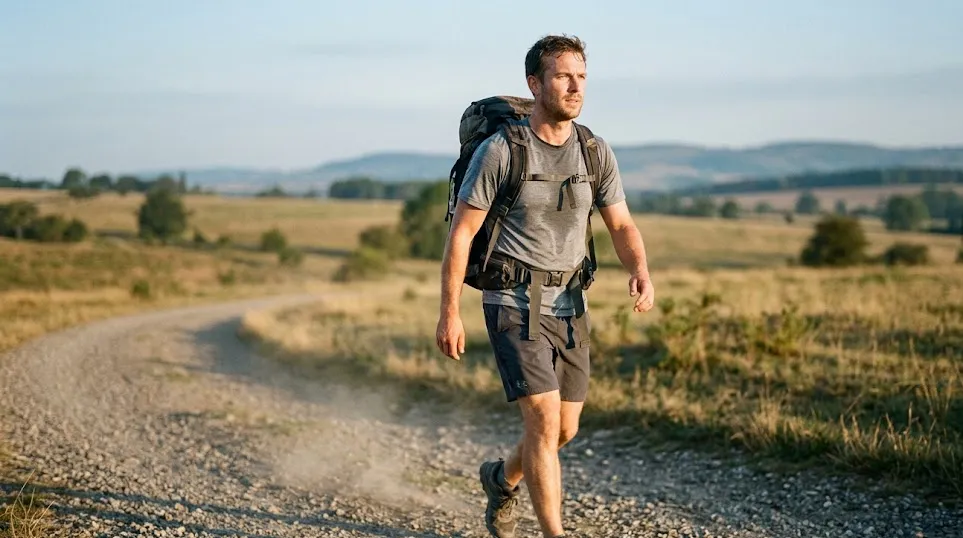
Rucking is walking with a weighted pack, usually 20–45 lb, at a brisk 3.5–4.0 mph. To start rucking you need three things: a backpack that loads your hips (not your shoulders), about 20 lb of weight, and broken-in trail shoes or boots. Begin with 20 lb over 2 conversational miles and build to 35 lb over 6 miles across eight weeks.
That’s the whole sport in a paragraph. The rest of this guide is the detail that keeps you off the injury list: how much weight by bodyweight, what gear is actually worth buying, the pace that counts as rucking versus just hauling a heavy bag, and a week-by-week plan you can follow without guessing.
What rucking is (and what it isn’t)
Rucking is sustained walking under a loaded pack — the modern name for the load-bearing road march every infantry soldier has done for centuries. The pack is the point. Take it off and you’re walking; jog with it and you’re risking your knees and your lower back for no extra benefit.
It is not hiking (which is about terrain and scenery), not backpacking (multi-day, much heavier, gear-driven), and not weighted-vest walking (a vest sits on your torso; a ruck loads your hips and trains the carry pattern the military actually uses). Keep that distinction in your head, because it decides what gear you buy and how you train.
Why ruck? The benefits, with the numbers
Rucking gives you a low-impact cardio base plus real posterior-chain strength in one session, which is why it sits at the center of military selection prep and why civilians keep picking it up. The load drives your heart rate into a genuine training zone at walking speed, and walking spares your joints the repeated pounding of running.
The calorie difference is the headline, and it’s worth getting the number right since most articles hand-wave it. Using the Pandolf equation — the load-carriage metabolic model the U.S. Army Research Institute of Environmental Medicine built in 1977 and still the reference standard — a 180 lb person walking 3.5 mph burns roughly 300 calories an hour unloaded. Add a 30 lb pack and that jumps to about 500; a 50 lb pack pushes it near 650 (Source: BodySpec, 2026). So rucking burns somewhere around 1.7–2.2× unloaded walking depending on load, not the vague “2–3×” thrown around online. You get that extra burn at the same easy pace, without the impact spike of jogging.
Beyond calories, the load recruits glutes, hamstrings, spinal erectors, and traps far more than flat walking, so you build carrying strength and posture endurance at the same time. There’s a mental side too: holding a steady pace under weight for an hour is a different kind of discipline, which is why the same load carriage shows up across a military calisthenics workout and every selection pipeline.
Gear you actually need (by budget)
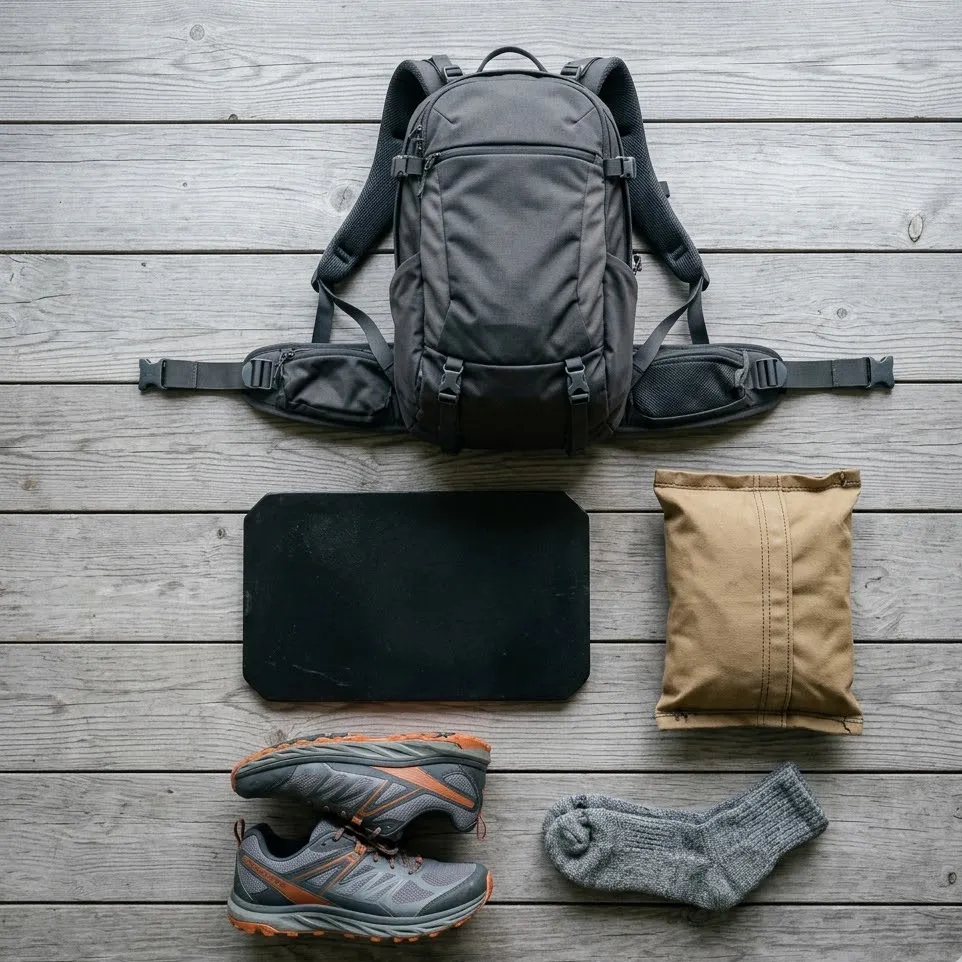
You need three things to ruck: a pack that transfers load to your hips, a weight source, and footwear you’ve already broken in. You can start for under $60 with kit you probably own, or spend $300-plus on purpose-built gear. The one non-negotiable is the pack moving weight onto your hip belt instead of hanging off your shoulders — everything else is preference.
Here’s the honest ladder, from “start this weekend with what you have” to “buy once, cry once.”
Affiliate disclosure: Some links below are Amazon affiliate links. If you buy through them, Gymstips may earn a small commission at no extra cost to you. We recommend gear on merit, not commission. Prices were checked in June 2026 and move often — confirm the current price before you buy.
| Tier | Pack | Weight source | Footwear | Est. cost |
|---|---|---|---|---|
| Budget | Sturdy daypack with a hip belt you already own | Sandbag filler bag or a bagged gym plate | Trail runners you already own | ~$10–60 |
| Mid | Hiking pack with a real load-bearing hip belt | One flat 20 lb ruck plate | Dedicated trail running shoes | ~$100–180 |
| Premium | GORUCK GR1 or Mystery Ranch | 20 lb + 30 lb ruck plates | Light boots + trail runners | ~$160–380 |
The GR1 runs about $335 for the 21L direct from GORUCK in 2026, so the premium tier is real money (Source: Ruck Authority, 2026). My stance: don’t buy it first. Start budget, confirm you’ll stick with rucking for a month, then spend on the pack — the pack is where money actually buys durability and comfort, not the weight.
Pack: load goes on your hips, not your shoulders
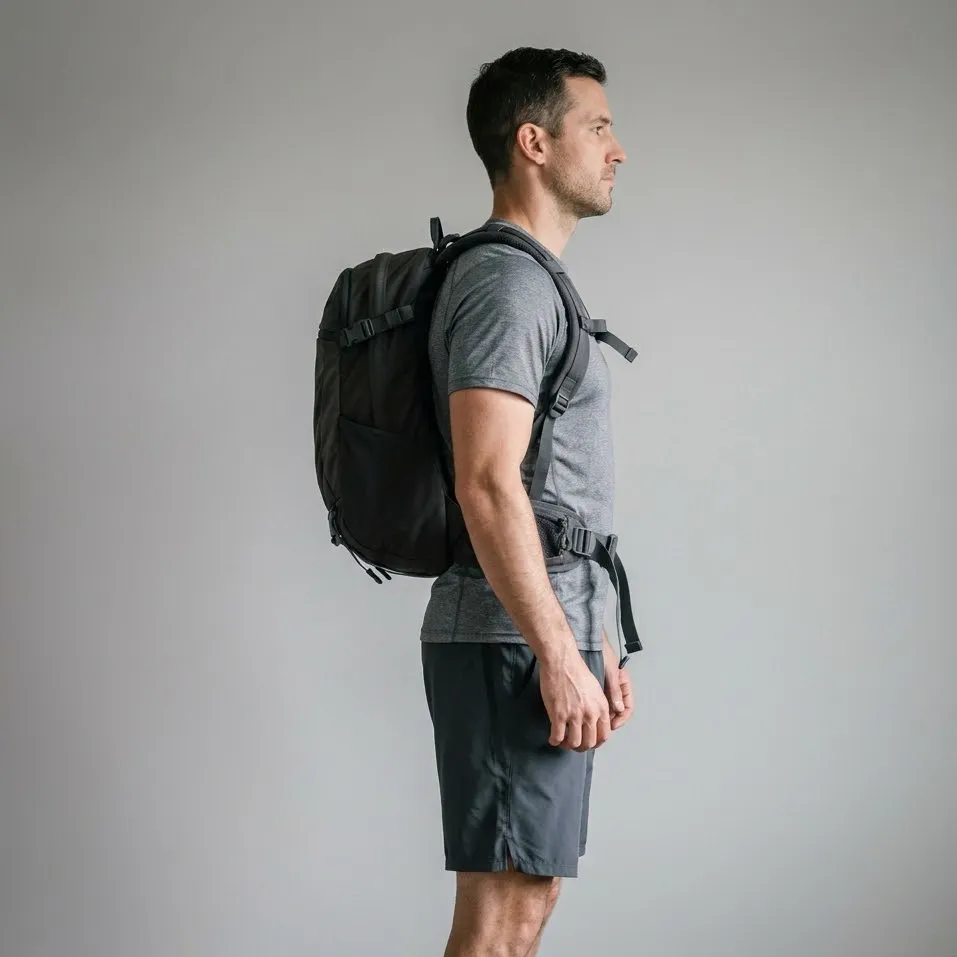
A purpose-built ruck pack (GORUCK GR1, Mystery Ranch, roughly $120–335) has a stiff back panel and a plate pocket that holds weight high and tight against your spine. A hiking daypack with a genuine hip belt ($60–150) does the same job for less. The cheapest viable option is any sturdy pack with a sternum strap plus a sandbag.
Whatever you pick, cinch the hip belt so the weight rides on your pelvis. The sternum strap stops the pack drifting side to side as you walk. If the load is pulling on your shoulders after a mile, the pack is wrong or worn wrong.
Weight: ruck plate vs sandbag
Quick decision block:
- Ruck plate (~$50–150 for 20/30/45 lb): flat, rides high and tight to your upper back, doesn’t shift. Best ride, costs the most (Source: Ruck Authority, 2026).
- Sandbag (~$10): cheap, infinitely adjustable, but it slumps and shifts unless you pack it tight against your back with a towel. Fine to start.
- Bagged gym plate: free if you own plates. Wrap it so the edges don’t dig into your spine.
If you already lift, a 25 or 35 lb gym plate wrapped in a towel gets you rucking tonight for $0. Buy a flat plate once you know you’re in.
Footwear: trail runners first, boots for selection
Trail running shoes are the right call for most beginners — more cushion, lighter, less blister risk than boots over the first few months. Save boots for selection prep, where the standard demands them.
Break in any new shoe or boot for 20–30 unloaded miles before you add a pack. Loaded miles on fresh footwear is the fastest route to blisters that end a session early.
How much weight should a beginner ruck with?
Start at roughly 5–10% of your bodyweight — for most beginners that’s 10–25 lb. Progress distance before you progress load, then add no more than about 5 lb per week. One-third of your bodyweight is a long-term ceiling for trained ruckers, not a starting point. If you have a history of back or knee issues, clear loaded walking with a clinician before you load up.
Page one of Google can’t agree on a number (5–10% bodyweight, flat 10 lb, 10–25 lb, or one-third bodyweight all show up). Here’s the chart that reconciles them by bodyweight:
| Bodyweight | Start load | 8-week target | Advanced ceiling |
|---|---|---|---|
| Under 130 lb | 10–15 lb | 20–25 lb | ~30 lb |
| 130–180 lb | 15–20 lb | 25–35 lb | 35–45 lb |
| Over 180 lb | 20–25 lb | 35–40 lb | 45 lb+ |
Read it as a gradient, not a target to rush. The “advanced ceiling” column tracks the one-third-bodyweight rule and is months of consistent rucking away, not weeks. When in doubt, go lighter and walk farther — distance under moderate load builds the same engine with less injury risk than heavy short walks.
How to start rucking: 3 rules
To start rucking: load 10–25 lb high and tight against your spine, cinch the hip belt and sternum strap, then walk 20–30 minutes at a conversational 15–20 min/mile pace. Build in this order — time, then distance, then pace and hills, then weight. Never add distance and weight in the same week.
Three rules that turn a heavy backpack walk into proper rucking.
Load 10–25 lb high and tight to your spine
Use 5–10% of your bodyweight, and keep the weight up against your upper back. Go lighter than your ego wants — you should finish the first session thinking you could have done more.
Put the pack on, cinch the hip belt and sternum strap, stand tall
Shoulders back, eyes up, weight on your hips. No forward lean. The pelvis carries the load, not the shoulders.
Walk 20–30 minutes at 15–20 min/mile
Keep it conversational — if you can’t talk in full sentences, slow down. Progress in order: time, then distance, then pace and hills, then weight.
The single most common beginner error is reversing rule three: people load up heavy and try to jog. Don’t. Walk fast; that’s rucking. If you want a structured base before you start, the 28-day military workout pairs well with these first sessions.
What’s a good rucking pace?
A sustainable beginner pace is about 3.5 mph (roughly 17:00/mile). A brisk fitness pace is 4.0 mph (15:00/mile), and selection-level rucking runs 4.0–4.2 mph or faster. Terrain changes everything, so band your pace to the ground under your feet:
| Effort / terrain | Pace (min/mile) | Speed (mph) | Use it for |
|---|---|---|---|
| Easy (hills, soft trail, recovery) | 18–20 | ~3.0–3.3 | Long slow distance, first weeks |
| Moderate (flat road, mixed trail) | 15–17 | ~3.5–4.0 | Most beginner sessions |
| Fast (flat, hard surface) | Under 15 | 4.0+ | Pace work, selection prep |
| RASP standard (reference) | ~14:17 | 4.2 | 12-mile ruck in under 3 hours |
Most pace charts give you one flat number. Adjust for terrain instead: a 16:00 road pace becomes a perfectly good 19:00 on a rocky uphill trail at the same effort. Chase effort, not the clock, until you’re training for a standard.
The 8-week beginner rucking program
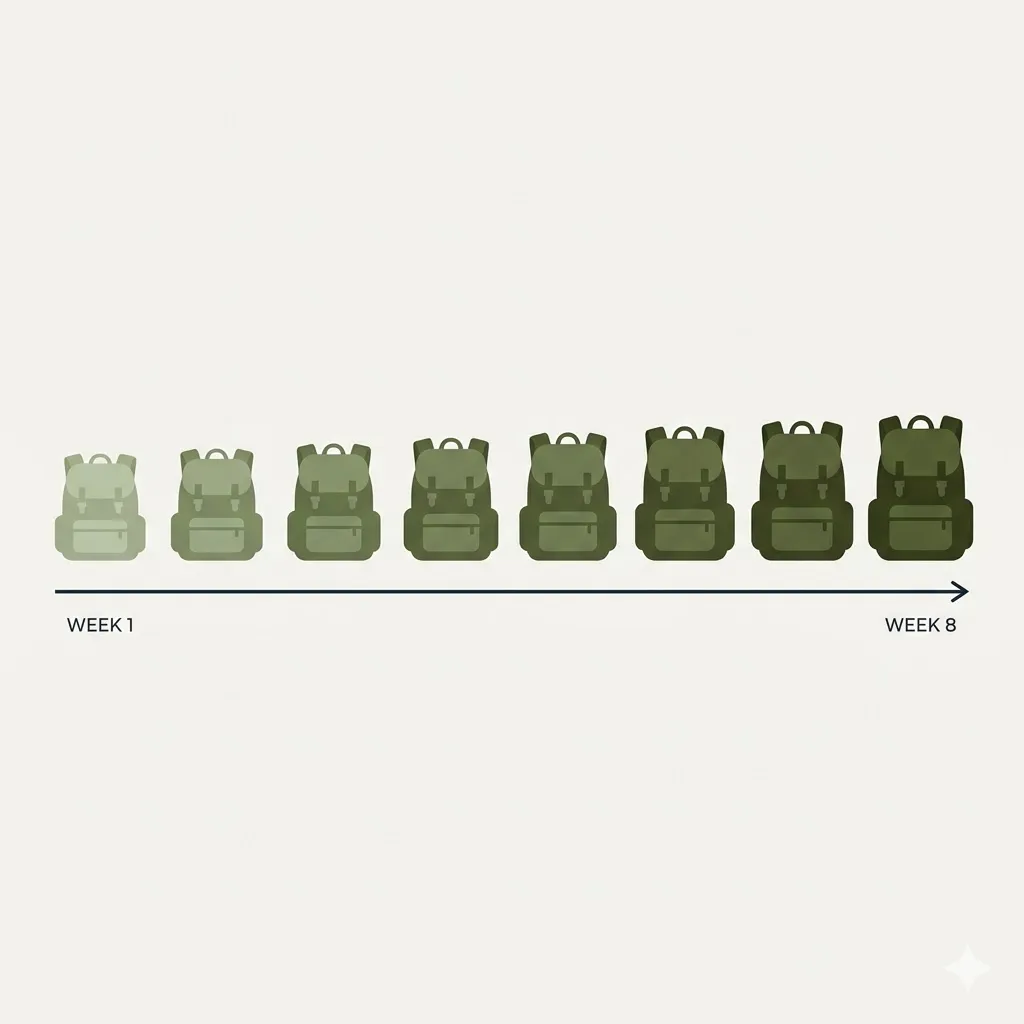
Run two sessions a week on non-consecutive days. Week 1 starts at 20 lb over 2 miles at an easy 3.5 mph; week 8 finishes at 35 lb over 6 miles at 4.0 mph. The rule that keeps you healthy: add distance OR weight in a given week, never both, and back off if anything in your lower back or feet complains.
This table is the part of this guide nothing on page one offers — most competitors stop at “ruck 30–45 minutes, three times a week.” Here’s an actual progression:
| Week | Weight | Distance | Pace | Notes |
|---|---|---|---|---|
| 1 | 20 lb | 2.0 mi | 3.5 mph | Conversational. Learn the fit and posture. |
| 2 | 20 lb | 2.5 mi | 3.5 mph | Add distance only. Check feet after. |
| 3 | 20 lb | 3.0 mi | 3.5–3.7 mph | Distance again. Dial in hip-belt tension. |
| 4 | 25 lb | 3.0 mi | 3.7 mph | First weight bump (+5 lb). Hold distance. |
| 5 | 25 lb | 4.0 mi | 3.7 mph | Distance up. Introduce one small hill. |
| 6 | 30 lb | 4.0 mi | 3.8 mph | Weight bump. Hold distance. |
| 7 | 30 lb | 5.0 mi | 3.8–4.0 mph | Distance up. Long session of the week. |
| 8 | 35 lb | 6.0 mi | 4.0 mph | Target session. You’re now a rucker. |
If a week feels rough, repeat it before moving on — there’s no prize for finishing on schedule with a tweaked back. Deload (drop to week-1 numbers for a session) any time you feel beaten up. After week 8 you can keep adding distance toward 8–12 miles, or weight toward the advanced ceiling in the bodyweight chart, but not both at once.
Rucking for military selection (RASP, SFAS, and the rest)
Civilian rucking and selection rucking share the same mechanics but live in different worlds. Selection demands heavier loads at faster sustained paces over longer distances, on a clock, often in boots and full kit. The 8-week plan above is base-building — it gets you walking strong under load. It is not a pass standard, and you should not jump from week 8 to a selection ruck.
These standards get mis-cited constantly, so here are the verified numbers. Note the recurring 15:00/mile (4 mph) pace floor across nearly every branch:
| Program | Distance | Load | Time standard |
|---|---|---|---|
| Army standard 12-miler | 12 mi | 35 lb dry (water not counted) | Under 3 hr (15:00/mi) |
| Air Assault School (final) | 12 mi | 35 lb + weapon | Under 3 hr |
| RASP (Ranger) | 12 mi | 35 lb+ dry | Under 3 hr (≈14:17/mi recommended faster) |
| SFAS (Special Forces) | 12 mi screen; movements up to ~18 mi; “the Trek” up to ~32 mi | 45–65 lb across events | Event-dependent; 12-mi screen under 3 hr |
Sources: GORUCK 12-mile ruck standards (2026); The Ruck Calculator military standards (2026); Wikipedia, U.S. Army Special Forces selection and training (2026).
A few honest caveats. The classic Army and RASP 12-miler is 35 lb dry weight, with water not counted toward the total — but cadre and coaches routinely recommend training to hit 2.5 hours, not just the 3-hour minimum. SFAS doesn’t publish a single tidy ruck standard; it runs land-navigation movements of around 12–18 miles under heavy loads and ends with a long road march (“the Trek” / Long Range Individual Movement) of up to roughly 32 miles. If you’re prepping for selection, train to the heavier, faster end of every number here, not the floor. Our Army Ranger workout plan covers the RASP side, and the special forces training program goes deeper on SFAS-style movements.
Common rucking mistakes (and the fixes)
Most beginner problems trace back to six errors: loading the shoulders instead of the hips, adding weight too fast, jogging to hit a pace, neglecting foot care, rucking every day, and skipping the sternum strap. Each has a one-line fix.
- Weight on shoulders, not hips. Fix: cinch the hip belt first, then snug the shoulder straps. The pelvis carries the load.
- Adding weight too fast. Fix: cap increases at ~5 lb per week, and never add distance and weight in the same week. Your lumbar spine pays the bill for impatience.
- Jogging to keep pace. Fix: walk fast. If you’re bouncing, you’re shortcutting the low-impact benefit and overloading your knees.
- Skipping foot care. Fix: break footwear in over 20–30 unloaded miles, wear moisture-wicking socks, and stop at the first hotspot to tape it.
- Rucking daily. Fix: two to three sessions a week on non-consecutive days. Load tolerance is built in recovery, not in back-to-back beatings.
- No sternum strap. Fix: clip it. It stops the pack swinging laterally, which otherwise rubs your shoulders raw and wastes energy.
Rucking FAQ
How much weight should a beginner ruck with?
Start at about 5–10% of your bodyweight — for most people that’s 10–25 lb. Use the bodyweight chart above, progress distance before weight, and add no more than ~5 lb per week.
What is a good rucking pace?
Around 3.5 mph (17:00/mile) is sustainable for beginners; 4.0 mph (15:00/mile) is a brisk fitness pace; the RASP standard is 4.2 mph (≈14:17/mile). Aim for conversational effort and adjust for terrain.
How far or how long should a beginner ruck?
Start with 20–30 minutes or about 2 miles. Build distance before adding weight, working toward 4–6 miles over a couple of months.
How often should you ruck per week, and can you ruck every day?
Two to three sessions a week on non-consecutive days. Don’t ruck daily as a beginner — load tolerance builds during recovery, and daily loading is how lower-back and foot injuries start.
Does rucking burn more calories than walking?
Yes. By the Army’s Pandolf load-carriage model, a 180 lb person burns roughly 300 cal/hour walking unloaded at 3.5 mph versus about 500 with a 30 lb pack — roughly 1.7–2.2× more, at the same pace (Source: BodySpec, 2026).
Is rucking better than running?
Neither is universally better. Rucking is lower impact and builds carrying strength plus a cardio base; running is faster for raw aerobic capacity. For joint-friendly conditioning and strength in one session, rucking wins; for pure speed and VO2 max, running does.
Do you need a special ruck pack to start?
No — not for the first month. Any sturdy backpack with a hip belt and sternum strap plus a sandbag or bagged gym plate works. Buy a purpose-built pack once you know you’ll stick with it.
What shoes or boots are best for rucking?
Trail running shoes for most beginners — lighter, more cushioned, lower blister risk. Switch to boots if you’re prepping for military selection, and break in any footwear over 20–30 unloaded miles first.
How long until rucking shows results?
Expect noticeable cardio and endurance gains in 3–4 weeks of consistent twice-weekly sessions, and visible body-composition changes in roughly 8–12 weeks when paired with reasonable nutrition.
Bottom line
Start at 20 lb over 2 conversational miles, build to 35 lb over 6 miles across eight weeks, and respect the gradient — distance before weight, never both at once. Walk fast, keep the load on your hips, and break in your shoes before you load them. The gear matters far less than showing up twice a week. Consistency is the whole game.
Sources
- BodySpec — Rucking Calorie Calculator: Burn vs. Walking & Running (2026) — calorie figures + Pandolf equation (USARIEM, 1977)
- GORUCK — The 12 Mile Ruck: Standards, Time, and Prep (2026) — Army/RASP 12-mile standard (35 lb, under 3 hr)
- The Ruck Calculator — Military Ruck Standards by Branch (2026) — Army, Air Assault, RASP, SFAS, USMC standards
- Wikipedia — United States Army Special Forces selection and training (2026) — SFAS movement distances / the Trek (LRIM)
- Ruck Authority — Best Ruck Plates 2026 / Rucker vs GR1 — 2026 GR1 (~$335) and ruck-plate pricing ($50–150)