Gymstips is reader-supported. Some links may be Amazon affiliate links; if you buy through them we may earn a small commission at no extra cost to you.
TL;DR — Can You Really Build Glutes at Home?
You can build glutes at home with bodyweight exercises like hip thrusts, Bulgarian split squats, and single-leg glute bridges — if you progressively overload through tempo, range of motion, and unilateral variations. The 10 exercises below are ranked by EMG glute activation, with a 4-week no-equipment progression plan to keep gains moving.
Table of contents
Why Glute Strength Matters (Beyond Aesthetics)
Strong glutes reduce knee and lower-back injury risk, improve sprint power, and help correct anterior pelvic tilt. The gluteus maximus is the primary driver of hip extension — standing up, climbing stairs, running. When it is weak, the lower back and hamstrings pick up the slack, which often leads to compensatory movement patterns and pain. Training glutes at home takes nothing but floor space and consistency.
10 Best Bodyweight Glute Exercises (Ranked by Activation)
The 10 best glute exercises you can do at home without equipment, ranked by EMG muscle activation: (1) hip thrust, (2) single-leg glute bridge, (3) Bulgarian split squat, (4) step-up, (5) glute bridge, (6) reverse lunge, (7) curtsy lunge, (8) donkey kick, (9) fire hydrant, (10) clamshell. Each targets the gluteus maximus, medius, or both using only bodyweight.
Rankings draw on two key EMG reviews: Neto et al. (2020) in the Journal of Sports Science & Medicine, which analyzed loaded compound movements, and Boren et al. (2011) in the International Journal of Sports Physical Therapy, which tested bodyweight rehabilitation exercises. Where a specific bodyweight variation was not studied, placement reflects biomechanical similarity to tested movements. Because the Neto review used loaded exercises, bodyweight versions will produce lower absolute activation, but the relative ranking between movement patterns holds.
1. Hip Thrust (Feet-Elevated, Bodyweight)
Targets: Gluteus maximus | Level: Intermediate
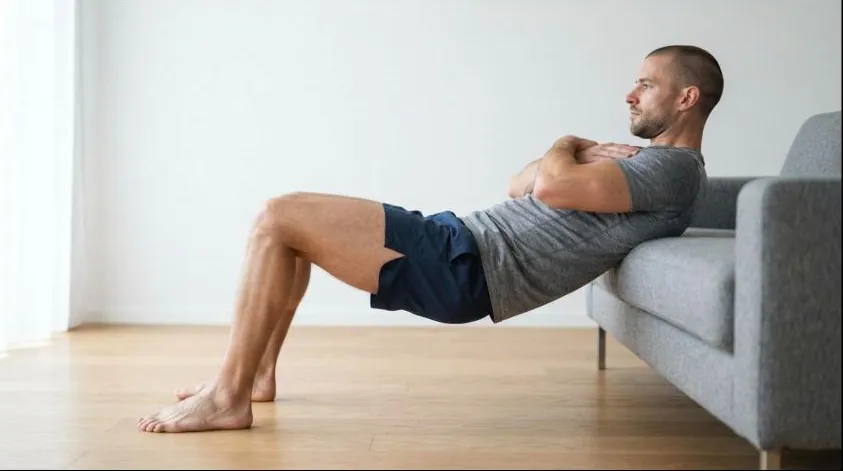
The feet-elevated hip thrust produces very high glute max activation by maximizing hip extension range through an elevated surface. Standard loaded hip thrust variations ranged from 73-86% MVIC in the Neto 2020 review; the bodyweight version with feet on a couch or chair mimics that movement pattern without a barbell.
How to do it:
- Sit on the floor with your upper back against a couch and feet flat on a chair or sturdy surface about knee height.
- Drive through your heels and squeeze your glutes to lift your hips until your thighs are parallel to the floor.
- Hold the top position for one second, then lower under control.
Sets x Reps x Tempo: 3 x 12-15 | 2-1-3 (2s up, 1s squeeze, 3s down)
Form cue: Tuck your chin slightly and maintain a posterior pelvic tilt at the top — ribs down, belt buckle toward your chin.
Common mistake: Hyperextending the lower back at the top instead of squeezing glutes to finish the movement.
2. Single-Leg Glute Bridge
Targets: Gluteus maximus + medius | Level: Intermediate
The single-leg glute bridge doubles the load per leg compared to the bilateral version. Boren et al. (2011) measured single-leg bridge activation at roughly 54% MVIC for glute max, with added gluteus medius demand for hip stabilization.
How to do it:
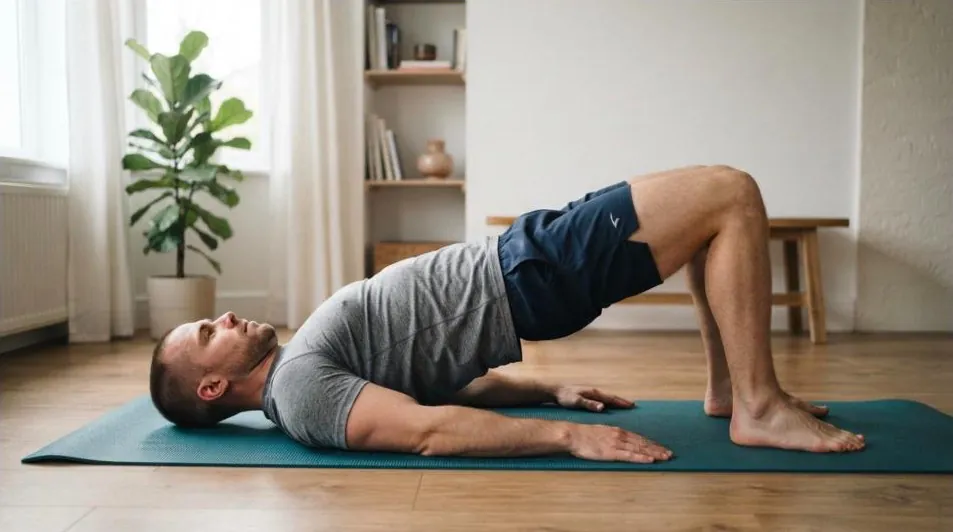
- Lie on your back with one foot flat on the floor, knee bent at about 90 degrees. Extend the other leg straight or hold it at 90 degrees of hip flexion.
- Press through the working heel and lift your hips until your body forms a straight line from shoulder to knee.
- Lower slowly without letting your hips rotate or drop to one side.
Sets x Reps x Tempo: 3 x 10-12/leg | 2-1-3 (2s up, 1s squeeze, 3s down)
Form cue: Keep your hips level throughout. If one hip drops, you are not ready for this variation yet — go back to bilateral bridges.
Common mistake: Pushing through the toes instead of the heel, which shifts the load to the hamstrings.
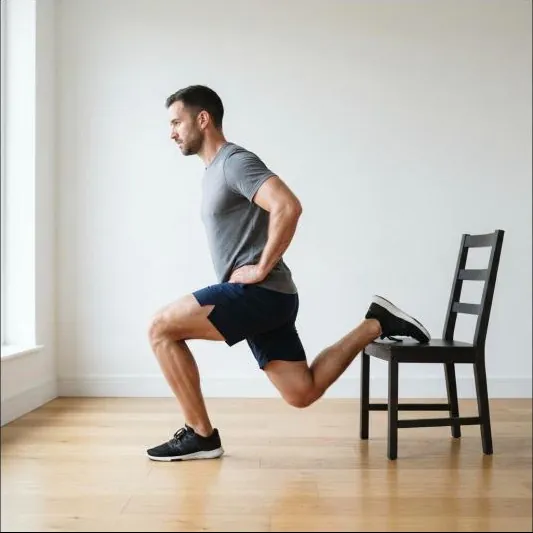
3. Bulgarian Split Squat
Targets: Gluteus maximus + quadriceps | Level: Intermediate
The Bulgarian split squat combines single-leg loading with a deep hip flexion stretch, which places the glute max under tension at a long muscle length. Neto et al. (2020) rated the split squat at roughly 70% MVIC for glute max activation. The rear-foot-elevated version increases range of motion further.
How to do it:
- Stand about two feet in front of a chair or couch. Place the top of one foot on the surface behind you.
- Lower your back knee toward the floor while keeping your front shin roughly vertical.
- Drive through the front heel to stand, squeezing the glute at the top.
Sets x Reps x Tempo: 3 x 10-12/leg | 3-0-1 (3s down, no pause, 1s up)
Form cue: Lean your torso forward about 20-30 degrees — a more upright torso loads the quads, a slight lean loads the glutes.
Common mistake: Letting the front knee cave inward during the ascent.
4. Step-Up (Chair Height)
Targets: Gluteus maximus + quadriceps | Level: Intermediate
Step-ups topped the Neto et al. (2020) ranking for overall glute max activation — loaded step-up variations ranged from 104-169% MVIC across studies. The bodyweight version at chair height (roughly 40-50 cm) still produces strong glute activation because the movement demands full hip extension from a deep starting position.
How to do it:
- Stand facing a sturdy chair, bench, or stair. Place one foot fully on top.
- Press through that heel to stand tall on the box. Do not push off with the trailing foot.
- Lower yourself slowly on the same leg.
Sets x Reps x Tempo: 3 x 10-12/leg | 2-0-3 (2s up, no pause, 3s down)
Form cue: Keep the trailing foot relaxed and hang it off the side — this prevents you from cheating with a push-off.
Common mistake: Using the back leg to assist the step, which defeats the purpose. If you catch yourself doing it, lower the platform height.
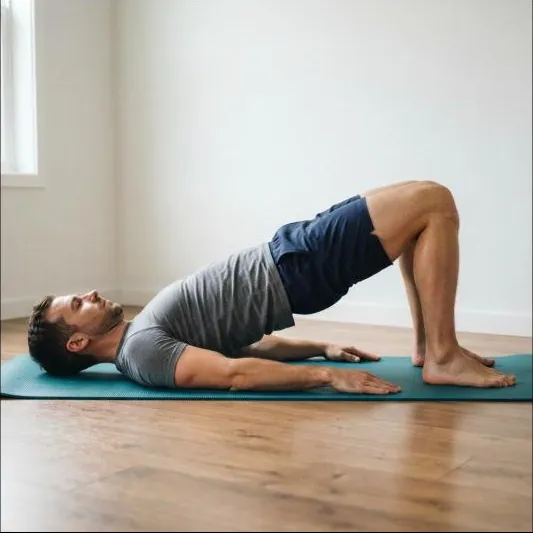
5. Glute Bridge
Targets: Gluteus maximus | Level: Beginner
The standard glute bridge is the entry point for every posterior chain program. It teaches hip extension mechanics with zero impact and minimal skill demand. Boren et al. (2011) measured single-leg bridge glute max activation at about 54% MVIC; the bilateral version produces less per-leg activation but builds the motor pattern for harder variations.
How to do it:
- Lie on your back with feet flat on the floor, knees bent at 90 degrees, arms at your sides.
- Press through both heels and lift your hips until your body forms a straight line from knees to shoulders.
- Squeeze your glutes hard at the top, then lower slowly.
Sets x Reps x Tempo: 3 x 15 | 2-1-2 (2s up, 1s squeeze, 2s down)
Form cue: Drive through your heels, not your toes. You should be able to wiggle your toes at the top.
Common mistake: Lifting the hips too high and arching the lower back. Neutral spine, glutes doing the work.
6. Reverse Lunge
Targets: Gluteus maximus + quadriceps | Level: Beginner
The reverse lunge loads the glutes through a long range of hip extension and is generally easier to control than forward lunges because the stepping leg absorbs less deceleration force. Neto et al. (2020) measured traditional lunge activation at roughly 66% MVIC for glute max; reverse lunges follow a similar activation pattern with a greater emphasis on the front leg’s hip extensors.
How to do it:
- Stand tall with feet hip-width apart.
- Step one foot backward and lower your back knee toward the floor until both knees form roughly 90-degree angles.
- Press through the front heel to return to standing.
Sets x Reps x Tempo: 3 x 12/leg | 2-0-1 (2s down, no pause, 1s up)
Form cue: Keep your torso slightly forward to load the glute of the front leg. A perfectly upright torso shifts work to the quads.
Common mistake: Taking too short a step back, which turns the movement into a quad-dominant exercise.
7. Curtsy Lunge
Targets: Gluteus medius + maximus | Level: Intermediate
The curtsy lunge adds frontal-plane hip motion to the standard lunge, which increases gluteus medius demand. The crossover step forces the hip abductors to stabilize, making this one of few bodyweight exercises that targets the glute med in a standing position.
How to do it:
- Stand with feet hip-width apart.
- Step one foot diagonally behind and across the other leg, lowering your back knee toward the floor.
- Press through the front heel to return to standing.
Sets x Reps x Tempo: 3 x 10-12/leg | 2-0-1 (2s down, no pause, 1s up)
Form cue: Keep your front knee tracking over your toes — the tendency is for it to collapse inward during the crossover.
Common mistake: Rotating the hips instead of keeping them square. The glute med only works hard if the pelvis stays neutral.
8. Donkey Kick
Targets: Gluteus maximus | Level: Beginner
The donkey kick (quadruped hip extension) isolates the glute max with minimal hamstring involvement. Boren et al. (2011) measured quadruped hip extension at roughly 60% MVIC for glute max. Low skill floor. Teaches the mind-muscle connection before progressing to compound movements.
How to do it:
- Start on all fours with wrists under shoulders and knees under hips.
- Keeping the knee bent at 90 degrees, drive one heel toward the ceiling until the thigh is in line with your torso.
- Squeeze the glute at the top, then lower slowly without resting the knee on the floor.
Sets x Reps x Tempo: 3 x 15/leg | 2-1-2 (2s up, 1s squeeze, 2s down)
Form cue: Stop when the thigh reaches parallel to the floor. Going higher does not increase glute activation — it just hyperextends your lower back.
Common mistake: Using momentum to swing the leg up. Slow, controlled reps with a squeeze at the top.
9. Fire Hydrant
Targets: Gluteus medius | Level: Beginner
The fire hydrant targets hip abduction (moving the thigh away from the midline), which is the primary function of the gluteus medius. It is a staple in physical therapy protocols for runners with hip drop and knee-caving patterns.
How to do it:
- Start on all fours with wrists under shoulders and knees under hips.
- Keeping the knee bent at 90 degrees, lift one knee out to the side until the thigh is roughly parallel to the floor.
- Lower slowly without resting the knee down between reps.
Sets x Reps x Tempo: 2 x 15/leg | 2-1-2 (2s up, 1s hold, 2s down)
Form cue: Keep your hips square to the floor. If your torso leans to the opposite side, you are going too high.
Common mistake: Rotating the hips open instead of keeping the movement purely in the hip joint.
10. Clamshell
Targets: Gluteus medius | Level: Beginner
The clamshell is the lowest-intensity glute med exercise on this list, but it earns its place because it isolates hip external rotation under minimal load. Boren et al. (2011) measured clamshell variations at 47-77% MVIC for glute med, making it one of the more effective medius-targeting exercises despite its simplicity.
How to do it:
- Lie on your side with hips and knees bent at about 45 degrees, feet stacked together.
- Keeping your feet together, rotate your top knee open as far as possible without rolling your pelvis backward.
- Hold briefly at the top, then lower slowly.
Sets x Reps x Tempo: 2 x 20/side | 2-1-2 (2s up, 1s hold, 2s down)
Form cue: Place your hand on the top of your pelvis. If you feel it rolling backward as you open the knee, reduce the range of motion.
Common mistake: Rolling the hips backward to fake a bigger range of motion. The pelvis must stay stacked.
How These Exercises Rank by EMG Glute Activation
EMG (electromyography) measures how hard a muscle contracts during an exercise. Here is how each of the 10 exercises above ranks for gluteus maximus and gluteus medius activation, based on loaded-exercise EMG data and bodyweight rehabilitation studies.
| Exercise | Glute Max Activation | Glute Med Activation | Primary Source |
|---|---|---|---|
| Hip Thrust (feet-elevated) | Very High | Moderate | Neto et al., 2020 (loaded) |
| Single-Leg Glute Bridge | High | High | Boren et al., 2011 (bodyweight) |
| Bulgarian Split Squat | Very High | Moderate | Neto et al., 2020 (loaded) |
| Step-Up (chair height) | Very High | Moderate-High | Neto et al., 2020 (loaded) |
| Glute Bridge | Moderate-High | Low-Moderate | Boren et al., 2011 (bodyweight) |
| Reverse Lunge | High | Moderate | Neto et al., 2020 (loaded) |
| Curtsy Lunge | Moderate-High | High | Biomechanical estimate |
| Donkey Kick | High | Moderate | Boren et al., 2011 (bodyweight) |
| Fire Hydrant | Low-Moderate | High | Biomechanical estimate |
| Clamshell | Low | High | Boren et al., 2011 (bodyweight) |
A few notes on this table. Neto et al. (2020) studied loaded compound exercises, not bodyweight variations. The activation levels for hip thrusts, split squats, step-ups, and lunges are extrapolated from loaded data — bodyweight versions will produce lower absolute activation but the relative ranking between exercises holds. Boren et al. (2011) tested bodyweight rehabilitation exercises, so those values are more directly applicable.
For the full EMG ranking including gym exercises, see our complete glute exercise guide.
Sample No-Equipment Glute Workout (25 Minutes)
This 25-minute routine hits glute max and med using five exercises from the list above. Do it 2-3 times per week with at least 48 hours between sessions. Start with 2 minutes of bodyweight squats and leg swings as a warm-up.
| Exercise | Sets | Reps | Tempo | Rest |
|---|---|---|---|---|
| Glute Bridge (warm-up) | 2 | 15 | 2-1-2 | 30s |
| Hip Thrust (feet-elevated) | 3 | 12 | 2-1-3 | 60s |
| Bulgarian Split Squat | 3 | 10/leg | 3-0-1 | 60s |
| Reverse Lunge | 3 | 12/leg | 2-0-1 | 45s |
| Fire Hydrant | 2 | 15/leg | 2-1-2 | 30s |
Total working time is about 22-25 minutes depending on transition speed. Stretch your hip flexors for 30 seconds per side afterward.
For a full lower-body session, see our bodyweight leg workout.
4-Week Bodyweight Glute Progression Plan
Progressive overload without weights means adding reps, slowing tempo, and advancing to single-leg variations. This 4-week plan builds glute strength and size using only bodyweight. A 2023 Bayesian network meta-analysis in the British Journal of Sports Medicine confirmed that training a muscle group at least twice per week ranks among the most effective hypertrophy prescriptions (Source: Currier et al., 2023).
| Week | Sets x Reps | Tempo | Variation | What Changes |
|---|---|---|---|---|
| 1 | 3 x 10-12 | 2-1-2 | Bilateral basics | Glute bridge 3×12, hip thrust 3×10, reverse lunge 3×10/leg, donkey kick 3×12/leg, clamshell 2×15/side |
| 2 | 3 x 12-15 | 2-1-2 | Same exercises | Add 2-3 reps per set across all exercises. Same tempo. |
| 3 | 3 x 12-15 | 3-2-3 | Add pause at peak | Slow the eccentric (lowering) to 3 seconds. Add a 2-second squeeze at the top. Total time under tension roughly doubles. |
| 4 | 3 x 10-12 | 3-2-3 | Unilateral versions | Glute bridge becomes single-leg bridge. Hip thrust becomes single-leg hip thrust. Step-up replaces reverse lunge. Reps drop because the load per leg increases. |
After week 4, restart at week 1 using the week 4 exercise variations as your new baseline. That cycle of add reps, slow tempo, advance variation is the core of bodyweight progressive overload.
Learn more about progressive overload principles in our progressive overload training guide.
5 Ways to Progress Glute Exercises Without Weights
When a bodyweight exercise gets easy, apply one of these five methods before adding external load. Each increases mechanical tension without equipment. The ACSM position stand on resistance training identifies progression variables including exercise selection and order, movement velocity, rest intervals, and training frequency (Source: ACSM, 2009).
| Method | What It Does | When to Use | Example |
|---|---|---|---|
| Add reps | Increases total volume | You complete all sets with clean form | 3×12 becomes 3×15 |
| Slow the tempo | Increases time under tension (TUT) | 15+ reps feels easy at current speed | 2-1-2 becomes 3-2-3 |
| Add a pause | Eliminates momentum, peaks contraction | Tempo change is mastered | 2-second hold at the top of each rep |
| Increase ROM | Lengthens the muscle under load | Full ROM at current depth feels easy | Standard reverse lunge becomes deficit reverse lunge (front foot on a book) |
| Go unilateral | Roughly doubles load per working leg | Bilateral version at 15+ reps is easy | Glute bridge becomes single-leg glute bridge |
Work through these in order. Most people stall on bodyweight glute training because they just add reps forever. Tempo and unilateral progressions are where the real growth stimulus lives.
When Should You Add Weight to Glute Training?
Add external resistance when you can complete 15-20 controlled reps with a 3-second eccentric on the hardest unilateral variation (single-leg hip thrust, for example). At that point, bodyweight alone stops providing enough mechanical tension for hypertrophy in most trainees.
This is not a hard biological cutoff. It is a practical guideline based on programming logic: when you can perform high-rep sets at a slow tempo without reaching failure, the stimulus is no longer sufficient for growth. But when slow, single-leg bodyweight reps feel easy for 20 reps, you have likely exhausted the progressive overload options above.
Your best first additions are a set of resistance bands for banded hip thrusts and a pair of adjustable dumbbells for goblet squats and dumbbell Romanian deadlifts. An exercise mat helps if you train on hard floors. Skip machines until you max out free weights at home.
Start with resistance bands or dumbbells: see our best dumbbell exercises for glutes. Ready for the gym? See our best glute machines guide.
FAQ
What is the 888 rule for glutes?
The 888 rule is a social-media training protocol, not an established scientific principle. It involves performing 8 full-range reps, 8 pulse reps at the top, and an 8-second isometric hold — all as one continuous set, typically on hip thrusts or glute bridges. The idea is to maximize time under tension and metabolic stress in a single set. No peer-reviewed study has evaluated this specific protocol. It can work as a finisher, but structured progressive overload (more reps, slower tempo, harder variations) is better supported by evidence for long-term growth.
Can you build glutes without weights?
Yes, up to a point. Bodyweight exercises like hip thrusts, single-leg bridges, and Bulgarian split squats produce high glute activation (Source: Neto et al., 2020). You can progress for months using tempo changes, pauses, and unilateral variations. The ceiling comes when the hardest bodyweight variation at a slow tempo is no longer challenging for 15-20 reps. At that point, add bands or dumbbells.
How to grow glutes fast at home?
Train glutes 2-3 times per week with progressive overload. Focus on compound movements (hip thrusts, split squats, lunges) over isolation exercises. Use the 4-week progression plan above. Eat enough protein — for adults under 65 who resistance train, intakes of at least 1.6 g of protein per kg of body weight daily supported lean mass gains in a 2022 meta-analysis (Source: Nunes et al., 2022). Get at least 7 hours of sleep per night, per CDC adult guidelines (Source: CDC). “Fast” is relative — consistent training and adequate nutrition produce visible changes over weeks to months, but individual timelines vary.
How often should you train glutes at home?
Two to three times per week with 48-72 hours between sessions. A 2023 Bayesian meta-analysis found that twice-weekly training per muscle group ranks among the most effective prescriptions for hypertrophy (Source: Currier et al., 2023). Three sessions per week may offer a small additional benefit if you recover well, but twice is the evidence-backed minimum for growth.
How many bodyweight glute exercises per workout?
Four to six exercises per session. That gives you enough variety to hit glute max and glute med from multiple angles without running into diminishing returns. The sample routine above uses five. Going past six exercises in a single session adds fatigue without proportional stimulus — shorten the session and train more frequently instead.
Do bodyweight squats work glutes?
Yes, but less than you would expect. Standard bodyweight squats primarily load the quadriceps. In a study of 13 resistance-trained women, Contreras et al. (2015) found significantly greater glute max activation during hip thrusts compared to back squats (Source: Contreras et al., 2015). If your goal is glute growth, squats should be a secondary exercise. Prioritize hip thrusts, bridges, and split squats instead. See the EMG activation table above for the comparison.
What are signs of weak glutes?
The most common signs are knee caving during squats or running, lower-back pain during hip-hinge movements, anterior pelvic tilt (excessive lower-back arch when standing), and a noticeable hip drop on one side during single-leg activities like running or stair climbing. If you notice these patterns, start with the beginner exercises on this list (glute bridge, donkey kick, clamshell) to rebuild activation.
Can you fix a saggy bum with exercise?
Yes. Resistance training builds muscle volume beneath the skin, which changes the shape and firmness of the glutes over time. You need progressive overload (not just high-rep bodyweight work) and either a caloric surplus or maintenance-level calories to support muscle growth. Spot reduction of fat is not possible, but building the glute muscles lifts and fills out the area. Results depend on training consistency, nutrition, and starting point.
Sources
- Neto, W. K. et al. (2020). “Gluteus Maximus Activation during Common Strength and Hypertrophy Exercises: A Systematic Review.” Journal of Sports Science & Medicine, 19(1), 195-203. https://pmc.ncbi.nlm.nih.gov/articles/PMC7039033/
- Boren, K. et al. (2011). “Electromyographic Analysis of Gluteus Medius and Gluteus Maximus During Rehabilitation Exercises.” International Journal of Sports Physical Therapy, 6(3), 206-223. https://pmc.ncbi.nlm.nih.gov/articles/PMC3201064/
- Contreras, B. et al. (2015). “A Comparison of Gluteus Maximus, Biceps Femoris, and Vastus Lateralis EMG Activity in the Back Squat and Barbell Hip Thrust Exercises.” Journal of Applied Biomechanics, 31(6), 452-458. https://pubmed.ncbi.nlm.nih.gov/26214739/
- Currier, B. S. et al. (2023). “Resistance training prescription for muscle strength and hypertrophy in healthy adults: a systematic review and Bayesian network meta-analysis.” British Journal of Sports Medicine, 57, 1211-1220. https://pubmed.ncbi.nlm.nih.gov/37414459/
- American College of Sports Medicine (2009). “Progression Models in Resistance Training for Healthy Adults.” Medicine & Science in Sports & Exercise, 41(3), 687-708. https://pubmed.ncbi.nlm.nih.gov/19204579/
- Nunes, E. A. et al. (2022). “Systematic review and meta-analysis of protein intake to support muscle mass and function in healthy adults.” Journal of Cachexia, Sarcopenia and Muscle, 13(2), 795-810. https://pubmed.ncbi.nlm.nih.gov/35187864/
- CDC. “How Much Sleep Do I Need?” https://www.cdc.gov/sleep/about_sleep/how_much_sleep.html