


TL;DR — What Does a Weighted Vest Do for You?
Weighted vest benefits are backed by exercise-science research: added load increases calorie expenditure by roughly 12% during walking (Source: Puthoff et al., 2006), preserves bone mineral density over multi-year periods (Source: Snow et al., 2000), triggers a body-weight regulation mechanism that reduces fat mass (Source: Ohlsson et al., 2020), and builds functional strength and balance. Below, six benefits with the studies behind them, plus a free calorie calculator.
Table of contents
What Are the Benefits of a Weighted Vest?
A weighted vest adds resistance to movements you already do (walking, running, push-ups, squats), forcing your body to work harder without changing your routine. Six benefits have strong enough primary research to cite by name. Here they are, with the evidence behind each one.
- Higher Calorie Burn — increases oxygen consumption by approximately 12% during loaded walking (Source: Puthoff et al., 2006).
- Bone Density Preservation — maintains femoral neck BMD where controls lose roughly 4.4% over five years (Source: Snow et al., 2000).
- Strength and Muscle Activation — applies progressive overload to bodyweight exercises, a principle shown to produce strength gains in loaded bodyweight training (Source: Kotarsky et al., 2018; push-up variations, not vest-specific).
- Greater Cardiovascular Demand — elevates heart rate and oxygen consumption at any given pace, creating a stronger aerobic training stimulus (Source: Puthoff et al., 2006).
- Fat Loss via the Gravitostat — triggers a body-weight homeostasis mechanism; heavy-vest wearers lost 1.37 percentage points more body weight than controls in three weeks (Source: Ohlsson et al., 2020).
- Improved Balance and Fall-Risk Reduction — strengthens lower-body power and improves fall-risk indices in older adults (Source: Shaw & Snow, 1998).
A vest also increases trunk muscle engagement during upright activities, since your core stabilizers work harder under axial load. That is a secondary effect of loaded training rather than a standalone research-backed benefit.
1. Burns More Calories During Any Activity
Wearing a weighted vest increases oxygen consumption by approximately 12% during walking, according to Puthoff et al. (2006) in Medicine & Science in Sports & Exercise. That study tested vests at 10%, 15%, and 20% of body weight across multiple treadmill grades and found a dose-response relationship: heavier loads and steeper inclines amplified the metabolic cost further.
The mechanism is straightforward physics. Moving more mass requires more energy. Your body burns calories proportional to the total weight it carries, which is why even a modest 10-lb vest meaningfully shifts your daily expenditure during a 30- or 45-minute session.
Walking is one context where this applies. See our walking with a weighted vest guide for protocols. The calculator below lets you estimate your personal calorie increase based on your weight, vest load, and activity.
2. Preserves and Builds Bone Density
A five-year trial by Snow et al. (2000), published in the Journal of Gerontology: Medical Sciences, found that postmenopausal women who performed weighted-vest exercises with jumping maintained femoral neck bone mineral density. The exercise group gained approximately 1.5% BMD at the femoral neck, while controls lost roughly 4.4% over the same period (Source: Snow et al., 2000). The between-group difference was statistically significant.
Why this matters: bone responds to mechanical loading that exceeds everyday forces. The combination of vest weight plus impact from jumping crossed the threshold needed to stimulate osteogenesis, new bone formation at the hip. That is a meaningful finding for anyone concerned about osteoporosis risk.
This benefit applies specifically to loaded, impact-based exercise, not to passive vest wearing. Strapping on a vest while sitting at a desk will not preserve bone density.
3. Increases Strength and Muscle Activation
Adding external load to bodyweight exercises applies progressive overload, the same principle that drives strength gains in the weight room. Kotarsky et al. (2018), published in the Journal of Strength and Conditioning Research, demonstrated that progressively loaded push-up variations produced upper-body strength and muscle-thickness gains comparable to bench-press training over four weeks in 23 healthy men.
An important distinction: that study progressed difficulty through push-up leverage changes (narrower hand placement, elevated feet), not by adding vest weight. The underlying principle is the same (increase resistance on bodyweight movements to drive adaptation), but no published trial has tested vest-loaded push-ups specifically. A weighted vest is one practical tool for applying this principle. It loads your torso without changing movement patterns, making every rep harder. Legs, glutes, and back take on the most additional work during lower-body movements. Chest, shoulders, and triceps handle it during upper-body pushing.
For specific exercises to pair with a vest, see our weighted vest workouts guide.
4. Improves Cardiovascular Fitness
Wearing a weighted vest elevates heart rate and oxygen consumption at any given walking or running speed, effectively turning a moderate-intensity session into a vigorous one. Puthoff et al. (2006) measured oxygen consumption increases of roughly 8% with a 10% BW vest, 12% with a 15% BW vest, and higher still at 20% BW during treadmill walking at 2.5 mph (Source: Puthoff et al., 2006). At steeper grades, the increase was larger.
That matters because cardiovascular adaptation depends on training intensity. A vest lets you reach higher heart-rate zones without running faster or adding incline. Useful for anyone with joint limitations that prevent high-speed running, or for runners who want harder easy-day walks.
One clarification: no published trial has isolated weighted-vest training and measured VO2 max improvement as a primary outcome. The evidence shows vests reliably increase the cardiovascular demand of exercise. Whether that stimulus produces greater VO2 max gains than simply exercising harder without a vest remains untested in a controlled trial.
5. Supports Fat Loss Through the Gravitostat Mechanism
Ohlsson et al. (2020), published in EClinicalMedicine, randomized 69 adults with obesity to wear either a heavy vest (approximately 11% of body weight) or a light control vest (1%) for eight hours daily over three weeks. The heavy-vest group lost approximately 1.68% of body weight, while controls lost about 0.31%. The adjusted between-group difference was 1.37 percentage points, with the additional loss coming primarily from fat mass (Source: Ohlsson et al., 2020). Lean mass was preserved.
The proposed mechanism is a “gravitostat”: a body-weight sensor in weight-bearing bones that detects increased loading and signals the brain to reduce appetite and fat storage. Think of it as a biological thermostat for body weight. This is distinct from burning extra calories through movement. Participants in the Ohlsson trial were not exercising; they wore the vest during normal daily activities.
Important context: this was a small, three-week proof-of-concept trial. It demonstrates the mechanism exists in humans but does not establish long-term weight-loss efficacy. Treat it as promising early evidence, not a guaranteed fat-loss strategy.
6. Improves Balance and Reduces Fall Risk
Shaw and Snow (1998), published in the Journal of Gerontology: Medical Sciences, found that a nine-month weighted-vest exercise program improved lower-body strength (by 16-33%), leg power (by 13%), and fall-risk indices in 44 community-dwelling women aged 50-75 (Source: Shaw & Snow, 1998). The intervention combined vest-loaded movements with targeted lower-body exercises three times per week.
The key outcome here is improvement in fall-risk indices, not actual fall incidence. Stronger legs and better power production help older adults recover from stumbles, which is the physical mechanism behind fall prevention. Loaded exercise under controlled conditions challenges balance in a way that unloaded exercise does not.
A caution: for older adults or those with joint concerns, start with a lighter load than the general guideline and work with a trainer or physical therapist for initial sessions. An overly heavy vest can temporarily impair balance and increase fall risk in the short term.
Weighted Vest Benefits at a Glance — Evidence Summary
The table below summarizes the primary research behind each weighted vest benefit.
| Benefit | Key Finding | Source | Population |
|---|---|---|---|
| Calorie Burn | ~12% increase in VO2 during loaded walking (15% BW vest) | Puthoff et al., Med Sci Sports Exerc, 2006 | 20 healthy adults |
| Bone Density | Femoral neck BMD maintained (+1.5%) vs ~4.4% loss in controls over 5 years | Snow et al., J Gerontol Med Sci, 2000 | Postmenopausal women |
| Strength | Progressive bodyweight loading produced strength/thickness gains comparable to bench press (push-up variations, not vest-specific) | Kotarsky et al., J Strength Cond Res, 2018 | 23 healthy young men |
| Cardiovascular | Heart rate and O2 consumption elevated at same pace; higher training stimulus | Puthoff et al., Med Sci Sports Exerc, 2006 | 20 healthy adults |
| Fat Loss (Gravitostat) | 1.37 pp greater relative weight loss (mainly fat) vs controls in 3 weeks | Ohlsson et al., EClinicalMedicine, 2020 | 69 adults with obesity |
| Balance / Fall Risk | Improved lower-body strength 16-33%, power 13%, and fall-risk indices after 9 months | Shaw & Snow, J Gerontol Med Sci, 1998 | 44 women aged 50-75 |
Weighted Vest Calorie Calculator
Use this calculator to estimate how many extra calories a weighted vest adds to your workout. Enter your body weight, vest weight, activity type, and duration below.

Calculate Your Extra Calorie Burn
Calories burned without vest: 0 kcal
Calories burned with vest: 0 kcal
Extra calories from the vest: 0 kcal
How the formula works: The calculator uses the standard MET equation (kcal/min = MET x 3.5 x mass in kg / 200) and adds your vest weight to total mass. When you carry more weight, your body expends energy proportionally to the added load. MET values come from the 2024 Adult Compendium of Physical Activities (Source: Herrmann et al., 2024).
This is an estimate. Real-world calorie burn depends on your fitness level, terrain, temperature, and individual metabolism. The calculator gives you a reasonable baseline, not a lab-grade measurement. For walking-specific calculations and protocols, see our walking with a weighted vest guide.
Who Should and Should Not Use a Weighted Vest
Most healthy adults can safely train with a weighted vest, but certain conditions require caution or make vest training inadvisable. Use this framework instead of a generic “ask your doctor” list.
| Category | Who | Guidance |
|---|---|---|
| Use freely | Healthy adults with no joint or spinal conditions | Start light and add weight gradually over weeks. Wear during training only, not all day. |
| Use with caution | Mild joint issues, early-stage osteoporosis, older adults with good baseline balance, anyone returning from injury | Get medical clearance first. Start with a very light load. Work with a trainer or physical therapist for initial sessions. Stop if joint pain increases during or after sessions. |
| Avoid | Pregnancy, severe osteoporosis, acute spinal conditions (herniated disc, spinal stenosis), uncontrolled cardiovascular disease, significant balance disorders | Vest training is contraindicated. Use alternative training methods. These conditions involve risks that added axial loading can worsen. |
Starting weight guidance: Most fitness professionals and clinical sources recommend beginning at a low percentage of body weight and progressing gradually. A common starting point is a vest that feels manageable for your full workout without altering your form or gait. For detailed sizing help, see our weighted vest sizing guide.
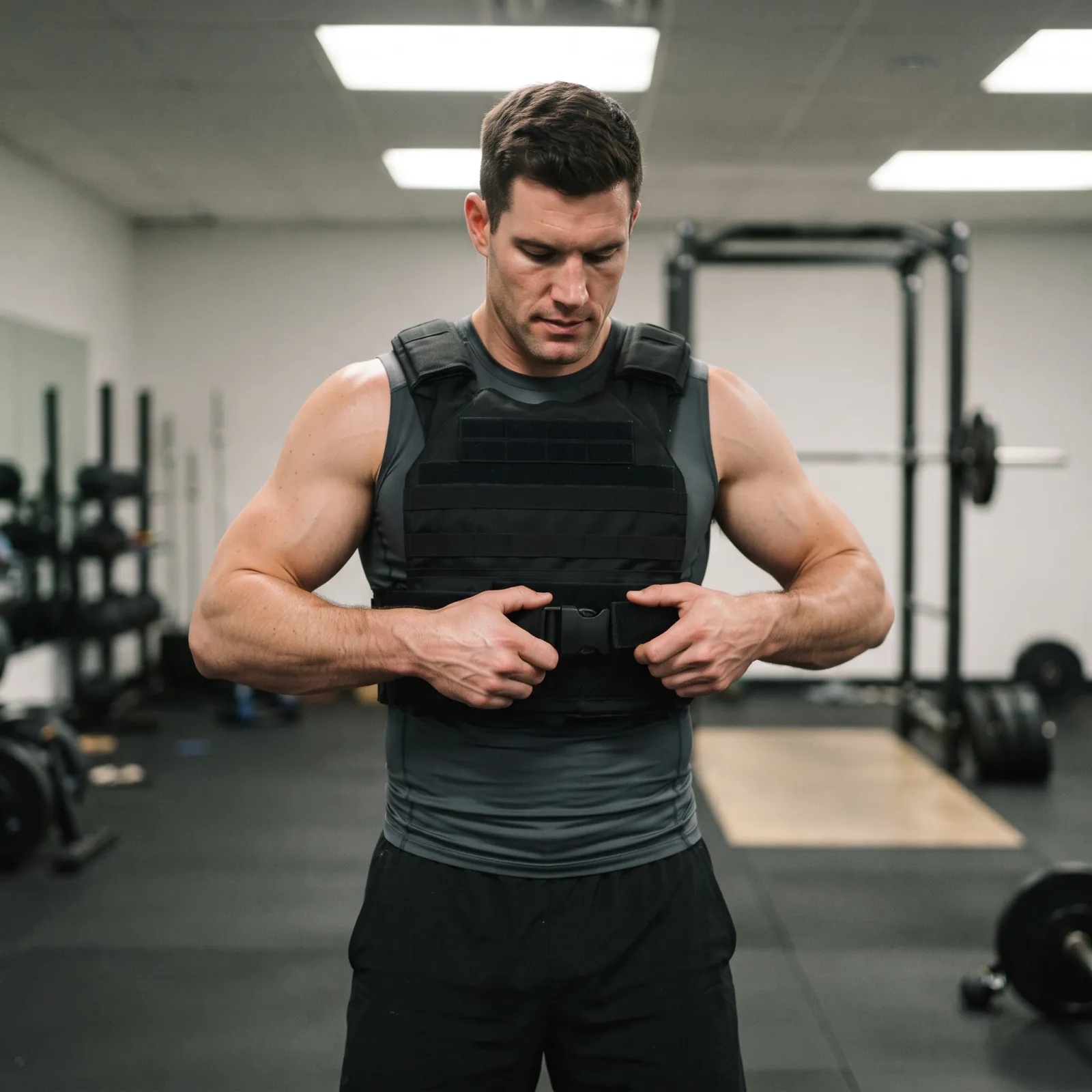
Warning signs to stop: Sharp joint pain (not muscle fatigue), numbness or tingling in extremities, dizziness, altered gait where you cannot walk normally. Remove the vest immediately if any of these occur.
This content is for informational purposes. Consult a healthcare provider before starting weighted vest training if you have existing medical conditions.
How to Get Started
Start light and train 2-3 sessions per week, limiting vest wear to training periods only. Here is a simple progression:
- Pick your starting weight. Use our weighted vest sizing guide to find the right load for your body weight and experience level.
- Choose 2-3 existing workouts per week. Add the vest to bodyweight exercises you already know: squats, lunges, push-ups. See our weighted vest workouts guide for structured routines.
- Train for 20-45 minutes per session. Do not wear the vest all day. Training-only use lets your body recover and adapt.
- Add weight gradually. Increase by small increments every one to two weeks. If your form or gait changes, the vest is too heavy.
Frequently Asked Questions
Do weighted vests help lose belly fat?
Weighted vests can contribute to overall fat loss through two mechanisms: increased calorie burn during exercise and the gravitostat response studied by Ohlsson et al. (2020), which reduced total body fat by 1.37 percentage points more than controls. But no mechanism produces spot reduction. You cannot target belly fat specifically with a vest or any other tool. Fat loss occurs systemically when you maintain a caloric deficit over time. A vest helps create that deficit, not direct where fat comes from.
How many hours should you wear a weighted vest?
Limit vest use to your training sessions, typically 20 to 60 minutes. All-day wear is unnecessary and increases injury risk from sustained joint loading. The Ohlsson et al. (2020) gravitostat study used 8 hours of daily wear, but that was a controlled research protocol for sedentary participants, not a training recommendation. For exercise purposes, your session duration is enough.
What are the disadvantages of a weighted vest?
The main risks are excessive joint stress if the vest is too heavy, postural compensation if you lack core strength to maintain form under load, and contraindications for people with spinal conditions, severe osteoporosis, or cardiovascular disease. Start light. If your gait or exercise form changes noticeably with the vest, reduce the weight.
Does walking with a 20 lb weighted vest burn more calories?
Yes. A 180-lb person walking at 3.5 mph with a 20-lb vest burns roughly 11% more calories than without one, based on the MET-adjusted formula (the vest adds 11% to total body mass, and calorie cost scales proportionally). The exact number depends on speed, terrain, and individual factors. Use the calorie calculator above for your personal estimate, and see our walking with a weighted vest guide for complete protocols once it is live.
Do weighted vests help with bone density?
Yes. Snow et al. (2000) demonstrated that a five-year weighted-vest exercise program with jumping preserved femoral neck bone mineral density in postmenopausal women, while controls lost approximately 4.4% of BMD at the same site (Source: Snow et al., 2000). The key is combining vest loading with impact exercise (jumping, stepping), not passive wear.
Does a weight vest help build muscle?
Yes, by providing progressive overload to bodyweight movements. The principle is supported by Kotarsky et al. (2018), who showed that progressively loaded push-up variations produced upper-body strength and muscle-thickness gains comparable to bench press over four weeks. A vest applies the same overload principle to squats, lunges, pull-ups, and dips. See our weighted vest workouts guide for exercise ideas.
Sources
- Puthoff ML, Darter BJ, Nielsen DH, Yack HJ. “The effect of weighted vest walking on metabolic responses and ground reaction forces.” Medicine & Science in Sports & Exercise. 2006;38(4):746-752. DOI: 10.1249/01.mss.0000210198.79705.70
- Snow CM, Shaw JM, Winters KM, Witzke KA. “Long-term exercise using weighted vests prevents hip bone loss in postmenopausal women.” Journal of Gerontology: Medical Sciences. 2000;55(9):M489-M491. DOI: 10.1093/gerona/55.9.M489
- Ohlsson C, Gidestrand E, Bellman J, et al. “Increased weight loading reduces body weight and body fat in obese subjects — A proof of concept randomized clinical trial.” EClinicalMedicine. 2020;22:100338. DOI: 10.1016/j.eclinm.2020.100338
- Kotarsky CJ, Christensen BK, Miller JS, Hackney KJ. “Effect of Progressive Calisthenic Push-up Training on Muscle Strength and Thickness.” Journal of Strength and Conditioning Research. 2018;32(3):651-659. DOI: 10.1519/JSC.0000000000002345
- Shaw JM, Snow CM. “Weighted vest exercise improves indices of fall risk in older women.” Journal of Gerontology: Medical Sciences. 1998;53A(1):M53-M58. DOI: 10.1093/gerona/53A.1.M53
- Herrmann SD, Willis EA, Ainsworth BE, et al. “2024 Adult Compendium of Physical Activities: A third update of the energy costs of human activities.” Journal of Sport and Health Science. 2024;13(1):6-12. DOI: 10.1016/j.jshs.2023.10.010