

Heart Rate Zones for Working Out: Chart by Age + Calculator

Gymnase Tips is reader-supported. When you buy through links on our site, we may earn an affiliate commission at no extra cost to you.
TL;DR — What Heart Rate Zone Should You Train In?
Heart rate zones for working out split into five intensity bands based on your max heart rate. Most gym sessions land in zones 2-4. Zone 2 (60-70% MHR) builds your aerobic base; zones 4-5 drive performance gains. Use the calculator below to find your personal BPM targets by age and resting heart rate.
Table of contents
What Are Heart Rate Zones?
Heart rate zones are five intensity levels defined as percentages of your maximum heart rate, used to target specific training adaptations from fat oxidation to VO2max improvements. The American Heart Association defines the overall training range as 50-85% of MHR (Source: AHA, 2024). Think of them as gears on a bike.
Each zone triggers different physiological responses. Zone 1 is a warm-up pace where you could hold a full conversation without effort. Zone 5 is an all-out sprint where talking is impossible. The zones between them progressively shift your body from burning predominantly fat to relying on carbohydrates for fuel, with corresponding changes in lactate production, cardiac output, and perceived effort.
Why does this matter in a gym setting? Because knowing your zone tells you whether your 30 minutes on the treadmill actually built your aerobic base or just tired you out without a clear training stimulus.
The 5 Heart Rate Training Zones Explained
Each zone trains a different energy system. Here are all five with BPM ranges, fuel sources, and practical applications.
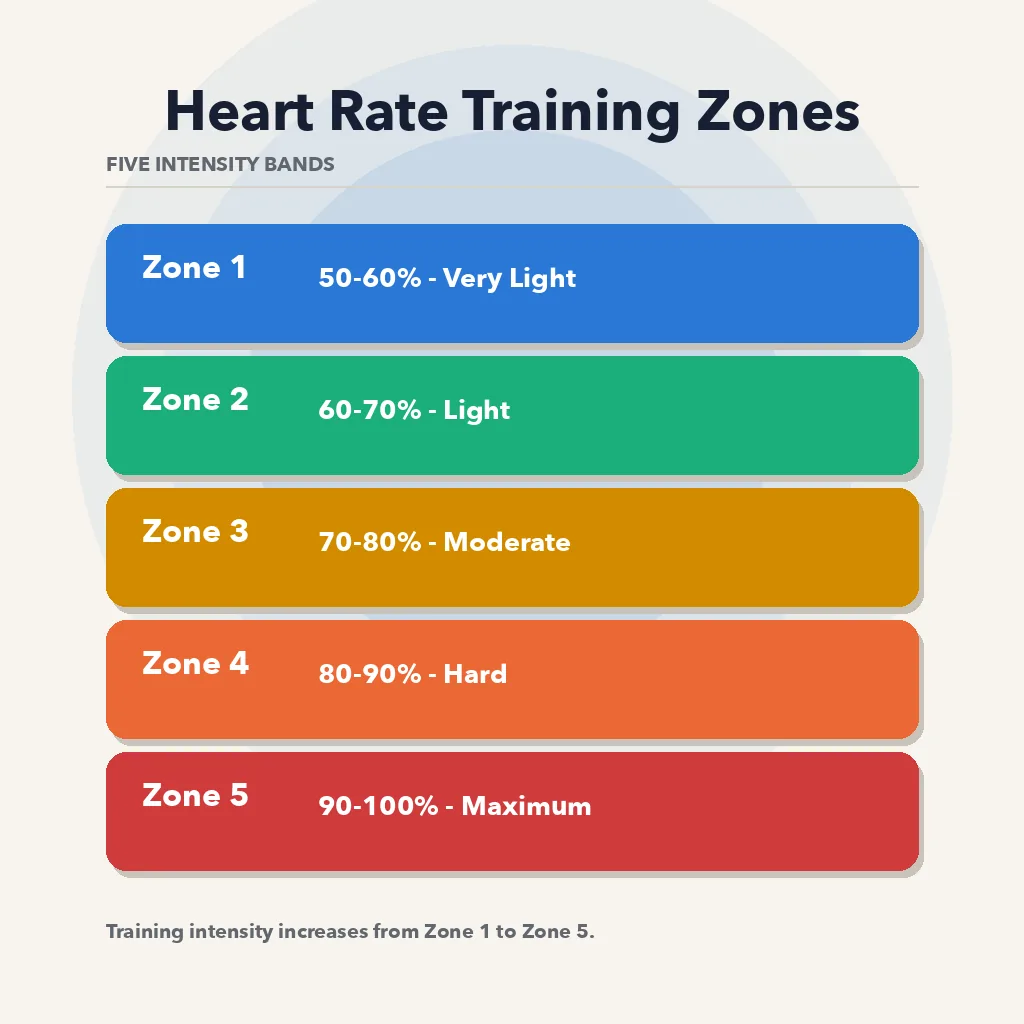
| Zone | % of MHR | Intensity | Primary Fuel | Training Effect | Example |
|---|---|---|---|---|---|
| 1 | 50-60% | Very Light | Fat | Recovery, warm-up | Walking, light stretching |
| 2 | 60-70% | Light | Mostly fat | Aerobic base, mitochondrial density | Brisk walk, easy cycling |
| 3 | 70-80% | Moderate | Fat + carbs | Aerobic capacity | Steady-state cardio, tempo work |
| 4 | 80-90% | Hard | Mostly carbs | Lactate threshold, speed | Intervals, hill sprints |
| 5 | 90-100% | Maximum | Carbs (anaerobic) | VO2max, anaerobic power | All-out sprints, max efforts |
A simple way to gauge your zone without a monitor: the talk test. In zone 2, you can speak in full sentences. Zone 3 limits you to short phrases. By zone 4, you get out a few words between breaths. Zone 5? Talking is off the table.
RPE (rate of perceived exertion) on a 1-10 scale roughly maps to zones: zone 1 feels like a 2-3, zone 2 is a 4, zone 3 sits at 5-6, zone 4 is a 7-8, and zone 5 is a 9-10.
Zone 2 — Why It Gets So Much Attention

Zone 2 training (60-70% MHR) improves mitochondrial density and fat oxidation capacity, forming the foundation for all other fitness gains. San-Millan and Brooks demonstrated in their 2018 study that impaired fat oxidation at this intensity predicts metabolic dysfunction and chronic disease risk (Source: San-Millan & Brooks, Sports Medicine, 2018).
At zone 2, energy production is predominantly aerobic, relying on mitochondrial beta-oxidation of fatty acids. Over weeks of consistent training at this intensity, muscle cells increase their mitochondrial density, improving your capacity to produce energy from fat. This adaptation has downstream effects: better lactate clearance during harder efforts, improved endurance, and enhanced metabolic flexibility.
Practical zone 2 activities for gym-goers include incline walking at 3.0-3.5 mph on a 5-8% grade, cycling at a conversational pace, or light rowing. You can also get quality zone 2 work at home with fun, low-equipment workouts like easy jump rope or step-ups. The key test: if you cannot hold a conversation, you have drifted into zone 3.
How Much Zone 2 Per Week?
The ACSM recommends at least 150 minutes per week of moderate-intensity aerobic activity for adults (Source: ACSM, 2024). That translates to 3-4 sessions of 30-45 minutes at zone 2 intensity for most gym-goers.
Beginners should start with three 20-30 minute sessions and build from there. More advanced trainees who lift four or five days per week often fit zone 2 work into 30-minute sessions on their non-lifting days, or as a 15-20 minute cool-down after strength training. The point is accumulating volume at a genuinely easy effort, not cramming it all into one weekend session.
Heart Rate Zones by Age (Full BPM Table)
Your heart rate zones shift with age because max heart rate declines roughly one beat per year. The table below shows BPM ranges for all five zones at every age from 20 to 70, calculated using the 220-minus-age formula.
| Age | MHR | Zone 1 (50-60%) | Zone 2 (60-70%) | Zone 3 (70-80%) | Zone 4 (80-90%) | Zone 5 (90-100%) |
|---|---|---|---|---|---|---|
| 20 | 200 | 100-120 | 120-140 | 140-160 | 160-180 | 180-200 |
| 25 | 195 | 98-117 | 117-137 | 137-156 | 156-176 | 176-195 |
| 30 | 190 | 95-114 | 114-133 | 133-152 | 152-171 | 171-190 |
| 35 | 185 | 93-111 | 111-130 | 130-148 | 148-167 | 167-185 |
| 40 | 180 | 90-108 | 108-126 | 126-144 | 144-162 | 162-180 |
| 45 | 175 | 88-105 | 105-123 | 123-140 | 140-158 | 158-175 |
| 50 | 170 | 85-102 | 102-119 | 119-136 | 136-153 | 153-170 |
| 55 | 165 | 83-99 | 99-116 | 116-132 | 132-149 | 149-165 |
| 60 | 160 | 80-96 | 96-112 | 112-128 | 128-144 | 144-160 |
| 65 | 155 | 78-93 | 93-109 | 109-124 | 124-140 | 140-155 |
| 70 | 150 | 75-90 | 90-105 | 105-120 | 120-135 | 135-150 |
These numbers assume the standard 220-minus-age formula. That formula has known accuracy limitations (more on that below). For personalized zones that account for your resting heart rate and fitness level, use the Karvonen calculator in the next section.
How to Calculate Your Heart Rate Zones
Subtract your age from 220 for a quick estimate of your max heart rate, but the Karvonen method (which factors in resting heart rate) is more accurate for trained individuals. Use the calculator below to get both sets of numbers.
Here is a worked example for a 35-year-old with a resting heart rate of 60 BPM:
Standard method: MHR = 220 – 35 = 185 BPM. Zone 2 = 185 x 0.60 to 185 x 0.70 = 111-130 BPM.
Karvonen method: Heart rate reserve (HRR) = 185 – 60 = 125 BPM. Zone 2 = (125 x 0.60) + 60 to (125 x 0.70) + 60 = 135-148 BPM.
Notice the difference. The Karvonen method produces higher zone targets for someone with a low resting heart rate because it accounts for your fitness baseline. For anyone doing structured training, the Karvonen method gives a more honest picture of actual training intensity. Skip it only if you do not know your resting heart rate.
MHR Formula Comparison
The 220-minus-age formula is the most commonly used but least accurate option. Two newer formulas give better estimates depending on age and sex.
| Formula | Equation | Derived From | Best For | Source |
|---|---|---|---|---|
| Fox (Standard) | 220 – age | ~10 small studies, no regression analysis | Quick estimates | Fox et al., 1971 |
| Tanaka | 208 – (0.7 x age) | Meta-analysis of 351 studies, 18,712 subjects | Adults of all ages, both sexes | Tanaka et al., JACC, 2001 |
| Gulati | 206 – (0.88 x age) | 5,437 asymptomatic women | Women specifically | Gulati et al., Circulation, 2010 |
The 220-minus-age formula was never derived from rigorous research. Fox and Haskell plotted data points from roughly eleven studies and unpublished data compilations, drew a line through them, and published the result in 1971 (Source: Robergs & Landwehr, JEPonline, 2002). Tanaka et al. later showed through a meta-analysis of 18,712 subjects that the older formula systematically overestimates MHR in young adults and underestimates it in older adults (Source: Tanaka et al., JACC, 2001). For a 60-year-old, the difference between the two formulas is 6 BPM (Fox: 160, Tanaka: 166). That is enough to misplace your zone boundaries.
For women, the Gulati formula is worth considering: it was validated on 5,437 women and accounts for the fact that women’s peak heart rate declines more steeply with age than men’s (Source: Gulati et al., Circulation, 2010).
Karvonen Calculator (Interactive)
Enter your age and resting heart rate below to see personalized BPM targets for all five zones, calculated with both the standard and Karvonen methods.
How to measure your resting heart rate: Check your pulse first thing in the morning, before getting out of bed, for three consecutive days. Count beats for 60 seconds. Average the three readings. A normal resting heart rate for adults is 60 to 100 BPM (Source: Cleveland Clinic, 2024). Trained athletes often sit in the 40s or 50s.
Find Your Personal Heart Rate Zones
| Zone | % MHR | Standard BPM | Karvonen BPM |
|---|
The Karvonen calculator uses the heart rate reserve formula developed by Karvonen et al. in 1957 (Source: Karvonen et al., Annales Medicinae Experimentalis et Biologiae Fenniae, 1957). The core equation: Target HR = ((MHR – Resting HR) x Zone%) + Resting HR. By incorporating your resting heart rate, it adjusts for your current cardiovascular fitness and produces zones that more closely track actual metabolic intensity during exercise.
Heart Rate Zones During Strength Training

Heart rate during strength training fluctuates unpredictably. A heavy squat set can spike you to zone 4-5 while rest periods drop you back to zone 1 within 90 seconds. This makes HR zones a poor metric for measuring lifting intensity, though they remain useful for programming cardio around your lifting days.
Why does heart rate behave differently during lifting? Resistance training involves short bursts of maximal or near-maximal effort followed by rest. Your heart rate responds to the acute demand of each set, but it does not reflect the sustained metabolic stress that makes HR zones meaningful during steady-state cardio. Two additional factors muddy the picture: the Valsalva maneuver (holding your breath during heavy lifts) temporarily spikes blood pressure and heart rate, and isometric muscle contractions compress blood vessels, further distorting the reading.
Here is what you can expect from different training styles:
- Heavy compound lifts (squats, deadlifts, bench press): HR peaks in zone 3-4 during sets, drops to zone 1-2 during rest. Average session HR stays in zone 2-3 despite high perceived effort.
- Curls, lateral raises, and other isolation work barely push HR past zone 1-2. Smaller muscle groups create less cardiovascular demand.
- Supersets and circuits: Reducing rest and chaining exercises together pushes average HR into zone 3-4, sometimes hitting zone 5. A bodyweight circuit training session can sustain zone 4 for extended periods.
- Dumbbell and bodyweight workouts land somewhere in between, depending on rest periods and exercise selection.
For lifting, use progressive overload and RPE to measure intensity. Save heart rate data for planning your cardio sessions around training days: if your lifting session averaged zone 3 for 50 minutes, that counts toward your weekly moderate-intensity volume.
The 80/20 Rule for Heart Rate Training
Spend 80% of your cardio time in zones 1-2 and 20% in zones 4-5. This polarized split, backed by exercise physiologist Stephen Seiler’s research across elite endurance athletes, produces better results than training mostly in zone 3 (Source: Seiler & Kjerland, Scandinavian Journal of Medicine & Science in Sports, 2006).
The logic is straightforward. Zone 3 is the “grey zone”: hard enough to accumulate fatigue, but not intense enough to trigger the high-end adaptations (VO2max, lactate tolerance) that zones 4-5 produce. Most recreational gym-goers default to zone 3 for every cardio session because it feels like real work. It is. It is also suboptimal.
Stöggl and Sperlich tested this directly by randomizing 48 endurance athletes into four different training models for nine weeks. The polarized group improved VO2 peak by 11.7% and time to exhaustion by 17.4%, outperforming the threshold training group on both measures (Source: Stöggl & Sperlich, Frontiers in Physiology, 2014).
For a gym-focused trainee, the 80/20 rule means keeping your easy cardio genuinely easy and making your hard sessions genuinely hard. No more moderate-effort everything.
Sample Weekly Heart Rate Training Plan
Here is a five-day plan that applies the 80/20 split for someone who lifts three days per week.
| Day | Session | Target Zone | Duration |
|---|---|---|---|
| Monday | Upper body strength | N/A (HR varies) | 50-60 min |
| Tuesday | Zone 2 incline walk or easy cycling | Zone 2 | 35-45 min |
| Wednesday | Lower body strength | N/A (HR varies) | 50-60 min |
| Thursday | Zone 2 treadmill workout or rowing | Zone 2 | 35-45 min |
| Friday | Upper body strength + interval finisher (4x30s sprints) | Zone 4-5 (finisher only) | 60 min total |
| Saturday | Zone 2 walk, hike, or light cycling | Zone 2 | 40-60 min |
| Sunday | Rest | – | – |
This gives roughly 110-150 minutes of zone 2 work and one short zone 4-5 burst, landing close to an 80/20 distribution. Adjust the zone 2 days based on recovery from lifting.
Common Heart Rate Zone Mistakes
The most common mistake is training in zone 3 for every cardio session. It feels productive, but it is too intense for aerobic base building and too easy for real high-end gains. Here are four errors that undermine zone-based training.
Relying on 220-minus-age without adjustment. The formula can be off by 7-11 BPM depending on your age and genetics (Source: Robergs & Landwehr, JEPonline, 2002). Use the Karvonen method or, better yet, get a lab-based VO2max test for your actual MHR.
Spending all cardio time in zone 3 is the most common programming mistake. You accumulate fatigue without the aerobic base benefits of zone 2 or the performance benefits of zone 4-5. Most people land here because zone 2 feels too easy and zone 4-5 feels too hard.
Trusting wrist-based monitors during high intensity. A Cleveland Clinic study found wrist-worn HR monitors had concordance with EKG readings ranging from just 0.67 to 0.92, with errors up to 34 BPM depending on the activity (Source: American College of Cardiology, 2017). A chest strap like the Polar H10 or Garmin HRM-Pro Plus hit 0.996 concordance. For zone-based training, chest straps give you data you can actually trust.
Beta-blockers lower exercise heart rate by roughly 18% on average, according to a study of 42,771 subjects (Source: Priel et al., Current Research in Physiology, 2021). That shift moves every zone boundary downward, making standard calculations unreliable. If you take beta-blockers or other heart-rate-affecting medications, ask your physician for an adjusted target or use perceived exertion instead.
FAQ
What heart rate zone burns the most fat?
Zone 2 has the highest rate of fat oxidation per calorie burned. But total calorie expenditure matters more for fat loss than the fuel source during a single session. Higher-intensity zones burn more total calories per minute, which can offset the lower percentage from fat. A mix of zone 2 and zone 4-5 intervals works better for fat loss than staying exclusively in zone 2.
What heart rate zone should I work out in?
It depends on your goal. Building an aerobic base: zone 2. Fat loss: a combination of zone 2 for volume and zone 4-5 intervals for calorie burn. General performance: the 80/20 polarized split (80% zone 1-2, 20% zone 4-5). Most gym-goers benefit from spending the majority of their cardio time in zone 2, with one or two higher-intensity sessions per week.
Can you stay in zone 5 the whole workout?
No. Zone 5 (90-100% MHR) is sustainable for roughly 3 to 10 minutes at most, because the body cannot clear lactate and sustain oxygen delivery at that intensity for longer (Source: ACSM Guidelines for Exercise Testing and Prescription, 11th ed.). Zone 5 belongs in an interval format: short bursts of 30 seconds to 4 minutes followed by equal or longer recovery periods. Sprint intervals and max-effort sets are the correct applications.
Do I really need to track heart rate zones?
Not mandatory. RPE and the talk test are valid alternatives that cost nothing. But tracking adds objectivity, especially for avoiding the zone 3 trap where everything feels moderate yet nothing improves. A basic chest strap or even a fitness watch gives you enough data to know whether your easy days are actually easy. Most useful for people doing structured cardio programming alongside lifting.
Is zone 2 the same on every watch?
No. Garmin, Apple Watch, WHOOP, and Polar use different zone models with different breakpoints. Some use three zones, some use five, and the percentages vary. Garmin defaults to a five-zone model based on estimated MHR; Apple uses a simpler above/below threshold split for some metrics. Custom zones based on your own MHR and resting heart rate are more accurate than any manufacturer’s defaults.
Should I do zone 2 on rest days?
Yes, if it stays genuinely easy. Walking, light cycling, or easy swimming at zone 2 intensity promotes active recovery by increasing blood flow to recovering muscles without adding meaningful fatigue. But here is the catch: if it feels like effort, you have probably drifted into zone 3, which delays recovery instead of aiding it. Keep it conversational.
This content is for informational purposes. Consult a physician before starting a new exercise program, especially if you take medications that affect heart rate.
Sources
- American Heart Association. “Target Heart Rates Chart.” heart.org, 2024. heart.org
- Robergs RA, Landwehr R. “The surprising history of the ‘HRmax=220-age’ equation.” Journal of Exercise Physiology Online, 2002; 5(2):1-10. asep.org
- Tanaka H, Monahan KD, Seals DR. “Age-predicted maximal heart rate revisited.” Journal of the American College of Cardiology, 2001; 37(1):153-156. jacc.org
- Gulati M, et al. “Heart rate response to exercise stress testing in asymptomatic women: the St. James Women Take Heart Project.” Circulation, 2010; 122(2):130-137. pubmed.ncbi.nlm.nih.gov
- Karvonen MJ, Kentala E, Mustala O. “The effects of training on heart rate: a longitudinal study.” Annales Medicinae Experimentalis et Biologiae Fenniae, 1957; 35(3):307-315.
- San-Millan I, Brooks GA. “Assessment of metabolic flexibility by means of measuring blood lactate, fat, and carbohydrate oxidation responses to exercise.” Sports Medicine, 2018; 48(2):467-479. pubmed.ncbi.nlm.nih.gov
- Seiler KS, Kjerland GO. “Quantifying training intensity distribution in elite endurance athletes.” Scandinavian Journal of Medicine & Science in Sports, 2006; 16(1):49-56. pubmed.ncbi.nlm.nih.gov
- Stöggl T, Sperlich B. “Polarized training has greater impact on key endurance variables than threshold, high intensity, or high volume training.” Frontiers in Physiology, 2014; 5:33. frontiersin.org
- American College of Cardiology. “Wrist-worn heart rate monitors less accurate than standard chest strap.” Press release, March 2017. acc.org
- Priel E, Wahab M, Mondal T, et al. “The impact of beta blockade on the cardio-respiratory system and symptoms during exercise.” Current Research in Physiology, 2021. pubmed.ncbi.nlm.nih.gov
- ACSM. “Physical Activity Guidelines.” acsm.org, 2024. acsm.org
- Cleveland Clinic. “Heart Rate: Normal Rates & What To Know.” my.clevelandclinic.org, 2024. my.clevelandclinic.org
- ACSM. Guidelines for Exercise Testing and Prescription, 11th ed. Wolters Kluwer, 2022.