
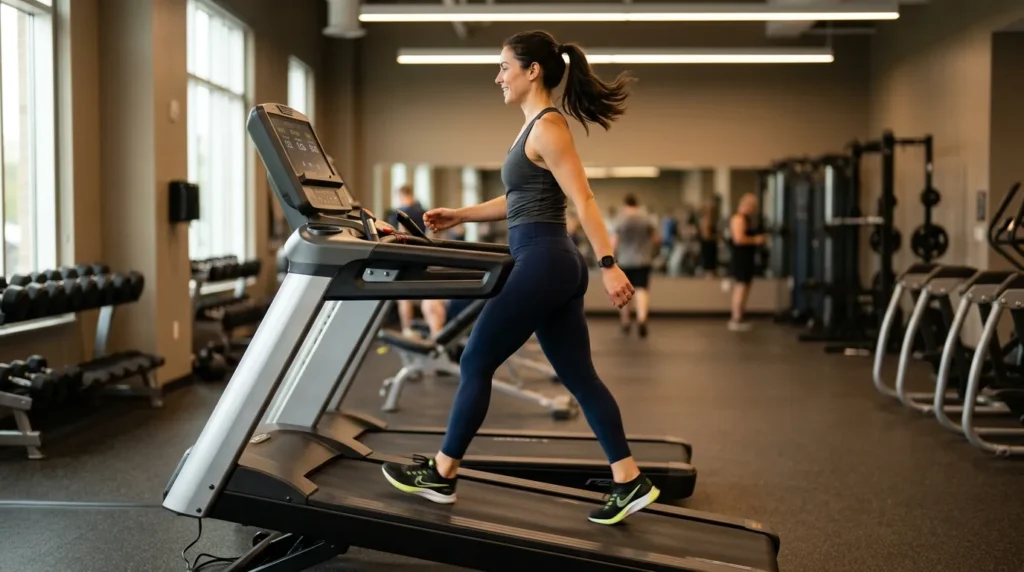
Incline Walking: Calorie Burn by Weight, 4-Week Plan and What Works
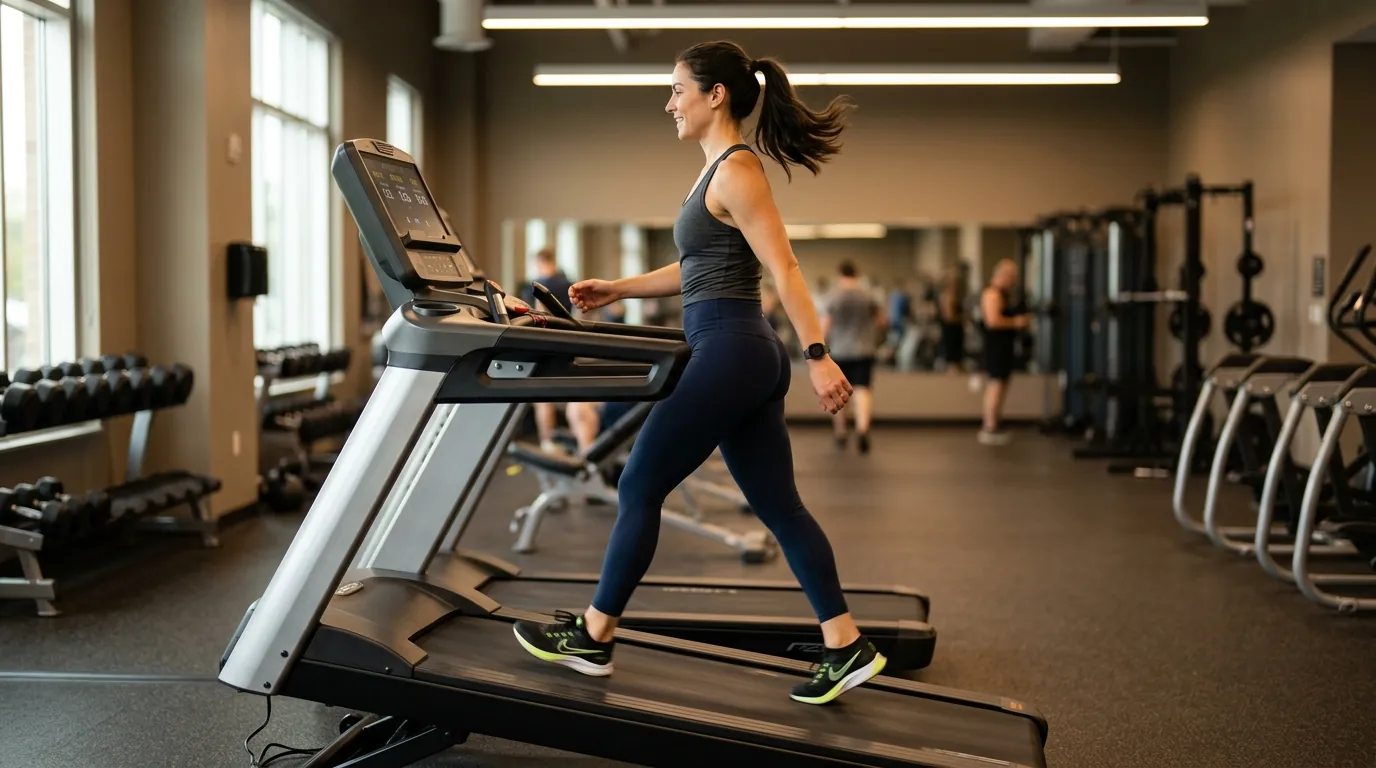
TL;DR — How Effective Is Incline Walking, Really?
Incline walking burns 30–88% more calories than flat walking at the same speed, depending on the grade. A 155 lb person walking 3.0 mph at 10% incline burns roughly 199 calories in 30 minutes versus 126 on flat ground. This guide gives you a calorie burn table by body weight and incline, a 4-week progressive plan, and honest answers about fat loss — including why spot reduction is a myth.
Table of contents
What Is Incline Walking and Why Does It Work?
Incline walking is walking on a treadmill or hill set to a gradient of 1–15%, which forces your body to recruit more muscle fiber and expend more energy than flat walking. It strengthens the glutes and hamstrings and offers a low-impact alternative to running for cardiovascular fitness.
The mechanics are straightforward. Steeper grades shift your center of mass forward and demand more work from your posterior chain — glutes, hamstrings, calves — with every step. The energy cost of walking rises roughly 0.2 MET per 1% of grade increase (Source: Compendium of Physical Activities, 2024 update). That’s why a 10% incline nearly doubles the metabolic demand compared to flat ground.
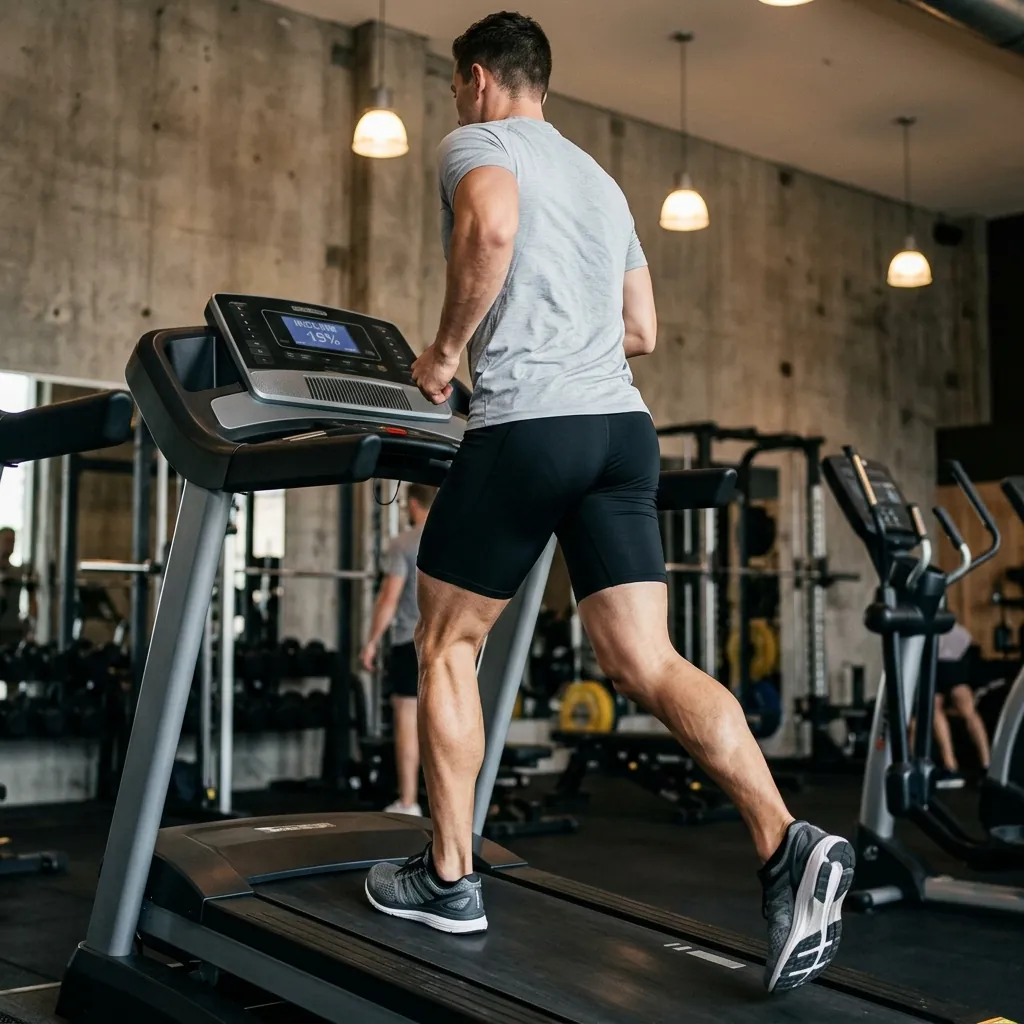
5 Benefits of Incline Walking (Beyond Just Calories)
Incline walking increases calorie expenditure by 30–88% over flat walking while reducing joint impact, making it one of the most efficient low-risk cardio options available.
Burns Significantly More Calories Than Flat Walking
At 3.0 mph, walking on a 12% incline burns about 70% more calories than walking on flat ground — without increasing speed or impact (Source: Compendium of Physical Activities MET values). You’re doing more metabolic work per step simply by fighting gravity.
Activates Glutes, Hamstrings, and Calves More Than Flat Terrain
EMG research shows that a steep incline (10 degrees, roughly 17.6% grade) increases gluteus maximus activation by approximately 25% per step compared to level walking (Source: Himmelreich et al., Goethe University Frankfurt). Over a 30-minute session at roughly 100 steps per minute, that’s 3,000 strides at a meaningfully higher load on your posterior chain.
Easier on Joints Than Running
Walking produces ground reaction forces of about 1.0–1.5 times body weight. Running generates 2.5–3.0 times. Incline walking gives you a higher metabolic cost without the pounding — a relevant tradeoff for anyone with knee issues, higher body weight, or a history of impact injuries.
Builds Cardiovascular Endurance Without High Intensity
A 10% incline at 3.0 mph lands most people at an RPE of 5–6, comfortably in the moderate-intensity zone. That’s enough stimulus to improve VO2max and resting heart rate over time without pushing into threshold territory where form breaks down and fatigue accumulates fast.
Supports Mental Health and Stress Reduction
A 2024 systematic review of 75 randomized controlled trials (8,636 participants) found that walking significantly reduces symptoms of both depression and anxiety (Source: JMIR Public Health and Surveillance, 2024). Adding incline doesn’t change the mental health benefit — it just makes the same walk more productive from a fitness standpoint.
How Many Calories Does Incline Walking Burn?
A 155 lb person burns approximately 199 calories walking at 3.0 mph on a 10% incline for 30 minutes — roughly 58% more than the 126 calories burned on flat ground. The table below shows estimates by weight and incline, calculated from Compendium MET values and the Minetti et al. (2002) gradient energy cost model.
Calorie Burn Table: 30 Minutes at 3.0 mph
| Body Weight | 0% Incline | 5% Incline | 10% Incline | 12% Incline | 15% Incline |
|---|---|---|---|---|---|
| 130 lb (59 kg) | 106 cal | 136 cal | 167 cal | 180 cal | 198 cal |
| 155 lb (70 kg) | 126 cal | 163 cal | 199 cal | 214 cal | 236 cal |
| 180 lb (82 kg) | 146 cal | 189 cal | 232 cal | 249 cal | 274 cal |
| 210 lb (95 kg) | 170 cal | 220 cal | 270 cal | 290 cal | 320 cal |
Formula: MET x body weight (kg) x time (hours) x 1.05. MET values from the Compendium of Physical Activities (2024): 3.4 at 0%, 4.4 at 5%, 5.4 at 10%, 5.8 at 12%, 6.4 at 15%. Individual results vary based on fitness level, walking efficiency, and body composition.
(Source: Ainsworth et al., Compendium of Physical Activities, 2024; Minetti et al., Journal of Applied Physiology, 2002)
Which Muscles Does Incline Walking Target?
Incline walking primarily targets the glutes, hamstrings, and calves — muscles that get minimal activation on flat ground. At 10%+ incline, gluteal engagement increases substantially compared to level walking, and you’ll feel the difference within the first few minutes.
Here’s how the emphasis shifts as incline increases:
| Muscle Group | Role | Activation Increase with Incline |
|---|---|---|
| Gluteus maximus | Hip extension against gravity | Significant increase starting at 5%+; compounds with steeper grades |
| Hamstrings | Assists hip extension, controls stride | Moderate increase, especially at 10%+ |
| Calves (gastrocnemius/soleus) | Ankle push-off on sloped surface | Noticeable increase at all inclines |
| Quadriceps | Knee stabilization | Moderate — less dominant than on flat terrain |
| Hip flexors | Lifts leg higher per step | Slight increase due to greater range of motion |
| Core (stabilizers) | Balance and trunk control | Engaged more as incline reduces handrail temptation |
The posterior chain does more work on an incline because your body has to push upward, not just forward. That’s why incline walking is often recommended for people who sit all day and need to counteract weak glutes — it targets exactly what desk life shuts off. For a full bodyweight program that complements incline walking, see fat loss exercises at home.
What Incline Should You Walk at on a Treadmill?
Most people should start at 3–5% incline and progress to 8–12% over several weeks. The right incline depends on your fitness level and goal.
One important baseline: setting your treadmill to 1% approximates the energy cost of walking outdoors on flat ground, since you don’t have wind resistance indoors (Source: Jones & Doust, Journal of Sports Sciences, 1996). So “0%” on a treadmill is actually slightly easier than walking outside.
Recommended Incline by Fitness Level
- Beginner (1–5% incline): Walk at 2.5–3.0 mph. Good for building base fitness, getting comfortable with the treadmill, and learning proper form without handrails.
- Intermediate (6–10% incline): Walk at 3.0–3.5 mph. Targets fat loss and cardiovascular improvement. This range is where calorie burn increases meaningfully without excessive joint stress.
- Advanced (11–15% incline): Walk at 3.0–3.5 mph. Aggressive posterior-chain work. Requires good ankle mobility and hip stability. Drop speed slightly if form suffers.
By goal: If you’re focused on glute development, aim for 10%+ at a moderate pace. For general fat loss, 6–10% gives the best trade-off between burn rate and sustainability. For cardiovascular conditioning, vary the incline within a session — intervals between 5% and 12% keep your heart rate in the right zone without monotony.
Is Incline Walking Better Than Running for Fat Loss?
Incline walking burns fewer total calories per minute than running but oxidizes a higher percentage of fat, with significantly lower injury risk. For sustainable fat loss, incline walking wins for most people — not because it’s “better” in a vacuum, but because it’s easier to do consistently.
A 2025 University of Nevada Las Vegas study found that participants burned approximately 308 calories during 30 minutes of incline walking, with about 41% of energy coming from fat. During self-paced running matched for total energy expenditure, fat made up only 33% of fuel (Source: University of Nevada Las Vegas, 2025).
Incline Walking vs. Running: Side-by-Side Comparison
| Factor | Incline Walking (10%, 3.0 mph) | Running (6.0 mph, flat) |
|---|---|---|
| Calories / 30 min (155 lb) | ~199 | ~330 |
| Fat oxidation % | ~41% | ~33% |
| Ground impact (x body weight) | 1.0–1.5x | 2.5–3.0x |
| Injury risk | Low | Moderate–High |
| Accessibility (beginners) | High | Lower |
| Long-term adherence | Higher for most | Lower dropout rate studies show |
The bottom line: running burns more total calories per minute. But if you can’t run — or won’t run consistently — incline walking at a steep grade gets you 60–70% of the calorie burn with a fraction of the injury risk. Total deficit over weeks matters more than burn rate in a single session. For more approaches to body recomposition, see calisthenics for weight loss.
Can Incline Walking Help You Lose Thigh or Belly Fat?
No — incline walking cannot target fat loss in your thighs or belly specifically. A meta-analysis of 13 studies with 1,158 participants found zero evidence that exercising a body part reduces fat in that area. The pooled effect was -0.03 (p = 0.508) — statistically, nothing (Source: Ramirez-Campillo et al., Human Movement, 2022).
Here’s what incline walking actually does for your legs: it creates a calorie deficit (which drives overall fat loss from wherever your body stores it most) and builds muscle in your glutes, hamstrings, and calves. Stronger, more defined leg muscles under less fat creates the visual result most people are after. But the fat comes off based on genetics and hormones, not which muscles you’re working.
So if someone told you that incline walking “targets thigh fat” — they’re either misinformed or selling something. Incline walking is excellent for fat loss. It’s just whole-body fat loss, distributed by your biology, not your treadmill settings. For an honest breakdown of what works for midsection fat, see lower belly fat workout.
The 12-3-30 Workout: Who It Suits and Who Should Modify
The 12-3-30 workout — 12% incline, 3.0 mph, 30 minutes — is a solid intermediate incline protocol, but 12% incline is too aggressive for beginners and the fixed structure lacks progressive overload. Most people benefit from building up to it rather than jumping straight in.
The protocol works for people who already have a baseline of cardiovascular fitness and can maintain good form (no handrails, no backward lean) at 12% for the full 30 minutes. That’s a narrower group than social media suggests.
Who should modify:
- True beginners: Start at 4–6% and build up. Jumping to 12% often means holding the rails, which defeats the purpose.
- People with knee or ankle issues: 12% demands significant ankle dorsiflexion. Drop to 8–10% and see how your joints respond over two weeks before progressing.
- Anyone who can’t maintain form for 30 minutes: Reduce the incline, reduce the time, or both. A quality 20-minute session at 8% beats a sloppy 30 minutes at 12%.
The bigger problem with 12-3-30 is that it’s a single workout repeated indefinitely. No progression in incline, speed, or duration means your body adapts and the stimulus plateaus. The 4-week plan below fixes that.
4-Week Progressive Incline Walking Plan
This plan starts at a manageable 2–4% incline and gradually builds to 8–12%, increasing duration and frequency each week. Follow it to build fitness safely before attempting protocols like 12-3-30.
| Week | Sessions/Week | Incline Range | Speed (mph) | Duration (min) | RPE Target |
|---|---|---|---|---|---|
| 1 | 3 | 2–4% | 2.8–3.0 | 20 | 4–5 |
| 2 | 3 | 4–6% | 3.0 | 25 | 5–6 |
| 3 | 4 | 6–8% | 3.0–3.2 | 25–30 | 5–6 |
| 4 | 4 | 8–12% | 3.0–3.5 | 30 | 6–7 |
RPE = Rate of Perceived Exertion on a 1–10 scale. 4–5 means you can hold a conversation comfortably. 6–7 means talking takes effort.
How to use this plan: Warm up for 3–5 minutes at 0% incline before each session. Cool down with 3 minutes at 0–1%. If any week feels too hard, repeat it before moving on. Progression means nothing if form breaks down.
Ready to advance after Week 4? Ask yourself: Can you complete 30 minutes at 12% incline, 3.0 mph, without holding the handrails, at an RPE of 5–6? If yes, you’re ready for the 12-3-30 protocol or can push to 15% incline for shorter intervals. If not, repeat Weeks 3–4 until you can. On non-treadmill days, try these fat loss exercises at home to maintain your calorie deficit.
3 Form Mistakes That Kill Your Calorie Burn
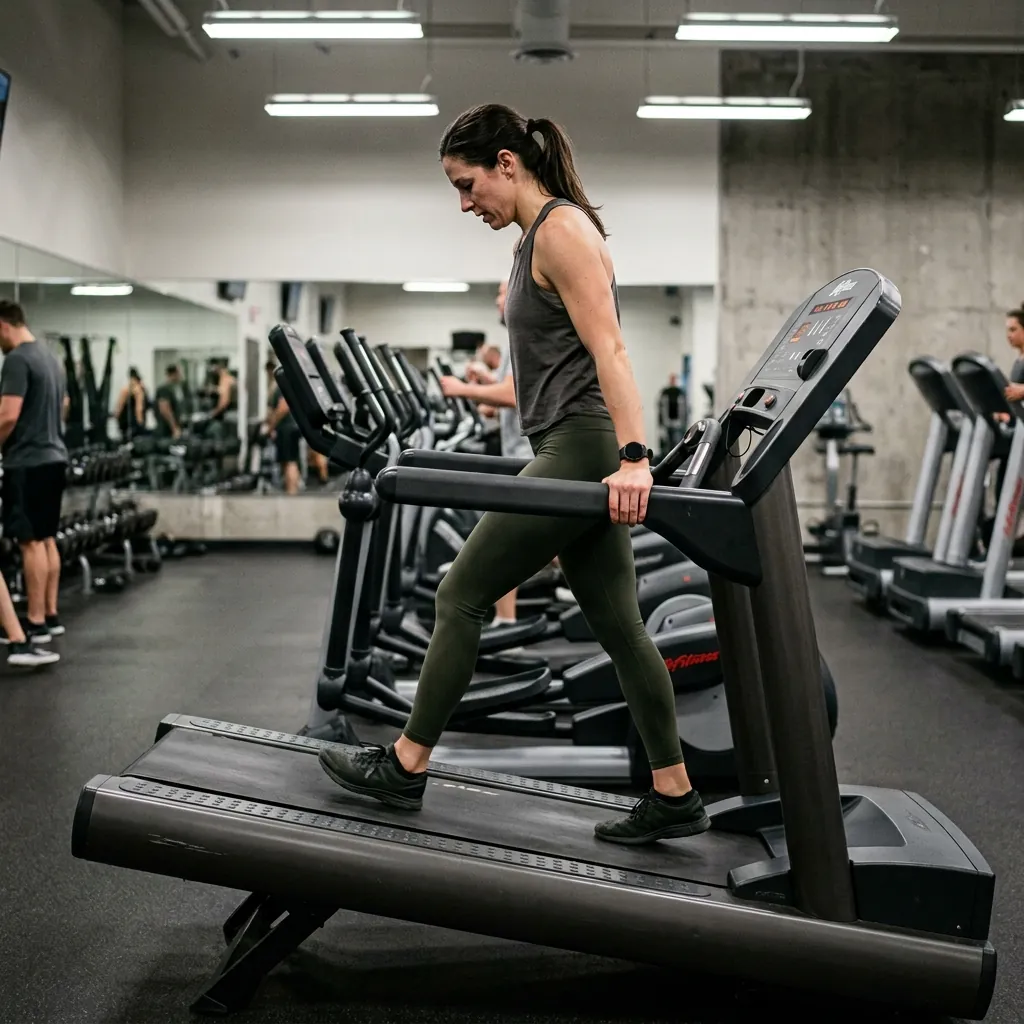
Holding the handrails is the most common incline walking mistake and it reduces your calorie burn by 20–25% (Source: Collette et al., 1994; confirmed by a 2014 University of Massachusetts Lowell study showing up to 31.8% reduction). Let go, shorten your stride, and lean slightly forward to get the full benefit.
1. Holding the Handrails
When you grip the rails, you transfer body weight onto your arms and reduce the workload on your legs — the exact muscles you’re trying to train. The ACSM recommends using handrails only while mounting the treadmill or if you’re about to fall. If you can’t walk without holding on, the incline is too steep for you right now. Drop it 2–3% and build up.
2. Leaning Backward
A common compensation for steep inclines. Leaning back shifts load away from your glutes and hamstrings and dumps it into your lower back. Instead, maintain a slight forward lean from your ankles — think “walking into a hill,” not away from it. Your torso should stay stacked over your hips.
3. Overstriding
Taking long steps on an incline reduces efficiency and increases stress on your shins. Shorter, quicker steps keep your foot landing beneath your center of mass and maintain a natural cadence. If your shins hurt after incline walking, overstriding is the most likely culprit.
Frequently Asked Questions
Is incline walking better than running for fat loss?
For most people, yes — not because it burns more calories per minute (it doesn’t), but because it’s more sustainable. Incline walking at 10% burns about 60% of the calories running does, with significantly lower joint impact and higher long-term adherence. Fat loss comes from consistent calorie deficits, and you’re more likely to stick with incline walking over months.
How long should you walk on an incline treadmill?
Start with 20 minutes and build to 30–40 minutes over several weeks. Sessions beyond 45 minutes at steep inclines offer diminishing returns for most people and increase fatigue-related form breakdowns. Three to four sessions per week at 25–30 minutes is a solid target for fat loss.
What incline should I walk on a treadmill to lose weight?
Aim for 6–10% at 3.0 mph as your working range. This zone meaningfully increases calorie burn (roughly 45–60% above flat walking) without requiring advanced fitness. Start at 4–5% if you’re new to incline walking and progress by 1–2% each week.
Does incline walking build glutes?
It strengthens and activates them significantly more than flat walking. EMG studies show increased gluteus maximus activation at inclines above 5%, with steeper grades producing greater engagement (Source: Himmelreich et al., Goethe University Frankfurt). For actual muscle hypertrophy (growth), you’ll eventually need to add resistance training — incline walking alone likely won’t produce substantial size gains, but it’s a strong foundation.
Is incline walking bad for your knees?
Generally, no. Incline walking produces lower ground reaction forces than running and less knee flexion stress than downhill walking or stair descent. People with existing knee conditions should start at lower inclines (3–5%) and monitor for discomfort. If anything, strengthening the muscles around the knee through incline walking can improve joint stability over time.
Can you lose belly fat by walking on an incline?
You can lose belly fat by walking on an incline, but not because it targets your belly. Incline walking burns calories and contributes to a calorie deficit, which drives fat loss from all over your body. Where you lose fat first is determined by genetics and hormonal factors, not the type of exercise you do (Source: Ramirez-Campillo et al., Human Movement, 2022).
Sources
- Ainsworth, B.E. et al. (2024). “2024 Adult Compendium of Physical Activities.” Compendium of Physical Activities
- Minetti, A.E. et al. (2002). “Energy cost of walking and running at extreme uphill and downhill slopes.” Journal of Applied Physiology, 93(3), 1039–1046. PubMed
- Ramirez-Campillo, R. et al. (2022). “A proposed model to test the hypothesis of exercise-induced localized fat reduction (spot reduction), including a systematic review with meta-analysis.” Human Movement, 23(3), 1–14. Human Movement Journal
- Jones, A.M. & Doust, J.H. (1996). “A 1% treadmill grade most accurately reflects the energetic cost of outdoor running.” Journal of Sports Sciences, 14(4), 321–327. PubMed
- Collette, R. et al. (1994). Effect of handrail support on metabolic cost of walking. Medicine & Science in Sports & Exercise.
- JMIR Public Health and Surveillance (2024). “The Effect of Walking on Depressive and Anxiety Symptoms: Systematic Review and Meta-Analysis.” JMIR
- University of Nevada Las Vegas (2025). Fat oxidation comparison between incline walking and running.



Pingback: Heart Rate Zones for Working Out: Chart by Age + Calculator