TL;DR — What Is a Straight-Arm Plank and How Does It Compare to a Forearm Plank?
A straight-arm plank (also called a high plank) is a plank held on your hands with elbows locked instead of resting on your forearms. It hits your shoulders, chest, and triceps harder than the forearm version because your arms are doing structural work, not just your core. Contrary to what most fitness sites claim, the one EMG study that actually measured this, an Old Dominion University thesis, found the forearm plank produced higher muscle activation in the rectus abdominis, external obliques, and even the anterior deltoid than the straight-arm plank did (Source: Clark, Old Dominion University, 2015). Use the straight-arm plank when you want to train pressing stability and wrist strength alongside your core, not because it’s automatically the “harder” ab exercise.
Table of contents
What Is a Straight-Arm Plank (High Plank)?
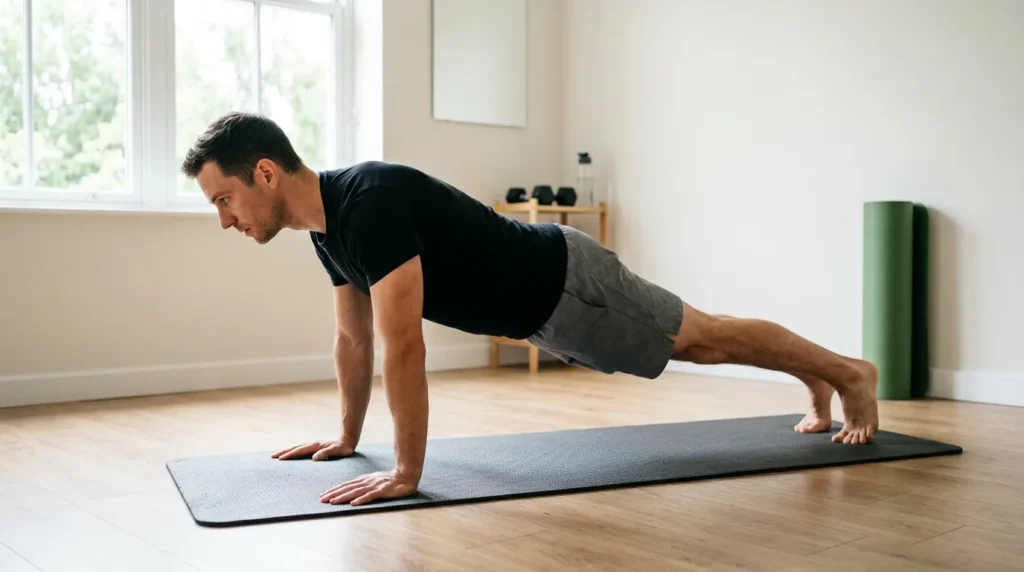
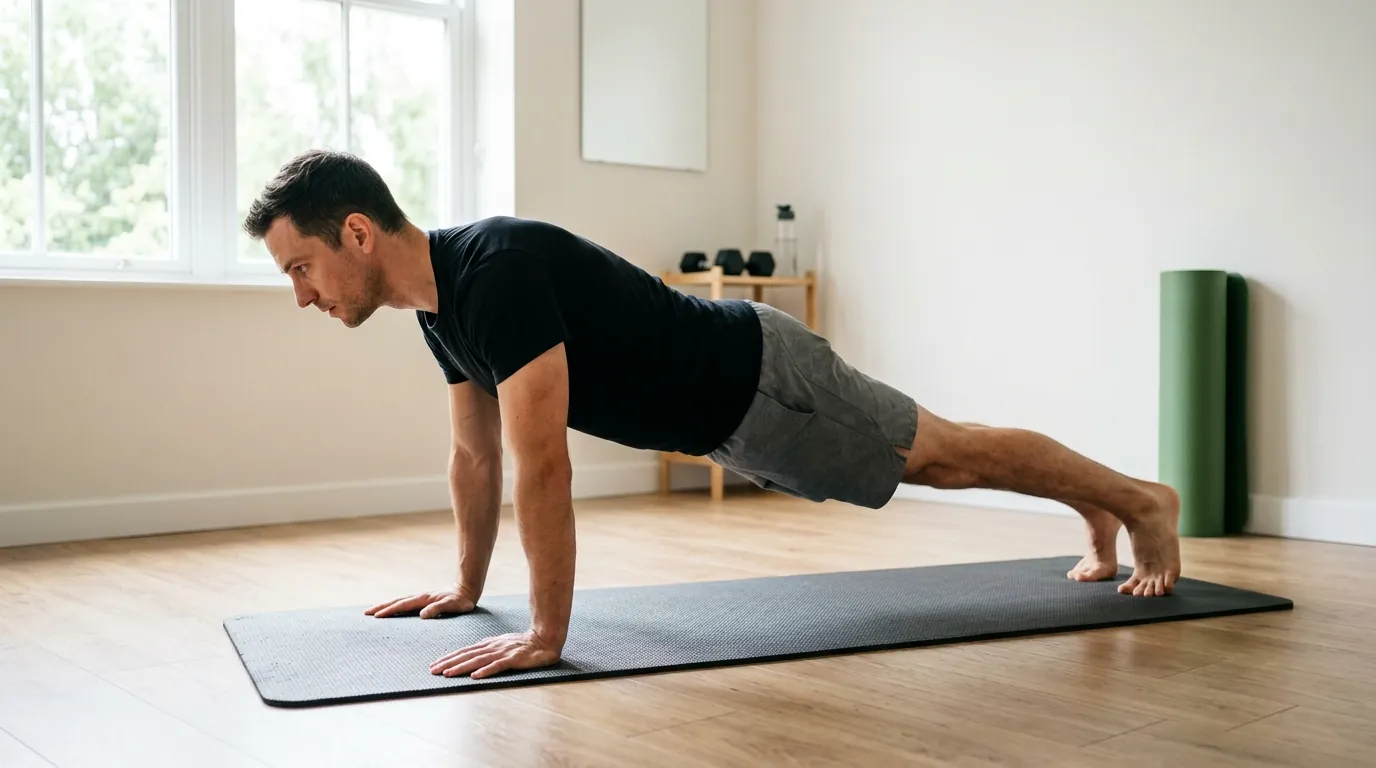
A straight-arm plank is a plank performed with your hands flat on the floor directly under your shoulders and your elbows locked, so your body forms one straight line from head to heels, essentially the top position of a push-up, held. It’s sometimes called a “full plank” or “high plank” to distinguish it from the forearm (low) plank, where you’re propped on your elbows instead of your hands.
For step-by-step forearm plank form, see our how to do a plank guide — this article covers the hand-supported variation specifically.
How to Do a Straight-Arm Plank
Set your hands under your shoulders, lock your elbows, and squeeze your glutes and abs so your hips stay level with your shoulders — not piked up, not sagging down. Hold that line while breathing normally.
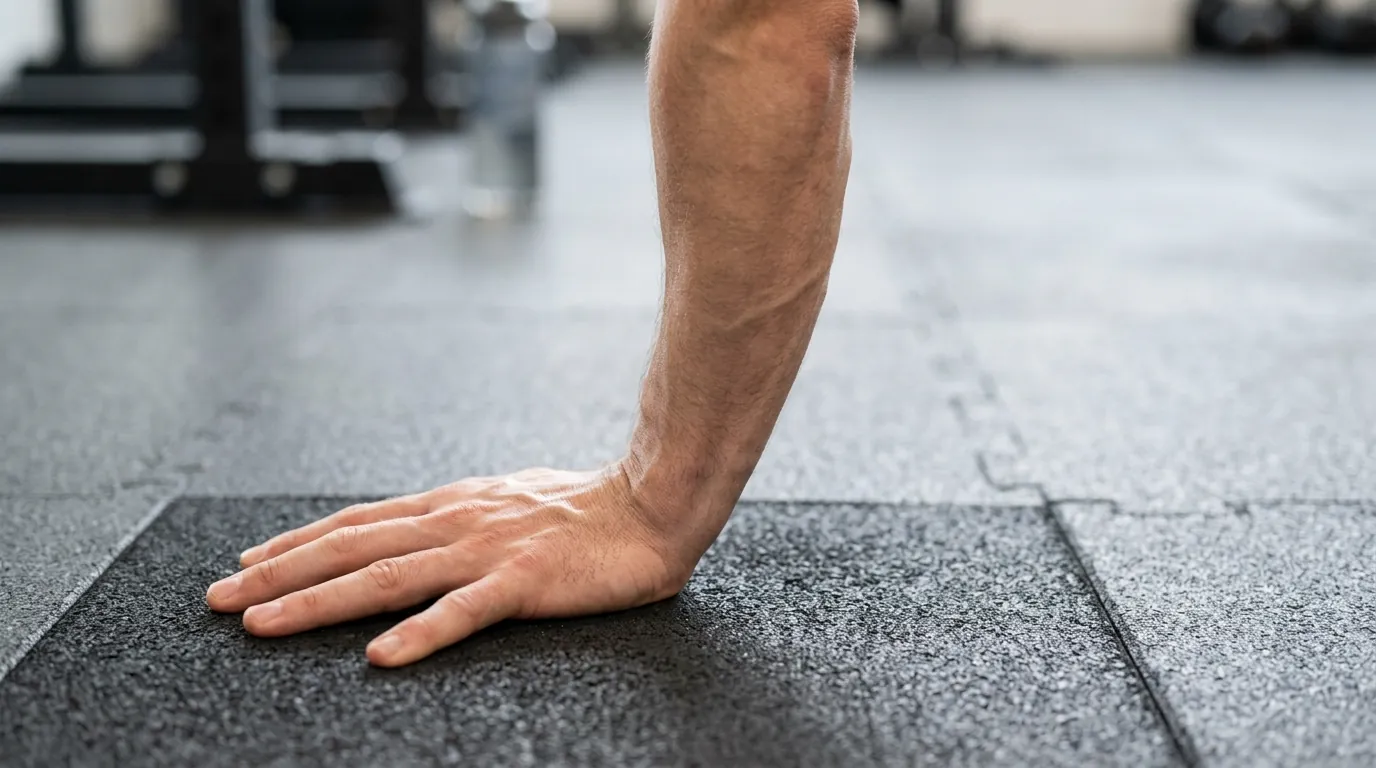
- Hand placement: Palms flat, fingers spread, positioned directly under your shoulders — not out in front of you. Pushing the floor away (protracting your shoulder blades slightly) takes pressure off your lower back.
- Arm position: Lock your elbows without hyperextending them. You want a straight bone-on-bone line from wrist to shoulder, not a soft bend that shifts the load into your triceps and shoulders unevenly.
- For your spine and hips, draw a line from your ears through your shoulders, hips, and ankles, and hold it there. Brace your abs like you’re about to take a punch, and squeeze your glutes so your lower back can’t sag.
- Keep your gaze on the floor a few inches in front of your hands; cranking your head up strains your neck and drags your hips out of position with it. Set your feet hip-width apart with toes tucked under. A narrower stance is harder to balance, a wider one is more forgiving while you’re still learning the hold.
- Don’t hold your breath. Slow nasal breathing while staying braced keeps you from shaking out early.
Hold for time, then reset — don’t let form break down chasing a number. For how long you should actually be holding based on your training level, see how long should you hold a plank.
Muscles Worked
The straight-arm plank is still primarily a core-stability exercise: rectus abdominis, transverse abdominis, and obliques all fire isometrically to keep your spine from moving. What changes versus the forearm version is the arm and shoulder demand: with your elbows locked and your hands on the floor, your triceps, anterior deltoids, and serratus anterior have to do real structural work to keep your arms rigid and your shoulder blades stable, and your wrists take load in extension that a forearm plank never asks for.
That’s the honest version of “harder.” That extra difficulty shows up in your upper body and wrists, not your abs — worth knowing before you pick a variation for a specific goal.
Straight-Arm Plank vs. Forearm Plank: Comparison Table
Most articles on this topic cite an unsourced “study” claiming the forearm plank beats the straight-arm plank for ab activation, without a link or author attached to it. We went and found an actual EMG study that tested this: a 2015 Old Dominion University thesis that measured anterior deltoid, rectus abdominis, and external oblique activation across forearm, straight-arm, and a foam-block-assisted plank in 19 physically active adults (Source: Clark, Old Dominion University, 2015). The result cuts against the common claim: the forearm plank actually produced higher average activation than the straight-arm plank in all three muscles measured: anterior deltoid (42.0% vs. 39.1% MVIC), rectus abdominis (30.2% vs. 20.1% MVIC), and external oblique (29.7% vs. 22.2% MVIC).
That study didn’t measure triceps, wrist flexors, or serratus anterior loading, so it doesn’t settle the shoulder/chest/arm question — mechanically, locking your elbows and bearing weight through your wrists clearly recruits your triceps and wrist stabilizers in a way a forearm plank simply can’t, since your forearms are flat on the ground. Use the table below as the practical breakdown, not as a claim that one version “burns more.”
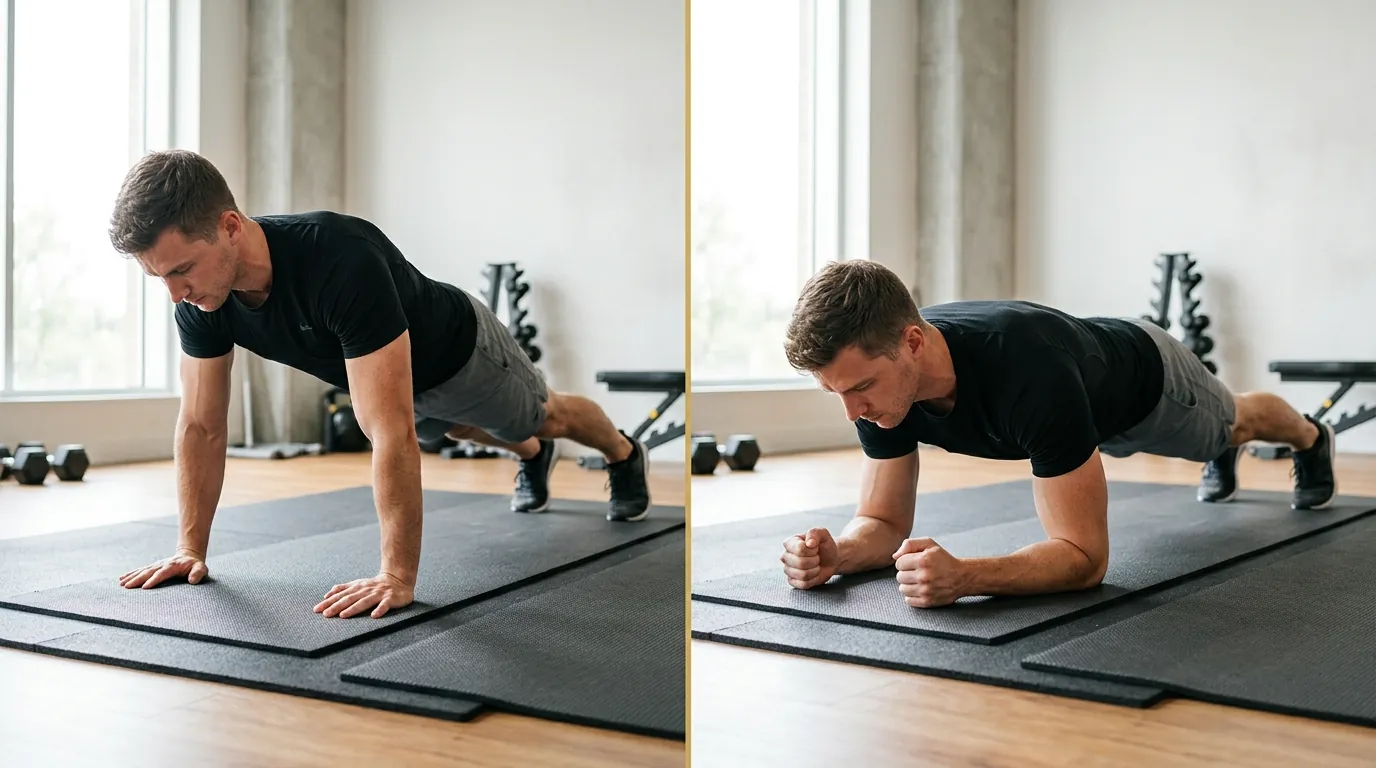
| Factor | Straight-Arm Plank (High Plank) | Forearm Plank (Low Plank) |
|---|---|---|
| Primary muscles | Core stabilizers + triceps, anterior deltoids, serratus anterior, wrist extensors | Core stabilizers, with higher measured RA and oblique EMG activation (Source: Clark, ODU, 2015) |
| Difficulty | Higher upper-body and wrist demand; easier to cheat with locked elbows | Lower joint load, but harder to disguise a weak core since there’s less arm support |
| Wrist/shoulder demand | High: full bodyweight through wrist extension and shoulder stabilizers | Low: weight distributed through forearms, no wrist extension |
| Best for | Athletes building push-up/pressing carryover, wrist and shoulder stability work, calisthenics progressions | Beginners, anyone with wrist pain, pure core-endurance training |
| Typical hold time | 20–45 seconds for most trained adults before form degrades | 30–60+ seconds; generally sustainable longer since there’s less joint loading |
Who Should Use the Straight-Arm Plank (and Who Shouldn’t)
Use the straight-arm plank if you’re training for push-ups, handstands, or any pressing movement where locked-arm stability matters — it transfers directly. Skip it, or swap to the forearm version, if you have wrist pain, carpal tunnel symptoms, or shoulder impingement, since holding bodyweight through an extended wrist and an actively stabilized shoulder joint tends to aggravate both (Source: NASM, 2024; CopperJoint, 2026).
If wrist load is the issue but you still want the shoulder-stability benefit, try a fist-supported plank or push-up handles to keep the wrist neutral. If it’s shoulder pain specifically, the forearm plank in our how to do a plank guide is the safer default until you’re pain-free.
Common Form Mistakes
- Sagging hips: Usually means your abs and glutes have checked out before your arms have. Reset instead of grinding through it — a sagging plank trains your lower back to compensate, not your core.
- Elbows flaring out to the sides instead of tracking back toward your feet puts unnecessary strain on the shoulder joint. Keep them pointed roughly toward your hips.
- Hips too high is the opposite problem — it turns the exercise into a shoulder stretch instead of a core hold. You should be a straight line, not a tent.
- Neck craning: Looking up or forward instead of down loads your cervical spine and usually drags your hips out of position with it.
Progression Path
Build up in this order rather than jumping straight to a max-effort hold:
- Knee-supported straight-arm plank: Same upper-body position, knees down. Good starting point if a full hold breaks down in under 10 seconds.
- Once you can hold a clean line on your knees for 30+ seconds, progress to a standard full straight-arm plank hold. For target hold times by fitness level, see how long should you hold a plank.
- Added instability: Once the base hold is solid, add single-leg lifts, shoulder taps, or a plank-to-push-up transition to challenge anti-rotation and shoulder stability further.
If you want to see what this looks like at the extreme end of the spectrum, our plank world record piece covers the current record holders — useful context, not a realistic training target.
FAQ
Is a straight-arm plank harder than a forearm plank?
It’s harder on your wrists, shoulders, and triceps, but not necessarily harder on your abs. The only EMG study directly comparing them found the forearm plank produced higher rectus abdominis and oblique activation (Source: Clark, ODU, 2015). “Harder” depends on which joints you’re asking about.
What muscles does the straight-arm plank work?
Rectus abdominis, transverse abdominis, and obliques for spinal stability, plus triceps, anterior deltoids, and serratus anterior to keep your arms locked and shoulder blades stable under load.
Should beginners do straight-arm or forearm plank?
Start with the forearm plank. It’s lower-risk for the wrists, and the measured core activation is at least as high (Source: Clark, ODU, 2015). Add the straight-arm version once you have solid shoulder and wrist stability.
Can you switch between straight-arm and forearm plank in one hold?
Yes — this is a common finisher drill. Lower from a straight-arm plank to your forearms one arm at a time, then push back up, alternating leads. It adds an anti-rotation challenge on top of the isometric hold.
How long should you hold a straight-arm plank?
Most trained adults can hold clean form for 20–45 seconds before the wrists and shoulders start to fatigue faster than the core does. See our plank hold-time guide for benchmarks by age and goal.
Does the straight-arm plank work the chest and shoulders more?
Mechanically, yes, bearing weight through locked elbows and stabilized shoulder blades recruits the chest, shoulders, and triceps in a way the forearm version doesn’t, even though the one EMG study on this specific comparison measured slightly higher anterior deltoid activation in the forearm plank (42.0% vs. 39.1% MVIC) (Source: Clark, ODU, 2015). The study didn’t measure triceps or pectoral activation, so the arm-and-chest-carryover argument for straight-arm planks still holds on biomechanical grounds, just not on the deltoid number alone.
Sources and Verification
- Clark, J.R. (2015). Effects of the JAQBLOQ Forearm and Straight Arm Plank on Core Muscle Activation. Master’s thesis, Old Dominion University. digitalcommons.odu.edu/hms_etds/106
- NASM. Carpal Tunnel Syndrome Corrective Exercise Programming. blog.nasm.org
- CopperJoint (2026). Dorsal Wrist Impingement: Symptoms, Causes, and Treatment Options. copperjoint.com