Updated October 2026
Gymnase Tips is reader-supported. Some links may be Amazon affiliate links; if you buy through them we may earn a small commission at no extra cost to you.
TL;DR — What Are the Best Upper Body Stretches?
The best upper body stretches target your shoulders, chest, upper back, and neck using dynamic moves before lifting and static holds after. This guide covers 12 gym-tested stretches organized by body region, with breathing cues and three ready-to-use routines (5, 10, and 15 minutes) you can run before or after any push, pull, or upper-body session.
Table of contents
Why Upper Body Stretches Matter for Gym Performance
Upper body stretches improve your range of motion on compound lifts like bench press and overhead press, reduce injury risk, and speed recovery between sessions. These upper body flexibility exercises matter most for gym-goers who press and pull heavy multiple times per week. The ACSM recommends stretching at least two to three days per week, holding each stretch for 10-30 seconds and repeating 2-4 times (Source: ACSM, 2025). That translates to deeper bench ROM, healthier shoulders on overhead pressing days, and less stiffness after pulling sessions.
Should You Stretch Before or After an Upper Body Workout?
Do dynamic upper body stretches before your workout to prime your joints and muscles, and static upper body stretches after your workout to improve flexibility and reduce soreness. Dynamic means movement-based: arm circles, wall slides, band pull-aparts . Static means holding a position for 20-45 seconds.
This matters more than most lifters think. A 2024 multilevel meta-analysis by Warneke et al. found that pre-exercise static stretching produces a small but significant force deficit (effect size = -0.21), with the impairment jumping sharply when stretching exceeds 60 seconds per muscle (effect size = -0.84) (Source: Warneke et al., Journal of Sport and Health Science, 2024).
Use dynamic moves as upper body warm up stretches before your first working set. Save static holds as upper body cool down stretches for after your last. For a complete pre-workout warm-up covering your full body, check out our workout mobility routine.
| Pre-Workout (Dynamic) | Post-Workout (Static) | |
|---|---|---|
| Type | Movement-based | Hold-based |
| Duration | 8-12 reps each | 20-45 sec hold each |
| Goal | Warm up, activate muscles | Cool down, lengthen tissue |
| Examples | Arm circles, wall slides, band pull-aparts | Cross-body stretch, doorway chest stretch, cat-cow |
| Strength impact | Neutral or positive | Negative if done before lifting |
12 Best Upper Body Stretches by Muscle Group
These 12 upper body stretches cover every major muscle group from shoulders to upper back. Each includes the target muscle, when to do it relative to your lift, hold time or rep count, and a breathing cue.
Shoulder Stretches
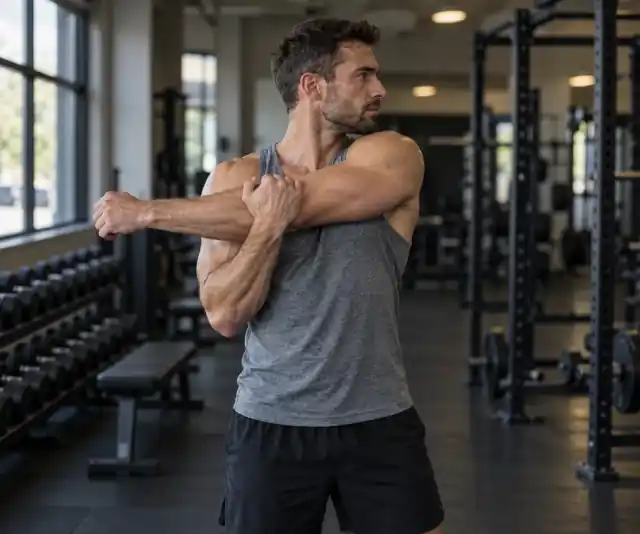
1. Cross-Body Shoulder Stretch (Static)
Target: posterior deltoid, rhomboids. Do this after pull-ups or barbell rows.
Stand tall. Bring one arm across your chest at shoulder height. Use the opposite hand to pull just above the elbow. Hold 30 seconds each side.
Breathe: inhale before pulling, exhale as you settle into the stretch.
Beginner mod: Keep the stretching arm slightly bent to reduce intensity. Advanced mod: Rotate your torso away from the stretching arm for a deeper pull through the rear delt.
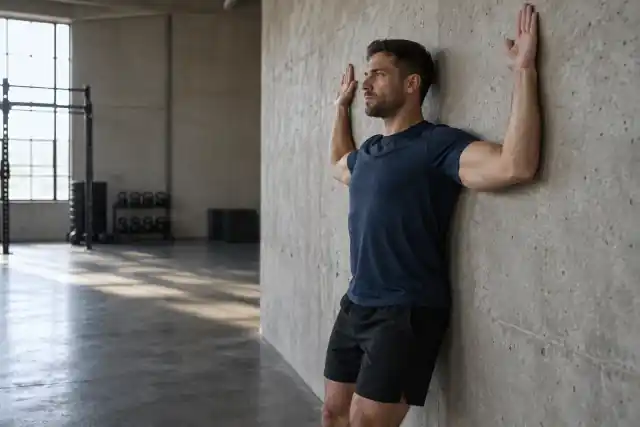
2. Wall Slides (Dynamic)
Target: rotator cuff, lower traps, serratus anterior. Do this before overhead press or bench.
Stand with your back flat against a wall. Press the backs of your hands, elbows, and shoulders into the wall. Slide your arms overhead, keeping all contact points on the wall. Return to the start. 10-12 reps.
Breathe: inhale on the way up, exhale on the way down.
Beginner mod: If you cannot maintain wall contact, step a few inches away from the wall. Advanced mod: Hold a light resistance band between your hands to increase rotator cuff activation.
3. Thread the Needle (Static)
Target: posterior shoulder, thoracic spine. Do this after rows or pull-ups when your upper back feels locked up.
Start on all fours. Slide your right arm under your left arm, lowering your right shoulder to the floor. Hold 30 seconds each side.
Breathe: exhale as you thread through, inhale as you return.
Chest Stretches
These chest and shoulder stretches target the pectorals and anterior delts that get short and tight from pressing movements.
4. Doorway Chest Stretch (Static)
Target: pectorals, anterior deltoids. Do this after bench press or dips.
Stand in a doorway. Place your forearm against the frame at 90 degrees, elbow at shoulder height. Step through with the same-side foot until you feel the stretch across your chest. Hold 30 seconds each side.
Breathe: inhale at the start, exhale and lean slightly deeper every five seconds.
Beginner mod: Place your hand lower on the frame (below shoulder height) to reduce pec strain. Advanced mod: Try three positions, low (45 degrees), mid (90 degrees), and high (135 degrees), for 15 seconds each to target sternal, mid, and clavicular pec fibers separately.
5. Floor Chest Opener (Static)
Target: pectorals, front shoulders. Do this after push-ups or a heavy bench session.
Lie face-down. Extend your right arm out to the side at shoulder height, palm down. Roll onto your right side using your left hand for support. Hold 30 seconds each side.
Breathe: slow exhales through the mouth as you roll deeper.
Upper Back Stretches
These upper back stretches work well in the gym after any pulling or deadlift session. They counter the thoracic flexion that builds up during heavy rows and conventional pulls.
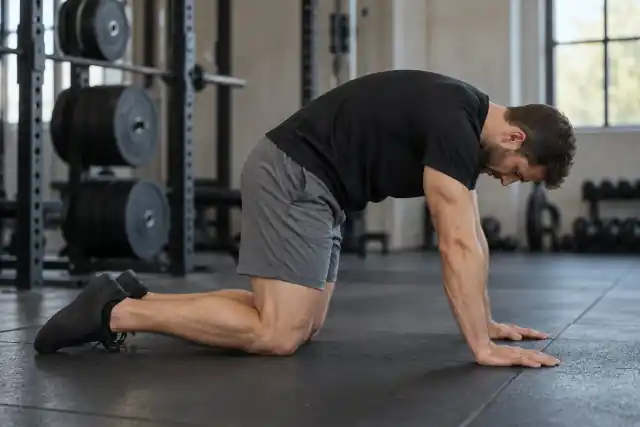
6. Cat-Cow (Dynamic)
Target: thoracic spine, erector spinae. Do this before or after deadlifts and rows to mobilize your mid-back.
Start on all fours, hands under shoulders, knees under hips. Arch your back and drop your belly toward the floor (cow). Then round your back and tuck your chin (cat). 8-10 reps.
Breathe: inhale into cow, exhale into cat.
7. Seated Thoracic Rotation (Dynamic)
Target: thoracic spine, obliques. Do this before rows or after any heavy pulling session.
Sit on a bench or the floor with your legs extended. Cross your arms over your chest. Rotate your torso to one side as far as you can without moving your hips. Return and rotate the other way. 8 reps per side.
Breathe: exhale as you rotate, inhale as you return to center.
8. Foam Roller Thoracic Extension (Static)
Target: thoracic spine, upper back muscles. Do this after deadlifts or any session where you spent time in flexion.
Place a firm foam roller perpendicular to your spine at mid-back level. Support your head with your hands. Let your upper back extend over the roller. Hold 20-30 seconds, then shift the roller up or down an inch and repeat.
Breathe: exhale as you extend over the roller. Let gravity do the work.
Beginner mod: Place a folded towel over the roller for less pressure. Advanced mod: Reach your arms overhead during the extension for a lat and pec stretch on top of the thoracic mobilization.
Neck Stretches
Heavy pressing and pulling tightens the upper traps and cervical muscles. Two stretches handle this.
9. Lateral Neck Tilt (Static)
Target: upper trapezius, levator scapulae. Do this after overhead press or shrugs.
Sit or stand tall. Tilt your right ear toward your right shoulder. Gently place your right hand on the left side of your head. Do not pull, just add light weight. Hold 20 seconds each side.
Breathe: slow exhales through the nose on each side.
10. Chin Tuck (Static)
Target: deep cervical flexors, suboccipital muscles. Do this after any pressing session, or if you spend hours at a desk between workouts.
Stand with your back against a wall. Tuck your chin straight back, creating a “double chin.” Hold for 10 seconds. Repeat 8-10 times.
Breathe: exhale as you tuck, inhale as you release.
Arm and Wrist Stretches
11. Overhead Tricep Stretch (Static)
Target: triceps, lats. Do this after dips, close-grip bench, or skull crushers.
Raise one arm overhead and bend the elbow, reaching your hand toward the opposite shoulder blade. Use the other hand to gently press the elbow back. Hold 30 seconds each side.
Breathe: inhale at the top, exhale as you press deeper.
Beginner mod: Bend your elbow less deeply — reach toward the back of your neck instead of the opposite shoulder blade. Advanced mod: Hold a light dumbbell (2-5 kg) in the stretching hand to add traction through the tricep and lat.
12. Wrist Flexor/Extensor Stretch (Static)
Target: forearm flexors and extensors. Do this after pull-ups, curls, or any grip-heavy work.
Extend one arm in front of you, palm up. Use the opposite hand to pull your fingers toward the floor for the flexor stretch. Hold 20 seconds. Flip your palm down and pull fingers toward you for the extensor stretch. 20 seconds each position, each arm.
Breathe: exhale as you apply pressure, breathe normally through the hold.
For a complete arm stretching routine targeting biceps, triceps, and forearms in depth, see our arm stretches guide.
3 Upper Body Stretching Routines (5, 10, and 15 Minutes)
Pick the routine that fits your schedule. Five minutes covers the essentials after a quick session. Ten minutes adds thoracic and neck work. Fifteen minutes hits every stretch in this guide.
5-Minute Routine
| Stretch | Hold/Reps | Target | Time |
|---|---|---|---|
| Cross-body shoulder stretch | 30s each side | Shoulders | 1:00 |
| Doorway chest stretch | 30s each side | Chest | 1:00 |
| Cat-cow | 8 reps | Upper back | 1:00 |
| Lateral neck tilt | 20s each side | Neck | 1:00 |
| Overhead tricep stretch | 30s each side | Arms | 1:00 |
| Total | 5:00 |
10-Minute Routine
| Stretch | Hold/Reps | Target | Time |
|---|---|---|---|
| Wall slides | 10 reps | Shoulders | 1:00 |
| Cross-body shoulder stretch | 30s each side | Shoulders | 1:00 |
| Thread the needle | 30s each side | Shoulders/Back | 1:00 |
| Doorway chest stretch | 30s each side | Chest | 1:00 |
| Floor chest opener | 30s each side | Chest | 1:00 |
| Cat-cow | 8 reps | Upper back | 1:00 |
| Foam roller thoracic extension | 30s x 3 positions | Upper back | 1:30 |
| Lateral neck tilt | 20s each side | Neck | 0:40 |
| Overhead tricep stretch | 30s each side | Arms | 1:00 |
| Total | ~10:00 |
15-Minute Routine
| Stretch | Hold/Reps | Target | Time |
|---|---|---|---|
| Wall slides | 10 reps | Shoulders | 1:00 |
| Cross-body shoulder stretch | 30s each side | Shoulders | 1:00 |
| Thread the needle | 30s each side | Shoulders/Back | 1:00 |
| Doorway chest stretch | 30s each side | Chest | 1:00 |
| Floor chest opener | 30s each side | Chest | 1:00 |
| Cat-cow | 10 reps | Upper back | 1:30 |
| Seated thoracic rotation | 8 reps/side | Upper back | 1:30 |
| Foam roller thoracic extension | 30s x 3 positions | Upper back | 1:30 |
| Lateral neck tilt | 20s each side | Neck | 1:00 |
| Chin tuck | 10 reps x 10s | Neck | 1:30 |
| Overhead tricep stretch | 30s each side | Arms | 1:00 |
| Wrist flexor/extensor stretch | 20s each position | Arms/Wrists | 1:30 |
| Total | ~15:00 |
How Long Should You Hold Upper Body Stretches?
Hold static upper body stretches for 10-30 seconds per side. For dynamic stretches, perform 8-12 controlled reps. The ACSM recommends 2-4 repetitions of each static stretch (Source: ACSM, 2025), and a 2025 Delphi consensus of 20 international stretching researchers recommends a minimum of 2 bouts of 5 to 30 seconds for acute range-of-motion gains (Source: Warneke et al., Journal of Sport and Health Science, 2025).
Beginners should start at 15-20 seconds per hold and build to 30 seconds over two to three weeks. More advanced lifters can push holds to 45 seconds, but skip prolonged static stretching beyond 60 seconds per muscle before any maximal or explosive effort. The 2025 Delphi panel explicitly recommends against it, and Warneke et al.’s 2024 meta-analysis found that stretching durations beyond 60 seconds per bout produced a large force deficit (effect size = -0.84) compared to a small effect at shorter durations (Source: Warneke et al., Journal of Sport and Health Science, 2024). Skip PNF stretching unless you have a partner. It works but is impractical solo.
Can Upper Body Stretches Fix Your Posture?
Upper body stretches can release tight pectorals and anterior deltoids that pull your shoulders forward, but stretching alone is not enough to fix posture. You also need to strengthen your upper back and rear delts. This pattern (tight chest, weak upper back) is what physical therapists call upper crossed syndrome. The 2025 Delphi consensus panel was clear: they do not recommend stretching to promote postural changes (Source: Warneke et al., Journal of Sport and Health Science, 2025). If you deal with stretches for upper body pain tied to desk posture or heavy pressing, the combination of stretching and strengthening is the actual fix.
Pair your chest and shoulder stretches with face pulls, band pull-aparts, and rows. A doorway pull-up bar doubles as a chest stretch anchor and a back-strengthening tool. For full joint mobility drills beyond stretching, see our calisthenics mobility exercises guide.
FAQ
What is the best single stretch for the upper body?
The cross-body shoulder stretch. It hits the posterior deltoid, rhomboids, and upper traps in one move. Hold 30 seconds each side. Coaches recommend it as the go-to stretch between pressing and pulling sets because it addresses the muscles most prone to tightness in gym-goers.
Are dynamic or static stretches better for upper body?
Neither is universally better. Dynamic stretches belong before your workout to warm up joints and activate muscles. Static stretches belong after, when your muscles are warm and you want to lengthen tissue. Using static stretches before lifting can reduce force output. Warneke et al.’s 2024 meta-analysis found a small but significant effect (ES = -0.21), with impairments growing sharply beyond 60 seconds of stretching per muscle (Source: Warneke et al., 2024).
What muscles do upper body stretches target?
Deltoids (all three heads), pectorals, trapezius, rhomboids, latissimus dorsi, rotator cuff muscles, biceps, triceps, forearm flexors and extensors, and the cervical spine muscles. A complete upper body flexibility routine addresses all of these groups.
How do you loosen tight upper arm muscles?
Overhead tricep stretch plus a wrist flexor/extensor stretch. Hold each for 30 seconds per side. For a dedicated routine that covers biceps, triceps, and forearms in depth, see the arm stretches guide linked in the Arm and Wrist Stretches section above.
Sources
- ACSM’s Guidelines for Exercise Testing and Prescription, 12th Edition (Wolters Kluwer, 2025): ACSM Guidelines
- Warneke K, Lohmann LH, et al. “Revisiting the stretch-induced force deficit: A systematic review with multilevel meta-analysis of acute effects.” Journal of Sport and Health Science, 2024;13(6):805-819: PMC
- Warneke K, Thomas E, Blazevich AJ, et al. “Practical recommendations on stretching exercise: A Delphi consensus statement of international research experts.” Journal of Sport and Health Science, 2025;14(6): PMC
- Page P. “Current concepts in muscle stretching for exercise and rehabilitation.” International Journal of Sports Physical Therapy, 2012;7(1):109-119: PMC