By the Gymstips Coaching Team · Last updated October 2026
Gymnase Tips is reader-supported. Some links may be Amazon affiliate links; if you buy through them we may earn a small commission at no extra cost to you.
TL;DR — What Are the Best Glute Exercises for Men?
The best glute exercises for men combine barbell hip thrusts, deep squats, and Romanian deadlifts with unilateral and cable work. Train glutes twice per week using the 4-week progressive program below. EMG research confirms hip thrusts activate the gluteus maximus more than any other barbell exercise. Skip random sets and follow a structured plan.
Table of contents
Why Men Should Train Glutes (It Goes Beyond Aesthetics)
Strong glutes improve your squat and deadlift lockout, reduce lower-back strain, and fix the postural problems that come from sitting eight hours a day. That alone should settle the question of whether guys need direct glute work.
Here is the performance case. In a study of 12 male team sport athletes, peak sprint velocity correlated strongly with horizontal ground reaction force during the barbell hip thrust (r = 0.69) (Source: Williams et al., Journal of Strength and Conditioning Research, 2021). The gluteus maximus is the primary hip extensor. Weak glutes force the hamstrings and lower back to compensate during heavy pulls, which is exactly why hamstring strains spike in athletes with poor glute activation.
Anterior pelvic tilt is another issue. One study of 120 healthy adults found that 85% of males presented with some degree of anterior pelvic tilt (Source: Herrington, Manual Therapy, 2011). Prolonged sitting tightens the hip flexors and weakens the glutes, making this worse. Direct glute training with full hip extension (hip thrusts, glute bridges) counteracts this pattern.
The bottom line: if you squat, deadlift, sprint, or sit at a desk, your glutes need dedicated work.
10 Best Glute Exercises for Men, Ranked by Muscle Activation
The best glute exercises for men prioritize heavy compound movements that drive high muscle activation. Based on EMG research, the barbell hip thrust leads for peak gluteus maximus recruitment, followed by deep back squats and Romanian deadlifts (Source: Contreras et al., Journal of Applied Biomechanics, 2015). The selection below mixes bilateral, unilateral, and isolation work to cover all three glute regions. For the complete ranking, see our full EMG-ranked glute exercise guide.
- Barbell Hip Thrust
- Back Squat (below parallel)
- Romanian Deadlift
- Bulgarian Split Squat
- Dumbbell Romanian Deadlift
- Deficit Reverse Lunge
- Cable Pull-Through
- Leg Press (high and wide foot placement)
- Hip Abduction Machine
- Single-Leg Glute Bridge
Barbell Compound Moves
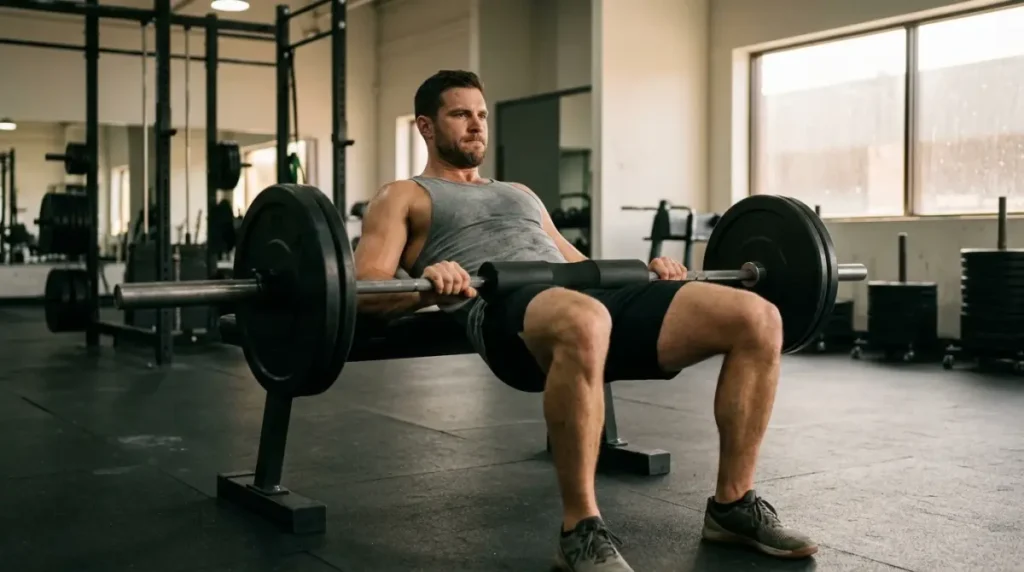
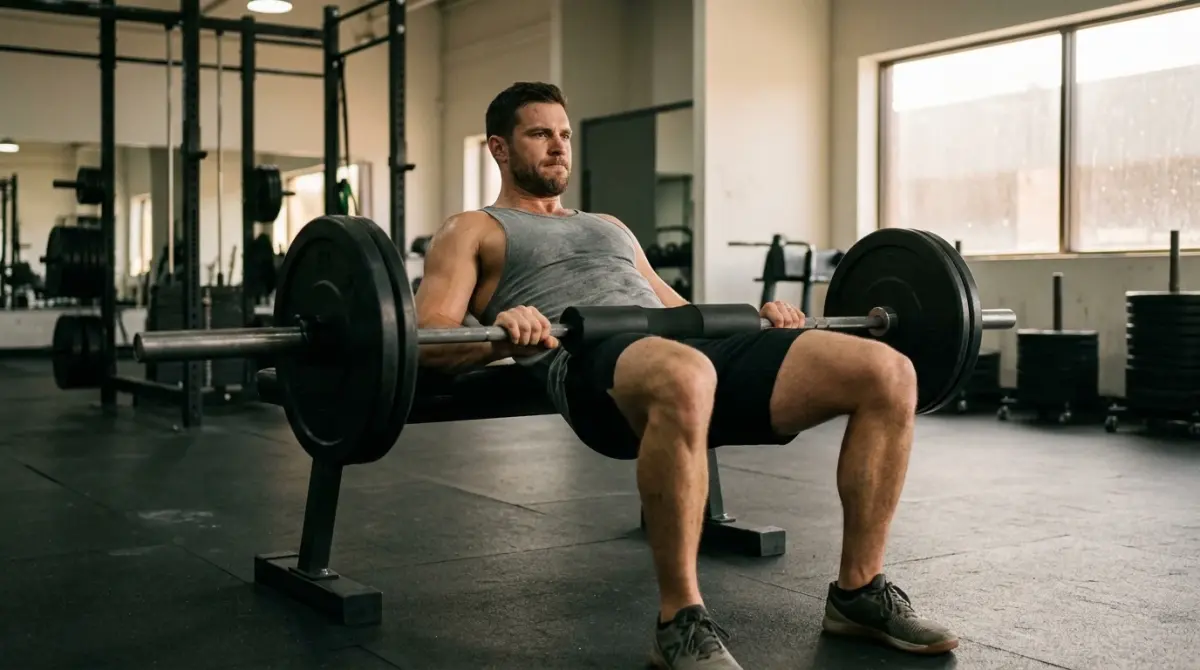
1. Barbell Hip Thrust
The top glute exercise for men by EMG data. Contreras et al. measured mean upper gluteus maximus activation at 69.5% MVIC during the hip thrust versus 29.4% during the back squat (Source: Contreras et al., Journal of Applied Biomechanics, 2015). That gap is not small.
Drive through your heels, squeeze hard at lockout, and keep your chin tucked. A barbell hip thrust pad saves your hip bones.
Sets/reps: 4 x 8-10, RPE 7-8.
2. Back Squat (Below Parallel)
Squats below parallel recruit significantly more gluteus maximus than half squats. The key is depth. If you are stopping at 90 degrees, you are leaving glute activation on the table.
Brace your core, break at the hips and knees simultaneously, and descend until the hip crease drops below the knee. Keep the chest up.
Sets/reps: 4 x 6-8, RPE 7-8.
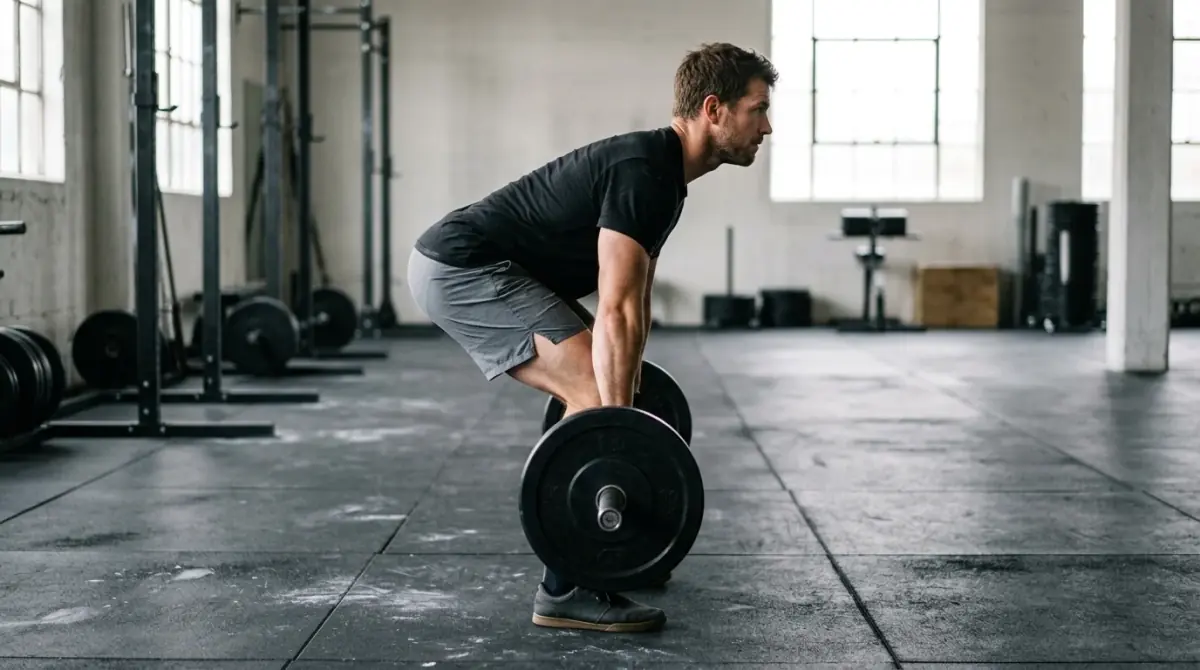
3. Romanian Deadlift
The RDL targets the gluteus maximus through a deep hip hinge with constant tension. It also hammers the hamstrings, making it one of the best posterior chain builders for men.
Hinge at the hips with a slight knee bend, push the hips back, and lower the bar to mid-shin. You should feel a strong stretch in the glutes and hamstrings at the bottom.
Sets/reps: 3 x 8-10, RPE 7-8.
Dumbbell and Unilateral Work
4. Bulgarian Split Squat
Unilateral work corrects left-right imbalances that bilateral lifts mask. The Bulgarian split squat loads each glute independently while also demanding hip stability from the gluteus medius.
Rear foot on a workout bench, front foot far enough forward that the knee tracks over the toes. Drop the back knee straight down.
Sets/reps: 3 x 10-12 each leg, RPE 7-8.
5. Dumbbell Romanian Deadlift
Same hip hinge pattern as the barbell RDL, but adjustable dumbbells allow a slightly different grip path and work well for hypertrophy volume after heavy barbell work.
Sets/reps: 3 x 10-12, RPE 7.
6. Deficit Reverse Lunge
Standing on a 2-4 inch platform increases the range of motion at the hip, which means more gluteus maximus stretch under load. A strong alternative to walking lunges when gym space is limited.
Sets/reps: 3 x 10-12 each leg, RPE 7.
Cable and Machine Exercises
Most men skip cables and machines for glute work entirely. That is a mistake. These exercises provide constant tension through the full range of motion, which free weights cannot match at every joint angle.
7. Cable Pull-Through
Face away from the cable stack, hinge forward, and drive the hips through to lockout. This movement isolates hip extension with no spinal loading. Good for high-rep glute work at the end of a session.
Sets/reps: 3 x 12-15, RPE 7.
8. Leg Press (High and Wide Foot Placement)
Skip the leg press for glutes unless you use a high, wide foot placement. The standard mid-platform position barely activates the glutes. Place your feet near the top of the platform, shoulder-width or wider, and press through your heels.
Sets/reps: 3 x 10-12, RPE 7-8.
9. Hip Abduction Machine
This targets the gluteus medius and upper gluteus maximus, two areas that barbell compounds miss. Sit upright (not leaning forward) and control the eccentric.
Sets/reps: 3 x 15-20, RPE 7.
Bodyweight Activation Moves
These are warm-up and activation tools, not primary builders. Use them before your main session to fire the glutes and reduce lower-back compensation. For a full bodyweight glute routine, see glute exercises you can do at home.
10. Single-Leg Glute Bridge
The single-leg progression adds instability and forces each glute to work independently. Hold the top for two seconds. Once you can hit 15 reps per side with a pause, add load. See bodyweight leg workouts for more progressions.
Sets/reps: 2 x 12-15 each leg, RPE 6.
For lower glute isolation moves targeting the gluteus medius and minimus specifically, we have a separate guide.
Strength Benchmarks: How Strong Should Your Glutes Be?
An intermediate male lifter should be able to hip thrust about 1.3-1.4x bodyweight and Romanian deadlift around 1.1-1.2x bodyweight for working sets of 8-10 reps. If you are below the beginner numbers, that is your starting point. If you are past intermediate, the 4-week program still applies but with heavier loads.
These benchmarks are based on community-sourced strength standards from over 100,000 lifts (Source: Strength Level, 2026). All figures are 1RM values.
| Level | Barbell Hip Thrust (x Bodyweight) | Romanian Deadlift (x Bodyweight) |
|---|---|---|
| Beginner | 0.5x | 0.75x |
| Intermediate | 1.75x | 1.5x |
| Advanced | 2.75x | 2.0x |
For working sets of 8-10 reps, expect to handle roughly 75-80% of your 1RM. That puts an intermediate 80 kg male at about 105-112 kg on the hip thrust and 90-96 kg on the RDL for working sets.
The 4-Week Glute Program for Men
This 4-week program turns the glute exercises for men above into a plan: glutes twice per week with progressive overload, heavy compounds and unilateral isolation split across two sessions. Week 4 is a deload. Follow the progression cues to add weight or reps each week. The program slots into a broader training split. If you are running a hybrid training program, replace your existing glute work with these two days.
Day A — Heavy Compound Focus
| Exercise | Sets | Reps | RPE |
|---|---|---|---|
| Barbell Hip Thrust | 4 | 8-10 | 7-8 |
| Back Squat (below parallel) | 4 | 6-8 | 7-8 |
| Romanian Deadlift | 3 | 8-10 | 7-8 |
Rest 2-3 minutes between sets on all three movements.
Day B — Unilateral and Isolation
| Exercise | Sets | Reps | RPE |
|---|---|---|---|
| Bulgarian Split Squat | 3 | 10-12 /leg | 7-8 |
| Cable Pull-Through | 3 | 12-15 | 7 |
| Hip Abduction Machine | 3 | 15-20 | 7 |
| Single-Leg Glute Bridge | 2 | 12-15 /leg | 6 |
Rest 60-90 seconds between sets. Control every eccentric.
Week-by-Week Progression
Weeks 1-3: Each week, add 2.5-5 kg to your barbell movements OR add 1-2 reps at the same weight. Do not do both. Pick one progression method and stick with it for all three weeks. RPE should stay between 7 and 8 for weeks 1-2, reaching 8-9 by week 3.
Week 4 (Deload): Drop all loads by 40% and reduce volume to 2 sets per exercise. Same movements, same form, lower fatigue. This is where adaptation happens.
A meta-analysis by Schoenfeld et al. found that training each muscle group twice per week produced a greater hypertrophy effect size (ES = 0.49) than once per week (ES = 0.30) (Source: Schoenfeld et al., Sports Medicine, 2016). Two sessions per week also spreads volume better across the week, reducing per-session fatigue.
3-Move Glute Warm-Up Before You Start
Do these three activation moves before every glute session to prime the glutes and reduce lower-back compensation. One set each, 30-60 seconds per movement.
- Banded Clamshell — 15 reps per side. Keep the heels together, open the knees against the resistance band.
- Glute Bridge Hold — Hold the top position for 30 seconds. Squeeze hard.
- Lateral Band Walk — 15 steps each direction. Stay low in a quarter-squat position.
For a complete warm-up mobility routine, we have a dedicated guide. After your session, cool down with some thigh stretches for cool-down.
FAQ — Glute Training for Men
How many times a week should men train glutes?
Twice per week with 48-72 hours between sessions. A 2016 meta-analysis in Sports Medicine found that training each muscle group twice weekly produced significantly greater hypertrophy than once weekly (Source: Schoenfeld et al., Sports Medicine, 2016). The program above follows this frequency.
How long does it take to build glutes for men?
Expect measurable hypertrophy at 8-12 weeks of consistent progressive overload. Strength gains come faster, often within 3-4 weeks, because of neural adaptations. Visible changes depend on body fat levels and training history. Stick with the program for at least two full cycles (8 weeks) before judging results.
Do squats alone build glutes for men?
Squats activate the glutes, but hip thrusts produce higher peak activation. Contreras et al. measured mean gluteus maximus EMG at 69.5% MVIC for hip thrusts versus 29.4% for back squats (Source: Contreras et al., Journal of Applied Biomechanics, 2015). Both belong in a complete program. Squats alone will build some glute mass, but a combined approach is more efficient.
Can men grow glutes without hip thrusts?
Yes. Deep squats, RDLs, lunges, and step-ups all recruit the gluteus maximus significantly. A systematic review found step-ups and their variations produced some of the highest glute activation levels among all resistance exercises (Source: Neto et al., Journal of Sports Science and Medicine, 2020). That said, the hip thrust is the most efficient single exercise for glute isolation based on available EMG data.
Can older men build glutes?
Yes. Resistance training builds glute muscle at any age provided progressive overload is present. Start with lighter loads, prioritize form, and progress gradually. The program above works for men over 50 by adjusting the starting weights and extending the progression timeline. Two sessions per week is sufficient.
Sources
- Contreras B, Vigotsky AD, Schoenfeld BJ, et al. “A Comparison of Gluteus Maximus, Biceps Femoris, and Vastus Lateralis Electromyographic Activity in the Back Squat and Barbell Hip Thrust Exercises.” Journal of Applied Biomechanics, 2015;31(4):452-458.
- Williams MJ, Gibson NV, Sorbie GG, et al. “Activation of the Gluteus Maximus during Performance of the Back Squat, Split Squat, and Barbell Hip Thrust and the Relationship with Maximal Sprinting.” Journal of Strength and Conditioning Research, 2021;35(1):16-24.
- Schoenfeld BJ, Ogborn D, Krieger JW. “Effects of Resistance Training Frequency on Measures of Muscle Hypertrophy: A Systematic Review and Meta-Analysis.” Sports Medicine, 2016;46(11):1689-1697.
- Herrington L. “Assessment of the degree of pelvic tilt within a normal asymptomatic population.” Manual Therapy, 2011;16(6):646-648.
- Neto WK, Soares EG, et al. “Gluteus Maximus Activation during Common Strength and Hypertrophy Exercises: A Systematic Review.” Journal of Sports Science and Medicine, 2020;19(1):195-203.
- Strength Level. “Hip Thrust Standards for Men and Women (kg).” Retrieved October 2026.
- Strength Level. “Romanian Deadlift Standards for Men and Women (lb).” Retrieved October 2026.