
Last updated: April 2026 — written by James Nolan, Gymnase Tips senior trainer.
Yes, you can gain muscle with calisthenics — the research is clear that bodyweight training produces hypertrophy comparable to free-weight training when volume, intensity, and proximity to failure are matched. Expect 8 to 15 pounds of lean muscle in year one as an untrained male adult, 4 to 8 pounds as an untrained female adult. The real question is not whether calisthenics builds muscle, but how far you can progress before bodyweight training stops providing enough overload.
This article answers honestly: what the science says, what to expect in your first year, where calisthenics plateaus, and the programming structure that actually produces muscle with bodyweight alone.
Quick Answer — Can You Gain Muscle With Calisthenics?
- Short answer: Yes — research shows hypertrophy comparable to free weights when volume, intensity, and proximity to failure are matched.
- Year-one gains: 8–15 lbs lean muscle (untrained men), 4–8 lbs (untrained women).
- The 3 requirements: Progressive overload, 10–20 working sets per muscle/week, sets within 1–3 reps of failure.
- Where it plateaus: Absolute leg mass, lateral delts, elite-level size (220+ lbs lean).
- Best for: Athletic build, V-taper physique, relative strength, joint-friendly training.
Table of Contents
- What the Research Says
- Where Calisthenics Wins
- Where Calisthenics Hits Its Ceiling
- The Programming That Builds Muscle
- What to Expect in Year One
- Minimum Effective Program
- FAQ
What the Research Says About Gaining Muscle With Calisthenics
Research on bodyweight resistance training consistently demonstrates that push-up, pull-up, and dip training produces muscular hypertrophy comparable to bench press and row training when loading, volume, and proximity to failure are equalized. The American College of Sports Medicine classifies bodyweight resistance training as an effective modality for both strength and hypertrophy across all adult populations.
The mechanism is the same regardless of resistance source: muscles respond to mechanical tension and progressive overload. Whether tension comes from a barbell, a dumbbell, or body weight moved through leverage-adjusted ranges of motion is secondary to whether that tension is sufficient and progressively increased over time.
Where Calisthenics Actually Wins
Shoulder and elbow health. The free range of motion in push-ups and pull-ups is less joint-punishing than barbell work for most people. Injury rates among calisthenics athletes are reportedly lower than among powerlifters at matched training age.
Connective tissue strength. High-rep bodyweight work conditions tendons and ligaments along with muscle, creating durable, injury-resistant joints.
Accessibility. Zero equipment cost. No gym commute. The session happens or does not, based on discipline alone.
Relative strength. Calisthenics produces athletes with the highest power-to-bodyweight ratios in any strength discipline. Muscle-ups, levers, and planches demand this trade-off.
Where Calisthenics Hits Its Ceiling
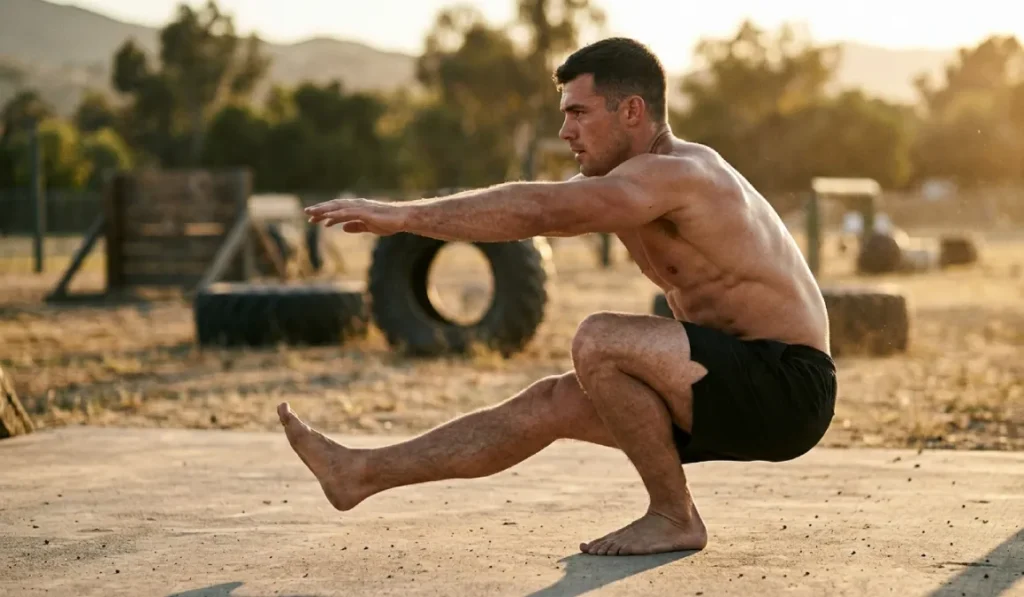
Absolute leg mass. Past a certain point, single-leg variations like pistol squats and shrimp squats max out. A heavy barbell back squat continues to progressively load the legs well past that ceiling.
Lateral delts. Bodyweight movements do not load the lateral delts as efficiently as a dumbbell lateral raise or a heavy overhead press.
Elite-level size. If your goal is 220+ pounds of lean muscle on a 6-foot frame, you will likely need weights eventually. For a typical intermediate physique goal — 180 to 200 pounds lean, visible definition, athletic build — calisthenics is enough.
The Programming That Actually Builds Muscle With Calisthenics
Three principles. Violate any of them and you will not grow.
1. Progressive Overload
Every workout needs to move forward on at least one lever:
- More reps than last session
- Harder variation of the same movement
- Shorter rest between sets
- Added external load (weighted vest, chains)
“Doing push-ups” is not a program. “Doing 3 × 15 this week, 3 × 17 next week, 3 × 20 the week after, then moving to decline push-ups” is a program.
2. Enough Volume
For hypertrophy, each muscle group needs approximately 10 to 20 working sets per week. If you are doing 4 sets of push-ups twice per week, that is 8 chest sets — the bottom of the effective range. Many home lifters under-train by 50 percent and wonder why they do not grow.
3. Proximity to Failure
Sets taken close to failure — within 1 to 3 reps — drive more muscle growth than easy sets. Calisthenics makes it tempting to stop when form gets hard. Do not. Push to 1 rep short of failure on most sets.
What to Expect in Year One
These numbers assume a previously untrained adult with reasonable nutrition (0.7 to 1 gram of protein per pound of bodyweight daily, slight caloric surplus).
| Timeframe | Expected Gains |
|---|---|
| Months 1-3 | Visible muscle in chest, shoulders, back, arms. 5-10 pounds of lean mass for men, 2-5 pounds for women. First pull-up. |
| Months 3-6 | Noticeable V-taper. Handstand against a wall. 10+ pull-ups. Defined abs with diet dialed in. |
| Months 6-12 | Muscle-up possible. One-arm push-up in progression. Pistol squat achieved. 15+ pounds of lean mass for most men. |
Year two produces smaller gains — roughly half the rate of year one — as the beginner-gains window closes.
The Minimum Effective Calisthenics Muscle-Building Program
Four sessions per week, 45 to 60 minutes each, for 12 weeks. Two push sessions, two pull sessions, legs and core integrated.
See our military calisthenics plan for a structured starter program, or our complete progression plan for the full roadmap.
What You Need for Muscle Growth Beyond Training
Protein. 0.7 to 1 gram per pound of bodyweight daily. A 170-pound man needs about 120 to 170 grams.
Calories. A slight surplus — 200 to 400 calories above maintenance — supports muscle gain without excessive fat accumulation. Our muscle-building nutrition guide covers the full breakdown.
Sleep. 7 to 9 hours. Under-sleeping blunts hypertrophy dramatically.
Consistency. 12 weeks of adequate training beats 3 weeks of perfect training.
Can I Gain Muscle With Calisthenics FAQ
How much muscle can I realistically gain with calisthenics in a year?
For untrained adult men: 8 to 15 pounds of lean muscle in year one with proper programming and nutrition. For untrained adult women: 4 to 8 pounds. Year two typically produces half that. These numbers match what free-weight training produces in similar conditions.
Do I need to go to failure every set?
No. Going to true failure every set over-taxes recovery and shortens training careers. Stop most sets 1 to 3 reps before failure. Go to failure occasionally — once every 2 to 3 sessions on an isolation movement.
Is a weighted vest necessary for muscle growth?
Not for your first 6 to 12 months. After that, a weighted vest (or harder progressions like one-arm work) becomes useful for continued overload on easier movements. Pull-ups especially benefit from added weight.
Should I combine calisthenics with weights for maximum growth?
This is the optimal approach for maximum muscle growth. Use calisthenics for pressing, pulling, and skill work; add barbell or dumbbell work for legs and lateral delts. Hybrid athletes develop the best of both systems.
What is the single most important thing for building muscle with calisthenics?
Progressive overload over time. Everything else — perfect form, ideal exercise selection, optimal nutrition — matters less than consistently making each movement harder week over week. That single habit separates the people who grow from the people who plateau.
Can older adults gain muscle with calisthenics?
Yes. Resistance training research in adults over 60 consistently shows meaningful hypertrophy and strength gains across all modalities, including bodyweight training. Start with scaled variations (wall push-ups, inverted rows) and progress at a pace that respects joint health.


Pingback: Muscle Building Guide: 7 Proven Techniques for Max Gains | GymsTips
Pingback: How to Build Muscle Without Weights: 6-Month Bodyweight Plan - gymnasetips.com
Pingback: 5-Day Home Workout Plan (Bodyweight Split)
Pingback: Military Workouts at Home: 4 Branch-Specific Routines