
Last updated: July 2026 — written by James Nolan, NSCA-CPT, Gymnase Tips senior trainer (12 years coaching lifters and endurance athletes).
TL;DR — What should you eat before a workout?
A pre-workout meal pairs 1–4 g/kg of carbohydrate with 0.25–0.4 g/kg of protein, eaten 1–4 hours before training, per the International Society of Sports Nutrition (Source: JISSN, 2017). On short notice, swap to 15–25 g of fast carbs (banana, rice cakes, sports drink) within 15 minutes. Keep fat and fiber low. Fasted training only fits short, low-intensity cardio — not lifting or sessions over 60 minutes.
How long before a workout should you eat?
Eat 1–4 hours before training when you can, and scale the carb dose to the time you have. The ISSN nutrient timing position stand recommends 1–4 g/kg of carbohydrate in the hours before higher-intensity or long-duration work, plus 0.25–0.4 g/kg of high-quality protein to blunt muscle protein breakdown (Source: JISSN, 2017). The bigger the meal, the longer the runway: a 600 kcal plate needs 3 hours; a banana needs 15 minutes. Match meal size to the clock, not the other way around.
Pre-workout meal timing table (3h / 1.5h / 45m / 15m)
This is the table competitor pages skip. Targets are anchored to the ISSN 1–4 g/kg carb range and 0.25–0.4 g/kg protein range (Source: JISSN, 2017), then scaled down as the window shortens to keep the gut clear. For the wider question of timing, see should you eat before or after a workout.
| Window before training | Carbs (g/kg) | Protein (g/kg) | Fat | Fiber | Example (75 kg lifter) |
|---|---|---|---|---|---|
| 3 hours | 2–4 g/kg | 0.3–0.4 g/kg | up to 15 g | up to 8 g | 120 g cooked rice + 180 g chicken + small salad |
| 1.5 hours | 1–2 g/kg | 0.25–0.3 g/kg | under 10 g | under 5 g | 60 g oats + 25 g whey + 1 banana |
| 45 minutes | 0.5–1 g/kg | 0.2–0.25 g/kg | under 5 g | under 3 g | Greek yogurt (200 g) + honey + berries |
| 15 minutes | 15–25 g fast carbs | optional 10–15 g whey | minimal | minimal | Banana + black coffee, or rice cakes + jam |
The longer your runway, the more you can lean on whole foods and slow carbs. The shorter the window, the more you bias to liquid, low-residue, fast-digesting choices to avoid sitting on a full stomach during heavy compounds.

Best Snacks to Eat Before Exercise (Quick List with Carb Counts)
A good snack before exercise is 15–25 g of fast-digesting carbs plus a little protein, eaten 30–60 minutes before you train. Keep the ratio around 2:1 carb-to-protein and go low on fat and fiber so it clears your stomach fast (Source: NASM, 2023). Think half a banana with peanut butter, not a burrito.
That’s the whole trick: enough quick carbs to top off energy, a touch of protein to steady it, and nothing heavy enough to sit and slosh. Below are the specific items I hand clients when they say “just tell me what to grab.” Gram counts are approximate and pulled from USDA figures — brands and sizes shift things a few grams either way.
| Snack | Carbs (g) | Protein (g) | Tag |
|---|---|---|---|
| Medium banana | 27 | 1 | on-the-go, vegan |
| Apple + 1 tbsp peanut butter | 25 | 4 | sweet, vegan |
| 2 plain rice cakes + 1 tbsp honey | 22 | 2 | on-the-go, vegan |
| 1–2 Medjool dates | 18–36 | 2 | sweet, vegan |
| 3/4 cup nonfat Greek yogurt + 1/2 cup berries | 18 | 15 | sweet |
| 1/2 cup cooked oatmeal + drizzle of honey | 20 | 3 | savory-ish, vegan |
| 1 slice whole-grain toast + honey | 22 | 4 | savory |
| 1 oz pretzels | 23 | 3 | savory, on-the-go |
| Unsweetened applesauce pouch | 15 | 0 | on-the-go, vegan |
| Small box of raisins (1.5 oz) | 34 | 1 | on-the-go, vegan |
| 1 cup grapes | 27 | 1 | sweet, vegan |
| 2 fig bars | 22 | 2 | sweet, on-the-go |
| Fruit + veggie squeeze pouch | 16 | 1 | on-the-go, vegan |
| 1 low-sugar protein/granola bar | 20 | 8 | on-the-go |
Quick simple-carb snacks (30–60 minutes before)
When you’ve only got half an hour to an hour, go simple: a banana, a handful of grapes, a couple of rice cakes with honey, or an applesauce pouch. These are almost pure fast carbs, so they hit your bloodstream quickly and don’t need much digesting. The closer you eat to your session, the simpler and lower-fiber the carb should be.
Sweet vs. savory pre-workout snacks
Sweet options — fruit, dates, yogurt with berries — win on speed and are the easiest to stomach right before lifting. If sweet-in-the-morning turns your gut, go savory: pretzels, whole-grain toast, or oatmeal with a pinch of salt do the same job with less sugar hit. Pick whichever you’ll actually eat consistently; adherence beats the “perfect” macro every time.
On-the-go & no-prep snacks (packaged options)
For the commute-to-gym crowd, keep shelf-stable carbs in your bag: pretzels, raisins, fig bars, a squeeze pouch, or a low-sugar bar. Zero prep, no refrigeration, and each lands in the 15–25 g carb window when you keep the serving to one pack. Firsthand note: I keep a box of dates and a sleeve of rice cakes in my gym bag for the days I skip breakfast — cheaper and gentler on the stomach than most pre-workout gels.
Vegan and low-sugar snack swaps
Most items on this list are already plant-based. For lower sugar, lean on savory whole-grain carbs (toast, oatmeal, a few whole-grain crackers) instead of dried fruit and honey, which spike fastest. Want protein without dairy? Add a tablespoon of nut butter or half a scoop of plant protein stirred into the oats.
How many carbs and how much protein? (the g/kg math)
Stop guessing in raw grams — scale by bodyweight. A 70 kg runner and a 110 kg powerlifter have completely different glycogen tanks, and a flat “40 g of carbs” is too much for one and too little for the other.
Worked example, 70 kg lifter, 90 minutes out:
- Carbs at 1.5 g/kg = 105 g
- Protein at 0.3 g/kg = 21 g
- Sample plate: 80 g dry oats (cooked) + 1 large banana + 25 g whey = ~110 g C / 27 g P / 6 g F
Worked example, 90 kg lifter, 90 minutes out:
- Carbs at 1.5 g/kg = 135 g
- Protein at 0.3 g/kg = 27 g
- Sample plate: 300 g cooked white rice + 150 g chicken breast + 1 banana = ~90 g C / 50 g P / 5 g F (round up rice to hit 135 g C if you need it).
Why fat under 10 g and fiber under 5 g within 90 minutes? Both slow gastric emptying. Fat sits in the stomach 3–4 hours; fiber adds bulk that reflux into your diaphragm during squats and deadlifts. Save them for off-training meals.
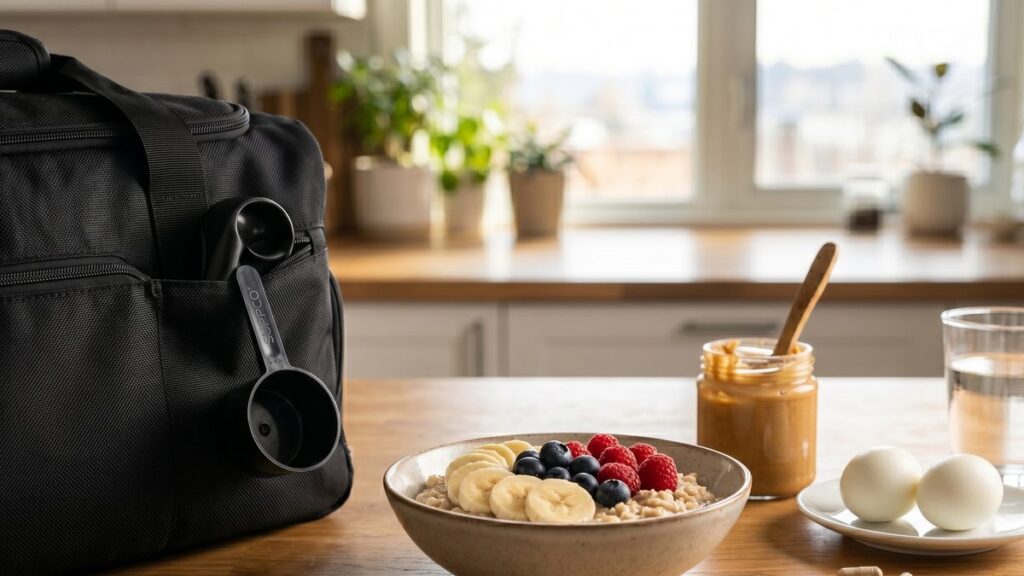
Firsthand note: On a heavy squat day I eat 90 g cooked oats, a banana, and 30 g whey exactly 90 minutes before my first warmup. Anything closer than 60 minutes and the first set of 5 feels like the third.
Goal-specific pre-workout meals
One template does not cover a cutting bodybuilder, a marathoner, and a powerlifter. Pick the card that matches your goal.
Cut (fat loss) — 80 kg lifter, 60–90 min pre
- 40 g dry oats + 25 g whey + 1 medium banana
- Macros: ~45 g C / 28 g P / 4 g F
- Calories: ~320 kcal
- Why it works: Hits 0.6 g/kg carbs and 0.35 g/kg protein on a deficit budget. Enough glycogen top-up to keep working weights, low enough kcal to stay in deficit.
Bulk (hypertrophy) — 90 kg lifter, 90–120 min pre
- 100 g dry white rice (about 300 g cooked) + 150 g grilled chicken + 1 banana
- Macros: ~90 g C / 50 g P / 5 g F
- Calories: ~620 kcal
- Why it works: 1 g/kg carbs plus 0.55 g/kg protein delivers high training volume capacity and a full EAA pool. Eat earlier if you train heavy lower-body.
Endurance — 70 kg runner, 2–3 h pre
- 60 g dry oats + 30 g honey + 200 ml skim milk + 1 banana
- Macros: ~110 g C / 15 g P / 5 g F
- Calories: ~560 kcal
- Why it works: 1.6 g/kg carbs aligns with the ISSN-supported range for sessions over 90 minutes, where pre-exercise CHO is the strongest performance lever (Source: PMC pre-exercise CHO review, 2020).
Strength / powerlifting — 100 kg lifter, 45–60 min pre
- 2 rice cakes + 30 g jam + 30 g whey + black coffee + 1 date
- Macros: ~55 g C / 26 g P / 2 g F
- Calories: ~360 kcal
- Why it works: Low residue keeps the gut quiet under a loaded belt. Fast carbs prime blood glucose for max-effort singles; whey covers protein without slowing digestion.
Female athlete note
The 2023 ISSN female athlete position stand recommends scaling carbohydrate availability up during the luteal phase, where sex-hormone shifts suppress endogenous glucose production at intensities above ~50% VO2max (Source: JISSN, 2023). Practically: in the two weeks before menses, add 0.5 g/kg to your usual pre-workout carb target — that is roughly an extra banana or 50 g of cooked rice for most lifters.
Pre-workout meal by training time
The clock changes what is realistic, not the underlying numbers.
Early-morning training (before 8 AM)
Two options. Option A — fed: wake 90 minutes before training, eat 40 g oats + banana + 25 g whey, train. Option B — minimal carb top-up: wake 20 minutes before, drink coffee, eat one banana or a rice cake with honey. Option A wins for any heavy lifting or sessions over 45 minutes; Option B is fine for short zone-2 cardio.
Lunchtime training (around 12 PM)
Eat a normal breakfast at 7–8 AM (50–80 g C, 30 g P), then a small snack at 11 AM — a banana, Greek yogurt with honey, or rice cakes. The breakfast handles glycogen; the snack handles blood glucose.
After-work training (5–7 PM)
The easiest window. Lunch at 12–1 PM does the heavy lifting (60–80 g C, 30–40 g P), then a small carb-protein snack at 4 PM if needed — apple + whey, or yogurt + berries. If you take a caffeinated pre-workout, stay outside the pre-workout half-life window before bedtime.
Late-night training (8 PM or later)
Avoid heavy meals within 2 hours to prevent reflux and sleep disruption. A 200–300 kcal carb-protein snack 45 minutes out (Greek yogurt + berries, or a banana + whey) covers fueling without overloading. Use a stim-free pre-workout to protect sleep.
Best pre-workout foods (top 6 ranked)
Trimmed to what actually moves the needle.
- Oats + banana + whey — the gold-standard 60–90 minute meal: 50 g slow carbs, 25 g protein, near-zero fat.
- White rice + chicken breast — fast carbs, lean protein, no fiber. Best 60–90 minutes out.
- Greek yogurt + honey + berries — 25 g protein and 35 g mixed carbs in 5 minutes of prep.
- Rice cakes + jam + whey shake — lowest-residue option for loaded compound work.
- Banana + black coffee — the universal 15-minute snack. 25 g carbs, free ergogenic.
- Smoothie (banana + oats + whey + water) — drinkable when solid food won’t sit.
Should you train fasted? Decision tree
Fasted training is a tool, not a default. Use this branching logic.
Step 1 — What’s your primary goal?
- Fat loss with low-intensity cardio under 45 minutes → fasted is fine. Modest fat-oxidation bump; matched-calorie studies show no meaningful difference in body composition over weeks (Source: PMC fasted vs non-fasted aerobic trial, 2014).
- Hypertrophy / strength → always fed. Fasted lifting tilts net muscle protein balance negative; the ISSN position stand explicitly recommends pre-exercise protein for MPS support (Source: JISSN, 2017).
- Endurance over 60 minutes → always fed. Glycogen runs out fast; pre-exercise CHO directly extends time-to-fatigue (Source: PMC pre-exercise CHO review, 2020).
Step 2 — Session length?
- Under 45 min low intensity → fasted OK.
- 45–60 min anything moderate → at minimum, 15–25 g fast carbs + 15 g whey 15 minutes out.
- Over 60 min → full pre-workout meal.
Step 3 — Intensity?
- Zone 2 cardio → fasted OK.
- HIIT, lifting, sport practice → fed.
If you train fasted by preference for a hard session anyway, the minimum-effective dose is 10 g of EAAs or 20 g of whey plus 200 mg of caffeine 15 minutes before — see our natural pre-workout alternatives if you’d rather skip commercial powders.
Foods to avoid before training
- High-fat meals (burgers, pizza, fried foods) — sit in the stomach 3–4 hours and blunt pre-workout absorption.
- High-fiber foods within 60 minutes (legumes, broccoli, bran) — gas and bloating during compound lifts.
- Spicy foods — reflux risk during squats, deadlifts, overhead presses.
- Carbonated drinks — gastric distention plus inversion equals nausea.
- Sugar alcohols (sorbitol, maltitol — common in protein bars) — major cause of mid-set GI distress.
- Alcohol — impairs protein synthesis, dehydrates, drops force output for 24+ hours.
- Anything new on a hard training day — test new foods on deload days only.
Troubleshooting: nausea, cramps, crashes, bloat
Every coach sees the same four failure modes. Here is the cause and the fix.
| Symptom | Root cause | Fix |
|---|---|---|
| Nausea mid-session | Too much fat or fiber too close to training | Switch to a liquid meal (smoothie or whey + banana) 45 minutes out; drop fat under 5 g pre-session |
| Cramps | Low sodium plus underhydration | 500 mg sodium + 16–20 oz water 60 minutes pre; add another pinch of salt to the pre-meal |
| Mid-set energy crash | Either undereating carbs, or a fast sugar bolus too close to training spiking insulin | Push the carb dose to 1 g/kg, eat 90 minutes out, and pair sugars with protein to flatten the curve |
| GI bloat / urgent bathroom trip | High-FODMAP foods, sugar alcohols, or fiber bars within 90 minutes | Drop protein bars and cruciferous veg pre-training; see does pre-workout make you poop for the supplement angle |
Hydration + caffeine stack
A 2% drop in body water can reduce strength performance and noticeably impair high-intensity capacity (Source: Mayo Clinic / multiple sports-nutrition reviews, 2024). Pre-load it.
- Water: 16–24 oz in the 1–2 hours before training, plus 8–12 oz immediately before the first set.
- Caffeine: 3–6 mg/kg (roughly 200–400 mg) 30–45 minutes pre, peaking at your hardest working sets. Black coffee delivers the same ergogenic benefit as commercial powders at a fraction of the cost — see pre-workout vs energy drink for a head-to-head.
- Sodium: 300–500 mg in the pre-meal if you sweat heavily or train in heat.
Stacking your meal with a pre-workout supplement
Standard sequence: eat your meal 60–90 minutes before training, then take pre-workout 20–30 minutes before working sets. Caffeine peaks right at your hardest sets, and the meal has cleared the stomach.
If you must compress the timeline, take pre-workout with the meal. Caffeine still hits at 30 minutes; the meal slows it slightly but doesn’t blunt total effect. Creatine actually improves uptake when taken with carbs. For powder selection and dosing protocols, see our complete pre-workout energy drinks guide.
Pre-workout meal FAQ
What is the best pre-workout meal?
The best pre-workout meal delivers 1–2 g/kg of carbohydrate and 0.25–0.4 g/kg of protein, with under 10 g of fat and under 5 g of fiber, eaten 60–90 minutes before training (Source: JISSN, 2017). The classic plate is 60 g of oats with a banana and 25 g of whey. For shorter notice, switch to fast carbs: rice cakes with jam, or a banana with a whey shake.
How long before a workout should I eat?
For a full meal (over 500 kcal), eat 2–3 hours before training. For a moderate meal (300–500 kcal), eat 60–90 minutes before. For a fast-carb snack (15–25 g carbs), eat 10–20 minutes before. The bigger the meal, the longer it needs to clear the stomach before heavy lifting.
Should I eat protein or carbs before a workout?
Both, but carbs do the heavier lifting for energy. Carbs refill blood glucose and top off muscle glycogen, which fuel almost every set of resistance training and every endurance effort. Protein (0.25–0.4 g/kg) blunts muscle protein breakdown during the session. Skip neither, but if you can only have one for short notice, take fast carbs.
Is it better to work out on an empty stomach?
Only for short, low-intensity cardio. For lifting, HIIT, or any session over 60 minutes, fed training wins on performance and muscle protein balance (Source: JISSN, 2017). Matched-calorie fat-loss outcomes are similar between fasted and fed cardio, so train fed if you prefer it.
What should I eat 30 minutes before a workout?
A fast-digesting, low-residue snack with 20–40 g of carbs and optional 10–15 g of protein. Examples: a banana with a whey shake, two rice cakes with honey, or Greek yogurt with berries. Skip fat, fiber, and large volumes that won’t clear the stomach in time.
What is a good snack before working out?
The best short-notice pre-workout snacks are a banana, rice cakes with honey, Greek yogurt with berries, or a small protein shake with fruit. All deliver 15–30 g of fast carbs with minimal fat or fiber, digesting fully within 20–30 minutes.
How long before exercise should I have a snack?
Eat a small snack 30 to 60 minutes before you train (Source: NASM, 2023). That window gives fast carbs time to reach your bloodstream without leaving food heavy in your stomach. The closer to your workout you eat, the smaller and simpler the snack should be — think a banana at the 20-minute mark, oatmeal at the hour mark.
What’s a good snack before a morning workout?
For an early session, grab something fast and gentle about 30 minutes before: half a banana, a couple of dates, a rice cake with honey, or an applesauce pouch. You want quick carbs your gut can handle first thing, without the fat, fiber, or big protein load that tends to cause cramping when you train soon after waking.
Pre-workout fueling is simpler than the supplement industry makes it look. Anchor to 1–4 g/kg of carbs and 0.25–0.4 g/kg of protein on the ISSN timing curve, keep fat and fiber low close to training, hydrate, and stack your caffeine 30 minutes before working sets. For deeper timing strategy see our pre-workout timing guide, and for dosing, how to take pre-workout.


Pingback: Is Creatine a Good Pre-Workout? The Real Science