Last updated: May 2026 — written by the Gymnase Tips training team.
Navy SEAL physical requirements are gated by the Physical Screening Test (PST), a 5-event fitness assessment every SEAL candidate must pass before being accepted into BUD/S training. The PST events, in order, are: 500-yard swim (using sidestroke or breaststroke), maximum push-ups in 2 minutes, maximum sit-ups in 2 minutes, maximum pull-ups (no time limit), and a 1.5-mile run. The minimum passing standards are roughly 12:30 swim, 50 push-ups, 50 sit-ups, 10 pull-ups, and 10:30 run — but those are the floor. Realistic competitive scores for candidates who actually make it through BUD/S are closer to 8:30 swim, 100+ push-ups, 100+ sit-ups, 20+ pull-ups, and 9:00 run. Beyond the PST, SEAL candidates must meet age, citizenship, vision, ASVAB score, and security clearance requirements. This guide breaks down the navy seal physical requirements event by event with both pass and competitive thresholds.
The 5 PST events at a glance
| Event | Pass minimum | Competitive | Recommended for BUD/S |
|---|---|---|---|
| 500-yard swim | 12:30 | 9:00 | 8:00–8:30 |
| Push-ups (2 min) | 50 | 80 | 100+ |
| Sit-ups (2 min) | 50 | 80 | 100+ |
| Pull-ups (max) | 10 | 15 | 20+ |
| 1.5-mile run | 10:30 | 9:30 | 8:30–9:00 |
The "pass minimum" gets you considered. The "competitive" range gets you a contract. The "recommended for BUD/S" range is what BUD/S graduates typically scored — soldiers below that range have a high attrition rate during Hell Week and the swim phases.
1. 500-yard swim — Navy SEAL physical fitness test
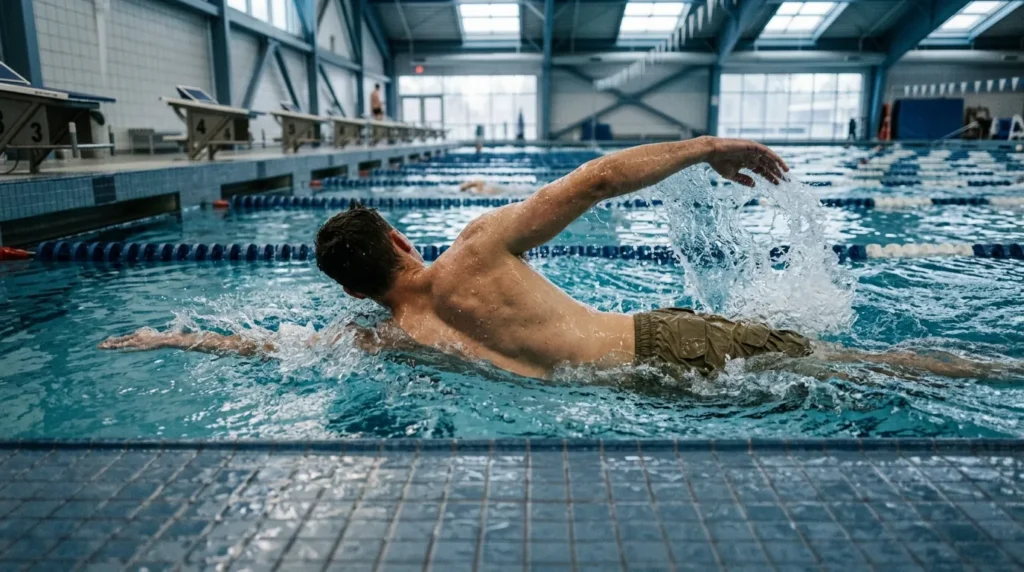
What you do: Swim 500 yards (10 lengths of a 50-yard pool, or 20 of a 25-yard pool) using either sidestroke or breaststroke. Freestyle and other strokes are not allowed for this event.
Standards:
- Pass minimum: 12:30
- Competitive: 9:00
- BUD/S-ready: 8:00–8:30
The swim is the event most candidates underestimate and where many wash out at the PST stage. Sidestroke is the SEAL combat swim — it’s the stroke you’ll use throughout BUD/S and beyond. If you’ve never swum sidestroke, expect to spend 8–12 weeks of dedicated practice to hit competitive times.
The 500-yard cutoff exists for a specific reason: in the operational environment, SEAL teams approach targets by water, and the ability to cover 500 yards quietly and efficiently is a baseline operational skill. Failing the swim isn’t just a fitness issue; it’s a skill gap that disqualifies you from the role.
2. Push-ups (2 minutes) — Navy SEAL PST
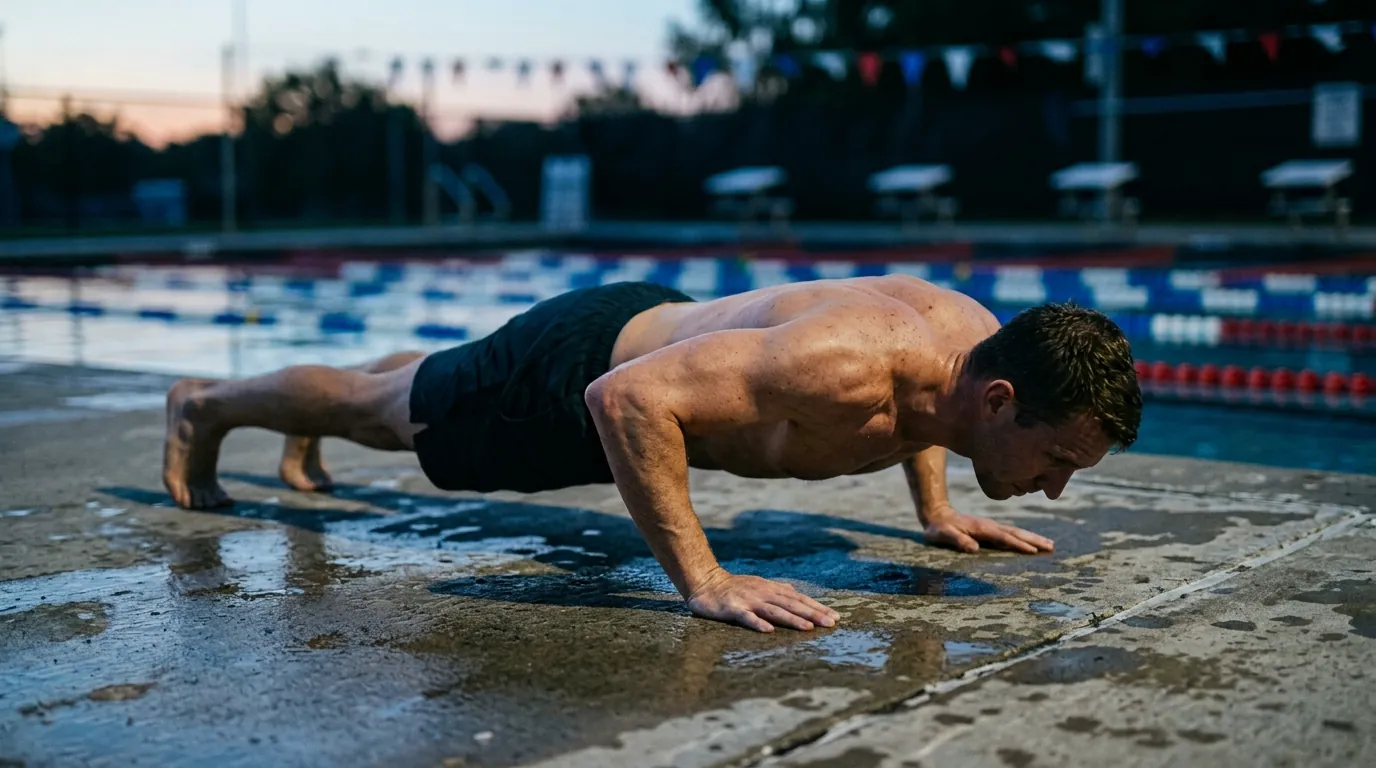
What you do: Maximum strict push-ups in 2 minutes. Hand-release form is not required (unlike the Army’s HRP), but reps must be to standard — full lockout at the top, chest to within fist-width of the floor at the bottom. Resting in the up position is allowed; resting in the down position or with knees on the floor disqualifies subsequent reps.
Standards:
- Pass minimum: 50
- Competitive: 80
- BUD/S-ready: 100+
Push-ups are the most trainable event on the PST. Going from 50 to 100 reps in 2 minutes is achievable in 12–16 weeks of structured volume work. The bodyweight programming in our Army PRT drills and 28-day military workout guides directly trains the strength-endurance the PST measures.
3. Sit-ups (2 minutes) — Navy SEAL PST
What you do: Maximum sit-ups in 2 minutes. Hands behind head or crossed on chest, feet held by a partner or anchored. Reps count when shoulders touch the deck and elbows touch knees on the way up.
Standards:
- Pass minimum: 50
- Competitive: 80
- BUD/S-ready: 100+
Sit-ups train the hip flexor endurance that carries you through BUD/S log PT, surf torture, and prolonged combat swimmer work. They’re the easiest of the 5 events to improve through volume, and the easiest to rep-cheat on if you don’t enforce strict form. Recruiters and BUD/S evaluators know the patterns; bouncing reps don’t count.
4. Pull-ups (max reps) — Navy SEAL PST
What you do: Maximum strict pull-ups, no time limit. Dead hang at the bottom (no kipping, no swing), chin clearly over the bar at the top, full extension between reps. Drop off the bar = event over.
Standards:
- Pass minimum: 10
- Competitive: 15
- BUD/S-ready: 20+
Pull-ups are where many candidates plateau. Going from 10 to 20 takes 6–9 months of structured pulling work — far longer than the equivalent push-up improvement. Start now; don’t wait until you’re 6 weeks from your PST date.
For a structured pull-up build, see our Navy SEAL calisthenics workout and the dedicated pull-up improvement progression. Consistent twice-weekly pull-up sessions with submaximal volume work outperform max-effort sessions for long-term gains.
5. 1.5-mile run — Navy SEAL physical fitness test
What you do: 1.5-mile run on a measured course, in boots and pants (some PSTs allow running shoes — verify with your recruiter). Times under 12:30 typically pass; competitive candidates run 9:00–9:30.
Standards:
- Pass minimum: 10:30
- Competitive: 9:30
- BUD/S-ready: 8:30–9:00
The 1.5-mile run is short enough that it’s a near-anaerobic event — pacing matters less than raw speed. Soldiers who train only with long, slow distance tend to underperform here. Mix in 400m and 800m intervals 2×/week for 8+ weeks before your PST date.
Beyond the PST: other Navy SEAL physical requirements
The PST is necessary but not sufficient. Other physical and administrative requirements:
Age
- Active enlistment: 17–28 years old at time of enlistment
- Officer programs: under 29 (waivers up to 30+ available for prior service or specific programs)
- Average navy seal height: 5’10" (men under 5’8" or over 6’4" face proportionally harder time with certain BUD/S evolutions, but there’s no formal height requirement)
Citizenship
- Must be a U.S. citizen
- Naturalized citizens are eligible
- Permanent residents (green-card holders) are not eligible for SEAL programs
Vision
- Distance: 20/40 or better in each eye, correctable to 20/20
- Color vision: must pass standard color blindness test
- PRK / LASIK: generally allowed if performed by approved providers and at least 12 months prior
ASVAB scores
- GS+MC+EI: ≥165, OR
- VE+MK+MC+CS: ≥220, OR
- VE+AR: ≥110 with MC: ≥50
These thresholds are designed to ensure candidates can absorb the technical training (advanced demolition, communications, navigation) that comes after BUD/S.
Security clearance
- Minimum Secret clearance required
- Most operational SEALs hold Top Secret/SCI clearance
- Disqualifying factors include felony convictions, drug use within recent timeframes, financial issues, and certain foreign contacts
Medical and dental
- Pass full Class I military physical
- No history of: asthma after age 12, recurrent dislocations, recent knee/shoulder/back surgery, diabetes, or other disqualifying conditions
- Dental: no significant unresolved dental issues
How does the PST compare to other military fitness tests?
| Test | Branch | Events | Pass min total | Difficulty |
|---|---|---|---|---|
| Navy PST | Navy SEAL | 5 (incl. swim) | Varies | Highest |
| AFT (Army Fitness Test) | Army | 5 | 300 (general) / 350 (combat) | High |
| Marine PFT | Marines | 3 | Varies by age | Medium-high |
| Air Force PFT | Air Force | 3 | Varies | Medium |
| Coast Guard PFT | Coast Guard | 3 | Varies | Medium |
The PST is the most demanding standard military fitness test because of the swim component, the strict pull-up form requirement, and the "competitive" thresholds being far above the listed minimums. For comparison data on the Army’s current standard, see our AFT score chart 2026 guide.
How to train for the Navy SEAL PST
A typical 16-week PST prep cycle:
Weeks 1–4: Base building
- 4 swim sessions/week building 500-yard time
- 3 push-up volume sessions (4×submaximal sets, 3 days/week)
- 2 pull-up sessions (5×3–5 reps with full rest)
- 3 runs (one easy, one tempo, one interval)
Weeks 5–10: Volume push
- 4 swim sessions, time under 11:00 by week 8
- Push-ups: 3 sessions, target 80+ in 2 minutes by week 10
- Pull-ups: 3 sessions, target 12–15 strict reps
- Runs: 4 per week, target 1.5-mile under 10:00
Weeks 11–14: Competitive prep
- Swim: build to 9:30 or better
- Push-ups: 100+ in 2 minutes
- Pull-ups: 15+ strict
- Runs: 1.5-mile under 9:30
Weeks 15–16: Test peak
- Reduce volume by 30%
- One full mock PST under timed conditions
- Recover, hydrate, sleep
- Test day
For the bodyweight component, our Navy SEAL calisthenics workout and 8-week military calisthenics plan give you the rep targets and progression structure that align with this framework.
Common mistakes that fail PSTs
- Underestimating the swim. Most failures happen here. If you can’t currently swim 500 yards in any time, start swimming 6+ months before your PST date.
- Skipping run intervals. Long, slow distance won’t get you under 9:30. The PST run is anaerobic-dominant.
- Training pull-ups with kipping or partial reps. PST pull-up form is strict. If you’re training kipping, the strict standard will shock you on test day.
- Peaking too early. Hitting your target numbers 4 weeks out, then training through fatigue, leads to test-day underperformance. Plan a 7–10 day taper.
- Showing up dehydrated or undersle. PST scores drop measurably with poor sleep and dehydration. Sleep 8 hours and hydrate normally for 48 hours pre-test.
Navy SEAL physical requirements FAQ
What’s the minimum passing PST score?
The official minimums are 12:30 swim, 50 push-ups, 50 sit-ups, 10 pull-ups, and 10:30 run. But minimum scores rarely earn a contract — recruiters look for competitive scores well above the floor.
What’s a competitive Navy SEAL PST score?
Competitive scores: 9:00 swim, 80+ push-ups, 80+ sit-ups, 15+ pull-ups, 9:30 run. BUD/S graduates typically scored even higher: 8:30 swim, 100+ push-ups/sit-ups, 20+ pull-ups, 8:30–9:00 run.
What’s the average Navy SEAL height?
The average SEAL height is approximately 5’10" — there’s no formal height requirement, but candidates significantly under 5’8" or over 6’4" face specific challenges with certain BUD/S evolutions (boat carry, log PT). Height isn’t disqualifying; it’s a factor.
Can women become Navy SEALs?
Yes. As of 2016, all SEAL roles are open to qualified women. Female candidates must meet the same physical standards as male candidates — no gender-normed scoring exists for SEAL selection.
What’s the difference between Navy SEAL and Navy SWCC?
Navy SEALs are sea-air-land special operators. Navy SWCC (Special Warfare Combatant-craft Crewmen) operate the high-speed boats that insert and extract SEAL teams. SWCC has its own PST with similar but distinct standards.
How long is BUD/S training?
Basic Underwater Demolition/SEAL (BUD/S) training is approximately 24 weeks, divided into 3 phases: physical conditioning (7 weeks, including Hell Week), combat diving (7 weeks), and land warfare (7 weeks). After BUD/S, additional training (parachute, SQT, team-specific) extends total time-to-Trident to 12–18 months.
What’s the BUD/S attrition rate?
Typically 70–80%. Most attrition happens in the first phase (physical conditioning), particularly during Hell Week. Performance below the "competitive" PST standards correlates strongly with BUD/S attrition; performance in the BUD/S-ready range correlates with completion.
Does prior military service help?
Yes — and prior special operations service helps significantly. Candidates with Marine, Army Ranger, or Air Force PJ backgrounds typically enter BUD/S with the conditioning baseline already built. New recruits face a much steeper learning curve.
What about the SEAL officer program?
SEAL officer candidates apply through the Navy ROTC, Naval Academy (USNA), or OCS pipelines. Physical standards are similar to the enlisted PST. Officer slots are extremely competitive — typically 16–18 selected per year out of hundreds of applicants.
The bottom line: Navy SEAL physical requirements are gated by the 5-event PST: 500-yard swim, 2-minute push-ups, 2-minute sit-ups, max pull-ups, 1.5-mile run. Pass minimums get you considered; competitive scores get you a contract; BUD/S-ready scores get you through. Beyond the PST, candidates must meet age, citizenship, vision, ASVAB, and security clearance requirements. The path is hard but not random — 16 weeks of structured prep using a swim-pull-push-run framework gets most healthy candidates from "interested" to "competitive." For the bodyweight strength component, see our Navy SEAL calisthenics workout, Army PRT drills, 28-day military workout, and 8-week military calisthenics plan.
Turn These Standards Into a Training Plan
Knowing the numbers is step one — training to them is the work. If you want the 16-week framework above as a structured, printable schedule, download our free Navy SEAL training program PDF: a 12-week BUD/S prep plan with swim, run, and calisthenics progressions plus a Day-84 mock PST to validate you’re hitting the competitive scores in this guide.