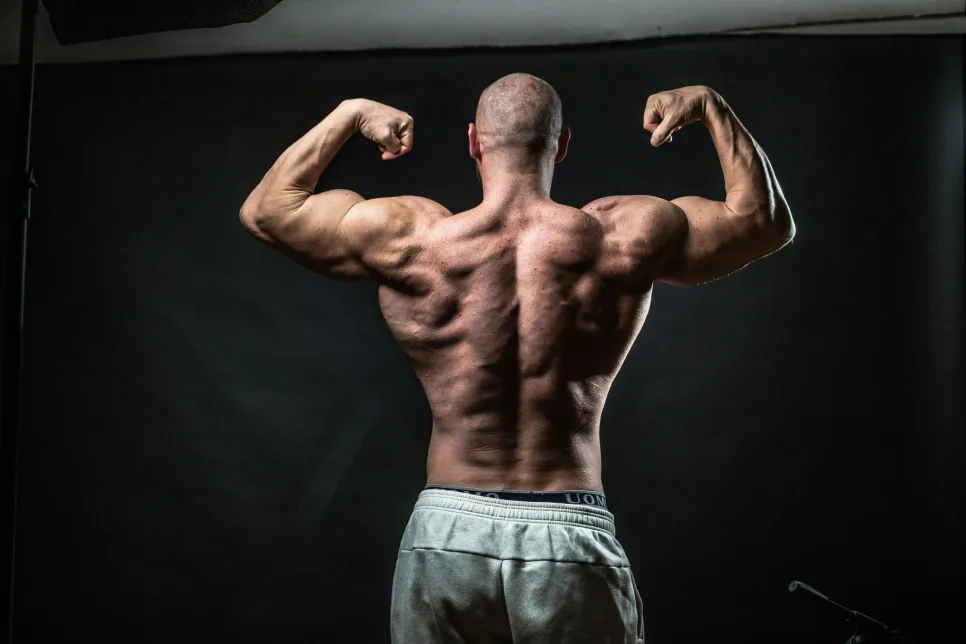
TL;DR — What’s the Difference in Transverse and Rectus Abdominis Workouts?
Transverse and rectus abdominis workouts train two very different muscles: the rectus abdominis flexes your spine for a visible six-pack, while the transverse abdominis (TVA) braces and stabilizes it instead of moving it. You need both: rectus work for definition, TVA work for the spine-safe bracing that keeps heavy lifts and plank tests honest. Below: how to tell them apart, ranked exercises for each, and a 4-week program.
Table of contents
Transverse Abdominis vs. Rectus Abdominis: What Each Muscle Actually Does
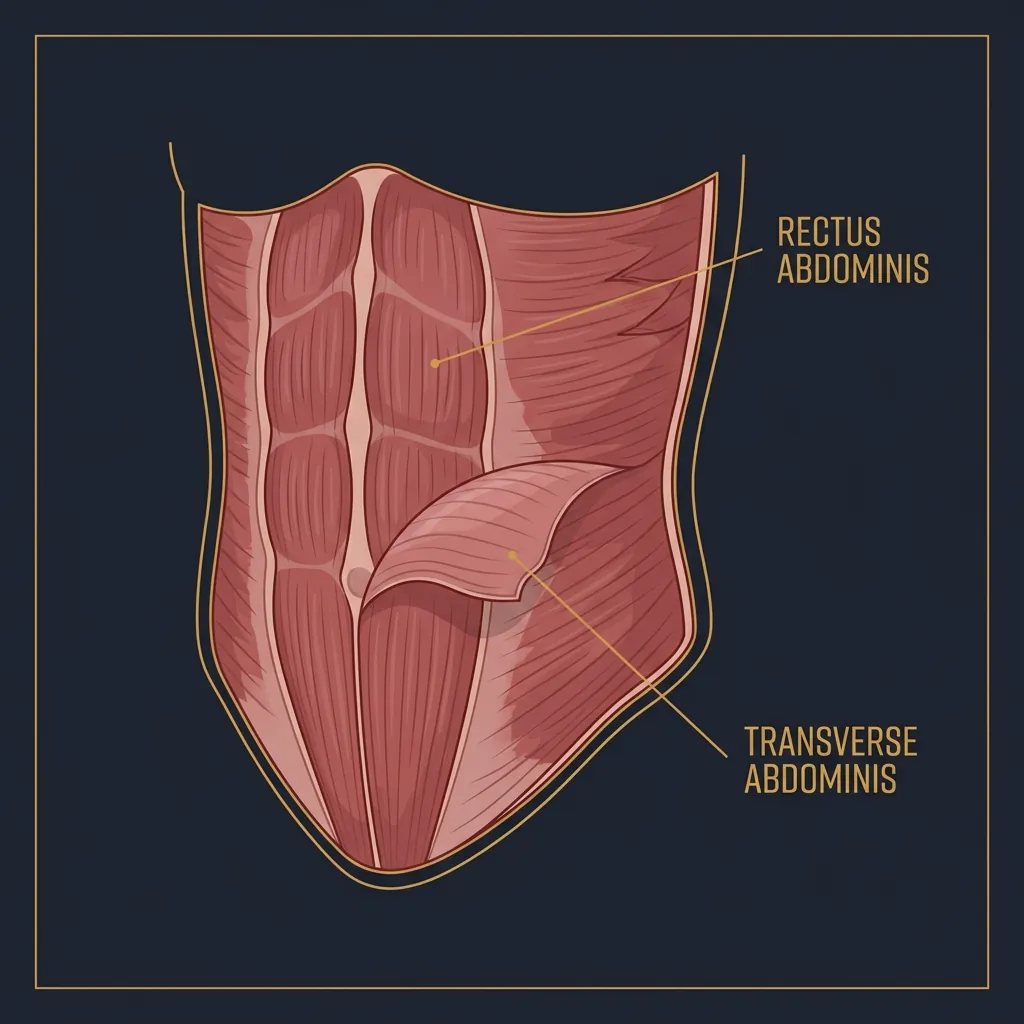
The rectus abdominis is the long, flat muscle running from your sternum to your pubic bone. It’s what people mean when they say “abs,” and its job is spinal flexion. Every time you curl your torso toward your knees, that’s the rectus doing the work. The transverse abdominis sits underneath it, wrapping around your torso like a corset from front to back. It doesn’t flex anything. It compresses the abdominal cavity and stiffens your midsection, which is what actually protects your spine when you squat, deadlift, or take a punch to the gut.
Here’s the distinction that matters in practice: rectus abdominis exercises move your spine through a range of motion. TVA exercises resist movement. They’re anti-extension, anti-rotation, or anti-flexion drills where the muscle’s job is to keep your torso still under load. If you can visibly see your torso curling, you’re training rectus. If your torso isn’t moving but you’re bracing hard against an outside force, you’re training TVA.
| Feature | Rectus Abdominis | Transverse Abdominis |
|---|---|---|
| Location | Superficial, front of torso | Deepest ab layer, wraps around torso |
| Primary action | Spinal flexion (crunch motion) | Intra-abdominal pressure, spinal stability |
| Visible on physique? | Yes — the “six-pack” | No — you feel it, you don’t see it |
| Trained by | Crunches, leg raises, ab wheel | Planks, dead bugs, Pallof press, vacuum pose |
| Fires first or second? | Second, after TVA pre-activates | First — activates ahead of limb movement to stabilize the spine |
Why Training Both Matters for Lifters and Military Fitness
Skip the TVA and your rectus training builds a muscle you can see but can’t rely on under load. That’s how lifters get strong crunches and a weak back at the same time. Research on trunk muscle sequencing shows the transversus abdominis activates before the rectus abdominis and external obliques during limb movement, functioning as a feed-forward stabilizer that braces the spine before you even move (Source: PMC, National Library of Medicine, 2015). If that pre-activation is weak or slow, your spine takes the load your abs should be absorbing.
This is where Gymstips’ usual lane — military and tactical fitness — actually lines up with the physiology. The Army Fitness Test plank event requires a minimum hold of 1 minute 30 seconds for 60 points and up to 3 minutes 40 seconds for a max score in the 17-21 age bracket, with standards scaling by age and gender (Source: U.S. Army, GoArmy.com, 2026). A plank is a pure TVA and anti-extension test, not a rectus exercise, which is exactly why lifters who only do crunches tend to shake apart on it. The same bracing pattern is what keeps your lower back from folding under a loaded ruck march or a heavy front squat. In a four-week core stability study, the exercise group’s TVA contraction onset time improved from 2.34 seconds at baseline to 2.07 seconds, a roughly 0.27-second gain, while a control group that did no core training showed essentially no change, 2.22 seconds to 2.23 seconds (Source: Selkow, Eck & Rivas, International Journal of Sports Physical Therapy, 2017). That’s the difference between your core firing before a heavy pull and scrambling to catch up mid-rep.
Practical translation: if you’re training for a PT test, rucking, or just want your squat and deadlift numbers to go up without your lower back complaining, TVA work isn’t optional accessory volume. It’s the foundation the rest of your core training sits on. For a broader anti-rotation and anti-extension routine that builds on this, our calisthenics core workout guide is a solid next step once you’ve got the basics down.
Best Transverse Abdominis Exercises
These are ranked by how directly they load the TVA’s actual job — resisting extension, rotation, or flexion rather than producing it. The cue that matters for all of them: brace like someone’s about to punch you in the stomach, not “suck your belly button to your spine.” The old hollowing cue under-trains the muscle compared to a full 360-degree brace.
- Dead Bug. Lie on your back, arms reaching to the ceiling, knees bent at 90 degrees. Lower one arm and the opposite leg toward the floor without letting your lower back arch off the ground. If your back lifts, you’ve lost the brace, and that’s your range limit. 3 sets of 8-10 reps per side.
- Want a top-tier stabilizer that needs no equipment? Bird Dog delivers. Get on hands and knees, extend opposite arm and leg while keeping your spine neutral and hips square. EMG research on quadruped stabilization exercises consistently shows bird dog among the top activators of the deep trunk stabilizers, alongside side planks (Source: PMC, National Library of Medicine, 2023). 3 sets of 8 reps per side, hold 2 seconds at full extension.
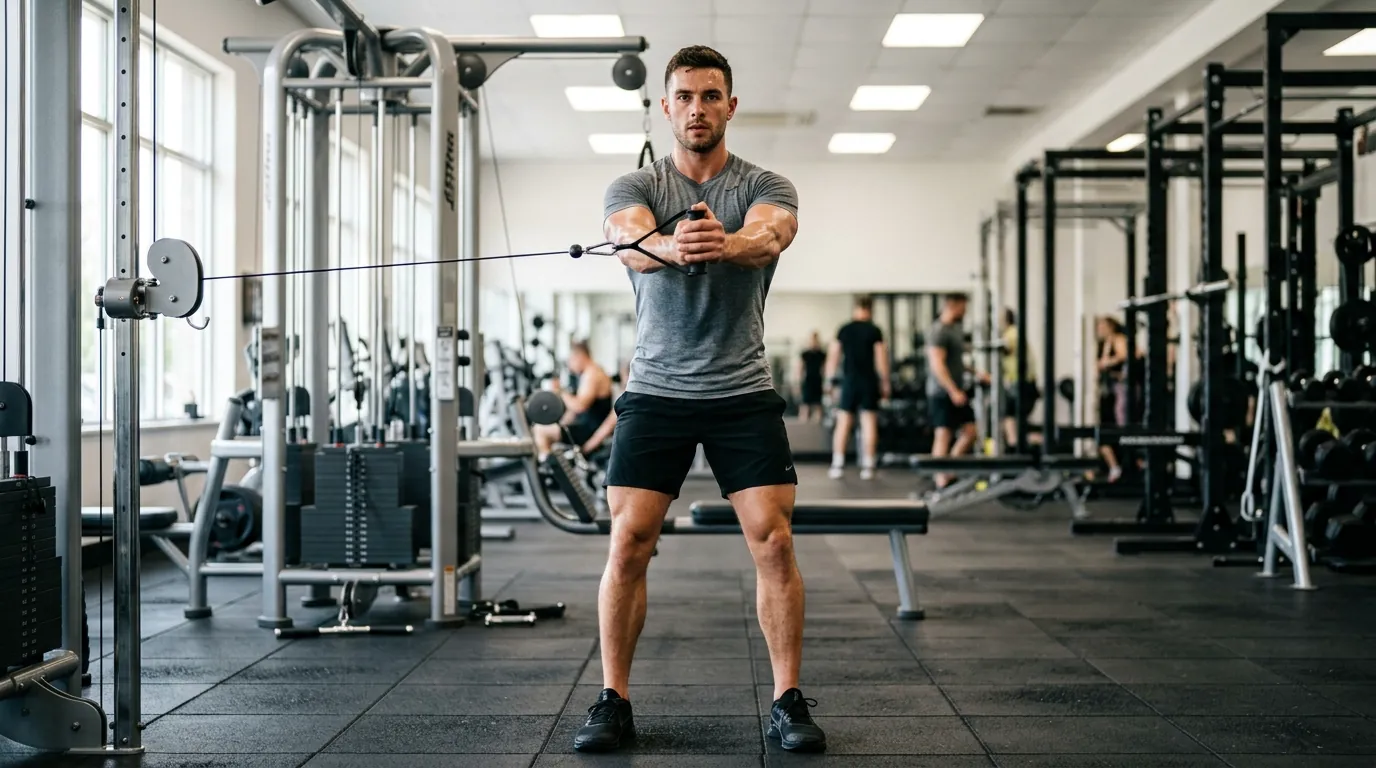
- Pallof Press. Anchor a band or cable at chest height, stand perpendicular to it, and press straight out in front of you while resisting the rotational pull. This is the clearest anti-rotation drill for the TVA and obliques together, and research on anti-rotation core training backs its high activation demand (Source: Saeterbakken & Fimland, Journal of Strength and Conditioning Research, 2012). 3 sets of 10-12 reps per side.
- For an unstable-surface progression, get your forearms on a stability ball in plank position (this is the stir-the-pot) and make small circles with your forearms while keeping your hips still. It adds an unstable surface on top of the anti-extension demand, forcing continuous bracing. 3 sets of 30-45 seconds, both directions.
- The standard and side plank remain the baseline anti-extension hold: squeeze your glutes, keep a straight line from shoulders to ankles, and breathe through the brace instead of holding your breath. Build toward the AFT standard of at least 1:30 before chasing max-score times.
- Vacuum Pose. Exhale fully, then draw your navel toward your spine and hold. This isolates the TVA more directly than almost anything else, but it trains the muscle in isolation rather than under load, so treat it as a warm-up activation drill, not your main TVA work. 3 sets of 15-20 second holds.
Best Rectus Abdominis Exercises
These move your spine through flexion, which is what builds visible ab definition and pure crunching strength. EMG research on abdominal exercises ranks the hanging leg raise, cable crunch, and ab wheel rollout among the highest activators of the rectus abdominis, consistently outperforming basic sit-ups and bicycle crunches (Source: PubMed/PMC, 2001; Ellim, 2025). Rank them by loadability — the ones you can progressively overload beat the ones that plateau at bodyweight.
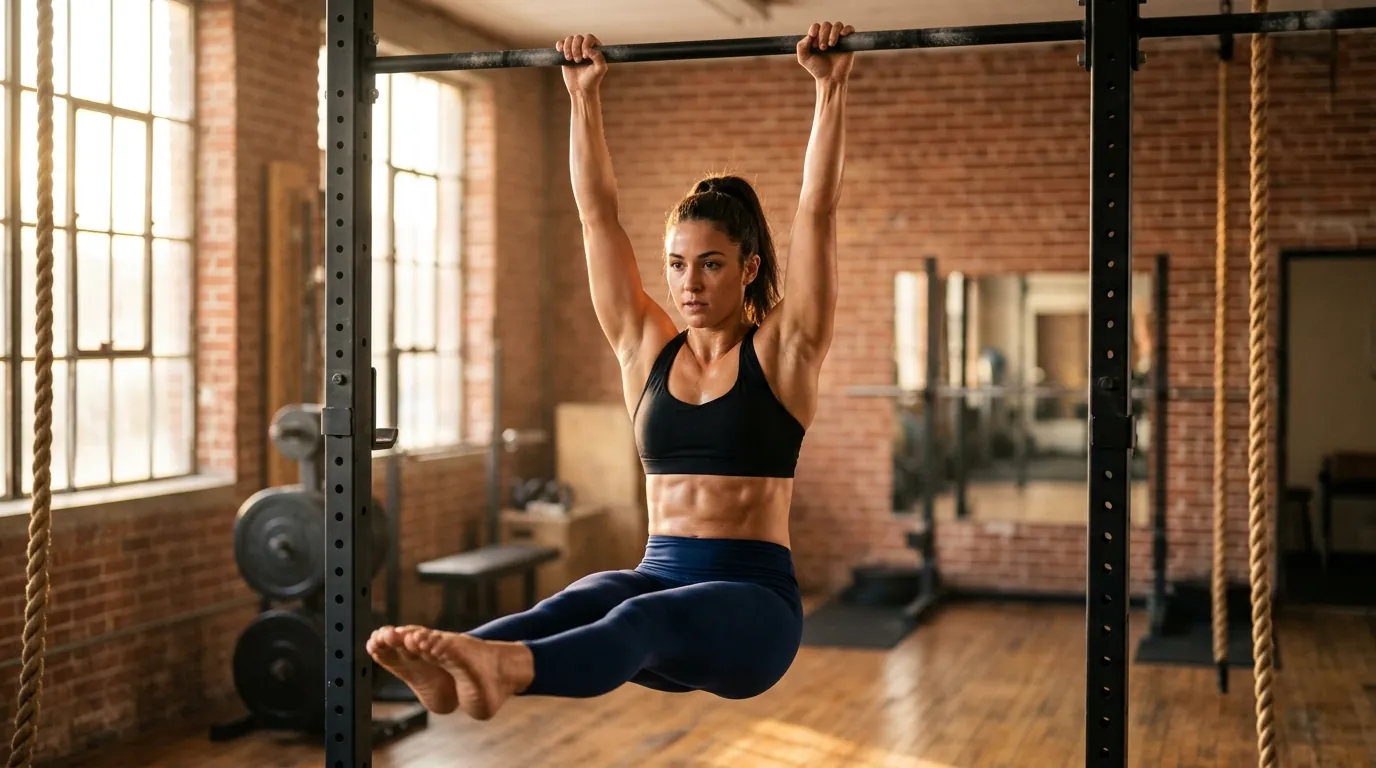
- Hanging Leg Raise. Hang from a bar, raise your legs (straight or bent) toward your chest without swinging. EMG data shows this produces the highest rectus abdominis activation of any commonly tested ab exercise when performed with the torso vertical (Source: PMC, National Library of Medicine, 2001). 3 sets of 8-12 reps.
- Need constant tension instead of a dead zone at the top? The cable crunch does that. Kneel in front of a cable stack and crunch your torso down against constant resistance, unlike a bodyweight crunch where tension drops off. 3 sets of 12-15 reps.
- Ab Wheel Rollout. From kneeling, roll the wheel out as far as you can control, then pull back using your abs, not your hip flexors. This one genuinely hits both muscles (flexion strength plus an anti-extension demand at full extension), but it earns its spot here for rectus loading specifically. 3 sets of 8-10 reps.
- Once bodyweight crunches stop being challenging, the weighted crunch keeps progressive overload going: same standard crunch, just with a plate held at your chest. 3 sets of 12-15 reps.
- Reverse Crunch. Lying on your back, curl your hips and knees toward your chest instead of curling your shoulders up. This shifts emphasis toward the lower rectus fibers, which most crunch variations under-train. 3 sets of 12-15 reps.
If your goal is specifically dropping the layer of fat covering these muscles rather than just training them harder, that’s a nutrition and total-body training problem, not an ab-exercise problem. Our lower belly fat workout guide covers that side of it in more depth.
Sample Combined Core Program
Train TVA before rectus in the same session — a pre-activated deep core lets you brace properly during flexion work and protects your spine during the heavier compound lifts you do afterward. This is a 3-day split you can run alongside your normal strength or PT training; each session runs 12-15 minutes.
| Day | TVA Block (do first) | Rectus Block (do second) |
|---|---|---|
| Day 1 | Dead Bug — 3×10/side Plank — 3x max hold | Hanging Leg Raise — 3×10 Weighted Crunch — 3×15 |
| Day 2 | Pallof Press — 3×12/side Bird Dog — 3×8/side | Cable Crunch — 3×15 Reverse Crunch — 3×15 |
| Day 3 | Stir-the-Pot — 3x40s Side Plank — 3x max hold/side | Ab Wheel Rollout — 3×8 Hanging Leg Raise — 3×12 |
Progression rule: for holds, add 10-15 seconds per week once you can complete all sets clean. For reps, add one rep per set per week; once you hit the top of the rep range across all sets, add load instead of reps. Run this for 4 weeks, then retest your plank hold. Most lifters following a similar structure see a meaningful jump in plank time within that window, consistent with the four-week timeframe used in TVA-focused stability research (Source: Selkow, Eck & Rivas, International Journal of Sports Physical Therapy, 2017).
Two rules that make or break this program: don’t train direct core work on days you’re already squatting or deadlifting heavy (your TVA is getting plenty of work bracing those lifts already), and never sacrifice plank or dead bug form to hit a time goal — a shaking lower back means you’ve exceeded your current TVA capacity, not that you’re pushing through a plateau.
Common Mistakes
Most people training “core” are actually only training rectus abdominis and wondering why their lower back still hurts under a loaded bar. Here’s what to fix.
- Bracing wrong. Sucking your stomach in (hollowing) is not the same as bracing. Bracing means tightening your entire midsection 360 degrees, like you’re about to take a hit; hollowing actually pulls the TVA away from full engagement and reduces spinal stability under load.
- Is your ab routine 100% flexion-based? Crunches and leg raises build a visible six-pack but do almost nothing for the anti-extension stability that protects your spine during squats, deadlifts, or a loaded ruck, and that gap is exactly what leaves you exposed under load.
- Skipping TVA activation before loaded lifts. Your deep core should pre-activate before a heavy pull, not scramble to catch up mid-rep. A few reps of dead bug or a 10-second brace hold before your working sets primes that feed-forward activation pattern instead of leaving it to chance.
- Holding your breath through the whole set. A hard brace still needs breath cycling on longer holds like planks. Breathe into your midsection, keep the brace, exhale without releasing tension; holding your breath the entire time just spikes blood pressure without adding stability.
- A three-minute plank with sagging hips trains bad movement patterns, not the TVA. Reset your form standard, even if that means starting your timer over at a shorter hold.
FAQ
What is the difference between the transverse abdominis and rectus abdominis?
The rectus abdominis is the surface muscle that flexes your spine and shows as the “six-pack.” The transverse abdominis is the deepest ab layer, wraps around your torso like a corset, and doesn’t move your spine — it stabilizes it by controlling intra-abdominal pressure.
How do you activate the transverse abdominis?
Brace your entire midsection 360 degrees, as if bracing for a punch to the stomach, rather than just sucking your belly button toward your spine. You should feel tension all the way around your torso, not just in the front.
Can you build visible abs by training the transverse abdominis?
No. The TVA sits under the rectus abdominis and doesn’t contribute to the visible “six-pack” look — that’s rectus abdominis definition combined with low body fat. TVA training builds stability and bracing strength, not visible muscle shape.
What is the best exercise for the transverse abdominis?
The Pallof press and dead bug are the two most reliable options because they force a controlled anti-rotation or anti-extension brace through a full range rather than a static hold, which better reflects how the TVA works during real lifting and movement.
Do planks work the transverse abdominis or rectus abdominis?
Mainly the transverse abdominis. A plank is an anti-extension hold — your spine isn’t moving, so the rectus abdominis is only isometrically engaged while the TVA and deep stabilizers do most of the work keeping your torso rigid.
How often should you train deep core muscles?
3 times a week is enough for most lifters, especially since the TVA is already getting indirect work during squats, deadlifts, and overhead pressing. Direct sessions of 10-15 minutes, as in the program above, are sufficient — more isn’t better once your compound lifts are already loading it.
Sources and Verification
- Transversus abdominis pre-activation and feed-forward timing relative to rectus abdominis — PMC, National Library of Medicine, 2015: Trunk Muscle Activation at the Initiation and Braking of Bilateral Shoulder Flexion Movements
- TVA activation ratio and contraction onset improvement after 4-week core stability training — Selkow, Eck & Rivas, International Journal of Sports Physical Therapy, 2017: Transversus Abdominis Activation and Timing Improves Following Core Stability Training
- Army Fitness Test plank time standards — U.S. Army, GoArmy.com, 2026: Plank (PLK) | AFT Event 4
- Bird dog and side plank EMG activation of deep trunk stabilizers — PMC, National Library of Medicine, 2023: Electromyographic and Stabilometric Analysis of the “Standing Bird Dog” Exercise
- Pallof press and anti-rotation core activation — Saeterbakken & Fimland, Journal of Strength and Conditioning Research, 2012
- Rectus abdominis EMG activation ranking (hanging leg raise, cable crunch, ab wheel) — PMC, National Library of Medicine, 2001: Electromyographic Analysis of Four Popular Abdominal Exercises