
25 Best Resistance Band Exercises by Muscle Group (+ 4-Week Plan)
Resistance band exercises build real strength without a gym membership, a rack of dumbbells, or a commute. A 2019 meta-analysis in SAGE Open Medicine found that elastic resistance training produces strength gains statistically equal to conventional weights for both upper and lower body (Lopes et al., 2019). That means the $20 set of bands in your closet is a legitimate training tool — not a consolation prize.
Below you will find 25 band exercises organized by muscle group, a band-buying cheat sheet, a 4-week progressive plan, and the specific overload methods that make bands work long-term. Pick five exercises and you have a full-body session in 30 minutes. Read the full list and you have a program that covers every major muscle group.
TL;DR — What Are the Best Resistance Band Exercises?
The five resistance band exercises that give you the most bang for a quick full-body session: banded squat (legs), seated band row (back), standing band chest press (chest), band overhead press (shoulders), and band Pallof press (core). Do 3 sets of 10-12 reps each, rest 60 seconds between sets, and you are done in under 30 minutes. A complete 4-week plan with all 25 exercises is below.
Table of contents
Gymnase Tips is reader-supported. Some links may be Amazon affiliate links; if you buy through them we may earn a small commission at no extra cost to you.
How to Choose the Right Resistance Band
The right band depends on the exercise and your current strength. A band that works for bicep curls will be too light for squats, so most people need a set of 3-5 bands rather than a single one.
Band Types
Four types cover every exercise in this guide:
- Tube bands with handles — best for upper-body pressing and pulling movements. The handles reduce grip fatigue and mimic cable machine angles. Typical range: 10-50 lb.
- Loop/power bands (41-inch) — the workhorse. These large latex loops work for squats, deadlifts, assisted pull-ups, and banded push-ups. Range: 5-200 lb depending on width.
- Mini bands (hip circles) — short loops designed for glute activation, lateral walks, and clamshells. Range: 5-50 lb.
- Pull-up assist bands — a subset of loop bands. Thicker widths (1.25-2.5 inches) provide 35-175 lb of assistance for pull-up progressions.
A door anchor expands your exercise options significantly — it lets you replicate cable machine angles for face pulls, tricep pushdowns, and chest presses without a fixed anchor point.
Resistance Levels and Color Guide
Colors vary by manufacturer, so always check the labeled resistance range rather than relying on color alone. Here is a general guide:
| Band Type | Best For | Resistance Range | Suggested Pick |
|---|---|---|---|
| Mini loop (12″) | Glute activation, warm-ups | 5-50 lb | 5-pack mini band set |
| Tube w/ handles | Upper-body pressing and pulling | 10-50 lb | Tube band set with handles |
| Loop / power (41″) | Squats, deadlifts, compound lifts | 5-200 lb | Loop band set (3-5 bands) |
| Pull-up assist (41″) | Assisted pull-ups, dips | 35-175 lb | Pull-up assist band |
Beginners: Start with a light and a medium band. For most men, that means a tube set labeled 10-30 lb or a loop band set starting at 15-35 lb. You will outgrow the light band within 2-3 weeks on lower-body exercises — that is normal and expected.
New to bands? Start with our beginner guide on how to use resistance bands.
25 Best Resistance Band Exercises
Here is the master reference table. Use it to plan sessions quickly — pick one exercise per muscle group for a full-body workout, or stack 3-4 exercises per group for a focused split.
| # | Exercise | Primary Muscle | Band Type | Difficulty |
|---|---|---|---|---|
| 1 | Banded Push-Up | Chest | Loop | ★★★ |
| 2 | Standing Band Chest Press | Chest | Tube/Loop | ★★ |
| 3 | Band Chest Fly | Chest | Tube | ★★ |
| 4 | Band Pull-Apart | Upper Back / Rear Delts | Loop/Mini | ★★ |
| 5 | Seated Band Row | Mid-Back / Lats | Loop/Tube | ★★ |
| 6 | Band-Assisted Pull-Up | Lats / Biceps | Loop (pull-up assist) | ★★★★ |
| 7 | Band Lateral Raise | Side Delts | Tube/Loop | ★★ |
| 8 | Band Overhead Press | Shoulders | Tube/Loop | ★★★ |
| 9 | Band Face Pull | Rear Delts / Rotator Cuff | Tube/Loop | ★★ |
| 10 | Band Bicep Curl | Biceps | Tube/Loop | ★ |
| 11 | Band Hammer Curl | Brachialis / Biceps | Tube/Loop | ★ |
| 12 | Band Tricep Pushdown | Triceps | Tube/Loop + Door Anchor | ★★ |
| 13 | Band Overhead Tricep Extension | Triceps | Tube/Loop | ★★ |
| 14 | Banded Squat | Quads / Glutes | Loop | ★★ |
| 15 | Banded Romanian Deadlift | Hamstrings / Glutes | Loop | ★★★ |
| 16 | Band Leg Extension (Seated) | Quads | Loop/Mini | ★★ |
| 17 | Banded Leg Curl | Hamstrings | Loop/Mini | ★★ |
| 18 | Banded Hip Thrust | Glutes | Loop + Mini | ★★★ |
| 19 | Banded Clamshell | Glute Med | Mini | ★ |
| 20 | Band Lateral Walk | Glute Med / Hip Abductors | Mini | ★★ |
| 21 | Banded Kickback | Glutes | Loop/Mini | ★★ |
| 22 | Band Pallof Press | Core (Anti-Rotation) | Tube/Loop | ★★★ |
| 23 | Band Woodchop | Obliques | Tube/Loop | ★★★ |
| 24 | Band Dead Bug | Deep Core / TVA | Loop | ★★ |
| 25 | Banded Plank Pull-Through | Core / Shoulders | Loop | ★★★★ |
Chest (3 Exercises)
1. Banded Push-Up
Band: Loop (draped across upper back, ends under palms)
Muscles: Chest, front delts, triceps
Loop the band across your upper back and pin the ends under your palms. Perform a standard push-up. The band adds peak resistance at lockout, where the push-up is normally easiest — turning it into an ascending-resistance press that matches your chest’s strength curve.
Rx: 3 x 10-15
2. Standing Band Chest Press
Band: Tube w/ handles or loop anchored behind you
Muscles: Chest, front delts, triceps
Anchor the band at chest height behind you (door anchor or post). Step forward until you feel tension at the start. Press both handles forward until arms are extended, squeezing your chest at the top. Control the return — do not let the band snap your arms back.
Rx: 3 x 12-15
3. Band Chest Fly
Band: Tube w/ handles or loop
Muscles: Chest (inner/sternal emphasis)
Anchor at chest height behind you. Start with arms wide, slight elbow bend. Bring hands together in an arc in front of your chest. Keep that elbow angle locked — bending more turns a fly into a press. The tension peaks when your hands meet, which is the opposite of a dumbbell fly.
Rx: 3 x 12-15
Back (3 Exercises)
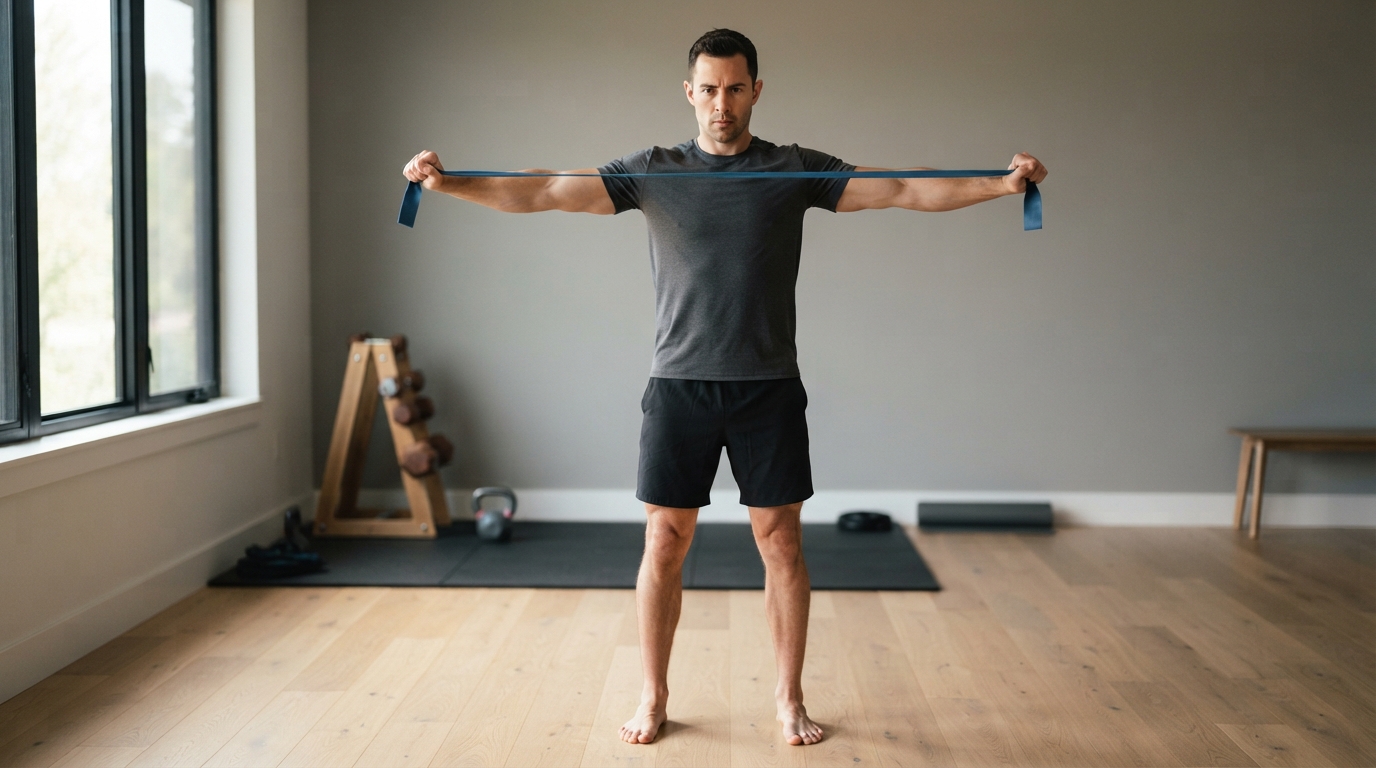
4. Band Pull-Apart
Band: Loop or mini band
Muscles: Rear delts, middle traps, rhomboids
Hold the band at shoulder height with arms extended, hands shoulder-width apart. Pull the band apart by squeezing your shoulder blades together until the band touches your chest. A 2022 EMG study in the International Journal of Sports Physical Therapy found that the palm-up grip position produced the highest infraspinatus and lower trapezius activation during this exercise (Tyler et al., IJSPT, 2022).
Rx: 3 x 15-20
5. Seated Band Row
Band: Loop or tube w/ handles
Muscles: Lats, rhomboids, mid-traps, biceps
Sit on the floor with legs extended. Loop the band around both feet, hold the ends. Pull toward your lower ribcage, driving elbows straight back. Pause for a one-count squeeze at full contraction. Keep your torso upright — leaning back past 10 degrees shifts work away from your back.
Rx: 3 x 12-15
6. Band-Assisted Pull-Up
Band: Pull-up assist band (heavy loop)
Muscles: Lats, biceps, rear delts
Loop a heavy band over a pull-up bar. Step or kneel into the loop. The band provides the most help at the bottom (where you are weakest) and the least at the top — a perfect match for the pull-up’s descending strength curve. Progress by switching to thinner bands over time. For more on this progression, see our assisted pull-ups guide.
Rx: 3 x 6-10
For a complete back band routine, see our exercise band back exercises guide.
Shoulders (3 Exercises)
7. Band Lateral Raise
Band: Tube or loop (stand on center)
Muscles: Side delts
Stand on the center of the band, hold the ends at your sides. Raise your arms out to the sides until parallel with the floor. Lead with your elbows, not your hands. Stop at shoulder height — going higher shifts work to the traps.
Rx: 3 x 12-15
8. Band Overhead Press
Band: Tube w/ handles or loop (stand on center)
Muscles: Front delts, side delts, triceps
Stand on the band, grip the handles or band ends at shoulder height. Press straight overhead until arms are fully extended. Brace your core hard — the increasing band tension at the top challenges your stability more than a dumbbell press does.
Rx: 3 x 10-12
9. Band Face Pull
Band: Tube or loop anchored at face height
Muscles: Rear delts, external rotators, mid-traps
Anchor the band at face height. Grip with both hands, pull toward your face while flaring elbows high. Finish with your hands beside your ears and thumbs pointing behind you. This exercise is the best band movement for shoulder health and posture — do it every session.
Rx: 3 x 15-20
Arms (4 Exercises)
10. Band Bicep Curl
Band: Tube or loop (stand on center)
Muscles: Biceps
Stand on the band center, hold the ends with underhand grip. Curl up without swinging your elbows forward — pin them to your sides. The resistance peaks at the top of the curl, where a dumbbell curl gets easiest. That is the main advantage over free weights for this exercise.
Rx: 3 x 12-15
11. Band Hammer Curl
Band: Tube or loop (stand on center)
Muscles: Brachialis, brachioradialis, biceps
Same setup as the bicep curl, but with a neutral (palms-in) grip. This shifts emphasis from the biceps to the brachialis, which sits underneath and pushes the bicep up when developed. Keep wrists straight throughout.
Rx: 3 x 12-15
12. Band Tricep Pushdown
Band: Tube or loop anchored high (door anchor)
Muscles: Triceps (lateral and medial heads)
Anchor the band above head height. Grip the ends, tuck elbows tight to your ribs. Extend your forearms down until arms are straight. Squeeze at the bottom for a full second. Do not let your elbows drift forward — that turns it into a press.
Rx: 3 x 12-15
13. Band Overhead Tricep Extension
Band: Tube or loop (anchor behind at low height, or stand on band)
Muscles: Triceps (long head emphasis)
Step on one end of the band, grip the other end behind your head with both hands. Extend arms overhead. The long head of the tricep only gets fully stretched when your arm is overhead, so this movement hits fibers that pushdowns miss.
Rx: 3 x 10-12
Legs — Quads and Hamstrings (4 Exercises)
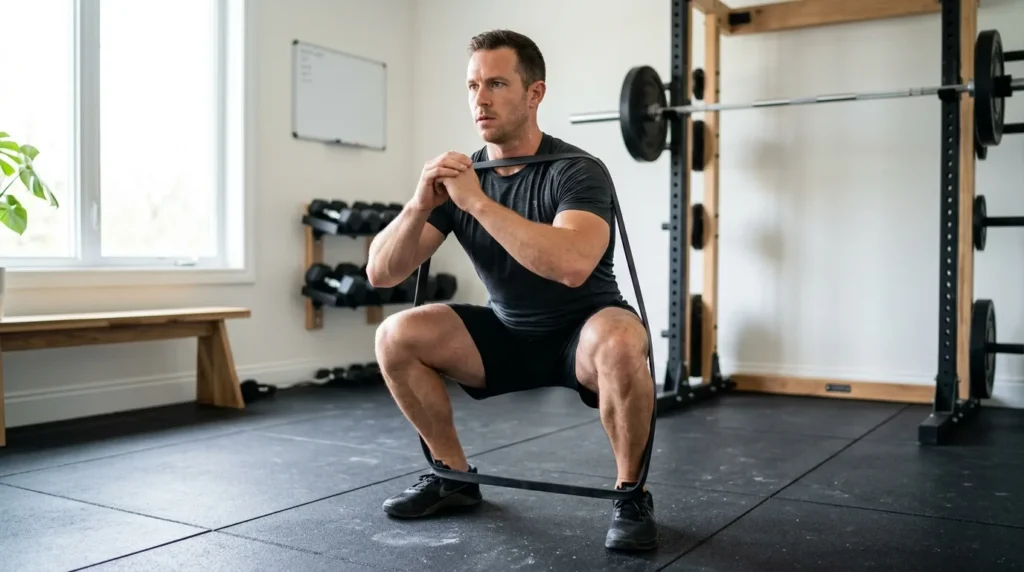
14. Banded Squat
Band: Loop (stand on center, band over shoulders)
Muscles: Quads, glutes, adductors
Stand on the loop band, bring the other end over your head to rest on your traps (like a barbell). Squat to parallel or below. The resistance increases as you stand up — matching your quads’ ascending strength curve. This makes the lockout genuinely hard, which a bodyweight squat never does.
Rx: 3 x 10-15
15. Banded Romanian Deadlift
Band: Loop (stand on center)
Muscles: Hamstrings, glutes, erectors
Stand on the center of the band, hold the other end at hip height. Hinge at the hips, pushing your glutes back while keeping a flat back. Lower until you feel a deep hamstring stretch, then drive your hips forward to stand. Squeeze your glutes at the top. Do not round your lower back — that is the one cue that matters most.
Rx: 3 x 10-12
16. Band Leg Extension (Seated)
Band: Loop or mini, anchored behind you
Muscles: Quads (rectus femoris emphasis)
Sit on a chair. Anchor the band behind the chair legs, loop it around your ankle. Extend your knee until your leg is straight. Hold the top for a two-count. The ascending resistance makes the lockout brutal — exactly where your quads need the most challenge for full development.
Rx: 3 x 12-15 per leg
17. Banded Leg Curl
Band: Loop or mini, anchored in front
Muscles: Hamstrings
Lie face down or stand on one leg. Anchor the band in front at ankle height, loop it around one ankle. Curl your heel toward your glute. Control the eccentric (lowering phase) for at least two seconds. The band provides the most resistance when your knee is fully bent, which differs from a machine leg curl.
Rx: 3 x 12-15 per leg
For a complete leg band routine, see our resistance band leg exercises guide.
Glutes (4 Exercises)
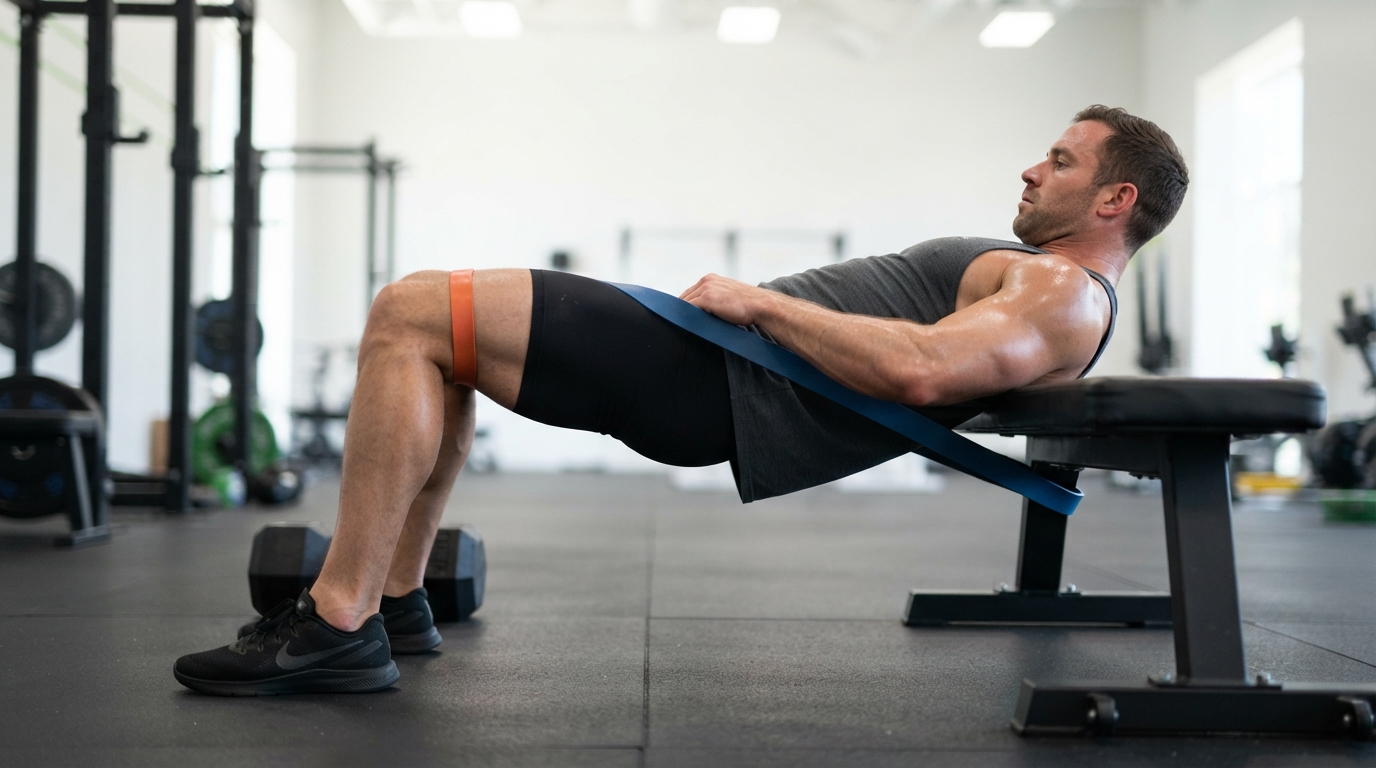
18. Banded Hip Thrust
Band: Loop across hips + mini band above knees
Muscles: Glutes (max), hamstrings
Sit with your upper back against a bench or couch. Place a loop band across your hips (pin the ends under your feet) and a mini band above your knees. Drive your hips to full extension, squeezing your glutes hard at the top. The mini band forces you to push your knees out, which keeps the glute med engaged throughout.
Rx: 3 x 12-15
19. Banded Clamshell
Band: Mini band above knees
Muscles: Glute med, external rotators
Lie on your side, knees bent 90 degrees, feet together. Open your top knee against the band’s resistance like a clamshell opening. Do not let your hips roll backward — that is the most common form breakdown and it shifts work to your hip flexors.
Rx: 3 x 15-20 per side
20. Band Lateral Walk
Band: Mini band above ankles or above knees
Muscles: Glute med, hip abductors
Place the mini band above your ankles. Get into a quarter-squat position. Step sideways, maintaining tension in the band the entire time — do not let your trailing foot snap back. Take 10-15 steps per direction. The burn should be on the outside of your hip, not your quads.
Rx: 3 x 10-15 steps each direction
21. Banded Kickback
Band: Loop or mini band
Muscles: Glutes (max), hamstrings
Get on all fours. Loop the band around one foot and anchor the other end under your hands (or use a mini band above knees). Extend your leg straight back, squeezing your glute at the top. Do not arch your lower back — if your back extends, your glute is not doing the work.
Rx: 3 x 12-15 per leg
Core (4 Exercises)
22. Band Pallof Press
Band: Tube or loop anchored at chest height
Muscles: Obliques, transverse abdominis (anti-rotation)
Stand perpendicular to the anchor point. Hold the band at your sternum with both hands. Press it straight out in front of you, resisting the rotation force. Hold for 2-3 seconds with arms extended. This is the single best anti-rotation core exercise you can do with a band — it trains the exact stability pattern your core needs during every compound lift.
Rx: 3 x 10-12 per side
23. Band Woodchop
Band: Tube or loop, anchored high or low
Muscles: Obliques, serratus, hip rotators
Anchor the band high. Stand sideways to the anchor. Grip the band with both hands and pull diagonally down and across your body, rotating your torso. Your hips should stay mostly square — the rotation happens through your thoracic spine, not your lumbar spine.
Rx: 3 x 10-12 per side
24. Band Dead Bug
Band: Loop, anchored behind at low height
Muscles: Deep core, transverse abdominis
Lie face up. Hold the band overhead with arms extended toward the anchor. Extend one leg out while lowering the opposite arm — resist the band pulling you into extension. Your lower back must stay pressed into the floor the entire time. If it lifts, you have gone too far.
Rx: 3 x 8-10 per side
25. Banded Plank Pull-Through
Band: Loop
Muscles: Core (anti-rotation + anti-extension), shoulders
Get into a plank position with the band placed to one side. Reach under your body with the far hand, grab the band, and drag it to the other side. Repeat. This combines anti-rotation stability with scapular control. Keep your hips dead level — if they rock side to side, widen your feet.
Rx: 3 x 8-10 per side
4-Week Full-Body Resistance Band Plan
This plan uses exercises from the list above (referenced by number). Train 3 days per week — Monday, Wednesday, Friday — with at least one rest day between sessions. That aligns with the ACSM’s 2026 resistance training guidelines, which recommend training each major muscle group at least twice per week (ACSM, 2026).
Week 1-2: Foundation
Focus on learning the movements and building a base. Use a light-to-medium band. Rest 60 seconds between sets.
| Day | Exercises | Sets x Reps | Rest |
|---|---|---|---|
| Mon | #14 Banded Squat, #2 Standing Chest Press, #5 Seated Row, #8 Overhead Press, #10 Bicep Curl, #22 Pallof Press | 3 x 12 | 60s |
| Wed | #15 Banded RDL, #1 Banded Push-Up, #4 Band Pull-Apart, #7 Lateral Raise, #12 Tricep Pushdown, #19 Clamshell | 3 x 12 | 60s |
| Fri | #18 Banded Hip Thrust, #6 Band-Assisted Pull-Up, #9 Face Pull, #20 Lateral Walk, #13 OH Tricep Extension, #24 Dead Bug | 3 x 12 (pull-ups: 3 x 6-8) | 60s |
Week 3-4: Progression
Move up to a medium or heavy band (or double up a lighter band). Add tempo work: 3 seconds on the eccentric (lowering), 1-second pause, then press/pull. Drop to 10 reps since the load is heavier. Cut rest to 45 seconds.
| Day | Exercises | Sets x Reps | Rest | Progression |
|---|---|---|---|---|
| Mon | #14 Banded Squat, #1 Banded Push-Up, #5 Seated Row, #8 Overhead Press, #11 Hammer Curl, #22 Pallof Press, #23 Woodchop | 3 x 10 | 45s | Heavier band + 3-1-0 tempo |
| Wed | #15 Banded RDL, #3 Band Chest Fly, #4 Pull-Apart, #9 Face Pull, #12 Tricep Pushdown, #18 Hip Thrust, #20 Lateral Walk | 3 x 10 | 45s | Heavier band + 3-1-0 tempo |
| Fri | #16 Leg Extension, #17 Leg Curl, #6 Band-Assisted Pull-Up, #7 Lateral Raise, #10 Bicep Curl, #21 Kickback, #25 Plank Pull-Through | 3 x 10 (pull-ups: 3 x 8-10) | 45s | Thinner assist band for pull-ups |
Each session takes 35-45 minutes. If you can complete all sets at the prescribed reps with good form and the last two reps do not feel hard, move up a band.
How to Progressive Overload With Bands
Progressive overload — gradually increasing the demand on your muscles — drives all strength and size gains. The 2026 ACSM Position Stand confirmed that load relative to capacity, weekly set volume, full range of motion, and sufficient effort as key training variables (ACSM, 2026). Bands handle overload differently than barbells, but the principle is the same.
Four methods that work:
1. Band stacking. Double up bands or switch to a thicker one. A medium loop band might provide 30-60 lb of resistance; adding a light band on top gives you 45-80 lb. This is the simplest overload method and the one you should use first.
2. Tempo manipulation. Slow the eccentric to 3-4 seconds. A 3-1-3 tempo (3 seconds down, 1-second pause, 3 seconds up) roughly doubles the time under tension per set without changing the band. This is especially effective for upper-body isolation exercises like curls and extensions.
3. Mechanical advantage changes. Widen your stance on squats, change anchor height on presses, or shorten the band by gripping further from the anchor. Each adjustment changes the resistance curve. Standing closer to your anchor point means the band is already partially stretched at the start — more resistance through the full range.
4. Isometric holds and partial reps. Hold the peak contraction for 3-5 seconds, or add partial reps at the end of a set. Bands are uniquely suited to isometrics because the resistance does not disappear at the top of the movement the way it does with cables.
Link these four methods to the 4-week plan above: weeks 1-2 use baseline bands and standard tempo, weeks 3-4 introduce band stacking and tempo changes. After four weeks, you can start mixing in stance changes and isometric finishers.
For a deeper look at progressive overload principles, see our progressive overload training guide.
Calisthenics + Resistance Bands: The Hybrid Advantage
Bands and bodyweight training are natural partners. A band can make a hard exercise easier (regression) or an easy exercise harder (progression) — both of which are hard to do with calisthenics alone.
Three high-value applications:
Band-assisted pull-ups. Loop a heavy band over the bar, step into it. The band supports a significant portion of your bodyweight at the bottom, where most people fail. As you pull higher and the band shortens, it gives less help. This is smarter than kipping or half-reps because it preserves the full range of motion. Check out our complete guide to pull-up variations and our assisted pull-ups walkthrough.
Banded push-ups. Drape a loop band across your upper back and under your palms. The resistance increases as you press up, adding meaningful resistance at lockout depending on the band. Once you can do 20+ bodyweight push-ups, banded push-ups are the next logical step before weighted push-ups. See our calisthenics upper body workout for more bodyweight-plus-band ideas.
Band-resisted dips. Loop a band around a dip station or between the handles. Step into it for assistance (like pull-ups), or drape it over your shoulders for added resistance. The same band that helps a beginner with dips will add resistance for an advanced trainee — just change how you use it.
This hybrid approach is the backbone of how the Gymstips training system works: use bands to fill the gaps that pure calisthenics cannot cover, especially for horizontal pressing and posterior chain work.
FAQ
Are resistance bands effective for building muscle?
Yes. A systematic review and meta-analysis by Lopes et al. (2019) found no significant difference in strength gains between elastic bands and conventional weights for both upper-body and lower-body exercises. Bands produce enough mechanical tension to trigger hypertrophy, provided you train close to failure and progress the resistance over time.
Can resistance bands replace weights?
For most people, yes — at least partially. Bands match weights for strength and hypertrophy when volume and effort are equal. The main limitation is maximal loading: you cannot replicate a 400-lb squat with bands. For beginners and intermediate trainees, bands alone are sufficient. Advanced lifters benefit from using bands as a supplement to free weights rather than a full replacement.
How often should you do resistance band workouts?
Two to three sessions per week, training each muscle group at least twice. The 2026 ACSM Position Stand recommends a minimum of two resistance training days per week for all major muscle groups. The 4-week plan in this article follows a 3-day full-body split (Monday, Wednesday, Friday) with rest days between sessions.
What resistance band level should beginners use?
Start with a light band (roughly 10-25 lb for tubes, 15-35 lb for loop bands). You should be able to complete 12 reps with good form while the last 2-3 reps feel genuinely difficult. If you can do 15+ reps without effort, the band is too light. Most beginners move up to a medium band within 3-4 weeks on compound exercises like squats and rows.
Can you get a full body workout with resistance bands?
Absolutely. The 25 exercises in this guide cover every major muscle group: chest, back, shoulders, arms, quads, hamstrings, glutes, and core. A single band session with 6-8 exercises (one per muscle group) takes 30-40 minutes and trains your entire body. The 4-week plan above is built as a 3-day full-body split using nothing but bands.
Sources
- Lopes, J.S.S. et al. (2019). “Effects of training with elastic resistance versus conventional resistance on muscular strength: A systematic review and meta-analysis.” SAGE Open Medicine, 7. DOI: 10.1177/2050312119831116. PubMed
- Tyler, T.F. et al. (2022). “Band Pull-Apart Exercise: Effects of Movement Direction and Hand Position on Shoulder Muscle Activity.” International Journal of Sports Physical Therapy, 17(2). PubMed
- ACSM (2026). “Resistance Training Prescription for Muscle Function, Hypertrophy, and Physical Performance in Healthy Adults: An Overview of Reviews.” Medicine and Science in Sports and Exercise. ACSM
- NSCA. “The Value of Resistance Bands as a Training Modality.” NSCA