

Bodyweight Circuit Training: 7 No-Equipment Circuits (Beginner to Advanced)
By the Gymstips Training Team | Updated September 16, 2026
Gymnase Tips is reader-supported. Some links may be Amazon affiliate links; if you buy through them we may earn a small commission at no extra cost to you.
TL;DR — How Effective Is Bodyweight Circuit Training?
Bodyweight circuit training builds muscular endurance, burns roughly 7-10 kcal/min depending on body weight, and needs zero equipment. This guide gives you 7 ready-to-follow circuits — beginner through military-grade — with a 4-week progression plan and weekly schedule. Pick your level and start today.
Table of contents

What Is Bodyweight Circuit Training?
Bodyweight circuit training is a workout format where you perform 5-8 exercises back-to-back with minimal rest between moves, using only your own body weight for resistance. Unlike straight sets (3 sets of squats, rest, 3 sets of push-ups, rest), circuits rotate through different movement patterns each round. Your heart rate stays elevated. You build muscular endurance and cardiovascular fitness at the same time.
A typical structure: 30-40 seconds of work per exercise, 15-20 seconds of transition rest, repeated for 3-4 rounds. Quick example:
- Bodyweight squats — 40s
- Push-ups — 40s
- Reverse lunges — 40s
- Plank hold — 40s
- Jumping jacks — 40s
Rest 20 seconds between exercises, 60 seconds between rounds. Three rounds takes roughly 18 minutes.
Benefits of Bodyweight Circuit Training
Bodyweight circuits combine strength and cardio in one session, burning 7-10 kcal/min while building muscular endurance. Here is what published research supports:
- Bodyweight circuit training registers a MET value of 6.0 in the 2024 Compendium of Physical Activities (Source: Compendium of Physical Activities, 2024). For a 75 kg person, that works out to roughly 7.9 kcal/min — comparable to a brisk jog but with added resistance stimulus. Heavier or faster trainees will land closer to 10 kcal/min.
- Cardiovascular fitness improves measurably. A 4-week bodyweight Tabata protocol (burpees, jumping jacks, mountain climbers, squat thrusts) produced an 8% VO2max increase in female participants (Source: McRae et al., Applied Physiology, Nutrition, and Metabolism, 2012). That is a meaningful jump from just four weeks of training with zero equipment.
- Your metabolism stays elevated after the session ends. High-intensity circuit training produced nearly double the post-exercise oxygen consumption (329 mL O2) compared to moderate steady-state cardio (169 mL O2) over 60 minutes of recovery (Source: Faleiro et al., Sports, 2025).
- No equipment needed. Your body weight is the load. Train in a hotel room, a park, a 6×6 foot living room.
- The format scales from complete beginner to advanced calisthenics athlete. Swap incline push-ups for planche push-ups, shorten rest, add rounds. Nothing to buy.
- Most circuits finish in 15-25 minutes. The ACSM’s bodyweight HICT protocol clocked just 7 minutes per round (Source: Klika & Jordan, ACSM’s Health & Fitness Journal, 2013). Hard to find a more time-efficient training method.
7 Bodyweight Circuits You Can Do Anywhere
These seven circuits cover every level from first-timer to military conditioning. Each lists exercises, work/rest timing, rounds, and form cues. Pick one and go.
Circuit 1 — Full-Body Beginner (20 Min)
Format: 30s work / 20s rest between exercises. 60s rest between rounds. 3 rounds.
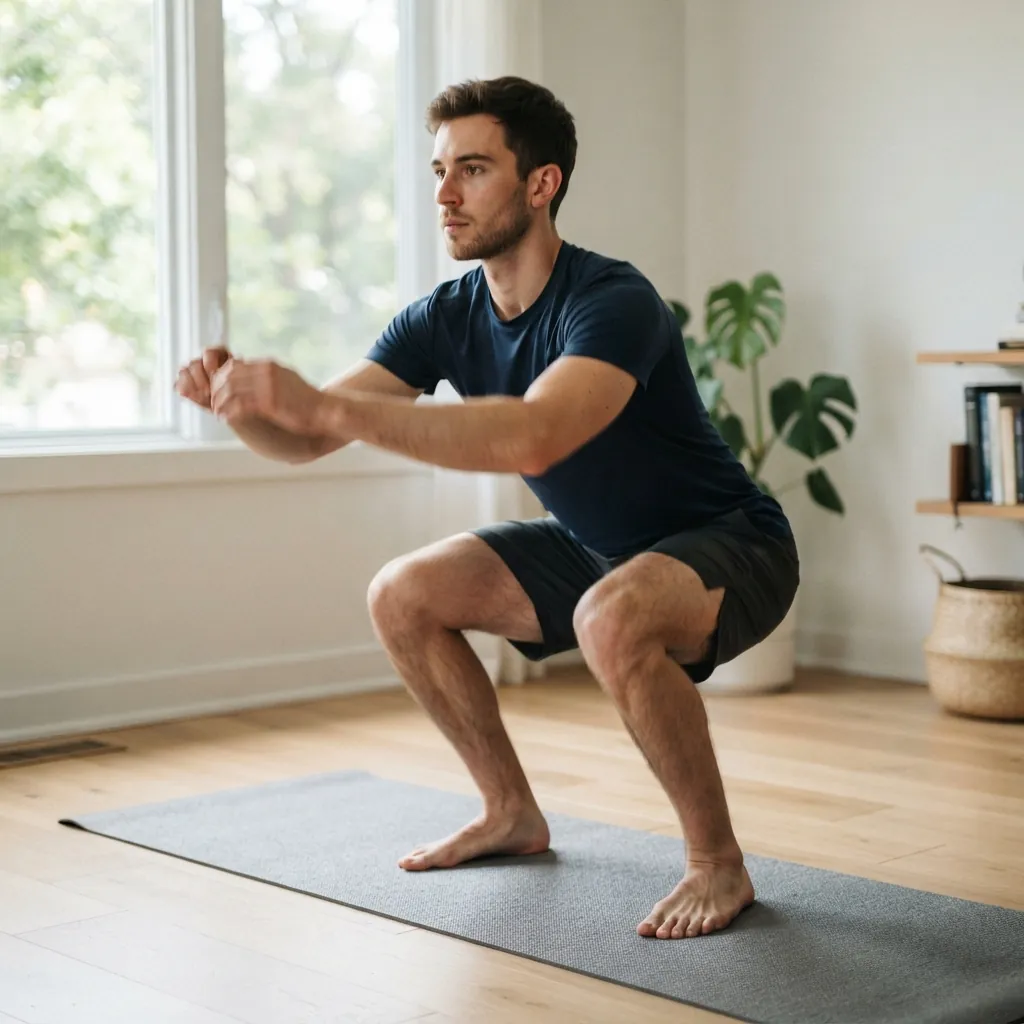
- Bodyweight squats — Feet shoulder-width, push hips back like sitting in a chair. Knees track over toes, not past them.
- Incline push-ups (hands on a bench or sturdy chair) — Straight line from head to heels. Lower chest to the edge, press back up. No sagging hips.
- Reverse lunges (alternating) — Step back, drop rear knee to just above the floor. Front shin stays vertical.
- Dead bugs — Lie face-up, extend opposite arm and leg while pressing your lower back flat into the floor. Slow and controlled beats fast here.
- Glute bridges — Drive through your heels, squeeze glutes at the top for a full second. Keep ribs down.
- Plank hold — Forearms on the floor, body rigid. If your hips sag, widen your feet for a more stable base.
Grab an exercise mat for comfort on the dead bugs and planks. This circuit works well as a standalone session or a warm-up before a longer training day.
Circuit 2 — Upper-Body Focus
Format: 35s work / 15s rest between exercises. 60s rest between rounds. 3 rounds.
- Standard push-ups — Hands just outside shoulder width. Lower until your chest is a fist-width from the floor.
- Pike push-ups — Hips high in an inverted V. Bend elbows and lower the crown of your head toward the floor. Targets shoulders hard.
- Diamond push-ups — Index fingers and thumbs form a diamond shape under your chest. Elbows stay tight to your ribs. This one hammers triceps.
- Superman pulls — Lie face-down, arms extended overhead. Lift chest and pull elbows back to your ribcage, squeezing shoulder blades together at the bottom.
- Tricep dips (off a chair or bench) — Fingers wrap the edge, lower until elbows hit 90 degrees. Keep your back close to the chair.
- Plank shoulder taps — High plank position. Tap opposite shoulder without rotating your hips. Wider feet make it easier.
Circuit 3 — Lower-Body Focus
Format: 35s work / 15s rest between exercises. 60s rest between rounds. 3 rounds.
- Jump squats — Squat to parallel, explode up, land soft with bent knees. If your knees ache, swap these for regular squats at a faster tempo.
- Bulgarian split squats (rear foot elevated on a chair) — Drop straight down, front knee tracks over mid-foot. This one burns. Control the descent.
- Calf raises (on a step edge for full range) — Rise onto the balls of your feet, pause at the top, lower slowly below the step line for a stretch.
- Lateral lunges — Take a wide step to the side, sit into one hip while the opposite leg stays straight. Push off back to center.
- Single-leg glute bridges — One foot planted, other leg extended. Drive through the planted heel. If you cramp, switch to two-leg bridges and slow the tempo.
- Wall sit — Thighs parallel to the floor, back flat against the wall. Hold. The last 10 seconds should feel awful.
Circuit 4 — Intermediate Full-Body
Format: 30s work / 15s rest between exercises. 45s rest between rounds. 4 rounds.
This steps up from the beginner circuit with harder movement variations and shorter recovery.
- Archer push-ups — Wide hand placement. Shift your weight over one hand as you lower, opposite arm straightens. Alternate sides each rep.
- Pistol squat progressions (hold a doorframe or chair for balance) — Lower on one leg, opposite leg extended forward. Go as deep as control allows. Depth improves fast.
- Burpees — Chest to floor, explosive stand, small jump at the top. No worm-ups off the floor; keep it strict.
- Alternating step-up jumps (onto a sturdy chair or low bench) — Drive knee up at the top. Land with control. Pick a height where you can maintain form all 30 seconds.
- Hollow body hold — Lie face-up, lift shoulders and legs off the floor, arms overhead. Press your lower back into the ground. Shake is fine. Sagging is not.
- Mountain climbers — High plank, drive knees to chest alternately. Keep hips level with shoulders; no piking up.
For anyone ready to layer in external resistance on later rounds, a set of resistance bands adds load without changing the movement pattern.
Circuit 5 — Fat-Loss AMRAP (20 Min)
AMRAP stands for “as many rounds as possible.” Set a 20-minute timer, cycle through the exercises, log your total rounds. Beat that number next session.
- Burpees — 8 reps. Full chest-to-floor, jump at the top.
- Mountain climbers — 20 reps (10 each side). Fast but controlled; hips stay level.
- Jump lunges — 10 reps (5 each side). Land soft, knee stays behind toes.
- High knees — 20 reps (10 each side). Drive knees to waist height, pump your arms.
- Push-ups — 10 reps. Standard form. Drop to knees only if you physically cannot complete the rep.
- Squat jumps — 10 reps. Full depth, full extension at the top.
No scheduled rest. Catch your breath when you need to, then pick up where you left off. An interval timer that beeps at 20 minutes keeps you honest.
This format works well for fat loss exercises at home when paired with a caloric deficit.
Circuit 6 — Military Conditioning EMOM
EMOM means “every minute on the minute.” At the start of each minute, perform the prescribed reps. Whatever time remains in that minute is your rest. Faster work earns more recovery. Twenty minutes total.
This circuit draws from exercises common in service-branch physical training — the kind of thing you would see in a boot camp workout or a military calisthenics workout guide.
- Minute 1: Pull-ups — 5 reps (use a doorway pull-up bar, or substitute inverted rows under a sturdy table)
- Minute 2: Push-ups — 15 reps. Strict: chest to the floor, full lockout.
- Minute 3: Flutter kicks — 20 reps (10 each side). Hands under your glutes, legs 6 inches off the floor. Lower back stays pinned.
- Minute 4: Squat thrusts — 10 reps. Like a burpee without the push-up or jump. Fast.
Cycle through these four movements for 5 full rounds (20 minutes). If you finish the prescribed reps in under 30 seconds, the exercise is too easy — add 2-3 reps next session.

Circuit 7 — Advanced Calisthenics Challenge
Format: 40s work / 10s rest between exercises. 90s rest between rounds. 5 rounds.
Not a starting point. These movements require existing strength and joint preparation. Poor form here means injury.
- Explosive pull-ups (or muscle-up progressions if you have a bar) — Pull hard enough that your hands momentarily leave the bar. No kipping.
- Clapping push-ups — Full depth, explosive press, clap, land with soft elbows. Wrists take impact here; warm them up.
- Pistol squats (unassisted) — Full depth on one leg, standing leg’s heel stays planted. If you topple, hold a counterweight in front of your chest.
- L-sit hold (on parallettes or the floor) — Legs extended, hips off the ground. Even 10 seconds counts. Build from tucked L-sits if needed.
- Plyometric lunges — Jump and switch legs mid-air. Land in a deep lunge. These crush your quads and spike your heart rate simultaneously.
- Handstand push-up negatives (against a wall) — Kick up into a wall handstand, lower yourself as slowly as possible. Aim for a 5-second descent. A foam roller or folded towel under your head gives a safety margin.
For a structured long-term progression path, see the full calisthenics workout plan.
4-Week Progression Plan
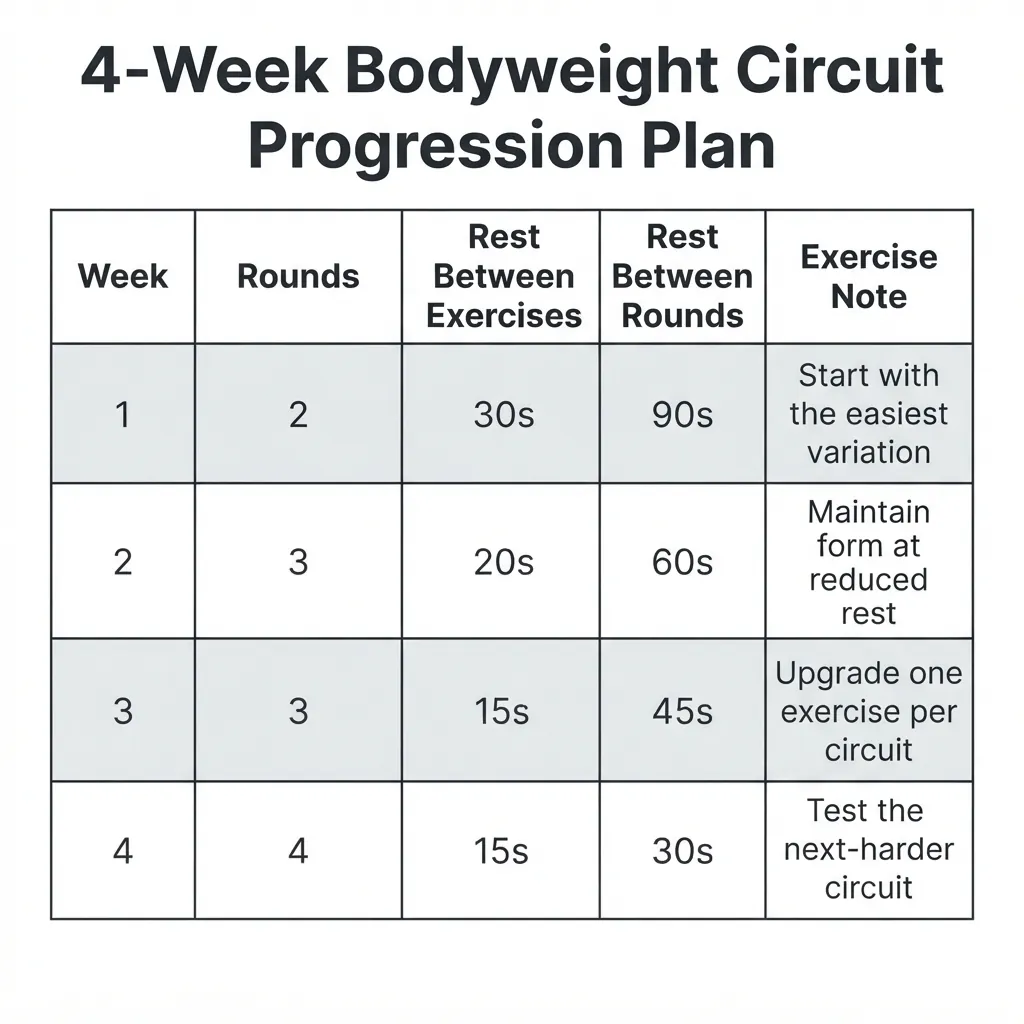
Progress bodyweight circuits weekly by adding rounds and cutting rest. This plan works for any circuit above.
| Week | Rounds | Rest Between Exercises | Rest Between Rounds | Exercise Note |
|---|---|---|---|---|
| 1 | 2 | 30s | 90s | Start with the easiest variation of each exercise |
| 2 | 3 | 20s | 60s | Maintain form at the reduced rest |
| 3 | 3 | 15s | 45s | Upgrade one exercise per circuit (e.g., incline push-ups to standard) |
| 4 | 4 | 15s | 30s | Test the next-harder circuit in the list |
After week 4, either restart the cycle with a harder circuit or add resistance band exercises to increase load.
When to deload: If your rep quality drops noticeably by round 2, or joints feel stiff rather than warm, repeat the previous week instead of advancing. Overreaching without external load happens less often than with barbell training, but accumulated fatigue from plyometric circuits (5, 6, 7) still builds.
Ready for a structured challenge after this? Try the 28-day calisthenics challenge.
Sample Weekly Training Schedule
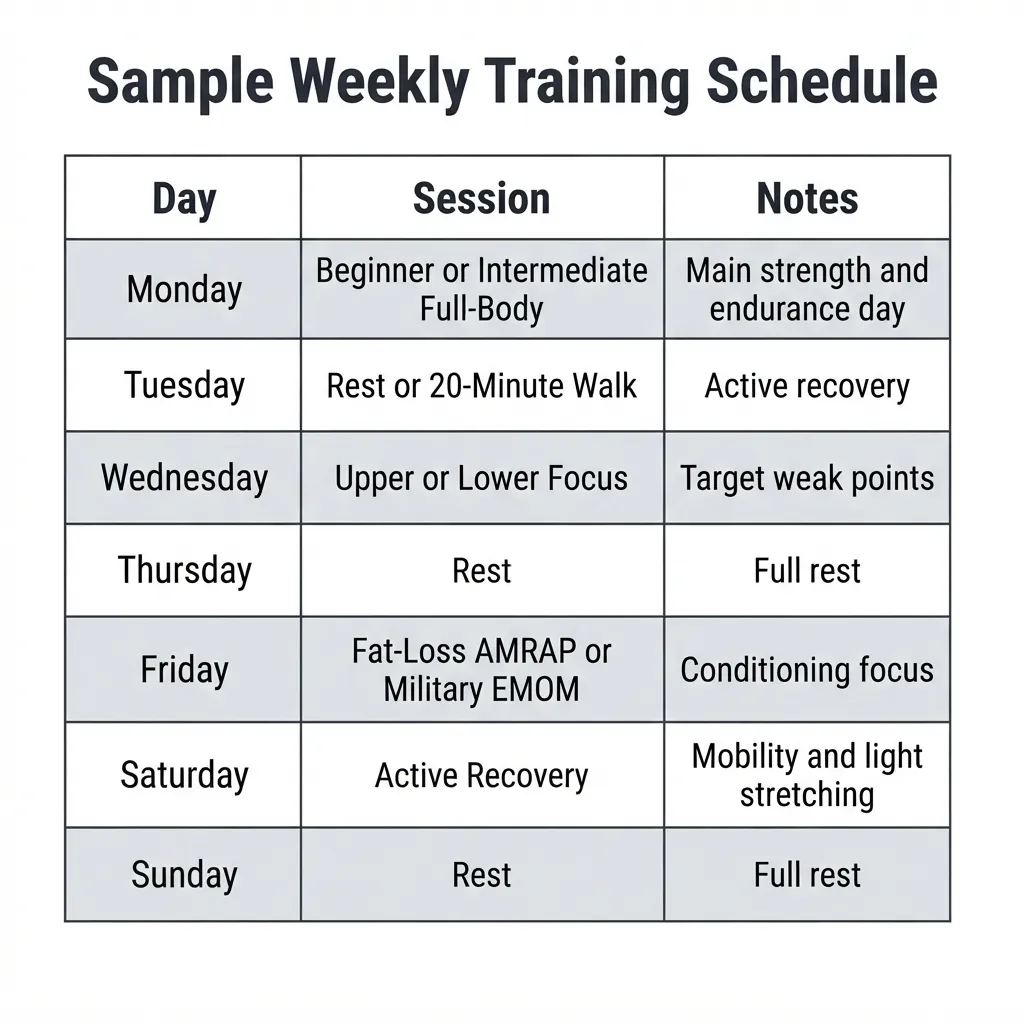
Three to four bodyweight circuit sessions per week is the sweet spot. That aligns with the ACSM’s 2026 resistance training guidelines, which set the evidence-based minimum at two sessions per week for all major muscle groups (Source: ACSM, 2026). More than four circuit sessions weekly risks overtraining when every session hits the full body.
| Day | Session | Notes |
|---|---|---|
| Monday | Beginner or Intermediate Full-Body (Circuit 1 or 4) | Main strength + endurance day |
| Tuesday | Rest or 20-min walk | Active recovery, not another circuit |
| Wednesday | Upper or Lower Focus (Circuit 2 or 3) | Target weak points |
| Thursday | Rest | Full rest |
| Friday | Fat-Loss AMRAP or Military EMOM (Circuit 5 or 6) | Conditioning focus |
| Saturday | Active recovery — mobility, light stretching | Or try fun workouts at home for variety |
| Sunday | Rest | Full rest |
Circuit Training vs HIIT — What Is the Difference?
Circuit training rotates through exercises with minimal rest to build endurance; HIIT alternates max-effort bursts with full recovery to spike heart rate. The core difference is rest structure and intensity ceiling.
Both burn calories and improve cardiovascular fitness, but they serve different primary goals:
| Circuit Training | HIIT | |
|---|---|---|
| Structure | 5-8 exercises, rotate with minimal rest | Short max-effort intervals + full recovery |
| Rest | 10-30s between exercises | 60-120s between intervals |
| Primary goal | Muscular endurance + cardiovascular fitness | Anaerobic power + peak calorie burn |
| Best for | General fitness, fat loss, time efficiency | Athletic conditioning, VO2max peaks |
| Duration | 20-40 minutes | 10-25 minutes |
| Example | 6 exercises x 30s each, 15s rest, 4 rounds | 30s all-out sprint, 90s walk, 8 rounds |
You can blend both. The AMRAP circuit (Circuit 5) and EMOM circuit (Circuit 6) above sit at the intersection — circuit structure with HIIT-level intensity. For a deeper look at how bodyweight training stacks up against loaded work, see calisthenics vs weights.
Warm-Up Before Your Circuit (3-5 Minutes)
A 3-5 minute warm-up before circuit training activates joints and raises core temperature. Skip it and injury risk climbs, especially on plyometric movements like jump squats and burpees.
Spend 30 seconds on each:
- Arm circles (forward, then reverse)
- Leg swings (front-to-back, then side-to-side)
- Hip circles (hands on hips, wide circles both directions)
- Inchworms (walk hands out to plank, walk feet to hands)
- Jumping jacks
That covers every major joint through its full range and gets your heart rate partway up before the first working set. No static stretching before circuits — save that for after.
FAQ
How long should a circuit training workout be?
Most people get a complete training stimulus in 20-30 minutes. Beginners should aim for 15-20 minutes (fewer rounds, longer rest). Advanced trainees can push to 30-40 minutes by adding rounds and cutting rest periods. The ACSM’s bodyweight HICT protocol demonstrated meaningful fitness improvements from sessions as short as 7 minutes repeated 2-3 times (Source: Klika & Jordan, ACSM’s Health & Fitness Journal, 2013).
How many exercises should be in a circuit?
Five to eight. Fewer than five under-stimulates because you repeat the same muscle patterns too quickly between rounds. More than eight degrades form as accumulated fatigue builds. Each exercise should target a different movement pattern — push, pull, squat, hinge, core — to avoid local muscle failure before the circuit ends.
Are bodyweight circuits effective?
Yes. Published research shows bodyweight circuit protocols improve VO2max and body composition. McRae et al. (2012) documented an 8% VO2max improvement in female participants after just 4 weeks of bodyweight Tabata training at 4 sessions per week (Source: McRae et al., Applied Physiology, Nutrition, and Metabolism, 2012). For more home-based fat-loss strategies, see fat loss exercises at home.
Is circuit training good for losing belly fat?
Circuit training supports fat loss by burning 7-10 kcal/min and elevating metabolism after the session through EPOC. No exercise spot-reduces belly fat. Fat loss requires a caloric deficit. Circuit training is one of the more time-efficient ways to increase daily energy expenditure, which makes sustaining that deficit easier.
Can you build muscle with circuit training?
Beginners and early intermediates can build muscle with bodyweight circuits because the mechanical tension is novel enough to trigger adaptation. As you get stronger, circuits primarily build muscular endurance rather than hypertrophy. To keep building muscle past that point, progress to harder calisthenics variations (pistol squats, archer push-ups, one-arm push-up progressions) or add external load. See the calisthenics workout plan for beginner to advanced for a structured approach.
How many times a week should you do circuit training?
Three to four times per week with at least one rest day between full-body sessions. The ACSM’s 2026 resistance training guidelines recommend a minimum of two sessions per week hitting all major muscle groups on non-consecutive days (Source: ACSM, 2026). The weekly schedule section above maps this out day by day.
Sources
- 2024 Adult Compendium of Physical Activities — MET value for bodyweight circuit training (6.0 METs, code 02032): pacompendium.com/conditioning-exercise
- McRae G, et al. “Extremely low volume, whole-body aerobic-resistance training improves aerobic fitness and muscular endurance in females.” Applied Physiology, Nutrition, and Metabolism. 2012;37(6):1124-1131: PubMed
- Faleiro V, et al. “Isocaloric High-Intensity Interval and Circuit Training Increases Excess Post-Exercise Oxygen Consumption.” Sports (Basel). 2025;13(10):355: PMC
- Klika B, Jordan C. “High-Intensity Circuit Training Using Body Weight: Maximum Results With Minimal Investment.” ACSM’s Health & Fitness Journal. 2013;17(3):8-13: journals.lww.com
- ACSM 2026 Resistance Training Guidelines Update: acsm.org