Gymnase Tips is reader-supported. Some links may be Amazon affiliate links; if you buy through them we may earn a small commission at no extra cost to you.
TL;DR — What Are the Best Kettlebell Workouts?
The best kettlebell workouts pair ballistic movements (swings, cleans, snatches) with grinds (presses, squats, get-ups) in routines matched to a specific goal. Beginners need 4-6 exercises across 2-3 weekly sessions. Intermediate and advanced lifters progress by adding load, volume, or single-arm variations. Below: 15+ exercises sorted by movement pattern, a grind-vs-ballistic weight table, and 4 ready-to-follow routines.
Table of contents
Why Kettlebell Training Works
Kettlebell training delivers exceptional calorie burn, strengthens the posterior chain through loaded hip hinges, and builds grip strength that carries over to every pulling movement you do. An ACE-funded study at the University of Wisconsin found that a 20-minute kettlebell snatch protocol burned approximately 20.2 calories per minute — equivalent to running a 6-minute mile (Source: ACE, 2010).
That calorie output comes from the combination of aerobic and anaerobic demand. Researchers measured 13.6 cal/min aerobically and another 6.6 cal/min anaerobically via blood lactate (Source: ACE, 2010). Separate research published in the Journal of Strength and Conditioning Research showed that just 4 weeks of kettlebell snatch training improved VO2max by 6% in NCAA Division I female soccer players (Source: Falatic et al., JSCR, 2015).
Grip strength matters beyond the gym. The PURE study — 139,691 participants across 17 countries — found that every 5 kg decrease in grip strength raised all-cause mortality risk by 16% (Source: Leong et al., The Lancet, 2015). Kettlebell carries, swings, and snatches load the grip under fatigue in ways a barbell cannot replicate.
One kettlebell. Twenty minutes. No commute. That is the time-efficiency argument for home training, and it holds up under scrutiny.
Combine kettlebell training with a calisthenics workout plan for a complete training program.
Essential Kettlebell Exercises by Movement Pattern
Organizing exercises by movement pattern — hinge, squat, press, pull, ballistic, carry, and core — prevents the most common programming mistake: overloading one pattern while ignoring another. Pick one or two exercises from each category, and you have a balanced session. Every exercise below works with a single kettlebell.
Hinge (Posterior Chain)
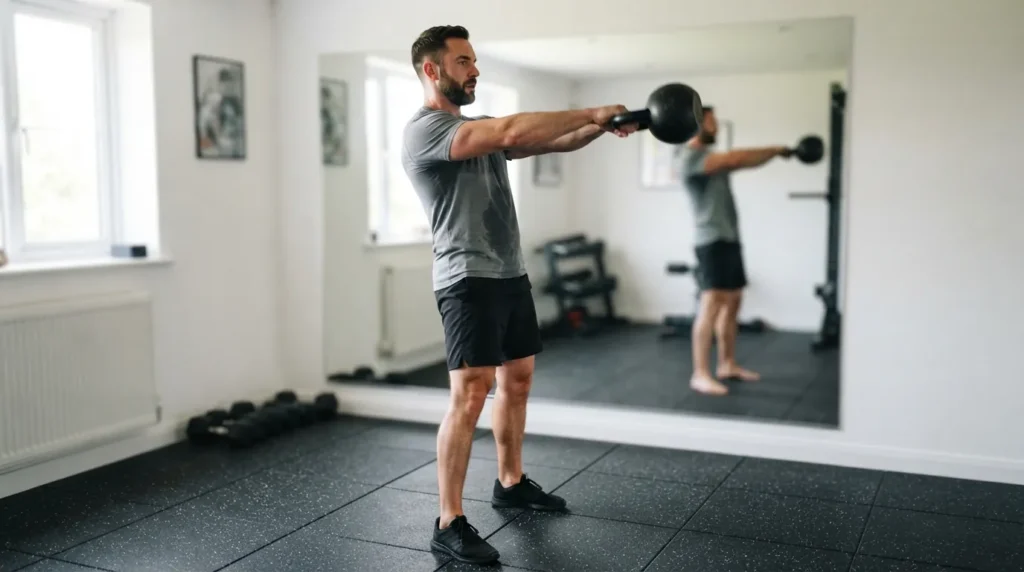
Two-Hand Kettlebell Swing
Stand with feet shoulder-width apart, bell about a foot in front of you. Hike the bell back between your legs, then snap your hips forward to project it to chest height. Arms stay straight — the power comes from the hip drive, not the shoulders.
Breathe: Sharp exhale through pursed lips at the top of each swing. Inhale on the backswing.
Works: Glutes, hamstrings, erector spinae, grip.
Single-Arm Swing
Same hip hinge, one hand on the bell. The free arm mirrors the working arm. Grip demand doubles. Rotate the thumb slightly outward at the top to control the arc.
Breathe: Same pattern — exhale at hip extension, inhale on the backswing.
Works: Glutes, hamstrings, obliques (anti-rotation), grip.
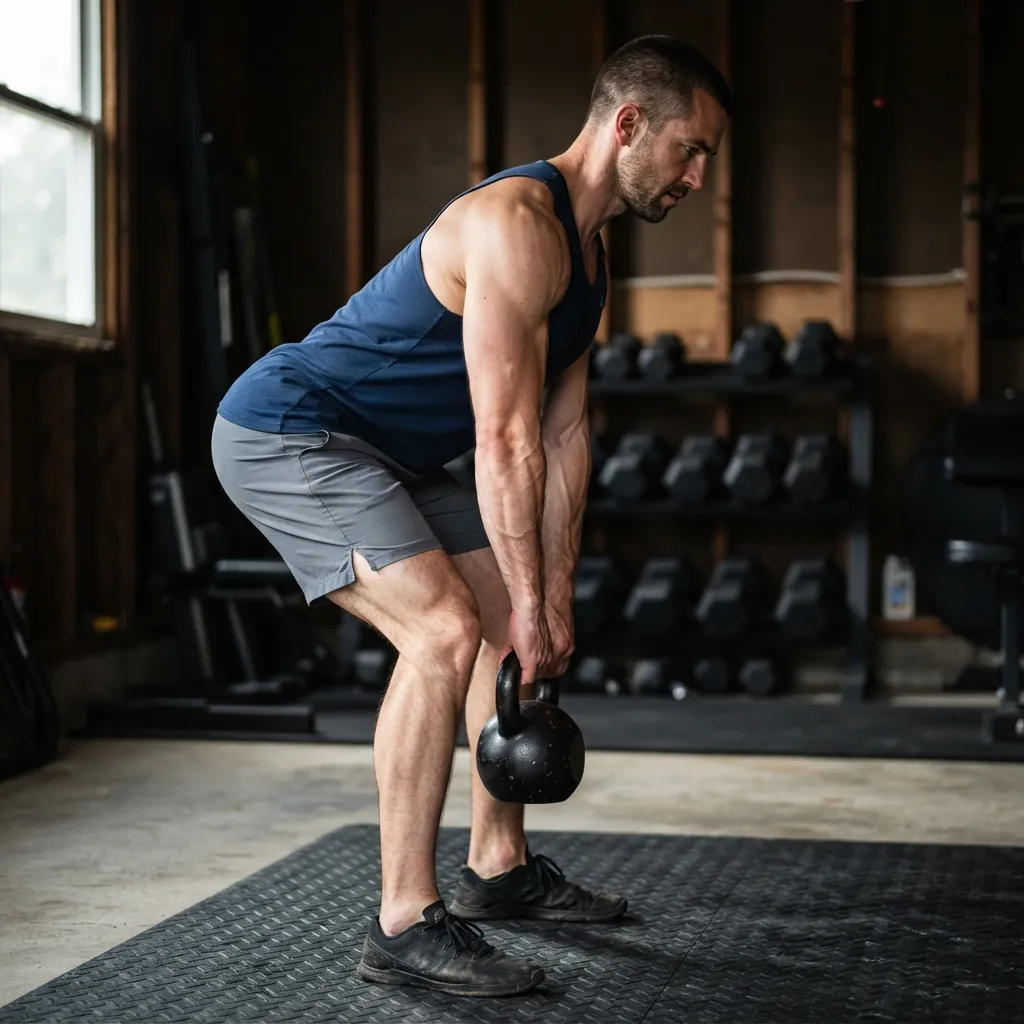
Kettlebell Deadlift
Bell centered between your feet. Push your hips back, grab the handle with both hands, brace your core, and stand up by driving through the floor. This is the pattern you learn before you swing.
Breathe: Inhale at the bottom, exhale as you stand.
Works: Glutes, hamstrings, erector spinae, quads.
Squat
Goblet Squat
Hold the bell by the horns at chest height, elbows tucked. Squat until your elbows brush the inside of your knees. Drive up through your whole foot. The front load forces an upright torso, which teaches squat mechanics better than most barbell drills.
Breathe: Inhale on the descent, exhale on the drive up.
Works: Quads, glutes, core, upper back (isometric).
Kettlebell Front Squat
Clean the bell to the rack position — wrist straight, elbow tight to your ribs, bell resting against your forearm. Squat to depth and stand. Heavier than a goblet squat for the same bell weight because the offset load taxes the core harder.
Breathe: Inhale at the top, hold through the descent, exhale on the way up.
Works: Quads, glutes, core, shoulder stabilizers.
Cossack Squat
Hold the bell at your chest. Step wide, then shift your weight to one leg and squat to full depth while the other leg stays straight. Builds lateral hip mobility and single-leg strength simultaneously.
Breathe: Inhale as you lower, exhale as you drive back up.
Works: Adductors, quads, glutes, hip mobility.
For targeted glute isolation with kettlebells, see our glute isolation guide.
Press and Pull
Kettlebell Overhead Press
Clean the bell to rack. Press it straight overhead until your bicep is beside your ear. Lock the elbow. Lower under control. Keep your ribs down — flaring them turns a press into a spine-compressing lean-back.
Breathe: Exhale forcefully as you press. Inhale as you lower.
Works: Deltoids, triceps, core (anti-lateral flexion).
Kettlebell Row
Hinge forward about 45 degrees, free hand on your knee or a bench. Pull the bell to your hip, squeezing the shoulder blade back. Lower with a 2-second eccentric. Resist rotating your torso.
Breathe: Exhale on the pull, inhale as you lower.
Works: Lats, rhomboids, rear delts, biceps.
Kettlebell Clean and Press
A two-part lift. Clean the bell from the floor to rack position in one smooth arc (not a reverse curl — the bell should roll around your wrist, not crash into it). Then press overhead. Lower to rack, drop to the hike position, repeat.
Breathe: Short exhale on the clean, another forceful exhale on the press.
Works: Full body — posterior chain on the clean, shoulders and triceps on the press.
Ballistic / Power
Kettlebell Snatch
The king of kettlebell ballistics. Swing the bell back, then drive it overhead in one arc. At the top, punch your hand through so the bell lands softly on your forearm. Avoid the “bang” — if the bell slams your wrist, you are pulling too early.
Breathe: Exhale at lockout. Inhale on the downswing.
Works: Entire posterior chain, shoulders, grip, cardiovascular system.
Kettlebell Clean
Like the first half of the clean and press. Hike the bell, drive the hips, and guide it to rack position. The bell path stays close to the body. Think “zipping up a jacket,” not “curling a dumbbell.”
Breathe: Exhale sharply as the bell reaches rack.
Works: Glutes, hamstrings, forearms, core.
Kettlebell High Pull
A swing that finishes with the elbow pulling high, bell at chin height. The elbow leads. This is a progression toward the snatch — learn it first if the snatch feels uncoordinated.
Breathe: Exhale at the top when the elbow pulls high.
Works: Posterior chain, upper back, shoulders.
Carry
Farmer’s Carry
Pick up a heavy bell in one hand. Walk 30-40 meters without leaning to the loaded side. Simple. Brutally effective for grip, core stability, and work capacity.
Breathe: Steady nasal breathing. No holding your breath.
Works: Grip, obliques, traps, hip stabilizers.
Waiter’s Carry
Press the bell overhead and walk. The shoulder stabilizers work overtime. Go lighter than you think — this is about control, not load.
Breathe: Steady, controlled breathing through the nose.
Works: Shoulder stabilizers, core, grip.
Racked Carry
Bell in the rack position, walk. Somewhere between the farmer’s carry and waiter’s carry in difficulty. Good for teaching the rack position under fatigue.
Breathe: Steady nasal breathing. Keep your ribs down.
Works: Core, upper back, biceps (isometric).
Core and Mobility
Turkish Get-Up
Start lying on your back with the bell pressed to lockout in one hand. Stand up without bending the loaded arm. Then reverse the sequence back to the floor. This single exercise trains shoulder stability, hip mobility, and core strength through seven distinct positions. Go slow — 30-45 seconds per rep is normal.
Breathe: Breathe at each transition point. Do not rush.
Works: Shoulders, core, hips, thoracic spine — nearly everything.
Kettlebell Windmill
Press the bell overhead, then hinge laterally at the hip, reaching the free hand toward the floor while keeping your eyes on the bell. This is a hip hinge, not a side bend. Feels awkward at first. Gets addictive.
Breathe: Inhale at the top, slow exhale as you hinge down.
Works: Obliques, hamstrings, shoulder stabilizers, thoracic mobility.
Kettlebell Halo
Hold the bell by the horns upside-down at chest level. Circle it around your head, keeping it close to your skull. Alternate directions. This is a warm-up staple and a shoulder-mobility drill in one.
Breathe: Breathe naturally. No specific timing required.
Works: Shoulders (full range), core (anti-rotation).
What Weight Kettlebell Should You Use?
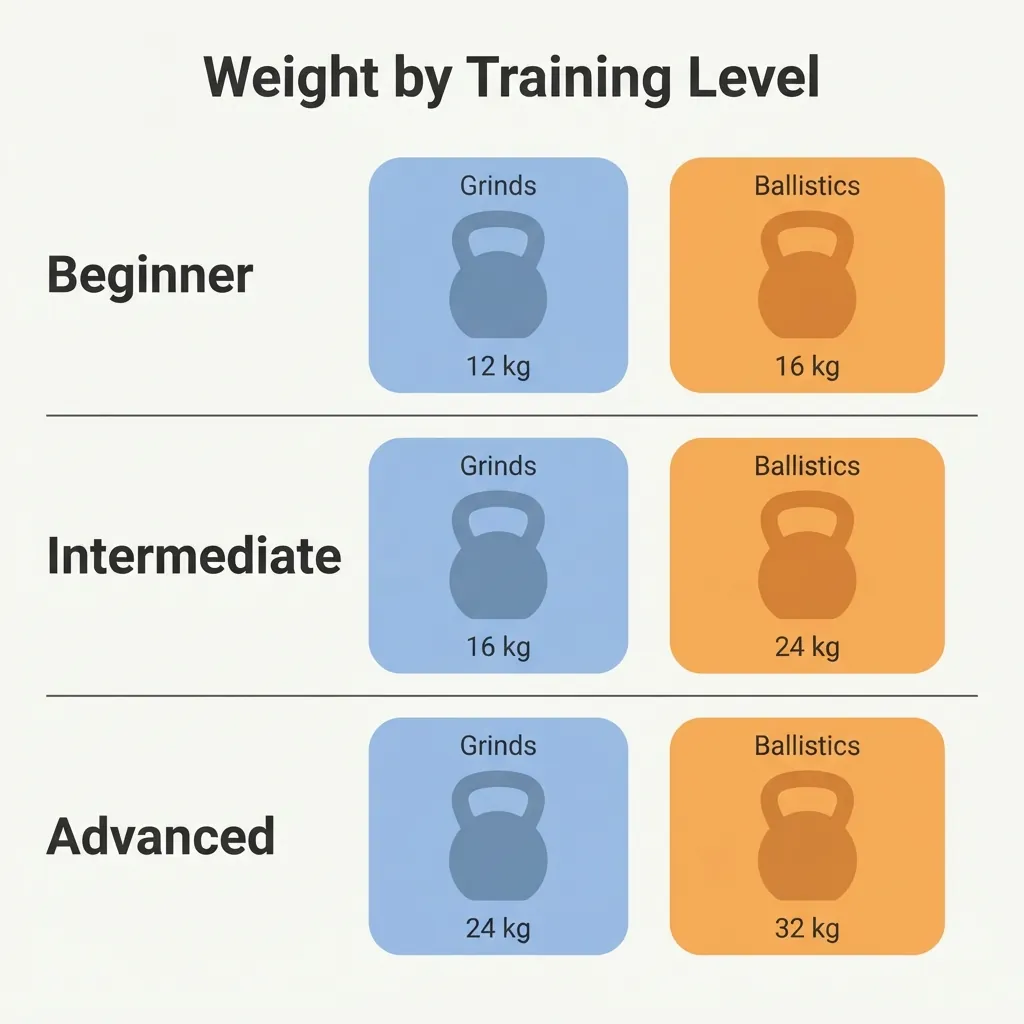
A beginner man should start with a 16 kg (35 lb) kettlebell for ballistic movements like swings and cleans, and a 12 kg (26 lb) bell for grinds like presses and get-ups. Beginner women: 12 kg (26 lb) for ballistics, 8 kg (18 lb) for grinds. These ranges align with StrongFirst’s certification prep guidelines, which recommend men start at 16 kg and women at 8 kg (Source: StrongFirst).
Why two weights? Ballistic movements use the entire posterior chain and momentum, so they handle heavier loads. Grinds rely on smaller muscle groups (shoulders, triceps) moving slowly under tension. Using your swing weight for a Turkish get-up is a recipe for a shoulder injury. No competitor on page one makes this distinction, and it matters.
| Level | Grinds (presses, get-ups, windmills) | Ballistics (swings, cleans, snatches) |
|---|---|---|
| Beginner men | 12 kg / 26 lb | 16 kg / 35 lb |
| Intermediate men | 16 kg / 35 lb | 24 kg / 53 lb |
| Advanced men | 24 kg / 53 lb | 32 kg / 70 lb |
| Beginner women | 8 kg / 18 lb | 12 kg / 26 lb |
| Intermediate women | 12 kg / 26 lb | 16 kg / 35 lb |
| Advanced women | 16 kg / 35 lb | 24 kg / 53 lb |
A cast-iron kettlebell with a smooth, powder-coated handle is the best starting option. Competition kettlebells (same size shell regardless of weight) are worth considering if you plan to train snatches seriously — the uniform diameter keeps the rack and lockout position consistent across weights. If budget or space is tight, an adjustable kettlebell covers multiple weight jumps in one unit.
4 Kettlebell Routines for Every Goal
These four kettlebell routines cover the most common training goals. Pick one based on your priority — fat loss, raw strength, metabolic conditioning, or building a foundation — and run it for 4-6 weeks before progressing. Each uses a single kettlebell and takes 15-30 minutes.
For a dedicated full-body kettlebell session, see our full body kettlebell workout guide.
Fat-Loss Kettlebell Circuit
A circuit format keeps your heart rate elevated and accumulates high calorie expenditure in minimal time. At 20.2 cal/min total (aerobic + anaerobic combined), a 20-minute high-intensity kettlebell session yields roughly 400 calories (Source: derived from ACE, 2010 — 13.6 aerobic + 6.6 anaerobic cal/min). Run this 3 times per week.
Format: 5 exercises, 40 seconds work / 20 seconds rest, 4 rounds. Rest 60 seconds between rounds. Total time: ~22 minutes.
| Exercise | Work | Rest |
|---|---|---|
| Two-Hand Swing | 40s | 20s |
| Goblet Squat | 40s | 20s |
| Single-Arm Clean (switch at 20s) | 40s | 20s |
| Kettlebell Row (switch at 20s) | 40s | 20s |
| Kettlebell Snatch (switch at 20s) | 40s | 20s |
Pair this circuit with a boot camp workout on alternate days for variety.
Strength Builder Routine
Heavy grinds with full rest. This is not a conditioning workout — treat it like a strength session. Use a bell that limits you to 5 clean reps. Train 3 times per week with at least 48 hours between sessions.
Format: 4 exercises, 4 sets of 5 reps, 2-3 minutes rest between sets. Total time: ~30 minutes.
| Exercise | Sets | Reps | Rest |
|---|---|---|---|
| Kettlebell Front Squat (each side) | 4 | 5 | 2-3 min |
| Kettlebell Overhead Press (each side) | 4 | 5 | 2-3 min |
| Kettlebell Row (each side) | 4 | 5 | 2 min |
| Two-Hand Swing (heavy) | 5 | 5 | 2-3 min |
15-Minute Conditioning Blast
An AMRAP (as many rounds as possible) format that taxes the cardiovascular system through ballistic movements. Set a timer for 15 minutes and complete as many rounds as you can with clean form. Log your rounds and beat the number next session.
Format: AMRAP, 15 minutes. No programmed rest — rest only when form breaks.
| Exercise | Reps |
|---|---|
| Single-Arm Swing (each side) | 10 |
| Kettlebell Clean and Press (each side) | 5 |
| Goblet Squat | 10 |
| Kettlebell High Pull (each side) | 5 |
Research supports this approach. The ACE study measured heart rates near maximal levels during kettlebell snatch intervals — 86-99% of peak heart rate achieved during the kettlebell protocol (Source: ACE, 2010). Ballistic kettlebell work delivers real cardiovascular training stimulus without a treadmill.
Beginner Foundation (4-Week Plan)
Three exercises. Three sets. Three days per week. Master the fundamentals before chasing variety. Add one exercise per week as competence grows.
| Week | Exercises | Sets x Reps | Notes |
|---|---|---|---|
| 1 | Kettlebell Deadlift, Goblet Squat, Kettlebell Halo | 3 x 8 | Focus on the hip hinge pattern |
| 2 | Add: Two-Hand Swing | 3 x 10 | Swap deadlifts for swings once the hinge is solid |
| 3 | Add: Kettlebell Overhead Press | 3 x 8 | Five exercises total now |
| 4 | Add: Turkish Get-Up | 3 x 3 each side | Go light — technique over load |
By week 4, you have 6 exercises covering all major movement patterns and are ready for any of the three intermediate routines above.
Goal-Specific Routine Comparison
Use this table to match the right routine to your training priority. All four routines use a single kettlebell, work for a home gym or commercial facility, and require no other equipment.
| Fat-Loss Circuit | Strength Builder | 15-Min Conditioning | Beginner Foundation | |
|---|---|---|---|---|
| Goal | Calorie burn, body recomposition | Maximal strength, muscle | Cardiovascular fitness, work capacity | Learn patterns, build base |
| Format | Circuit (40s on / 20s off) | Straight sets | AMRAP | Progressive weekly build |
| Duration | ~22 min | ~30 min | 15 min | ~20 min |
| Frequency | 3x/week | 3x/week | 2-3x/week | 3x/week |
| Key exercises | Swings, cleans, snatches | Front squats, presses, heavy swings | Cleans, high pulls, swings | Deadlifts, goblet squats, halos |
| Best for | Intermediate with fat-loss priority | Intermediate/advanced wanting strength | Anyone wanting fast cardio sessions | True beginners, first 4 weeks |
Warm-Up and Cool-Down for Kettlebell Training
Every kettlebell session needs a warm-up that primes the hinge pattern, opens the thoracic spine, and activates the glutes. Skip it and you risk lower-back strain on swings and shoulder impingement on presses. This 5-minute protocol covers all three priorities.
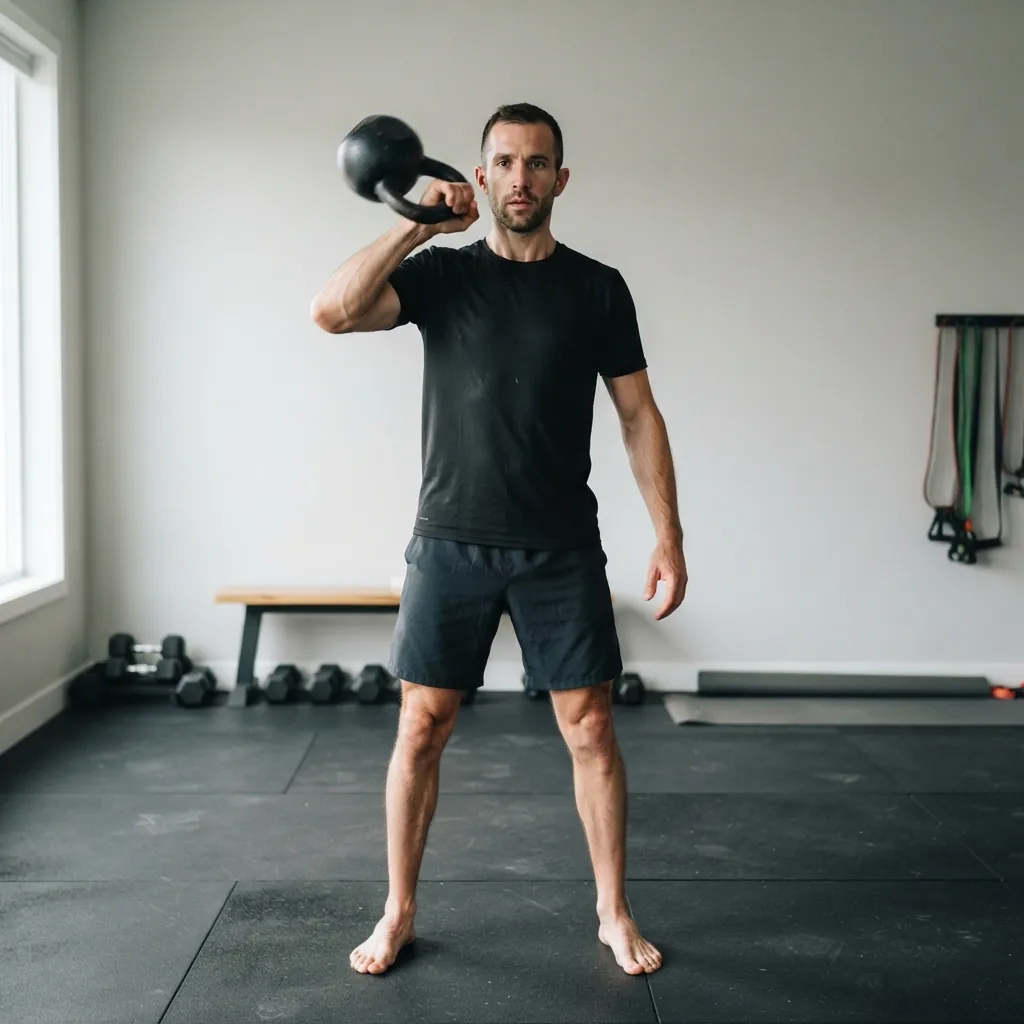
5-Minute Warm-Up
- Kettlebell Halo — 10 reps each direction (light bell or no bell). Circles around the head, close to the skull. Loosens the shoulders and thoracic spine.
- Goblet Squat Hold — 30 seconds at the bottom position. Push your knees out with your elbows. Breathe deeply into your belly.
- Hip Hinge Drill — 10 reps with hands on hips or a dowel along the spine. Crease at the hips, push your butt back, feel the hamstrings load. This is the pattern that protects your back during swings.
- Arm Circles — 10 each direction. Big, slow circles. Forward, then backward.
- Light Swings — 15 reps at about 60% effort. A gradual ramp, not a cold start.
5-Minute Cool-Down
- Half-Kneeling Hip Flexor Stretch — 30 seconds each side. Squeeze the glute of the back leg.
- Standing Hamstring Stretch — 30 seconds each leg. Foot on a low surface, hinge forward.
- Thoracic Rotation — 8 reps each side from a quadruped position. Hand behind your head, rotate toward the ceiling.
- Wrist Flexor/Extensor Stretch — 20 seconds each direction. Especially relevant after high-rep swings or snatches.
Breathe steadily through every stretch. No bouncing.
When to Increase Your Kettlebell Weight
Move up in weight when the current bell no longer challenges you across the majority of your working sets. The specific triggers are more useful than the vague “when it feels easy” advice you find elsewhere.
Increase your kettlebell weight when ALL of these are true for 2+ consecutive sessions:
- You complete every prescribed set with 2 or more reps still in the tank
- Your programmed rest periods feel longer than necessary
- RPE (rate of perceived exertion) on the final set is below 7 out of 10
- Your form stays clean throughout — no compensations creeping in
How much to add: Jump 4 kg for ballistics (swings, cleans, snatches) and 2-4 kg for grinds (presses, get-ups). If the new weight wrecks your form, drop back and add volume at the old weight first.
You can also add intensity by wearing a weighted vest during goblet squats and carries.
How Often Should You Do Kettlebell Workouts?
Most people benefit from 3 kettlebell sessions per week with at least one rest day between sessions. That frequency gives enough stimulus for strength and conditioning gains while allowing adequate recovery — especially for the lower back, which takes a beating from swings and deadlifts.
Here is how frequency scales with experience:
- Beginners (0-6 months): 2-3 sessions per week. Your connective tissue needs time to adapt to ballistic loading.
- Intermediate (6-18 months): 3-4 sessions. You can handle higher weekly volume. Alternate heavy and light days.
- Advanced (18+ months): Up to 5 sessions with proper periodization. Include a deload week every 4-6 weeks — reduce volume by 40-50% to let accumulated fatigue dissipate.
On rest days, active recovery works better than doing nothing. Light walking, mobility work, or a bodyweight circuit keeps blood moving without adding training stress.
Try bodyweight circuit training as an active-recovery day option, or pair kettlebell days with incline walking for low-impact recovery.
Frequently Asked Questions
How many kettlebell exercises should be in a workout?
Four to six exercises per session covers all major movement patterns without turning the workout into a marathon. Beginners should stick to 3-4 until the hip hinge and rack position feel automatic. More exercises means less practice per movement, which slows skill development.
Can you get fit with just a kettlebell?
Yes. A single kettlebell provides enough resistance for both strength and cardiovascular training. The ACE study confirmed calorie burn rates of 20.2 cal/min during high-intensity kettlebell work (Source: ACE, 2010). As you outgrow one weight, progress to single-arm variations, add tempo manipulation, or buy a heavier bell. A pair of cast-iron kettlebells in two sizes covers years of training.
What weight kettlebell should a beginner start with?
Beginner men: 12 kg for grinds, 16 kg for ballistics. Beginner women: 8 kg for grinds, 12 kg for ballistics. See the full weight selection table above for intermediate and advanced recommendations. These ranges come from StrongFirst’s certification prep guidelines.
How often should you do kettlebell workouts?
Two to four times per week, depending on intensity and recovery capacity. Three sessions per week with a rest day between each is the sweet spot for most people. See the frequency section above for a breakdown by experience level.
Are kettlebell workouts better than dumbbells?
Neither is universally better. Kettlebells excel at ballistic and power movements — swings, cleans, snatches — because the offset center of mass loads the grip and posterior chain differently than a dumbbell. Dumbbells are better for isolation work and traditional pressing patterns. If you have access to both, use both. If you can only pick one for a home gym, a kettlebell offers more exercise variety per unit of weight.
Is a 20-minute kettlebell workout enough?
For conditioning and fat loss, absolutely. At 20.2 cal/min total (aerobic + anaerobic), a 20-minute high-intensity kettlebell session yields roughly 400 calories (Source: derived from ACE, 2010). That is enough for meaningful cardiovascular and metabolic adaptations. For pure maximal strength goals where you need 2-3 minutes of rest between heavy sets, 20 minutes is too short — plan 30-40 minutes instead.
Do kettlebell workouts really work?
They work. The research is clear. ACE measured approximately 20.2 cal/min during a snatch-based protocol — equivalent to running a 6-minute mile (Source: ACE, 2010). Falatic et al. found a 6% improvement in VO2max after just 4 weeks of kettlebell snatch training in NCAA Division I female soccer players (Source: Falatic et al., JSCR, 2015). Combine kettlebell training with a calorie deficit for fat loss or progressive overload for strength, and results follow.
Can you build muscle with only a kettlebell?
Yes, especially for beginners and intermediates who have not yet exhausted their novice strength gains. The mechanisms: heavier bells for progressive overload, single-arm work to increase relative intensity, slower tempos to increase time under tension, and complexes (chaining exercises without setting the bell down) for metabolic stress. Advanced lifters chasing maximum hypertrophy will eventually need heavier external loads, but a 32 kg kettlebell and smart programming covers a lot of ground.
Sources
- ACE — Kettlebells: Twice the Results in Half the Time? — Porcari & Schnettler calorie burn study (2010)
- Falatic et al. — Effects of Kettlebell Training on Aerobic Capacity, JSCR 2015 — VO2max improvement study
- Leong et al. — Prognostic value of grip strength (PURE study), The Lancet 2015 — Grip strength and mortality
- StrongFirst SFG Kettlebell Certification Prep Guide — Starting weight recommendations