Last updated: October 2026
Gymnase Tips is reader-supported. When you buy through links on our site, we may earn an affiliate commission at no extra cost to you.
TL;DR — Which Glute Isolation Exercises Work Best?
Glute isolation exercises with the highest muscle activation are the barbell hip thrust (143% MVIC peak), the glute squeeze (125% MVIC), and the side-lying hip abduction (63% MVIC for glute med), based on EMG studies through 2024. Below you’ll find all 12 ranked, a clamshell myth-bust backed by 2025 fMRI data, and two 4-week programs (gym and home).
Table of contents
What Are Glute Isolation Exercises?
Glute isolation exercises are single-joint movements that target the gluteus maximus, medius, or minimus with minimal involvement from the quads or hamstrings. Examples include hip thrusts, glute bridges, cable kickbacks, and hip abductions. Compound lifts like squats and lunges cross both the hip and knee joints; isolation exercises move only the hip.
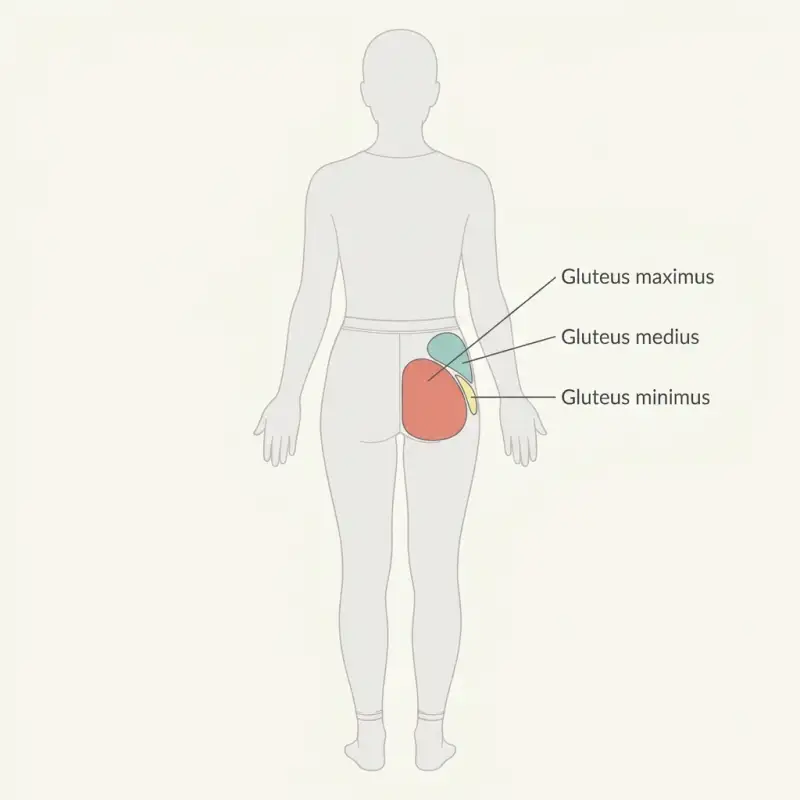
Your glutes are three separate muscles, each with a different job. The gluteus maximus handles hip extension: pushing your hips forward, standing up from a chair, sprinting. The gluteus medius controls hip abduction and stabilizes your pelvis when you stand on one leg. The gluteus minimus assists the medius and contributes to internal rotation.
Many lifters rely on squats and deadlifts for glute training. That works, up to a point. Compound lifts spread load across multiple muscle groups, which means the glute medius and lower maximus fibers can get underworked. Isolation exercises fill that gap. For a broader overview including compound options, see our complete glute exercise guide.
Glute Isolation vs Compound — What Actually Counts?
Step-ups, lunges, and Bulgarian split squats appear on most “glute isolation” lists, but they are compound movements that cross both the knee and hip joints. True isolation exercises move only the hip. The table below corrects eight common misclassifications.
| Exercise | Often Listed As | Actual Classification |
|---|---|---|
| Barbell hip thrust | Compound | Isolation (hip extension only; knee angle stays fixed) |
| Cable kickback | Compound | Isolation (hip extension only) |
| Glute bridge | Compound | Isolation (hip extension only; knee angle stays fixed) |
| Hip abduction (any variant) | — | Isolation (hip abduction only) |
| Step-up | Isolation | Compound (hip + knee extension) |
| Bulgarian split squat | Isolation | Compound (hip + knee extension) |
| Lunge | Isolation | Compound (hip + knee extension) |
| Romanian deadlift | Isolation | Compound (hip extension + spinal stabilization, hamstring-dominant) |
Why does this matter? If your program already has squats, lunges, and deadlifts, adding more compound hip-and-knee movements does not “isolate” your glutes. You need exercises that cross only the hip joint to preferentially load glute fibers. Both categories belong in a solid program. Compound lifts build overall strength; isolation work targets the gaps those big lifts miss. The hip thrust produces roughly twice the glute max activation of the back squat — 69.5% vs 29.4% mean upper glute max MVIC (Contreras et al., 2015).
EMG Activation Rankings — The Full Table
The barbell hip thrust produces the highest recorded glute activation at 143% MVIC peak (Source: Goller et al., 2024), followed by the glute squeeze at 125% MVIC peak from the same study. Full rankings for all 12 exercises below.
MVIC stands for maximal voluntary isometric contraction, the benchmark for EMG normalization. Values above 100% mean the exercise produced greater peak electrical activity than the maximal isometric hold used for calibration. That is normal in dynamic exercises.
| Rank | Exercise | Target Muscle | MVIC% (peak or mean) | Source |
|---|---|---|---|---|
| 1 | Barbell Hip Thrust | Glute Max | 143% | Goller et al., 2024 |
| 2 | Glute Squeeze / Machine Glute Drive | Glute Max | 125% | Goller et al., 2024 |
| 3 | Side-Lying Hip Abduction | Glute Med | 63% | Boren et al., 2011 |
| 4 | Banded Lateral Walk | Glute Med | 61% | Distefano et al., 2009 |
| 5 | Single-Leg Glute Bridge | Glute Max | 32.6–54.2% (mean ~40%) | Neto et al., 2019 (systematic review) |
| 6 | Cable Kickback | Glute Max | No direct EMG data | — |
| 7 | Kas Glute Bridge | Glute Max | No direct EMG data | — |
| 8 | Frog Pump | Glute Max | No direct EMG data | — |
| 9 | Cable Hip Abduction | Glute Med | No direct EMG data | — |
| 10 | Seated Machine Hip Abduction | Glute Med | No direct EMG data | — |
| 11 | Fire Hydrant | Glute Med | No direct EMG data | — |
| 12 | Clamshell | Glute Med | 4.5% (mfMRI) | Kim et al., 2025 |
A note on the numbers: Ranks 1–2 use peak MVIC% from Goller 2024. Ranks 3–4 use mean MVIC from peer-reviewed EMG studies. Rank 5 uses a systematic review range. Exercises marked “No direct EMG data” lack published MVIC measurements for that specific movement; they are included based on biomechanical merit and practical effectiveness, not activation rankings. The clamshell value uses mfMRI T2 signal change (a different methodology than surface EMG), which is why it appears dramatically lower. More on that in the clamshell section below.
Best Gluteus Maximus Isolation Exercises
These six exercises target the gluteus maximus through hip extension, and each one moves only the hip joint. The barbell hip thrust leads the group at 143% MVIC peak (Source: Goller et al., 2024). The single-leg glute bridge is the strongest bodyweight option, with a mean of about 40% MVIC across six studies (Source: Neto et al., 2019).
Barbell Hip Thrust
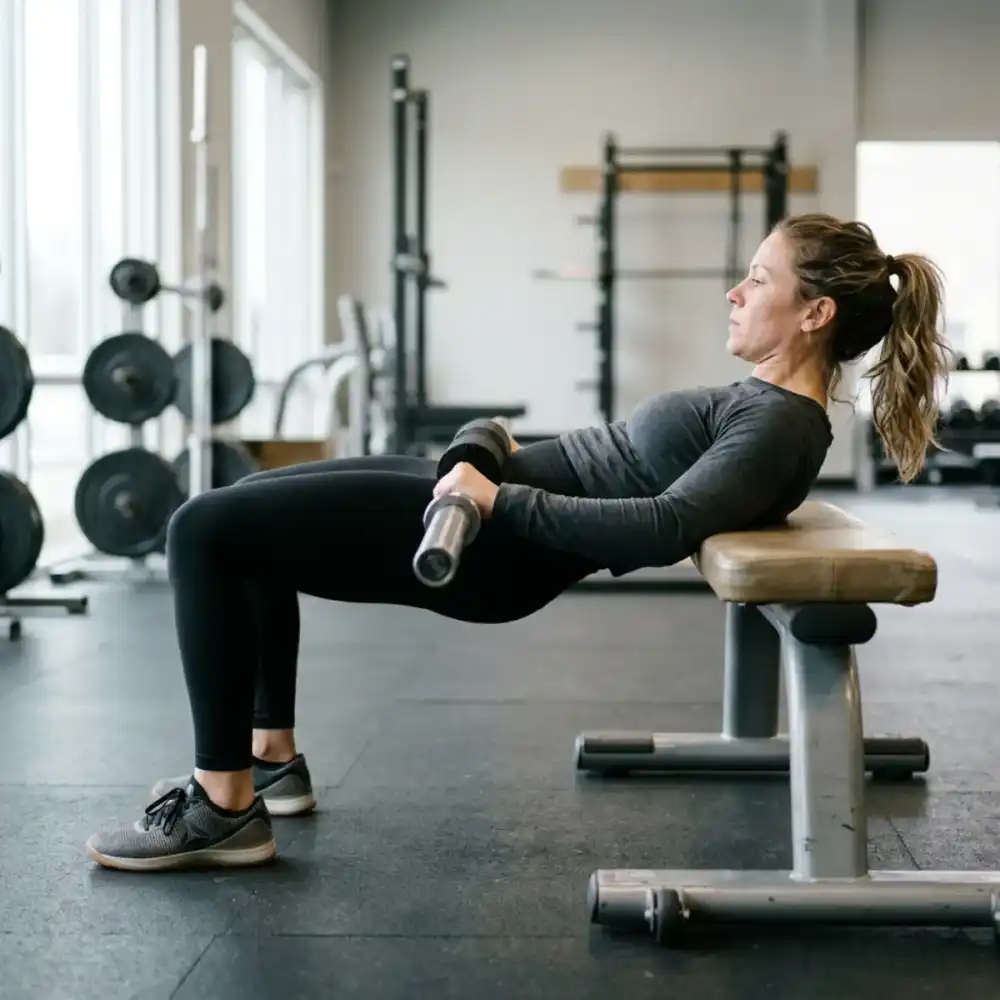
The barbell hip thrust ranks first with 143% MVIC peak activation (Source: Goller et al., 2024). No other isolation exercise comes close for raw glute max recruitment.
How to do it:
- Sit on the floor with your upper back against a stable bench. Roll a loaded barbell over your hips. Use a hip thrust pad or a thick towel for comfort.
- Plant your feet flat, roughly hip-width apart, with shins vertical at the top position.
- Drive through your heels, squeeze your glutes at lockout, and hold for a one-count. Tuck your chin slightly. Do not hyperextend your lower back.
Pro tip: Stop the rep at full hip extension. Pushing into lumbar hyperextension shifts the load off your glutes and onto your lower back. If your lower back cramps during hip thrusts, your rib cage is flaring. Brace your core and think “belt buckle to chin.”
Single-Leg Glute Bridge
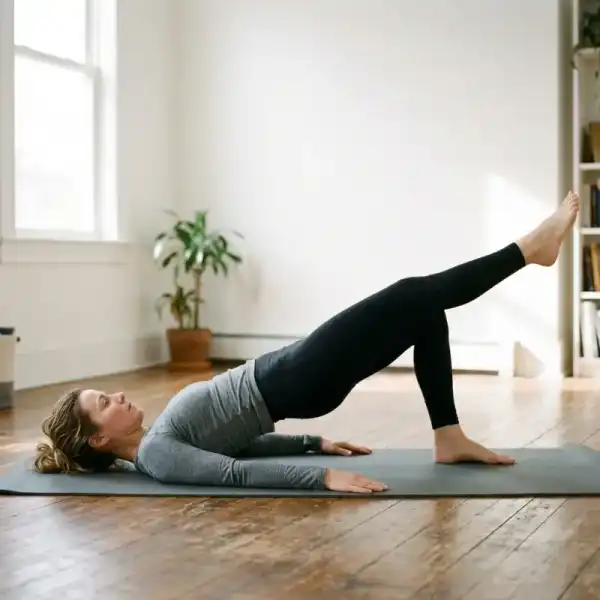
The single-leg glute bridge is the best bodyweight-only glute max exercise, producing a mean activation of ~40% MVIC with a range of 32.6–54.2% across six studies (Source: Neto et al., 2019). Zero equipment required. It also doubles as a unilateral strength check.
How to do it:
- Lie face-up with one foot flat on the floor, knee bent to roughly 90 degrees. Extend the other leg straight or hold the knee to your chest.
- Drive through the working heel and lift your hips until your body forms a straight line from shoulder to knee.
- Lower under control. Complete all reps on one side before switching.
Progression: Once 15 reps feel easy, add a dumbbell or weight plate on the working hip, or elevate the foot on a low step for greater range of motion.
Kas Glute Bridge
The Kas glute bridge is a short-range hip thrust variant designed to keep constant tension on the glute max. You lower only about 6 inches from lockout before driving back up. No study has measured the Kas variant specifically, but the mechanics suggest activation comparable to a standard loaded glute bridge.
How to do it:
- Set up exactly like a barbell hip thrust: upper back on a bench, barbell across hips.
- Start at the top (full lockout) and lower your hips only 4–6 inches.
- Drive back to lockout and squeeze. The range of motion is deliberately small.
The short ROM eliminates the bottom stretch where hamstrings tend to contribute more. Useful for lifters who feel their hamstrings dominating standard hip thrusts. For more exercises targeting the lower glute fibers, see our guide on lower glute exercises.
Cable Kickback
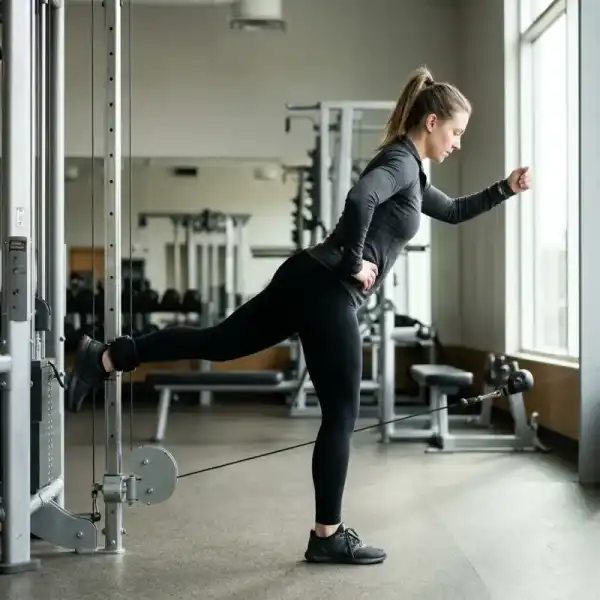
The cable kickback provides consistent resistance through the full range of hip extension. No peer-reviewed EMG study has measured this exact exercise, but the cable’s constant tension profile makes it a strong glute max builder in practice.
How to do it:
- Attach an ankle strap to a low cable pulley. Face the stack and hold the frame for balance.
- Keep your working leg straight or with a slight bend. Extend your hip backward, leading with your heel.
- Squeeze at the top. Return slowly. Do not let the weight stack yank your leg forward.
Common error: Excessive lumbar extension. If your lower back arches at the top, the range of motion has exceeded what your glutes can control. Shorten the ROM and focus on the squeeze.
Frog Pump
Frog pumps place the hips in external rotation, which shifts recruitment toward the lower fibers of the glute max. No peer-reviewed EMG study has measured frog pumps directly, though the externally rotated, knees-out position minimizes hamstring contribution.
How to do it:
- Lie face-up. Put the soles of your feet together with knees dropped open, like a butterfly stretch.
- Keep your feet pulled in close to your glutes (about 12 inches from your body).
- Drive your hips up by squeezing your glutes. Hold one second at the top.
Good finisher. High reps (20–30) at the end of a session work well because the externally rotated position limits how much load you can add.
Glute Squeeze / Machine Glute Drive
The glute squeeze produced 125% MVIC peak in the Goller 2024 study, second only to the hip thrust. The machine glute drive replicates this pattern with a fixed setup that reduces balance demands.
How to do it (standing glute squeeze):
- Stand tall, feet hip-width. Brace your core.
- Squeeze your glutes as hard as possible for 5–10 seconds. Think about cracking a walnut between your cheeks. That is the contraction you want at the top of every hip thrust rep.
Machine alternative: The glute drive machine locks you into hip extension with a belt or pad at the hips. It removes the setup hassle of barbell hip thrusts and allows heavy loading without a spotter.
Best Gluteus Medius and Minimus Isolation Exercises
The side-lying hip abduction produces 62.91% MVIC for the gluteus medius (Source: Boren et al., 2011), making it the top bodyweight option for this muscle. The commonly recommended clamshell ranks last. The 2025 fMRI data shows clamshells primarily activate the deep external rotators, not the glutes (Source: Kim et al., 2025).
Side-Lying Hip Abduction
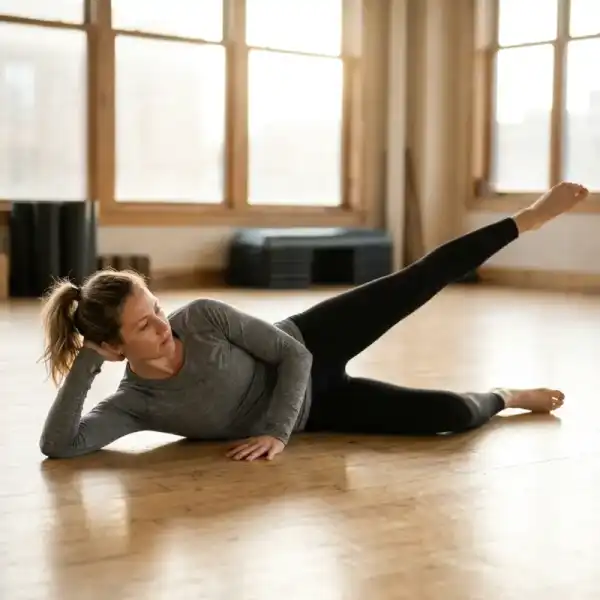
Side-lying hip abduction produces 62.91% MVIC in the gluteus medius (Source: Boren et al., 2011), the highest among bodyweight abduction options tested in that study.
How to do it:
- Lie on your side with legs stacked. Bottom arm under your head for support.
- Keep the top leg straight. Lift it to about 30–40 degrees. Go no higher, or the tensor fasciae latae takes over.
- Lower slowly. Add ankle weights once bodyweight sets of 15 feel easy.
Cable Hip Abduction
The standing cable hip abduction adds progressive resistance to the abduction pattern. No peer-reviewed EMG study has isolated this exact variation, but the cable provides constant tension throughout the range that bodyweight versions lack.
How to do it:
- Attach an ankle strap to a low cable. Stand sideways to the stack.
- Lift the working leg directly out to the side. Keep your torso upright and do not lean away from the cable.
- Control the return. Three seconds down, one second up.
Seated Machine Hip Abduction
The seated machine version provides a fixed path and easy load progression. No peer-reviewed study has isolated the seated machine abduction’s glute medius MVIC with standard EMG methodology, though the fixed path makes progressive overload straightforward.
How to do it:
- Sit with your back flat against the pad. Place the outside of your knees or thighs against the machine pads.
- Push outward against the pads in a controlled arc.
- Pause at end-range for one second. Return slowly and do not let the weight stack slam.
Common error: Momentum. Swinging the pads open with a jerking motion turns a glute exercise into a physics demonstration. Slow reps win here.
Banded Lateral Walk
Banded lateral walks produce 61% MVIC in the gluteus medius (Source: Distefano et al., 2009). They work well as both an activation drill before heavy compound work and a standalone glute med exercise.
How to do it:
- Place a resistance band around your ankles (hardest) or just above your knees (easier).
- Stand in a quarter-squat position with feet hip-width apart.
- Step sideways, maintaining tension in the band. Take 10–15 steps, then return.
Band placement matters. Ankle placement increases the moment arm and roughly doubles the resistance demand compared to above-knee placement.
Fire Hydrant
Fire hydrants combine hip abduction with external rotation from a quadruped position. No peer-reviewed study has directly measured fire hydrant glute medius MVIC. The closest tested movement, quadruped hip extension, produced 46.67% MVIC for the gluteus medius (Source: Boren et al., 2011), but a fire hydrant uses a different movement plane (abduction vs. extension).
How to do it:
- Start on all fours, hands under shoulders, knees under hips.
- Keep the knee bent at 90 degrees and lift the working leg out to the side.
- Lift until your thigh is roughly parallel to the floor. Hold one second, lower slowly.
Useful warm-up drill. For building glute medius size, the side-lying abduction and cable abduction are more effective due to their greater loading potential.
Why Clamshells Are Overrated (Kim 2025 fMRI Data)
Research note: Clamshells are not an effective glute isolation exercise. A 2025 fMRI study (Kim et al.) found the clamshell activated the gluteus medius at just 4.5% (T2 signal change), compared to 13.2% for side-lying abduction with external rotation and 11.6% for the single-leg bridge. Meanwhile, the clamshell produced 14.5% activation in the piriformis and 24.2% in the obturator internus (Source: Kim et al., 2025).
Every “best glute exercises” list includes clamshells. The rationale sounds logical: you are abducting and externally rotating the hip, which should hit the glute medius. But imaging data tells a different story. The clamshell’s short range of motion and bent-knee position preferentially loads the deep external rotators (piriformis, obturator internus) rather than the gluteus medius.
Does that make clamshells useless? No. They are a solid piriformis activation tool and still have a role in hip rehab protocols. But if your goal is glute medius hypertrophy, skip clamshells. Do side-lying hip abductions instead.
Glute Isolation Workout — Gym Program
This 4-week gym program uses 4 isolation exercises per session, building from 11 sets per session to 13. Each workout takes 25–35 minutes. Run it 2–3 times per week alongside your normal compound work.
Weeks 1–2:
| Exercise | Sets | Reps | RPE | Rest |
|---|---|---|---|---|
| Barbell Hip Thrust | 3 | 8–10 | 8 | 90s |
| Cable Kickback | 3 | 12–15 | 7–8 | 60s |
| Seated Machine Hip Abduction | 3 | 12–15 | 8 | 60s |
| Side-Lying Hip Abduction | 2 | 15–20 | 7 | 45s |
Weeks 3–4 (add volume):
| Exercise | Sets | Reps | RPE | Rest |
|---|---|---|---|---|
| Barbell Hip Thrust | 4 | 8–10 | 8–9 | 90s |
| Cable Kickback | 3 | 10–12 | 8–9 | 60s |
| Seated Machine Hip Abduction | 3 | 12–15 | 8–9 | 60s |
| Side-Lying Hip Abduction | 3 | 15–20 | 8 | 45s |
Total weekly sets at 2 sessions: Weeks 1–2 = 22 sets. Weeks 3–4 = 26 sets. This aligns with the dose-response findings from Pelland et al. (2025), which showed hypertrophy gains continue to scale with volume, though with diminishing returns past moderate thresholds (Source: Pelland et al., 2025). Men can run the same structure, with exercise selection shifting toward heavier hip thrusts and machine work. Our glute training for men guide covers that approach.
Glute Isolation Workout — Home (Bands + Bodyweight)
No gym needed. This home program pairs glute bridges, fire hydrants, and banded lateral walks across 3 weekly sessions with progressive overload through tempo and band resistance. For more options, see our full list of bodyweight glute exercises.
Weeks 1–2:
| Exercise | Sets | Reps | Tempo | Rest |
|---|---|---|---|---|
| Single-Leg Glute Bridge | 3 | 12–15 each side | 2-1-2 | 60s |
| Banded Lateral Walk | 3 | 15 steps each way | Controlled | 45s |
| Fire Hydrant | 2 | 15 each side | 2-1-1 | 45s |
| Frog Pump | 2 | 20–25 | 1-2-1 | 45s |
Weeks 3–4 (progress tempo + band resistance):
| Exercise | Sets | Reps | Tempo | Rest |
|---|---|---|---|---|
| Single-Leg Glute Bridge | 3 | 10–12 each side | 3-2-2 | 60s |
| Banded Lateral Walk (heavier band) | 3 | 15 steps each way | Controlled | 45s |
| Fire Hydrant (add ankle weight) | 3 | 12–15 each side | 2-1-1 | 45s |
| Frog Pump | 3 | 20–30 | 1-3-1 | 30s |
Progression here is through slower tempos (more time under tension) and heavier resistance bands. When the heaviest band feels easy for 15 reps, add a pause at the top of each rep before buying the next band up.
How Many Glute Isolation Exercises Per Workout?
Three to five glute isolation exercises per session is enough for most lifters. Aim for 10–20 hard sets per week spread across 2–3 sessions (Source: Pelland et al., 2025). More volume helps up to a point, but returns diminish and recovery costs go up.
The Pelland 2025 meta-regression analyzed 67 studies and 2,058 participants. The key finding: hypertrophy scales positively with weekly set volume, but with diminishing returns. There is no hard ceiling, but the practical sweet spot for most trainees falls within 10–20 weekly sets per muscle group.
Can you train glutes two days in a row? Yes, if total weekly volume stays the same. Splitting 16 sets across Monday/Tuesday is no worse than Monday/Thursday for hypertrophy. Frequency does not independently predict muscle growth according to the same meta-regression. That said, performance on day two will likely drop, so spacing sessions 48–72 hours apart is a practical default.
Exercise selection matters more than exercise count. Four exercises with 3–4 sets each at RPE 8–9 beats eight exercises done half-heartedly. Pick one heavy hip extension movement (hip thrust or loaded bridge), one cable or machine exercise, and one abduction pattern. That covers all three glute muscles.
FAQ
What is the 8-8-8 rule for glutes?
The 8-8-8 rule is a TikTok-originated protocol: 8 exercises, 8 sets each, 8 reps per set. That is 64 total sets in a single session, roughly three to six times the evidence-based volume for an entire week of glute training. The dose-response literature supports 10–20 hard sets per week spread across multiple sessions (Source: Pelland et al., 2025). Sixty-four sets in one workout will generate extreme fatigue and soreness with no hypertrophy advantage over a sensible program.
Does glute isolation grow glutes?
Yes. Isolation exercises produce hypertrophy when taken close to failure with sufficient volume. The Pelland 2025 meta-regression confirmed a positive dose-response relationship between training volume and muscle growth. Best results come from combining isolation work (hip thrusts, bridges, abductions) with compound lifts (squats, deadlifts) for total weekly volume.
Are 4 exercises enough for glute day?
Four exercises is plenty. Three to five isolation exercises per session covers glute max, medius, and minimus. Quality matters more than quantity. Sets taken within 2–3 reps of failure produce better hypertrophy outcomes than extra exercises performed casually.
What is the number one glute exercise?
The barbell hip thrust. It holds the highest recorded glute max EMG activation at 143% MVIC peak (Source: Goller et al., 2024). That said, “best” depends on equipment access and training level. If you train at home, the single-leg glute bridge is the top bodyweight option. If you only have cables, kickbacks rank highest.
What is the difference between a glute bridge and a hip thrust?
Both are hip extension exercises targeting the glute max. The difference is setup and range of motion.
| Feature | Glute Bridge | Hip Thrust |
|---|---|---|
| Back position | Floor | Elevated on bench |
| Range of motion | Shorter | Longer (deeper hip flexion) |
| Load capacity | Lower | Higher |
| MVIC% (glute max) | ~40% mean, single-leg (Neto 2019) | 143% peak (Goller 2024) |
| Best for | Warm-up, home training, rehab | Heavy glute max loading |
The elevated back position of the hip thrust allows your hips to drop below bench level, creating a greater stretch at the bottom. More ROM plus heavier loading equals higher activation and greater overload potential.
Sources
- Goller, M. et al. (2024). “How to activate the glutes best? Peak muscle activity of acceleration-specific pre-activation and traditional strength training exercises.” European Journal of Applied Physiology, 124, 1757–1769. link.springer.com
- Kim, S. et al. (2025). “Superficial and Deep Gluteal Muscle Activation During Common Therapeutic Exercises: A Muscle Functional MRI Analysis.” Sports Health, 18(3), 582–591. doi.org
- Pelland, J.C. et al. (2025). “The Resistance Training Dose Response: Meta-Regressions Exploring the Effects of Weekly Volume and Frequency on Muscle Hypertrophy and Strength Gains.” Sports Medicine. doi.org
- Contreras, B. et al. (2015). “A Comparison of Gluteus Maximus, Biceps Femoris, and Vastus Lateralis EMG Activity in the Back Squat and Barbell Hip Thrust Exercises.” Journal of Applied Biomechanics, 31, 452–458. ro.ecu.edu.au
- Neto, W.K. et al. (2019). “Examination of Gluteus Maximus Electromyographic Excitation Associated with Dynamic Hip Extension During Body Weight Exercise: A Systematic Review.” International Journal of Sports Physical Therapy, 14(1), 14–31. pmc.ncbi.nlm.nih.gov
Key sources shown. Every other study is named inline where it is cited.
