Gymnase Tips is reader-supported. When you buy through links on our site, we may earn an affiliate commission at no extra cost to you.
TL;DR — How Should Women Over 50 Start Strength Training?
Strength training for women over 50 builds muscle, protects bone density, and improves daily function. Start with two to three sessions per week using compound movements (squats, rows, presses) at a weight you can lift for the target reps with 2-3 reps still in reserve. Progress load by roughly 5-10% when the last set feels easy.
Table of contents
Why Strength Training for Women Over 50 Matters
Muscle mass drops by roughly 1-2% per year after age 50, and strength declines even faster, about 1.5% annually between 50 and 60, accelerating to 3% per year after that (Source: von Haehling et al., Journal of Cachexia, Sarcopenia and Muscle, 2010). That loss has a name: sarcopenia. Left unchecked, it chips away at balance, metabolism, and the ability to carry groceries upstairs without resting.
Bone density takes a parallel hit. During the menopause transition and the first postmenopausal years, women lose bone mineral density at roughly 2% per year on average, with total losses reaching up to 10% over a decade (Source: Finkelstein et al., Journal of Clinical Endocrinology & Metabolism, 2008; SWAN Fact Sheet, 2023). Resistance training directly counteracts both of these trajectories.
Then there is the metabolic angle. A 2021 meta-analysis of 12 randomized controlled trials found that resistance training significantly improved insulin sensitivity (measured by HOMA-IR) in adults over 60 (Source: Li et al., Journal of Exercise Science & Fitness, 2021). Stronger muscles absorb more glucose. That matters whether or not you have a diabetes diagnosis.
Progressive resistance training works at any age. A meta-analysis of 49 studies in adults over 50 found that roughly 20 weeks of training added an average of 1.1 kg of lean mass (Source: Peterson et al., Medicine & Science in Sports & Exercise, 2011). A companion meta-analysis by the same group found strength increases of roughly 24–33% across the main exercises studied (Source: Peterson et al., Ageing Research Reviews, 2010). The body responds. You just have to give it a reason.
The menopause connection
Falling estrogen accelerates both muscle and bone loss during the menopause transition. The same SWAN data show that bone mineral density barely budges during early perimenopause, then drops sharply once estrogen levels decline in late perimenopause and early postmenopause. Body composition shifts too, with fat tending to redistribute toward the midsection.
Strength training partially offsets both effects. It cannot replace estrogen, but it loads the skeleton, stimulates muscle protein synthesis, and improves the hormonal environment for tissue maintenance.
Before You Start: Safety and Medical Clearance
Most women over 50 can start a bodyweight or light-dumbbell program without medical clearance. However, check with your doctor first if you have an osteoporosis diagnosis, a joint replacement, cardiac history, uncontrolled high blood pressure, or a balance disorder.
This is a green-light section, not a stop sign. The goal is to identify modifications, not to avoid lifting entirely. One rule for anyone with osteoporosis: avoid forward spinal flexion, especially with load. That means heavy sit-ups, weighted toe touches, and similar movements that round the spine forward. The Bone Health & Osteoporosis Foundation states plainly: “Do not flex or bend your spine forward” (Source: Bone Health & Osteoporosis Foundation).
This post is not medical advice. Consult your doctor before starting a new exercise program, especially if you have existing conditions.
Warm-Up Protocol (5 Minutes)
A 5-minute warm-up before lifting reduces injury risk and improves performance. Do these five moves in order before every session.
- Arm circles and shoulder rolls (30 seconds). Forward and backward, gradually increasing the range.
- Bodyweight squats (60 seconds). Go only as deep as feels comfortable. Hold on to a chair if needed.
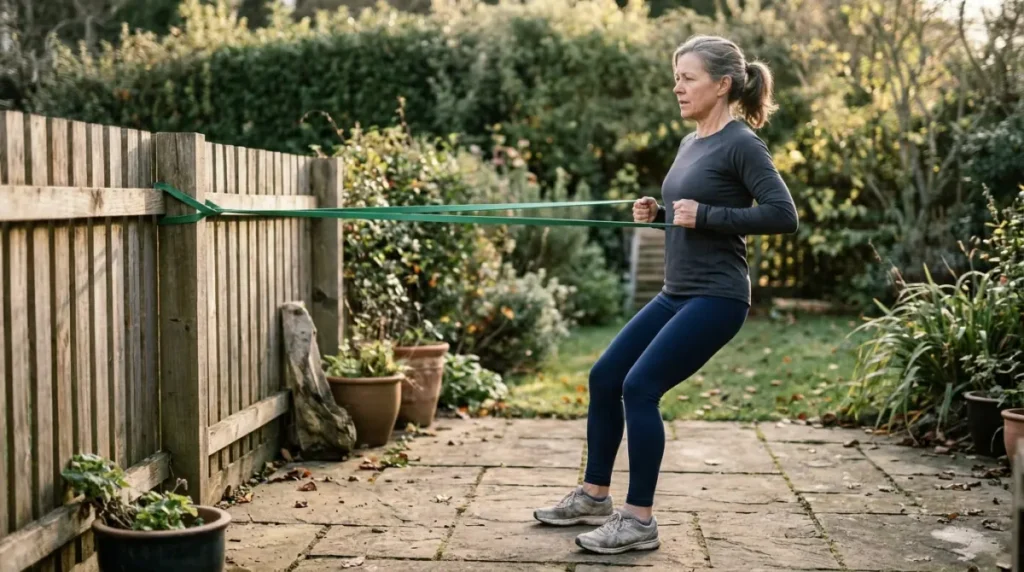
- Band pull-aparts (30 seconds). Light resistance band at chest height. Squeeze your shoulder blades together at the end of each rep.
- Leg swings, front to back (30 seconds per leg). Hold a wall or chair for balance.
- Cat-cow stretches (60 seconds). On hands and knees, alternate between arching and rounding the spine slowly.
8 Exercises Every Woman Over 50 Should Know
These eight compound exercises cover every major movement pattern. Master them with bodyweight or light dumbbells before adding load. And a strong opinion up front: start with free weights, not machines. Free weights build balance and coordination that a fixed machine path cannot teach. Save machines for specific joint restrictions or the over-60 modifications discussed below.
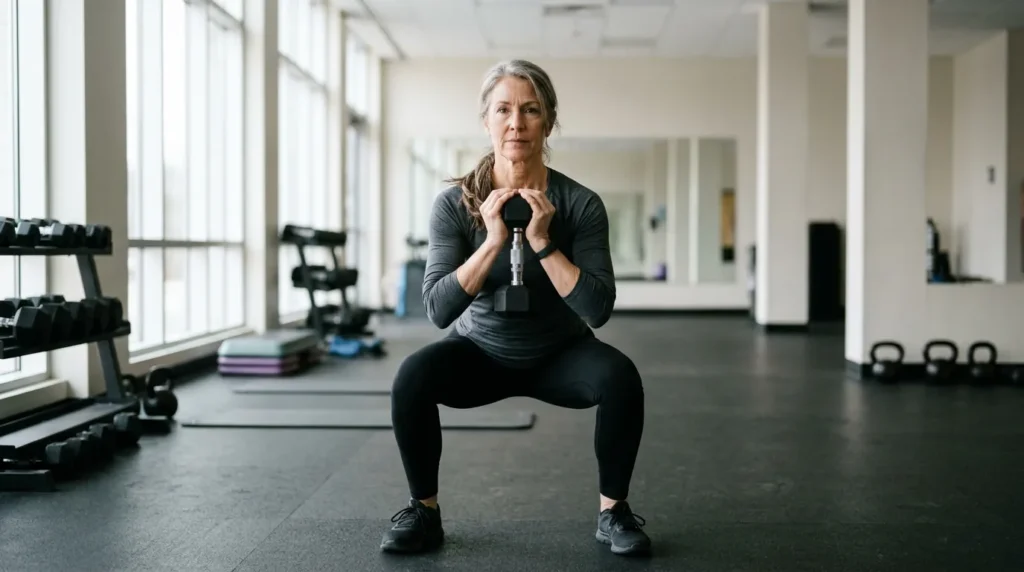
Goblet squat (squat pattern)
Quads, glutes, and core.
Hold a dumbbell vertically at your chest with both hands. Push your hips back and bend your knees until your thighs are roughly parallel to the floor, or as deep as you can go with a flat back. Drive through your heels to stand.
Regression: Chair-assisted squat. Sit down to a sturdy exercise chair, then stand without using your hands. For more leg-strengthening exercises for seniors, see our dedicated guide.
Romanian deadlift (hinge pattern)
Hamstrings, glutes, and lower back.
Stand with feet hip-width apart, dumbbells in front of your thighs. Hinge at the hips (not the waist), pushing your glutes backward while the weights slide down your shins. Stop when you feel a firm stretch in your hamstrings, then squeeze your glutes to stand tall.
Regression: Bodyweight hip hinge. Face a wall about one foot away and push your hips back until your glutes touch it.
Push-up or wall push-up (push pattern)
Chest, shoulders, triceps, and core.
Place your hands slightly wider than shoulder-width. Lower your chest toward the surface, keeping your body in a straight line from head to heels. Push back up without letting your hips sag.
Regression: Start with the wall, then move to an incline push-up on a counter or bench, then the floor. Progress through these as you get stronger.
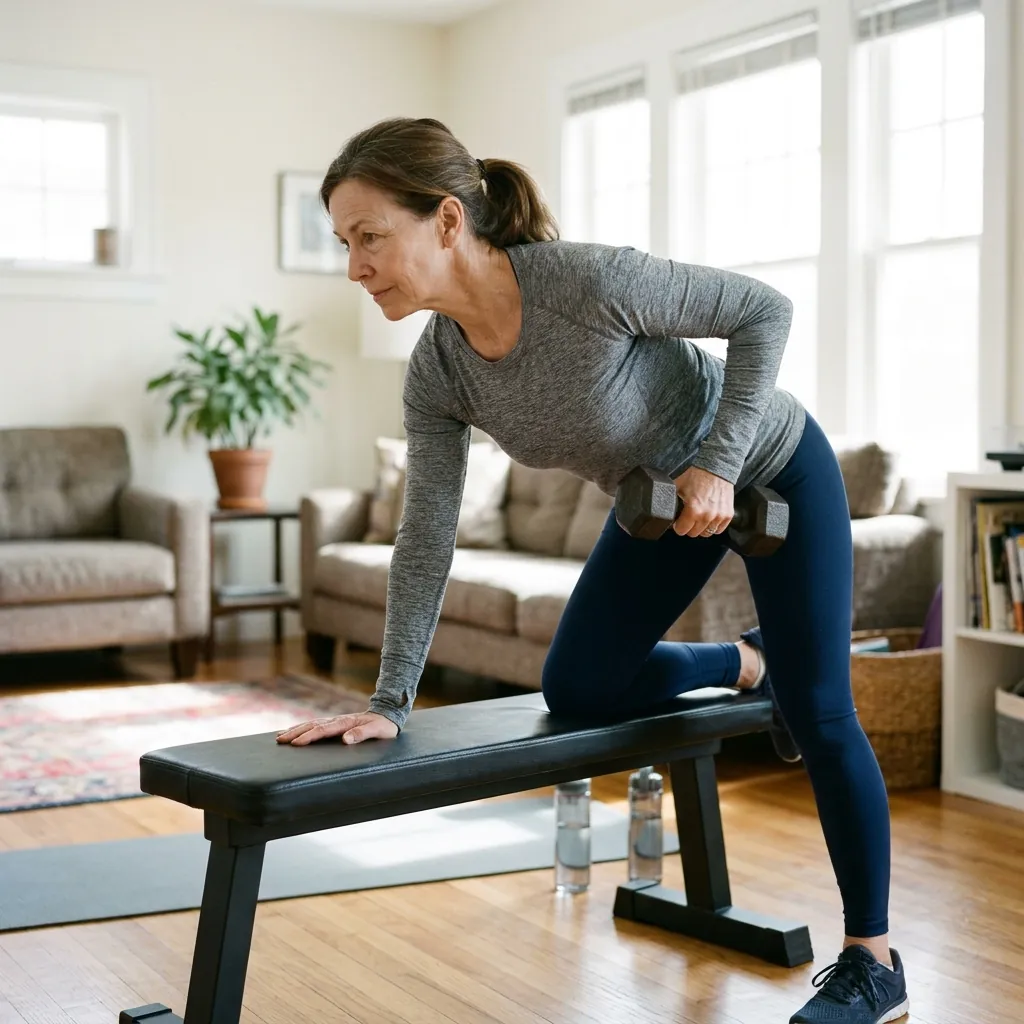
Dumbbell row (pull pattern)
Upper back (lats, rhomboids), biceps, and rear shoulders.
Place one hand and one knee on a bench or sturdy chair. Hold a dumbbell in the other hand, arm hanging straight. Pull the dumbbell toward your hip, squeezing your shoulder blade inward at the top. Lower slowly.
Regression: Band row seated. Loop a resistance band around a door handle or post, sit upright, and row toward your ribcage.
Farmer carry (carry pattern)
Grip, core, shoulders, and legs. Practically everything.
Pick up a dumbbell or kettlebell in each hand. Stand tall with your shoulders down and back. Walk in a straight line for 30-40 seconds, keeping upright posture. That is one set.
Regression: Use lighter weights, walk a shorter distance, or try a single-arm carry (one side at a time). For more on loaded carries and how a weighted vest adds challenge, see our breakdown.
Dead bug (core)
Deep core (transverse abdominis) and hip flexors.
Lie on your back, arms extended toward the ceiling, knees bent at 90 degrees over your hips. Slowly extend your right arm overhead and your left leg straight out, hovering both just above the floor. Return and repeat on the opposite side. Keep your lower back pressed into the floor throughout.
Regression: Heel slides. Keep your arms at your sides and slide one heel along the floor to extend the leg, then pull it back.
Step-up (single-leg pattern)
Quads, glutes, calves, and balance stabilizers.
Stand facing a low step or stair (6-8 inches to start). Place your entire right foot on the step and push through that heel to stand on top. Lower yourself slowly with the same leg. Complete all reps on one side before switching.
Regression: Use a lower step and keep one hand on a wall for balance support.
Kettlebell or dumbbell swing (power)
Glutes, hamstrings, core, and shoulders (endurance).
Stand with feet wider than hip-width, gripping a kettlebell or dumbbell with both hands. Hike the weight between your legs, then snap your hips forward explosively to swing the weight to chest height. Control the descent. The power comes from your hips, not your arms.
Regression: Banded hip thrust. Sit with your upper back against a bench, feet flat on the floor, and a resistance band across your hips. Drive your hips upward explosively, then lower with control. This builds the same hip-extension power without the ballistic load.
How Heavy Should a Woman Over 50 Lift?
Choose a weight that lets you complete every prescribed rep with good form and 2-3 reps in reserve. If the last rep of a set feels like your absolute max, the load is too heavy. The table below shows typical beginner starting points by exercise. Adjust up or down based on your own effort test.
| Exercise | Effort cue | Typical beginner range* |
|---|---|---|
| Goblet squat | 2-3 RIR at 10 reps | 8-15 lb dumbbell |
| Romanian deadlift | 2-3 RIR at 10 reps | 10-20 lb dumbbells |
| Push-up | Bodyweight first | Wall > incline > floor |
| Dumbbell row | 2-3 RIR at 10 reps | 8-12 lb dumbbell |
| Farmer carry | Walk 30 sec comfortably | 15-25 lb per hand |
| Dead bug | Controlled, no arching | Bodyweight |
| Step-up | Stable, no wobble | Bodyweight > 5-10 lb |
| KB/DB swing | Crisp hip snap at 12 reps | 15-25 lb |
*Illustrative ranges for a healthy beginner. Adjust based on your own 2-3 RIR test. Heavier or lighter is fine.
RIR stands for “reps in reserve.” If a set calls for 10 reps and you could grind out 12 or 13 before your form breaks, you have 2-3 RIR. That is the sweet spot for building strength while keeping injury risk low. The ACSM’s 2009 position stand on resistance training recommends 10-15 repetitions for older adults beginning a program (Source: ACSM Position Stand, Medicine & Science in Sports & Exercise, 2009).
The 12-Week Plan (2-3 Days Per Week)
This 12-week plan starts with two sessions per week and builds to three. Each phase increases volume and intensity so your body adapts without overreaching. All eight exercises from the section above are included. Pick a workout plan for women at home if you want a full home-training schedule alongside this program.
Phase 1: Foundation (Weeks 1-4)
| Parameter | Detail |
|---|---|
| Days per week | 2 (e.g., Monday / Thursday) |
| Exercises per session | All 8 |
| Sets x Reps | 2 x 12-15 |
| Rest between sets | 60-90 seconds |
| Progression trigger | Increase load 5-10% when you complete all sets at 2 RIR or less |
Focus on form. Every rep should feel controlled. If 12 reps are difficult, drop the weight until 15 feels manageable.
Phase 2: Build (Weeks 5-8)
| Parameter | Detail |
|---|---|
| Days per week | 2-3 (e.g., Monday / Wednesday / Friday) |
| Exercises per session | All 8 |
| Sets x Reps | 3 x 10-12 |
| Rest between sets | 60-90 seconds |
| Progression trigger | Increase load 5-10% when you complete all sets at 2 RIR or less |
Add a third day when you feel recovered between sessions. If two days still feels like plenty, stay with two and bump to three in Phase 3.
Phase 3: Progress (Weeks 9-12)
| Parameter | Detail |
|---|---|
| Days per week | 3 (e.g., Monday / Wednesday / Friday) |
| Exercises per session | All 8 |
| Sets x Reps | 3-4 x 8-10 |
| Rest between sets | 90-120 seconds |
| Progression trigger | Increase load 5-10% when you complete all sets at 2 RIR or less |
The rep range drops and rest periods lengthen. You will be lifting heavier than Week 1. That is the point.
Deload: Every fourth week (end of each phase), cut your working weights by 40-50% and keep the reps the same. Your joints and connective tissue need the recovery window more than your muscles do. Skip the deload only if you genuinely feel fresh and progressing.
When and How to Progress
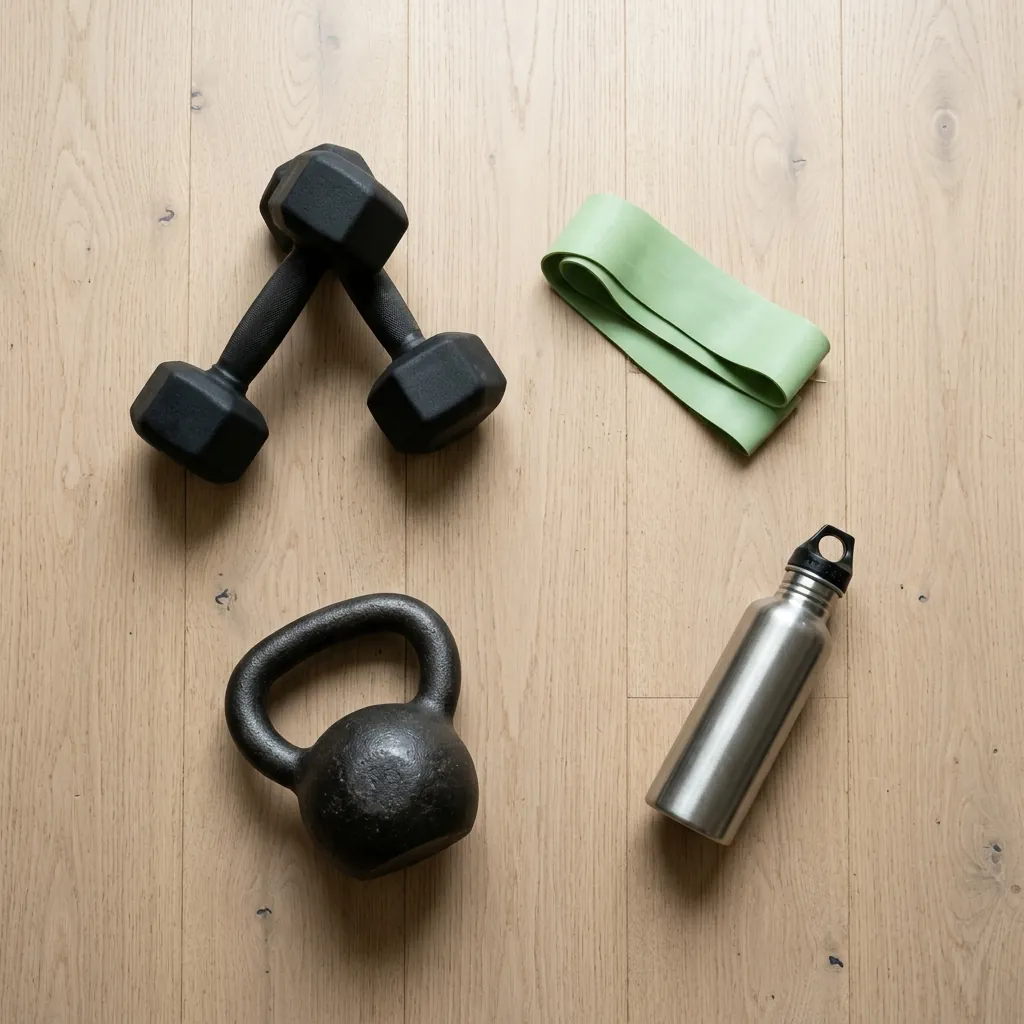
Add weight when you can complete every rep in your last set with 2-3 reps still in reserve. Increase by the smallest available increment, usually 2-5 lb for upper body and 5-10 lb for lower body.
Not every session will be a jump in weight. Some weeks you will add a rep or an extra set instead. Both count as progression. The load is one dial, not the only dial.
RPE (rate of perceived exertion) is another way to gauge effort on a 1-10 scale. An RPE of 7 roughly matches 3 RIR. If you prefer thinking in those terms, aim for RPE 7-8 on your working sets.
Plan deload weeks every 3-4 weeks or whenever sleep, stress, or joint soreness pile up. A lighter week is not wasted. It is what lets the next heavy block work.
Strength Training for Women Over 60
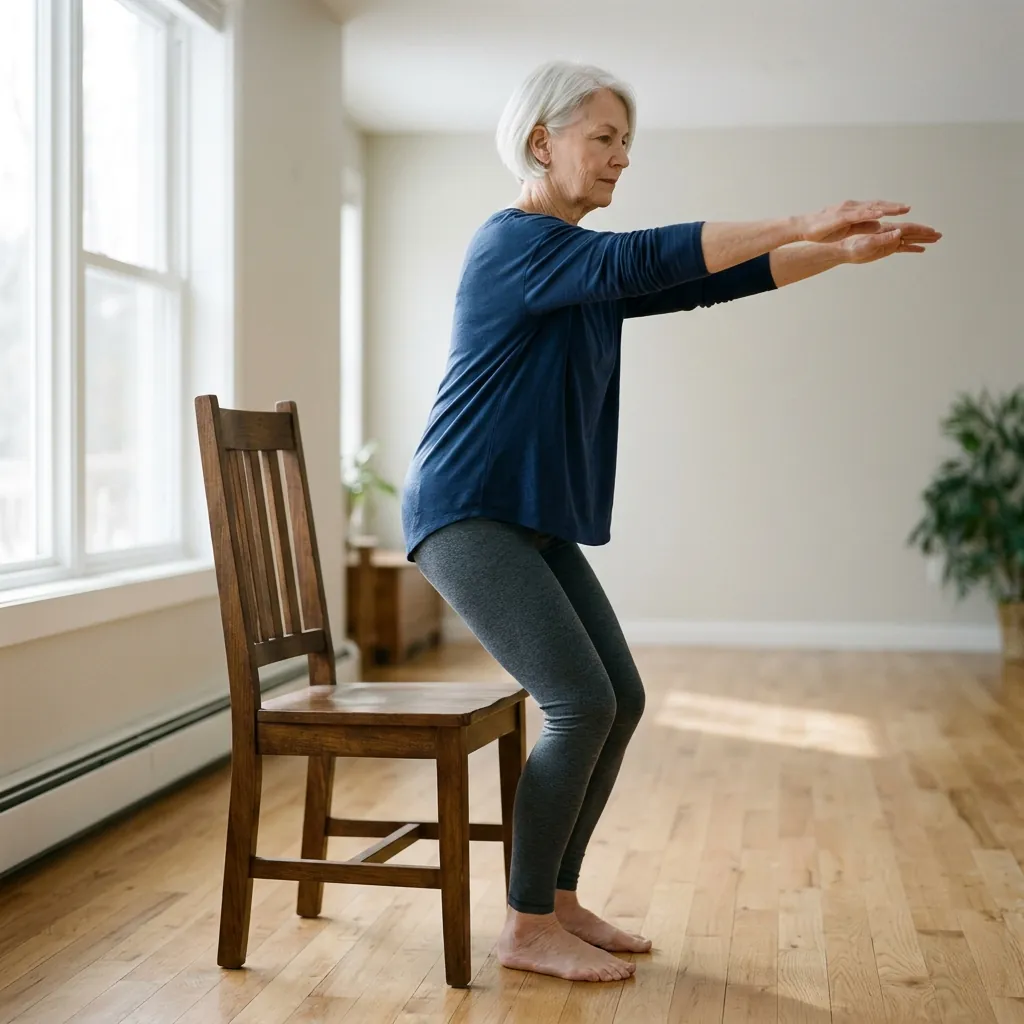
Women over 60 benefit from the same movement patterns but need longer warm-ups, more balance work, and extra recovery time. Start with two sessions per week and seated or supported variations of each exercise.
The core program above still applies. Here is what changes.
Warm-up: Extend from 5 to 8-10 minutes. Add light marching in place (60 seconds) and tandem stance holds (30 seconds per side) to the standard warm-up sequence. Balance degrades faster after 60, and a warm-up that trains it is time well spent.
Exercise modifications:
- Goblet squat becomes a chair squat. Sit to the chair, stand up, no hand push-off needed.
- Push-up stays at the wall or a high incline for as long as needed.
- Dumbbell row can be done seated in a sturdy chair with back support.
- Farmer carry shortens to 15-20 second walks with lighter weight.
- Step-up uses a lower step (4-6 inches) with wall support on one side.
- KB/DB swing swaps for the banded hip thrust regression full-time if balance is a concern.
Schedule variant:
| Parameter | Over-60 adjustment |
|---|---|
| Days per week | 2 (stay here for 8+ weeks before considering 3) |
| Sets x Reps | 2 x 12-15 for the first 6 weeks, then 2-3 x 10-12 |
| Rest between sets | 90-120 seconds (longer than the standard plan) |
| Recovery between sessions | 48-72 hours minimum |
| Progression trigger | Same 2-3 RIR rule, but smaller weight jumps (1-2 lb) |
When balance or joint issues limit free-weight work, machine-based exercises (leg press, seated row, chest press) are a solid alternative. They constrain the movement path, which reduces fall risk while still loading the muscles. Machines are not inferior, just different. Use them when they solve a real problem.
For targeted leg-strengthening exercises for seniors, we have a dedicated guide. And if joint stiffness limits your range of motion, add a dedicated mobility routine on off days.
Protein and Recovery Basics
Active women over 50 need at least 1.2 g of protein per kilogram of body weight daily to support muscle repair. For a 65 kg (143 lb) woman, that works out to roughly 78-80 g spread across three to four meals.
The PROT-AGE consortium sets the baseline for healthy older adults at 1.0-1.2 g/kg/day, and recommends 1.2 g/kg/day or more for those doing regular resistance or endurance exercise. The same paper recommends 25-30 g of protein per meal to reach the per-meal anabolic threshold in older adults (Source: Bauer et al., Journal of the American Medical Directors Association, 2013).
Here is what 80 g looks like in a day for a 65 kg woman:
- Breakfast: Two eggs plus a cup of Greek yogurt, roughly 28 g protein.
- Lunch: A palm-sized serving of chicken or fish (about 120 g cooked) with vegetables, roughly 28 g protein.
- Dinner: A serving of lentils or beans (1 cup cooked) plus a small portion of cheese, roughly 24 g protein.
Spreading protein evenly across the day matters more than any single post-workout shake. If you can eat a protein-rich meal somewhere around your training session, great, but do not stress over a precise window (Source: Schoenfeld & Aragon, Journal of Orthopaedic & Sports Physical Therapy, 2018).
Sleep is the other half of recovery. The CDC recommends 7 or more hours per night for adults (Source: CDC). Cutting sleep short cuts into the repair window your muscles need.
Cool-Down Stretches (5 Minutes)
A 5-minute cool-down after lifting improves flexibility and reduces next-day soreness. Hold each stretch for 20-30 seconds. No bouncing.
- Standing quad stretch. Hold your ankle behind you, keeping knees close together. Use a wall for balance.
- Seated hamstring stretch. Sit on the edge of a chair, extend one leg straight, and lean forward from the hips until you feel a stretch along the back of your thigh.
- Chest doorway stretch. Place your forearm against a door frame at shoulder height. Step through until you feel the stretch across your chest and front shoulder.
- Standing lat stretch. Grab a door frame or sturdy surface overhead with one hand. Lean your hips away from that side until you feel a stretch along your ribcage.
- Half-kneeling hip flexor stretch. Kneel on one knee with the other foot forward. Push your hips gently forward. This targets the front of the hip on the kneeling side.
Can Flabby Arms Be Toned After 50?
Yes. Compound pushing and pulling exercises (push-ups, rows, overhead press) build arm muscle, and progressive overload combined with a calorie deficit reduces the appearance of loose skin and fat over time.
Spot reduction is a myth. You cannot target fat loss on your arms specifically. But building muscle underneath changes the shape of your arms visibly, and overall fat loss makes those muscles more visible. The push-ups, rows, and farmer carries in the 12-week plan above train the arms plenty. Isolation exercises like bicep curls are fine to add, but they are not necessary.
What Is the 3-3-3 Rule for Working Out?
The “3-3-3 rule” is an informal fitness framework that circulates on social media with no single standard definition. The most common version splits the week into three days of strength training, three days of cardio or walking, and three days of flexibility or rest. Other versions describe three exercises for three sets done three times per week.
Because there is no governing body or research base behind the term, treat it as a rough weekly template rather than a strict program. The 12-week plan in this post covers the strength portion. Pair it with brisk walking on off days and the cool-down stretches (or a full mobility routine) for a balanced week.
Frequently Asked Questions
How many days a week should a woman over 50 do strength training?
Two to three days per week with at least one rest day between sessions. The U.S. Department of Health and Human Services Physical Activity Guidelines recommend muscle-strengthening activities on two or more days per week for all adults, including older adults (Source: HHS Physical Activity Guidelines, 2018). Three days gives more volume, but two is enough to build strength and preserve muscle mass.
Is it too late to start lifting weights at 50?
No. A landmark 1990 study trained frail nursing-home residents (average age 90, up to 96) with high-intensity resistance exercise for eight weeks. Average strength gains were 174%, and mid-thigh muscle area increased 9% (Source: Fiatarone et al., JAMA, 1990). If nonagenarians in a nursing home can get stronger, so can you.
Can I do strength training at home without equipment?
Yes. Bodyweight exercises like wall push-ups, chair squats, dead bugs, and step-ups are a valid starting point. Add resistance bands or a pair of adjustable dumbbells when bodyweight alone stops challenging you. See our full workout plan for women at home for a structured schedule.
Do I need a personal trainer to start?
Not required, but recommended for the first two to four sessions if you have injuries or zero lifting experience. A qualified trainer can check your movement patterns and catch form issues that are hard to self-correct. The plan and form cues in this post are designed for independent use if a trainer is not an option.
What if I have osteoporosis?
Strength training is recommended for osteoporosis. It stimulates bone formation and improves balance, which reduces fall risk. Avoid forward spinal flexion, especially with load (heavy sit-ups, weighted toe touches, crunches with added weight). The Bone Health & Osteoporosis Foundation advises: “Do not flex or bend your spine forward” (Source: BHOF). Get clearance from your doctor and consider starting with machine-based exercises or the seated regressions in the over-60 section.
Will lifting weights make me bulky?
No. Women produce far less testosterone than men. Normal female total testosterone ranges from 15-70 ng/dL compared with 270-1,070 ng/dL in men (Source: URMC Health Encyclopedia). That hormonal gap is a primary reason men carry more absolute muscle mass. Women who strength train build lean, functional muscle: visible tone and shape, not bulk. The professional female bodybuilders who look “bulky” train for years at extreme volumes with specific dietary protocols. A three-day-per-week general program will not get you there.
Sources
- von Haehling S, Morley JE, Anker SD. “An overview of sarcopenia: facts and numbers on prevalence and clinical impact.” J Cachexia Sarcopenia Muscle. 2010;1(2):129-133. onlinelibrary.wiley.com
- Finkelstein JS et al. “Bone mineral density changes during the menopause transition in a multiethnic cohort of women.” J Clin Endocrinol Metab. 2008;93(3):861-868. pubmed.ncbi.nlm.nih.gov
- Peterson MD, Sen A, Gordon PM. “Influence of resistance exercise on lean body mass in aging adults: a meta-analysis.” Med Sci Sports Exerc. 2011;43(2):249-258. pubmed.ncbi.nlm.nih.gov
- U.S. Department of Health and Human Services. “Physical Activity Guidelines for Americans, 2nd edition.” 2018. odphp.health.gov
- CDC. “How Much Sleep Do I Need?” cdc.gov
Key sources shown. Every other study is named inline where it is cited.