

Last updated: May 2026 — written by James Nolan, Gymnase Tips senior trainer.
Yes — military calisthenics is one of the most effective fitness systems ever tested at scale, with documented outcomes across millions of recruits over more than a century. Across the standard 10-week U.S. Army Basic Combat Training cycle, recruits typically improve their 2-mile run time by 2 to 4 minutes, push-up max by 15 to 30 reps, and sit-up max by 20 to 40 reps, while losing 3 to 8 percent body fat. The system works because it combines evidence-based programming principles (progressive overload, periodization, compound movement patterns) with the simplicity needed for mass adoption. It scales from deconditioned beginner to special operations operator with the same exercise library.
This guide covers the actual research and outcome data, what specific results to expect at 4, 8, and 12 weeks, the realistic limitations of the system, why it works mechanically, who it works best for, and where the ceiling is.
The evidence: what the data shows
The U.S. Army has used variations of bodyweight calisthenics since 1907, and every modernization (from PT-1 to current Holistic Health and Fitness) has retained the core compound bodyweight movements. The decades of accumulated outcome data are the strongest evidence the system works.
U.S. Army Basic Combat Training — 10-week documented outcomes
- 2-mile run time: typical improvement of 2-4 minutes (from ~17:30 to ~14:30 for the average male recruit)
- Push-up max (2 minutes): +15-30 reps from baseline
- Sit-up max (2 minutes): +20-40 reps from baseline
- Body fat reduction: 3-8 percent loss across the 10-week cycle
- Lean muscle gain: 5-10 lb for previously untrained men, 2-5 lb for women
- VO2 max improvement: 10-20 percent for previously sedentary recruits
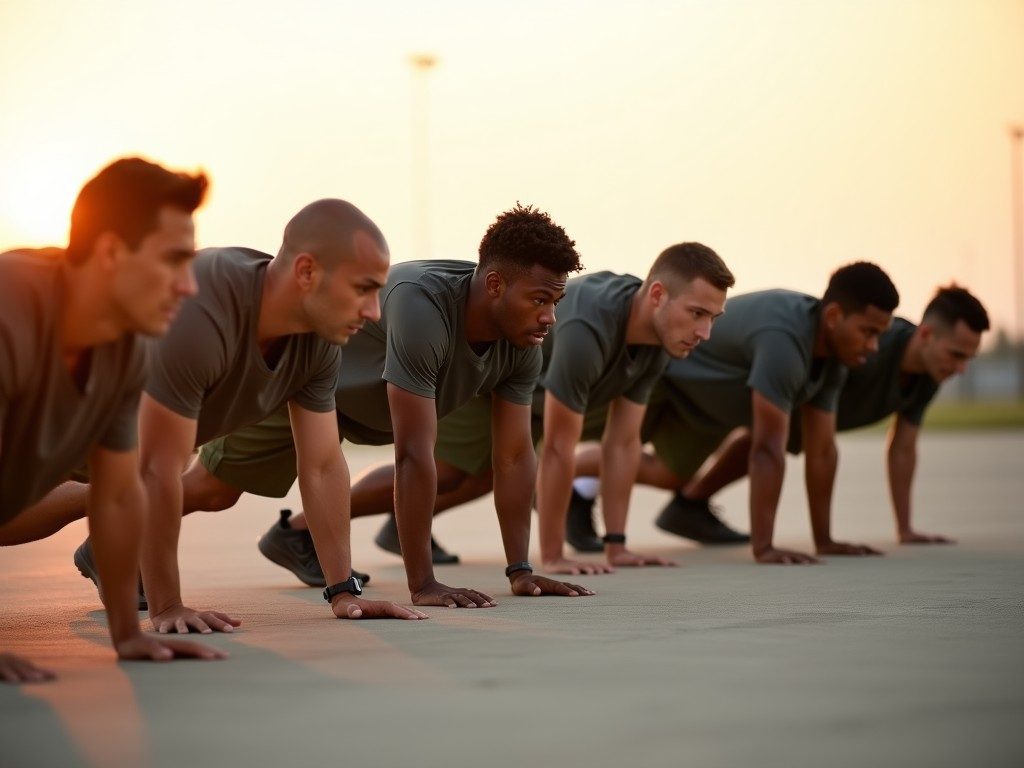
These numbers come from decades of Army performance tracking and have remained consistent across BCT cycles since the 1980s.
Sport science research on bodyweight training
The American College of Sports Medicine classifies bodyweight resistance training as effective for strength, hypertrophy, and cardiovascular conditioning across all adult populations. Specific findings:
- High-rep bodyweight circuits reliably improve VO2 max by 10-20 percent in 8-12 weeks for previously untrained adults
- Bodyweight training produces hypertrophy gains comparable to weight training for the first 6-12 months when total weekly volume is matched
- Circuit-style protocols (the structure used in military PT) outperform straight-set bodyweight training for cardiovascular conditioning gains
- High-rep bodyweight work shows lower musculoskeletal injury rates than equivalent-volume barbell training, primarily due to reduced spinal loading
What to realistically expect
After 2 weeks
- Noticeable improvement in workout completion (less gasping, faster recovery between rounds)
- Initial neural strength gains: push-up max may increase 3-5 reps even before muscle change
- Sleep quality improvement for most adults
- Mild “newbie soreness” subsiding as connective tissue adapts
After 4 weeks
- Push-up max +5-10 reps from baseline
- Run pace improvement of 30-60 seconds per mile
- Visible muscle activation during workouts (pumps in chest, shoulders, arms)
- Resting heart rate drops by 5-10 bpm for sedentary starters
- Belt notch tightens for those carrying excess body fat
After 8 weeks
- Push-up max +10-20 reps from baseline
- First strict pull-up achievable for most beginners (men); inverted row → negative pull-up progression for most women
- 2-mile run time improvement of 1-2 minutes
- Visible muscle definition in shoulders, arms, and quads
- 5-10 lb body composition change (men); 2-5 lb (women)
After 12 weeks
- Push-up max +15-30 reps from baseline (matching military BCT outcomes)
- 3-5 strict pull-ups for most men; 1-3 strict pull-ups for most women
- 2-mile run time improvement of 2-4 minutes
- Meaningful body composition change (most adults can pass military entry standards)
- Significant work capacity increase: long workouts that exhausted you in week 1 now feel manageable

Why the system works mechanically
- Progressive overload through volume: the plan systematically increases reps, rounds, and density week over week. Same overload principle as weight training, applied through bodyweight volume.
- Compound movement patterns: push-ups, pull-ups, squats, and lunges train multi-joint movements that mirror real-world physical demands. They produce better strength transfer than isolation exercises.
- Concurrent strength and conditioning: the circuit format combines resistance work with cardiovascular demand. Both adaptations occur in the same session.
- Connective tissue adaptation: high-rep bodyweight work develops tendons and ligaments alongside muscle, reducing injury rates compared with heavy barbell training.
- Periodization built in: the standard 4-week structure (baseline → volume → density → test) follows classic block periodization, the same model elite strength programs use.
The honest limitations
Military calisthenics is not magic. The system has real limits:
- Hypertrophy ceiling around month 6-12. For raw muscle size beyond a certain point, bodyweight loading becomes insufficient. Adding a weighted vest or transitioning to barbell work becomes necessary for continued growth.
- Doesn’t build maximum strength. Bodyweight training builds endurance and moderate strength. If you want to deadlift 500 lb, you need a barbell.
- Less effective for advanced athletes. Already-conditioned trainees see slower gains than untrained beginners. The 10-week BCT outcomes are for previously sedentary recruits.
- Requires consistent execution. Skipping sessions kills the periodization. The military gets results because soldiers can’t skip — civilians must self-impose that discipline.
- Doesn’t directly improve max running speed. The 2-mile run improvements come from aerobic base work, not the calisthenics itself. Don’t expect sprint times to drop without specific sprint work.
- Limited unilateral overload. Single-leg progressions (pistol squats, archer push-ups) help but don’t fully replace the unilateral loading possible with dumbbells.
Who benefits most
- Previously sedentary adults — the largest absolute gains happen in the first 12 weeks of structured training
- Recruits and selection candidates — directly trains the test demands
- Tactical professionals (firefighters, police, EMTs) — work-capacity training matches job demands
- Travelers and shift workers — minimal equipment requirements remove the gym-availability barrier
- Athletes coming off injury — the lower spinal loading is gentler during return-to-training
- Cost-conscious lifters — under $100 in equipment for 12+ months of progression
Who benefits less
- Aspiring powerlifters — needs barbell work for strength specificity
- Aspiring competitive bodybuilders — eventually needs the resistance variety of weight training
- Athletes already producing 60+ push-ups and 15+ pull-ups — diminishing returns from straight bodyweight, needs weighted variations
- People who hate structure — the system requires showing up to scheduled sessions; “intuitive training” doesn’t produce these outcomes
Military calisthenics vs other training systems
| System | Best for | Equipment cost | Time to first results |
|---|---|---|---|
| Military calisthenics | Work capacity + general fitness | $30-80 (pull-up bar) | 2-3 weeks |
| 5×5 barbell strength | Maximum strength gains | $1,000-3,000+ | 4-6 weeks |
| CrossFit | Mixed conditioning + strength | $150-300/month gym | 3-4 weeks |
| Bodybuilding split | Maximum hypertrophy | $50/month gym | 6-8 weeks |
| Street calisthenics | Skill mastery + impressive moves | $50-200 | 3-6 months for first skill |
FAQ
Does military calisthenics build real muscle?
Yes. Untrained men typically gain 5-10 lb of lean muscle in their first 12 weeks of structured military calisthenics. Women gain 2-5 lb. Past month 6-12, hypertrophy slows unless you add weighted variations or transition to barbell work for continued growth.
Is military calisthenics better than weight lifting?
Better for some goals (work capacity, conditioning, minimal equipment, injury prevention). Worse for others (maximum strength, advanced hypertrophy past month 12). For general fitness and the first year of structured training, it produces comparable results to weight lifting.
Can I lose weight with military calisthenics?
Yes. A 40-minute circuit burns 300-500 calories depending on bodyweight and intensity. Combined with a moderate caloric deficit (300-500 kcal/day), most adults lose 1-2 lb of fat per week without losing strength.
How long until I see results?
Conditioning gains appear in 2-3 weeks. Visible strength gains in 4-6 weeks. Noticeable muscle and body composition change in 8-12 weeks. The Army’s 10-week basic training window reflects this exact timeline.
Will military calisthenics make me too bulky?
No. The high-rep, low-load nature of bodyweight training builds toned, lean muscle rather than bodybuilder bulk. Most people develop the “athletic but not massive” look — defined arms, broader shoulders, flatter midsection.
Does it work for older adults?
Yes, with modifications. Connective tissue adaptation slows after age 50, so frequency drops to 3-4 days per week and burpees are typically replaced with step-ups. See our military calisthenics for men over 50 guide for joint-friendly modifications.
Can I do military calisthenics every day?
Yes, with proper rotation. The U.S. military runs 6-day-per-week PT precisely because the rotation alternates strength-endurance days with conditioning days, with one full rest day. Daily same-session repetition leads to overuse injuries within 6-8 weeks.
The bottom line: military calisthenics works because it pairs evidence-based programming principles with the simplicity needed for mass adoption. The 10-week U.S. Army basic training data is the strongest proof of concept ever produced for any fitness system: millions of recruits, decades of consistent outcomes, push-up max +15-30 reps, run time -2-4 min, body fat down 3-8 percent. The limitations (hypertrophy ceiling around month 6-12, no max-strength specificity) are real but secondary to the gains. To start training, see our complete guide + free 4-week plan, definition + history, and complete exercise reference.



Pingback: Military Calisthenics: Complete 2026 Guide + 4-Week Plan