
Last updated: May 2026 — written by the Gymnase Tips training team.
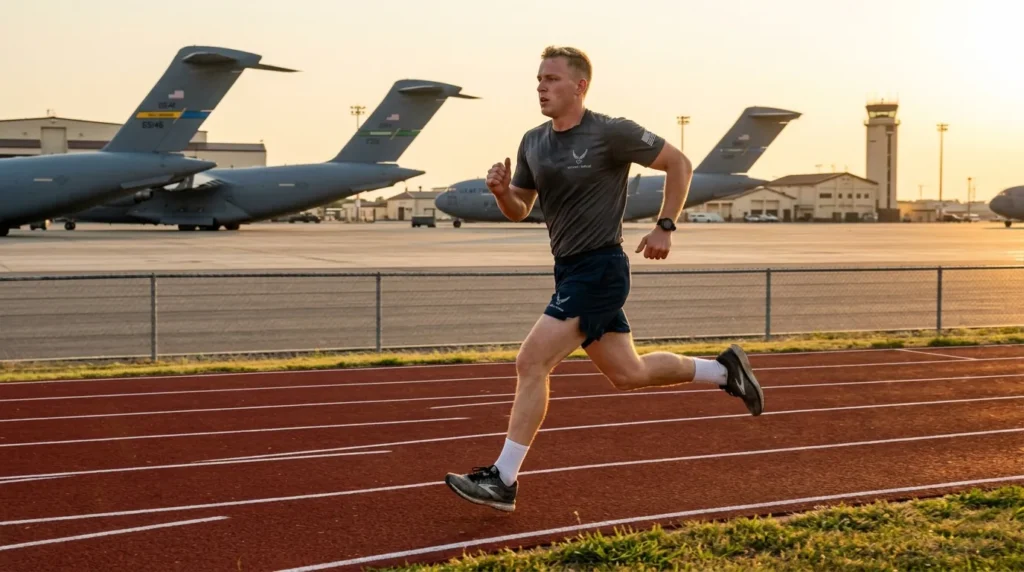
The Air Force PT test (officially the Physical Fitness Assessment, transitioning to the Physical Fitness Readiness Assessment in 2026) is a 100-point assessment with four scored components: a 2-mile run or 20-meter HAMR shuttle (50 points), an upper-body strength event of push-ups or hand-release push-ups (15 points), a core endurance event of sit-ups, cross-leg reverse crunches, or a forearm plank (15 points), and a body composition score from waist-to-height ratio (20 points). The 2026 update replaced the 1.5-mile run with a 2-mile run, reintroduced scored body composition, and gave Airmen optional event formats within each scored component. The test is in a diagnostic-only window from March 1 through August 31, 2026; official scoring under the new PFRA standards resumes September 1, 2026. This guide breaks down each component, explains the scoring weights, and walks through how to train for each option.
Table of Contents
- What Changed in 2026
- The Four Scored Components
- Scoring Weights & Pass Threshold
- Event Options Explained
- How to Train for Each Component
- Common Mistakes
- FAQ
What Changed in 2026
The Air Force overhauled its fitness assessment in 2026. Three changes matter most for active Airmen and prospective recruits:
- 2-mile run replaces the 1.5-mile run. All Airmen now run two miles for the cardio event; the HAMR shuttle remains the alternative.
- Waist-to-Height Ratio (WHtR) is back as a scored component. Body composition is worth 20 points of the 100-point total — the largest single change in scoring weight.
- Multiple event options. Airmen pick within each component: standard or hand-release push-ups; sit-ups, cross-leg reverse crunches, or plank for core; 2-mile run or HAMR shuttle for cardio.
The transition timeline: PFAs paused January 1, 2026. Diagnostic-only testing under the new PFRA runs March 1 through August 31, 2026 — Airmen test against the new standards but scores don’t count for record. Official scored testing resumes September 1, 2026 under DAFMAN 36-2905.
The Four Scored Components
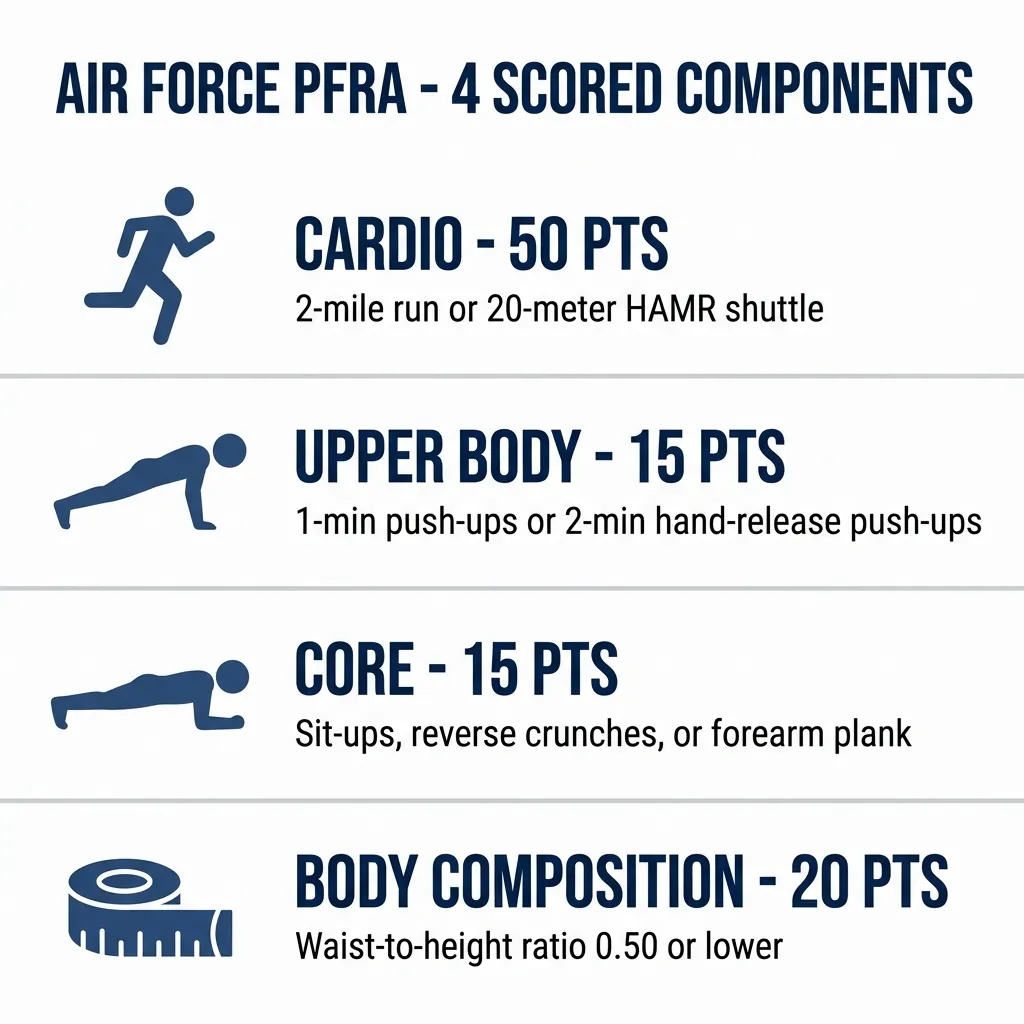
1. Cardio — 50 points
The cardio event is worth half the total score. Two options:
- 2-Mile Run — Flat course, indoor or outdoor (no treadmill). Times scale by age and gender. The new 2-mile distance replaces the 1.5-mile run that defined the previous PFA.
- 20-meter HAMR (High Aerobic Multi-shuttle Run) — Shuttle sprints between markers 20 meters apart, paced by audio cadence that increases each level. Continues until the Airman fails to reach the line in time on two consecutive attempts.
The 2-mile run rewards aerobic base; the HAMR rewards high-end aerobic capacity and speed. Most Airmen score better on the format that matches their training history — runners pick the run; sprinters pick the HAMR.
2. Upper-Body Strength — 15 points
- 1-minute push-ups — Standard format. Maximum reps in 60 seconds with strict form (chest at fist height, full arm extension at top).
- 2-minute hand-release push-ups (HRPU) — Maximum reps in 120 seconds. Chest must touch the ground and hands must lift fully off the floor between reps. The release prevents bouncing and ensures full range of motion.
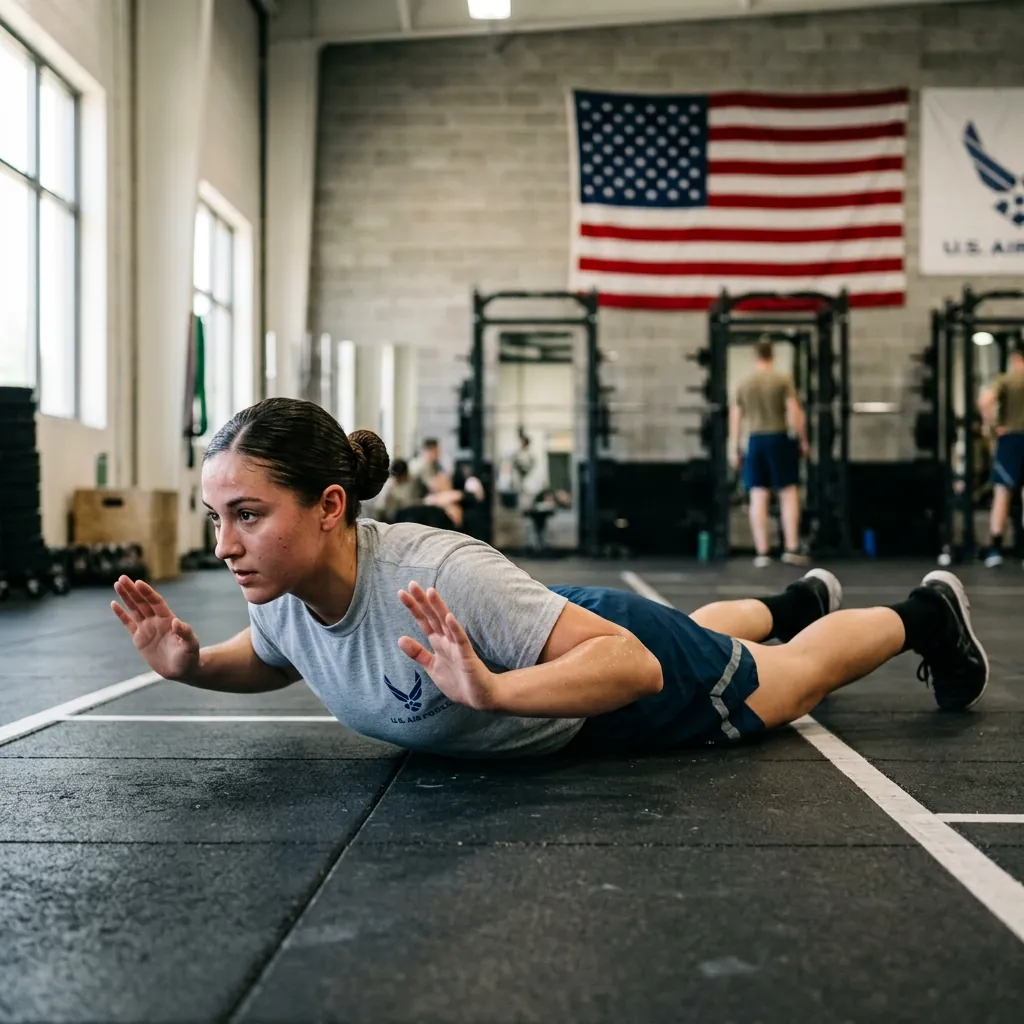
HRPU has 2× the time but stricter form requirements. Most Airmen score better on standard 1-minute push-ups if their max reps are above ~35; HRPU favors high-rep performers who can maintain strict form for 2 full minutes. Test both in training to know which suits you.
3. Core Endurance — 15 points
- 1-minute sit-ups — Traditional format. Maximum reps in 60 seconds.
- 2-minute cross-leg reverse crunches — Crossed-leg position; knees pull to chest. Lower-back-friendly alternative.
- Forearm plank — Timed hold to a maximum point value. Identical scoring across genders and ages. Lowest injury risk option.
The plank is the safest core event for older Airmen and those with lower-back history. Studies referenced by the Air Force Fitness Assessment Cells suggest the plank reduces lumbar injury risk by ~20% compared to traditional sit-ups while still distinguishing core endurance levels meaningfully.
4. Body Composition — 20 points
Waist-to-Height Ratio (WHtR) is calculated by dividing waist circumference by height in the same units. A WHtR below 0.50 is associated with reduced cardiometabolic risk in most adult populations; the Air Force scoring tables reward ratios at or below this threshold.
WHtR is measured up to 5 days before or after the other PFRA events, and it’s worth more points than either the strength or core events alone. For Airmen scoring well in cardio and strength but stuck just below the passing threshold, body composition is often the fastest 5–10 point gain available.
Scoring Weights & Pass Threshold
| Component | Points | % of Total |
|---|---|---|
| Cardio (run or HAMR) | 50 | 50% |
| Body composition (WHtR) | 20 | 20% |
| Upper-body (push-ups or HRPU) | 15 | 15% |
| Core (sit-ups, crunches, or plank) | 15 | 15% |
| Total | 100 | 100% |
Passing requires 75 total points with no individual component below 60% of its maximum. The cardio component’s 50% weight means strong runners can pass on cardio alone if other components are average; weak runners cannot pass even with maxed strength and core.
Event Options Explained
The 2026 PFRA’s biggest change for daily training is the option flexibility. Three principles for choosing:
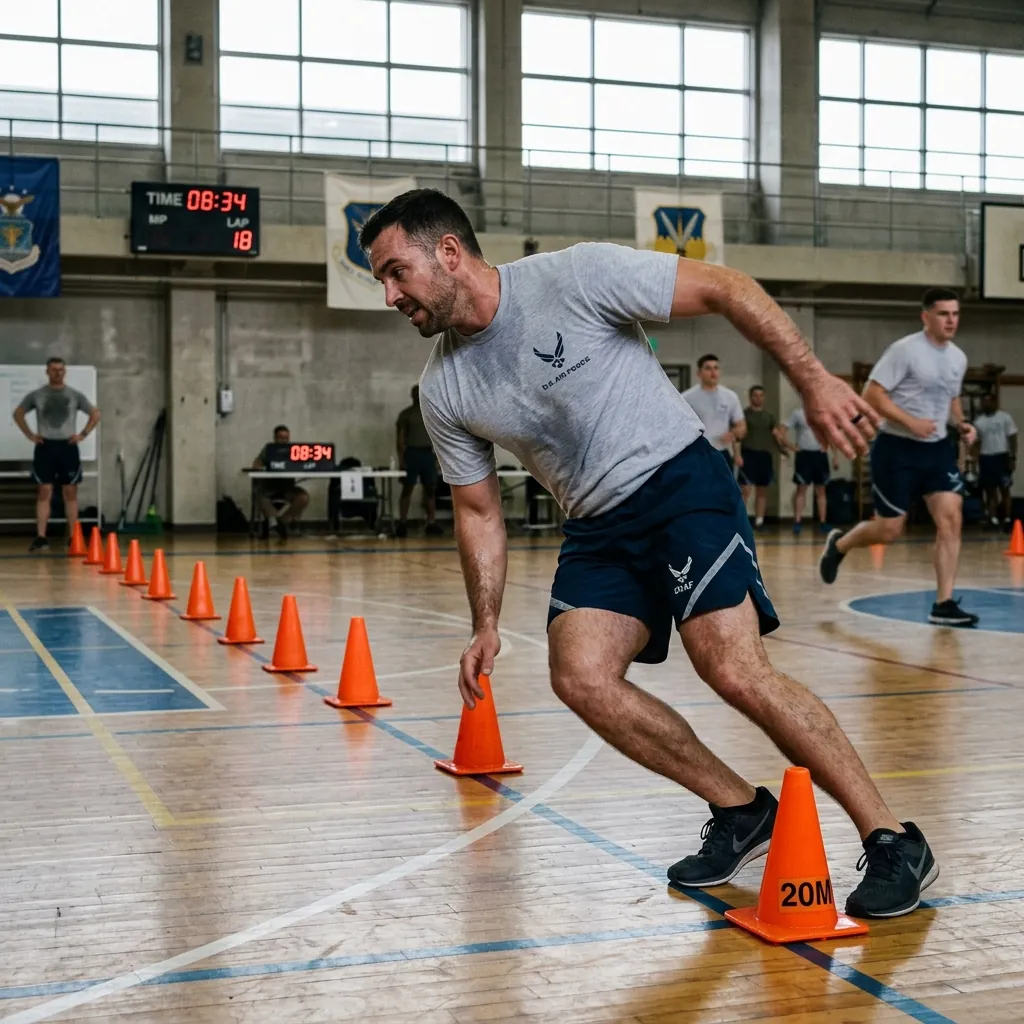
- Test both options on every component during the diagnostic window. March–August 2026 is risk-free — find your higher-scoring format before official scoring resumes in September.
- Match your training history. Runners pick the 2-mile run. Sprinters and athletes with shuttle-run backgrounds (basketball, soccer) pick HAMR. Lifters with strict push-up form pick HRPU. Higher-rep athletes pick the 1-minute push-up.
- Default to plank for core if you’re 35+. Lower injury risk, age-equalized scoring, and the highest reproducibility across test-day conditions.
How to Train for Each Component
2-Mile Run Training
The 2-mile run rewards both pace tolerance and aerobic base. Three quality runs per week beats five mediocre runs:
- Easy long run — 4–5 miles at conversational pace
- Tempo run — 1.5–2 miles at goal PFRA pace minus 10 seconds per mile
- Interval session — 6–8 × 400m at 5K race pace, with 90 seconds rest
For the HAMR specifically, replace the long run with a shuttle session: 5 × (20m × 8 shuttles) at increasing tempos.
Push-Up Training
Push-ups respond to volume more than intensity. 3 sessions per week, 4 sets per session at 60–70% of max with 90 seconds rest. For HRPU specifically, train the strict form deliberately — the hand-release demand is brutal at high volumes if not practiced. See our inverted push-up guide for a foundational variation that builds the same pushing pattern.
Plank / Core Training
The plank is daily work. Three 60–90 second holds every day plus one weekly max-effort attempt produces 30–60 second improvements in 4 weeks for most people. For sit-ups specifically, weighted sit-ups twice weekly (10–25 lbs on chest) build both strength and endurance.
Body Composition
WHtR responds to caloric deficit + protein intake + resistance training. The fastest WHtR improvements come from 8–12 week structured nutrition cycles paired with continued PT — not crash dieting. Most Airmen who target a 0.05 WHtR drop achieve it in 12 weeks with sustainable protocol changes.
Common Air Force PT Test Mistakes
- Training only the events you’ll test. Test both option formats during the diagnostic window so you can pick the higher-scoring version on test day.
- Ignoring body composition. 20 points is more than core or strength alone. WHtR work is a 12-week training cycle, not a test-week effort.
- Going out too fast on the 2-mile run. The new distance is 33% longer than the old 1.5-mile. Pacing strategies that worked under the old test will produce blow-up performances under the new one.
- Picking HRPU without testing form. Hand-release form is unforgiving at high reps. If you’ve never trained it, you’ll fatigue out at form breaks well below your standard push-up max.
- Skipping plank prep. Plank is the lowest-effort core option to score well on but only if trained — untrained planks fail at the 90-second mark for most adults regardless of fitness.
FAQ
What’s a passing score on the Air Force PT test?
75 total points with no individual component below 60% of its maximum value. Failing any component on the 60% threshold fails the entire PFRA regardless of total score.
How does the new PFRA compare to the Army’s AFT?
Different events, different weighting. The PFRA is heavily cardio-weighted (50%) with body composition included; the Army’s AFT distributes points across 5 events (deadlift, push-ups, sprint-drag-carry, plank, 2-mile run) with no body composition. Most Airmen find the AFT’s deadlift unfamiliar; most soldiers find the Air Force HAMR uniquely brutal.
Is body composition really 20% of the score?
Yes. WHtR is worth 20 points out of 100, more than any single muscular event. The Air Force restored scored body composition specifically because composite fitness — not isolated event performance — better predicts operational readiness and long-term health outcomes.
Can I still take the old PT test?
No. PFAs paused January 1, 2026 and the new PFRA replaces them entirely as of September 1, 2026. The diagnostic window (March–August 2026) tests against the new standards but scores aren’t recorded.
Where’s the official scoring chart?
DAFMAN 36-2905 (Department of the Air Force Manual on Fitness Standards) is the authoritative source. Always verify your scores against the current published version through your unit’s Fitness Assessment Cell — standards have been updated multiple times in the last 24 months and may be updated again.
Do AFSPECWAR/EOD candidates use a different test?
Yes. Air Force Special Warfare and EOD candidates use Tier 2 standards — significantly more demanding events including timed swim, ruck march, and obstacle course components in addition to the standard PFRA. Tier 2 prep follows different programming entirely; see our special forces training program for the broader special-operations prep framework.
Bottom Line
The Air Force PT test in 2026 is meaningfully different from prior versions: longer cardio (2-mile run), reintroduced body composition (WHtR), and event flexibility within each component. The diagnostic window through August 31, 2026 is the time to test both option formats on every component and pick the higher-scoring version. For broader military fitness training, see our military calisthenics workout guide, Marine Corps PFT guide, AFT score chart, and Army PRT drills.