

Boot Camp Workout: 4-Week Progressive Plan With Military-Style Circuits
TL;DR — What Is the Best Boot Camp Workout Plan?
A boot camp workout plan should progress weekly, not repeat the same circuit for months. This 4-week program uses 12 military-style exercises in timed circuits, scaling from 3 rounds of 30-seconds-on/30-seconds-off to 5 rounds of 40-on/20-off. Three difficulty tiers (beginner, intermediate, advanced), zero equipment required, roughly 600 calories burned per hour (Source: Porcari et al. / UW-La Crosse, 2011). Jump to the full plan.
Table of contents
Gymnase Tips is reader-supported. When you buy through links on our site, we may earn an affiliate commission at no extra cost to you.

What Is a Boot Camp Workout?
A boot camp workout is a high-intensity circuit that rotates through bodyweight exercises (push-ups, burpees, squats, sprints) in timed rounds with short rest periods. The format traces directly to U.S. Army Physical Readiness Training, now codified under FM 7-22, Holistic Health and Fitness (Source: U.S. Army, 2020). An ACE-sponsored study at the University of Wisconsin-La Crosse found participants burned 9.8 calories per minute during boot camp sessions, putting the hourly rate near 600 calories (Source: Porcari et al. / UW-La Crosse, 2011).
What separates boot camp training from a random HIIT session is structure. Military PRT programming cycles through push, pull, squat, hinge, and core patterns in a deliberate order, controlling volume and intensity across training phases. The drills in ATP 7-22.02, the Army’s companion manual for H2F exercises, read like a boot camp class roster: squat thrusts, flutter kicks, mountain climbers, and prone rows all appear.
That military DNA matters. It means the exercises scale to large groups, need no equipment, and follow a logical progression. Civilian boot camp classes borrowed the format but often skip the progression part. This plan puts it back.
Boot Camp Exercises: 12 Drills From Military PRT
These 12 exercises form the backbone of a military-style bootcamp circuit. Each comes from or mirrors drills in the Army’s PRT program (Source: U.S. Army FM 7-22, 2020). They are organized by movement pattern so every session hits the full body.
Push
1. Push-Ups. Chest, shoulders, triceps. Lock your elbows at the top, lower until your upper arms are parallel to the ground. The Army calls this “the push-up” in its conditioning drills. No fancy name needed.
2. Burpees. Full body. Chest to the deck, explode up. This is the single most efficient boot camp exercise because it loads both the push pattern and a plyometric jump in one rep.
3. Mountain Climbers. Core, hip flexors, shoulders. Hands planted, drive knees toward your chest in alternating rhythm. Keep your hips level with your shoulders.
Squat and Lunge
4. Squat Jumps. Quads and glutes. Sit to parallel, then jump. Land soft. PRT calls a variation of this the “squat bender” in its preparation drill.
5. Walking Lunges. Quads, glutes, balance. Step forward, drop the back knee to an inch above the ground. Alternate legs. These punish your legs in the best way during the later rounds.
6. High Knees. Hip flexors and cardio output. Sprint in place, driving knees above hip height. Use these as your active-recovery movement between heavier drills.
Hinge and Carry
7. Bear Crawls. Shoulders, core, quads. Hands and feet on the ground, knees hovering one inch off the floor. Crawl forward. Twenty feet of bear crawls will humble anyone.
8. Farmer Walks. Grip, traps, core. Grab two heavy objects (dumbbells, water jugs, sandbags) and walk. If you have nothing to carry, sub in a plank shoulder tap.
9. Sprint Intervals. Full body, cardiovascular. Mark 30-40 yards, sprint out, jog back. Outdoors, use a field or parking lot. Indoors, high knees or shuttle runs work.
Core
10. Flutter Kicks. Lower abs and hip flexors. Lie face-up, hands under your glutes, legs straight six inches off the ground. Alternate small kicks. This is a staple of Army PRT conditioning drill 1. See our calisthenics core workout for more core variations.
11. Plank Hold. Full core and shoulders. Hold a straight-arm or forearm plank. Squeeze your glutes, brace your abs, breathe. Thirty seconds feels easy. Ninety seconds does not.
12. Pull-Ups (if bar available). Lats, biceps, grip. Use a doorway pull-up bar or a park structure. No bar? Replace with inverted rows under a sturdy table or resistance-band pull-aparts.

The 4-Week Boot Camp Workout Plan
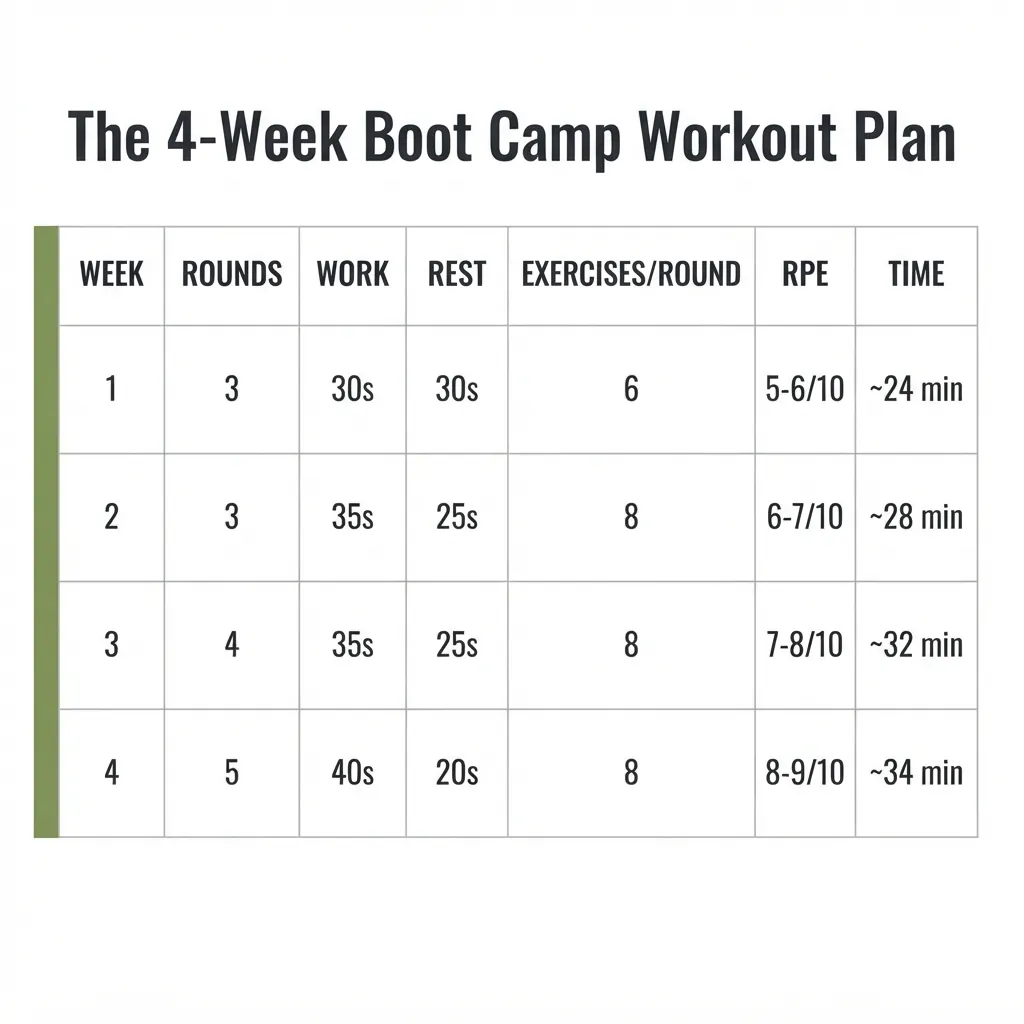
This 4-week plan progresses from 3 rounds of 30-seconds-on / 30-seconds-off in Week 1 to 5 rounds of 40-on / 20-off by Week 4. You train three days per week with at least one rest day between sessions. Total work time per session stays around 30 minutes, which aligns with the federal recommendation of at least 150 minutes per week of moderate-intensity or 75 minutes of vigorous-intensity activity (Source: HHS Physical Activity Guidelines, 2018).
Here is the opinion I will stand behind: skip the 45-minute boot camp classes that never change the programming. Progressive overload matters in circuits exactly as much as it does under a barbell. If you repeat Week 1 forever, you plateau by Week 3.
Weekly Progression
| Week | Rounds | Work | Rest | Exercises per Round | RPE Target | Session Time |
|---|---|---|---|---|---|---|
| 1 | 3 | 30 s | 30 s | 6 | 5-6 / 10 | ~24 min |
| 2 | 3 | 35 s | 25 s | 8 | 6-7 / 10 | ~28 min |
| 3 | 4 | 35 s | 25 s | 8 | 7-8 / 10 | ~32 min |
| 4 | 5 | 40 s | 20 s | 8 | 8-9 / 10 | ~34 min |
RPE means rate of perceived exertion, how hard the effort feels on a 1-to-10 scale.
How to run a session: Pick 6-8 exercises from the 12 above. Perform each exercise for the prescribed work interval, rest for the prescribed rest interval, then move to the next exercise. One pass through all exercises equals one round. Rest 60-90 seconds between rounds. An interval timer or a free phone app handles the timing.
Week 1-2 sample circuit (6 exercises, 3 rounds):
- Push-ups (30 s work)
- Squat jumps (30 s)
- Mountain climbers (30 s)
- Flutter kicks (30 s)
- Walking lunges (30 s)
- Bear crawls (30 s)
Week 3-4 sample circuit (8 exercises, 4-5 rounds):
- Burpees (35-40 s work)
- Sprint intervals (35-40 s)
- Push-ups (35-40 s)
- Squat jumps (35-40 s)
- Mountain climbers (35-40 s)
- Plank hold (35-40 s)
- High knees (35-40 s)
- Flutter kicks (35-40 s)
After completing Week 4, either repeat the cycle with advanced-tier modifications or transition to a longer program. The 28-day military workout picks up where this plan ends.
Printable Boot Camp Workout Summary
| Exercise | Type | Work | Rest | Beginner Mod | Advanced Mod |
|---|---|---|---|---|---|
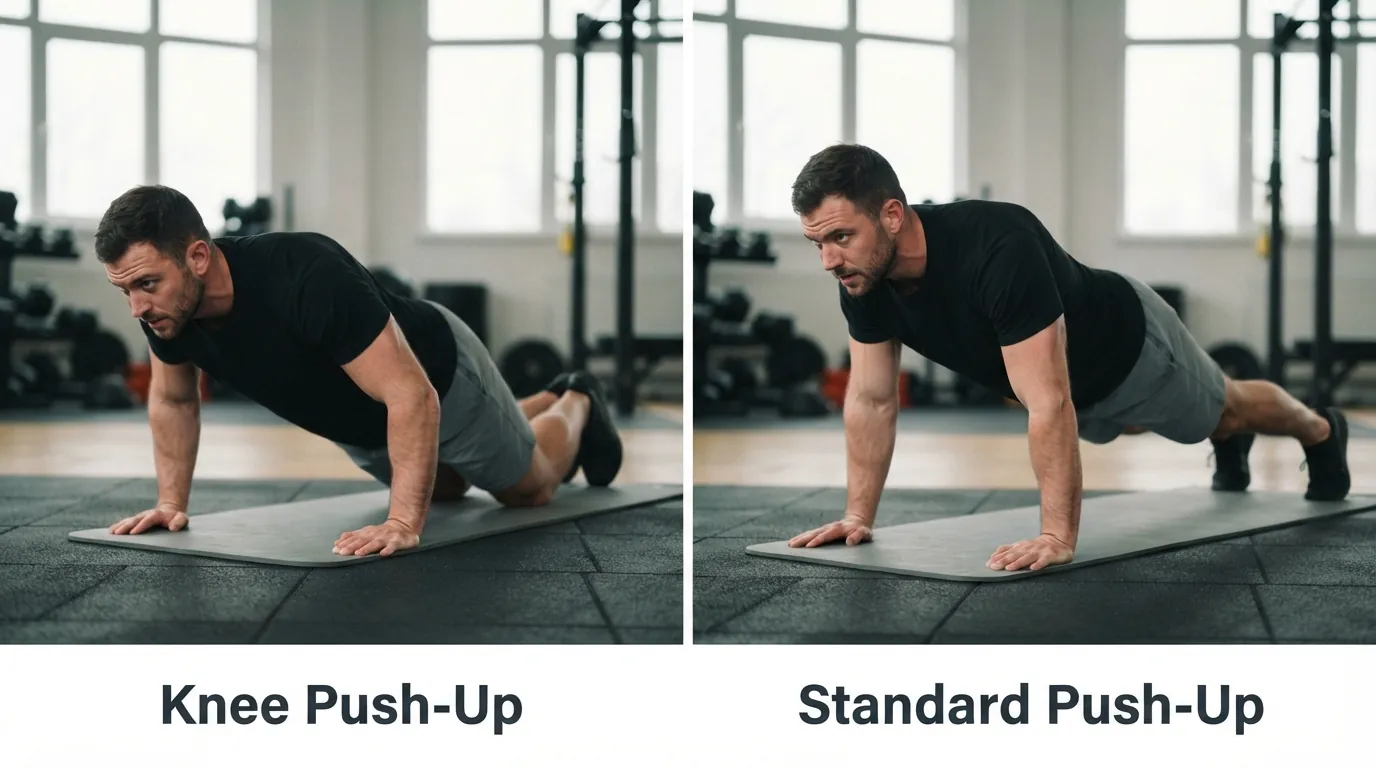
| Push-Ups | Push | 30-40 s | 20-30 s | Knee push-ups | Clap push-ups |
| Burpees | Full Body | 30-40 s | 20-30 s | Step-back burpees (no jump) | Burpee + tuck jump |
| Mountain Climbers | Core/Cardio | 30-40 s | 20-30 s | Slow tempo | Cross-body mountain climbers |
| Squat Jumps | Squat | 30-40 s | 20-30 s | Bodyweight squats (no jump) | Jump squats with weighted vest |
| Walking Lunges | Lunge | 30-40 s | 20-30 s | Stationary reverse lunges | Walking lunges with overhead hold |
| High Knees | Cardio | 30-40 s | 20-30 s | Marching in place | Sprint-pace high knees |
| Bear Crawls | Hinge/Carry | 30-40 s | 20-30 s | Slow crawl, knees can touch | Lateral bear crawls |
| Farmer Walks | Carry | 30-40 s | 20-30 s | Bodyweight plank shoulder taps | Heavy farmer carries |
| Sprint Intervals | Cardio | 30-40 s | 20-30 s | Jog intervals | Hill sprints |
| Flutter Kicks | Core | 30-40 s | 20-30 s | Bent-knee flutter kicks | Straight-leg, hands off floor |
| Plank Hold | Core | 30-40 s | 20-30 s | Forearm plank on knees | Plank with alternating arm reach |
| Pull-Ups | Pull | 30-40 s | 20-30 s | Band-assisted pull-ups | Weighted pull-ups |
Print this table or screenshot it. Stick it on the wall where you train. For a downloadable military-format version, see the military workout PDF.
Beginner, Intermediate, and Advanced Boot Camp Circuits
Pick your tier based on a simple push-up test. Under 10 unbroken push-ups: start at beginner. Between 10 and 25: intermediate. Over 25: advanced. Each tier uses the same 12 exercises with different work-to-rest ratios, round counts, and movement modifications.
This structure matters. Most boot camp programs tell you to “modify as needed” and leave it at that. That advice is useless without specifics. Here are the specifics.
Beginner Boot Camp (Weeks 1-4)
- Rounds: 3
- Work/rest: 30 seconds on / 30 seconds off
- Between-round rest: 90 seconds
- Exercises per round: 6
- Key modifications: Knee push-ups, step-back burpees (no jump), bodyweight squats (no jump), slow bear crawls, bent-knee flutter kicks, marching instead of high knees
Beginners should target an RPE of 5-6. You should be able to talk in short sentences during rest periods. If you cannot finish the work interval, shorten it to 20 seconds and build up. A calisthenics workout plan for all levels offers a parallel progression track.
Intermediate Boot Camp
- Rounds: 4
- Work/rest: 35 seconds on / 25 seconds off
- Between-round rest: 75 seconds
- Exercises per round: 8
- Key modifications: Standard push-ups, full burpees with jump, squat jumps, regular-tempo bear crawls, standard flutter kicks, high-knee sprints
RPE target: 7-8. Breathing is heavy during work intervals. Rest periods should feel too short by Round 3. That is the point.
Advanced Boot Camp
- Rounds: 5
- Work/rest: 40 seconds on / 20 seconds off
- Between-round rest: 60 seconds
- Exercises per round: 8-10
- Key modifications: Clap push-ups, burpee tuck jumps, weighted squat jumps (vest or band resistance), lateral bear crawls, cross-body mountain climbers, weighted farmer carries
- Added equipment (optional): A weighted vest (start at 10-15 lbs) or loop resistance bands increase loading without changing the exercises
RPE target: 8-9. Round 5 should feel like a genuine fight. If it does not, shorten the rest intervals to 15 seconds.
The military calisthenics program covers the strength progressions that complement these circuits.
Boot Camp Workout at Home (No Equipment Needed)
Every exercise in this plan works in a living room, garage, or park. You need roughly 6 by 6 feet of floor space and zero equipment.
For apartments: swap squat jumps for bodyweight squats, burpees for squat thrusts (chest to floor, stand up, no jump), and sprint intervals for high knees. That eliminates the impact noise without gutting the training effect.
For outdoor boot camp workouts, a park bench adds incline push-ups and box step-ups to the rotation. A hill within jogging distance replaces flat sprint intervals with hill sprints, which are harder on the glutes and easier on the knees.
The only optional purchases that genuinely help at home: an exercise mat for floor work on hard surfaces and a doorway pull-up bar for the one exercise that needs it. Everything else is a want, not a need. For more bodyweight ideas, see fun workouts at home.

How Many Calories Does a Boot Camp Workout Burn?
A person burns roughly 9.8 calories per minute during a boot camp workout, about 600 calories per hour, according to an ACE-sponsored study conducted at the University of Wisconsin-La Crosse (Source: Porcari et al. / UW-La Crosse, 2011). That study tested participants aged 19-29 exercising at 77% of their max heart rate.
The actual number depends on your body weight, effort level, and rest intervals. Heavier people burn more per minute. Shorter rest periods increase total energy expenditure. The 600-calorie figure assumes moderate-to-high intensity across a full 60-minute session; a 30-minute circuit burns roughly half that.
There is also an afterburn effect. EPOC (excess post-exercise oxygen consumption) adds 6 to 15 percent to the total energy cost of a high-intensity session (Source: ACE, citing LaForgia et al., 2006). For a 300-calorie boot camp workout, that means an extra 18-45 calories burned during recovery. Not life-changing on its own, but it compounds over three sessions a week across four weeks.
No calorie number guarantees weight loss. That requires a sustained calorie deficit. But boot camp training is one of the more time-efficient ways to drive up weekly energy expenditure.
Boot Camp vs. HIIT: What Is the Difference?
Boot camp is a type of HIIT, not a separate category. Every boot camp workout uses high-intensity intervals. But not every HIIT workout is a boot camp.
The distinction is structure. HIIT is a broad label for any workout alternating high-effort bursts with rest. That includes cycling sprints, rowing intervals, Tabata protocols, and dozens of other formats. Boot camp specifically means a circuit of 8-12 exercises, usually bodyweight, rotated in rounds with timed work-and-rest intervals. The exercise variety is wider, the format is fixed, and the military heritage shapes the drill selection.
| Feature | Boot Camp | HIIT (General) |
|---|---|---|
| Exercise count | 8-12 per session | 1-6 typically |
| Equipment | Usually none | Varies (bike, rower, weights) |
| Structure | Timed circuit rounds | Intervals (Tabata, EMOM, AMRAP) |
| Origin | Military PRT | Exercise physiology research |
| Typical duration | 30-45 min | 10-30 min |
AMRAP means “as many rounds as possible” in a set time. EMOM means “every minute on the minute,” where you start a new set at the top of each minute. Both are HIIT formats but not boot camp formats.
FAQ
What exercises are done in boot camp?
The standard boot camp roster pulls from push-ups, burpees, mountain climbers, squat jumps, flutter kicks, bear crawls, sprint intervals, walking lunges, planks, high knees, pull-ups, and farmer walks. All mirror drills from Army PRT conditioning. See the full 12-exercise list above for form cues and muscle targets.
Is a boot camp workout good for beginners?
Yes, with modifications. Replace jump-based movements with their grounded versions (squat jumps become bodyweight squats, burpees become step-back squat thrusts). Start at 3 rounds with a 30-second work / 30-second rest ratio and build from there. The beginner tier above lays out every modification.
How long should a boot camp workout be?
Plan for 25-35 minutes of circuit work plus a 5-minute warm-up and 5-minute cool-down. Total session: 35-45 minutes. The 4-week plan in this guide programs 24-34 minutes of actual work per session, which is enough to hit meaningful training stimulus without dragging into junk volume.
What is the difference between boot camp and HIIT?
Boot camp is a subset of HIIT. It uses timed circuits with 8-12 bodyweight exercises rotated in rounds. General HIIT covers any workout that alternates max-effort intervals with rest, including cycling, rowing, and weight-based protocols. See the full comparison above.
Can you lose weight with boot camp workouts?
Boot camp burns roughly 600 calories per hour (Source: Porcari et al. / UW-La Crosse, 2011). That rate of expenditure can contribute to a calorie deficit when paired with appropriate nutrition. Three 30-minute sessions per week adds up to around 900 extra calories burned. Weight loss still depends on total intake versus total output. No workout overrides a bad diet.
How many times a week should you do boot camp?
Three to four sessions per week with at least one rest day between sessions. The 4-week plan above programs three days per week, which provides enough training volume for adaptation without overreaching. If you want a fourth day, make it a lower-intensity mobility session or try the 28-day calisthenics challenge as a complement.
Sources
- Porcari, J.P., Hendrickson, K., Foster, C. & Anders, M. (2011). “Drop and Give Me 20!” ACE-sponsored research, University of Wisconsin-La Crosse. UW-La Crosse thesis (PDF)
- ACE Fitness. “7 Things to Know About Excess Post-Exercise Oxygen Consumption (EPOC).” acefitness.org
- U.S. Army. FM 7-22, Holistic Health and Fitness. October 2020 (C2, August 2025). armypubs.army.mil | PDF via media.defense.gov
- U.S. Army. ATP 7-22.02, Holistic Health and Fitness Drills and Exercises. armypubs.army.mil
- U.S. Department of Health and Human Services. Physical Activity Guidelines for Americans, 2nd edition. 2018. odphp.health.gov
Want a structured no-equipment alternative? Try our bodyweight circuit training guide — 7 circuits from beginner to military-grade, with a 4-week progression plan.