Last updated: May 2026 — written by the Gymnase Tips training team.
The Coast Guard Physical Fitness Test (PFT) became a service-wide annual requirement for the first time in Coast Guard history starting July 1, 2026 — ending decades of debate about whether the service needed a standardized PFT. The new test, based on the existing Boat Crew Physical Fitness Standards, consists of three events: maximum push-ups in 60 seconds, a timed forearm plank, and a cardio event chosen from a 1.5-mile run, a 12-minute swim (with 500-yard minimum for males and 400-yard minimum for females in the under-30 band), or a 2,000-meter row. Standards vary by age and gender. For Coast Guardsmen under 30, the male standard requires 29 push-ups, a 1:18 plank, and a 1.5-mile run in under 12:29; the female standard requires 15 push-ups, a 1:09 plank, and a 1.5-mile run in under 15:05. Planks fully replaced sit-ups in recent updates, aligning the Coast Guard with the Navy’s Physical Readiness Test changes. Results are recorded at the unit level but not currently used as a punitive measure. This guide breaks down every event, the current standards, and how to prepare.
Table of Contents
- What’s New in 2026
- The 3 PFT Events
- Standards by Age & Gender
- How to Choose the Cardio Event
- How to Train for Each Event
- Common Mistakes
- FAQ
What’s New in 2026
The Coast Guard was the only US military service that did not require an annual service-wide fitness test for all members. That changed September 2, 2025, when Coast Guard leadership announced that starting in 2026, all military personnel would be required to take a mandatory PFT. The official rollout timeline:
- Late 2025 — Physical Fitness Assessment (PFA). A diagnostic-only version of the test, used to familiarize members with the new format. Scores not recorded for evaluation.
- July 1, 2026 — Official Physical Fitness Test (PFT) goes live. Annual force-wide test becomes mandatory. Scores recorded at the unit level.
The test is described in ALCOAST 082/26 (the Coast Guard’s official service-wide message announcing the 2026 PRP update). Functionally, the PFT is identical to the PFA — three events, same standards. The PFT replaces the long-standing “tape tests” that previously assessed body composition without measuring actual fitness performance.
The 3 PFT Events
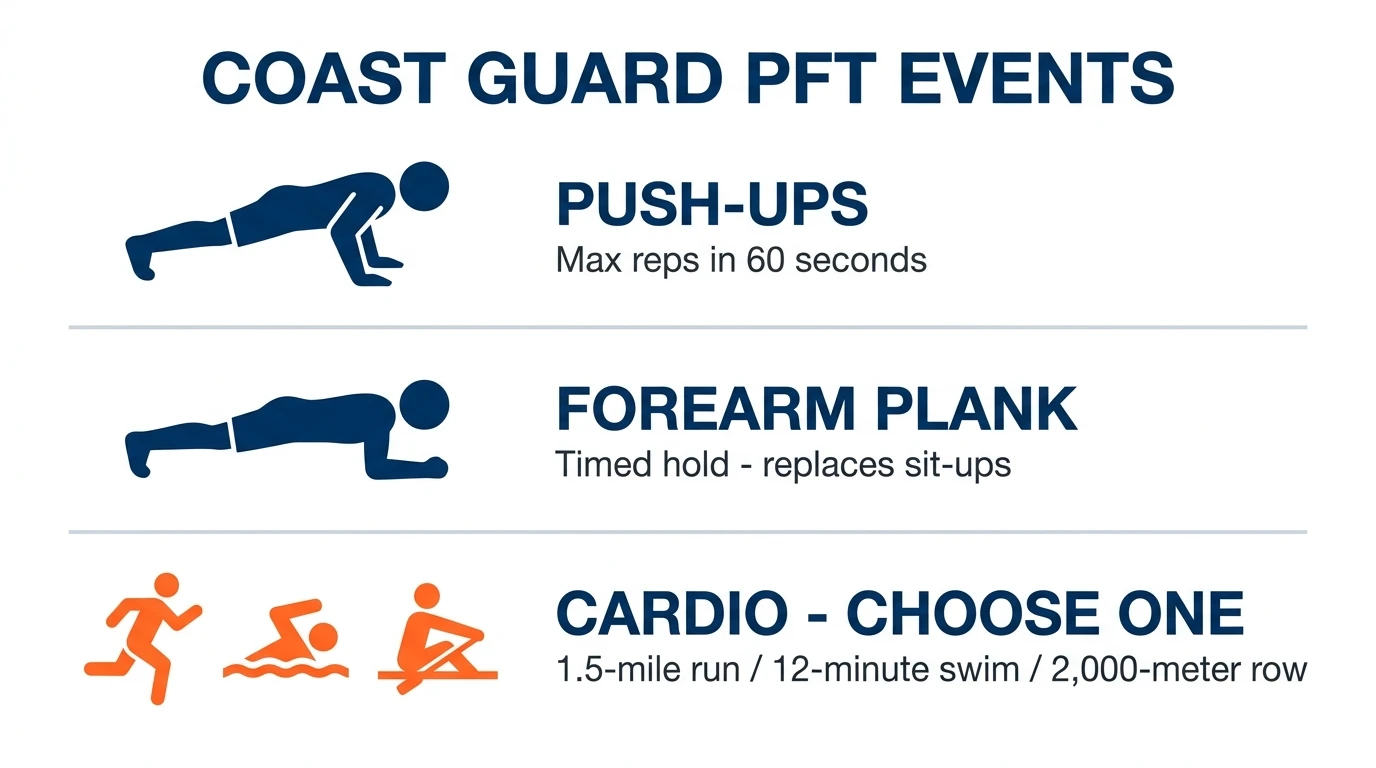
1. Push-Ups
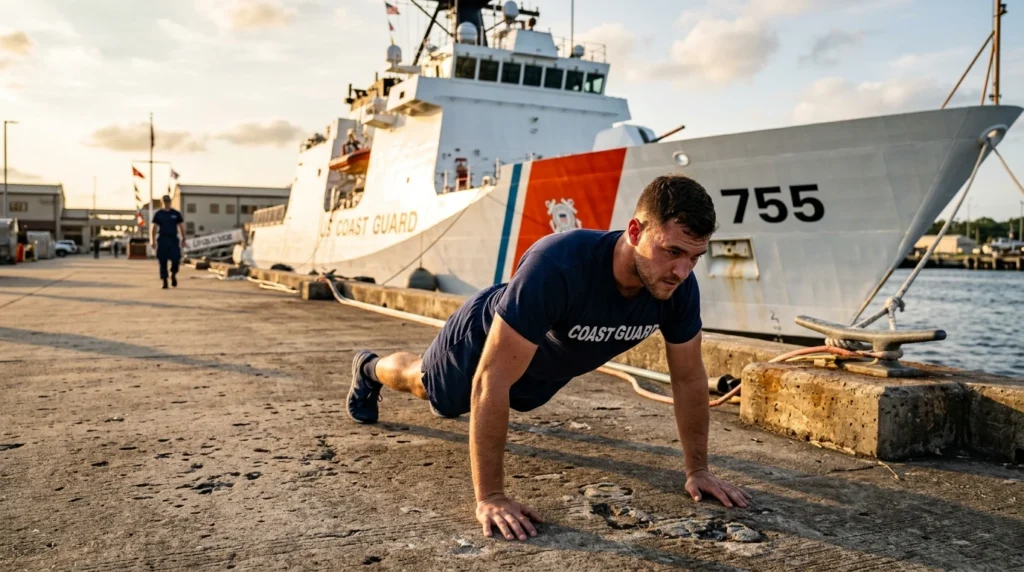
Maximum push-ups in 60 seconds. Standard form: hands shoulder-width or slightly wider, body straight from head to heels, chest descends to within a fist’s height of the floor, full arm extension at the top. No rest in the up position past 5 seconds — extended rest pauses the count.
2. Forearm Plank
Timed hold in standard forearm plank position: forearms on ground, elbows under shoulders, body in a straight line from heels to head. Time stops the moment form breaks (hips sag, hips pike, knees touch the ground, or the body’s straight line is lost).
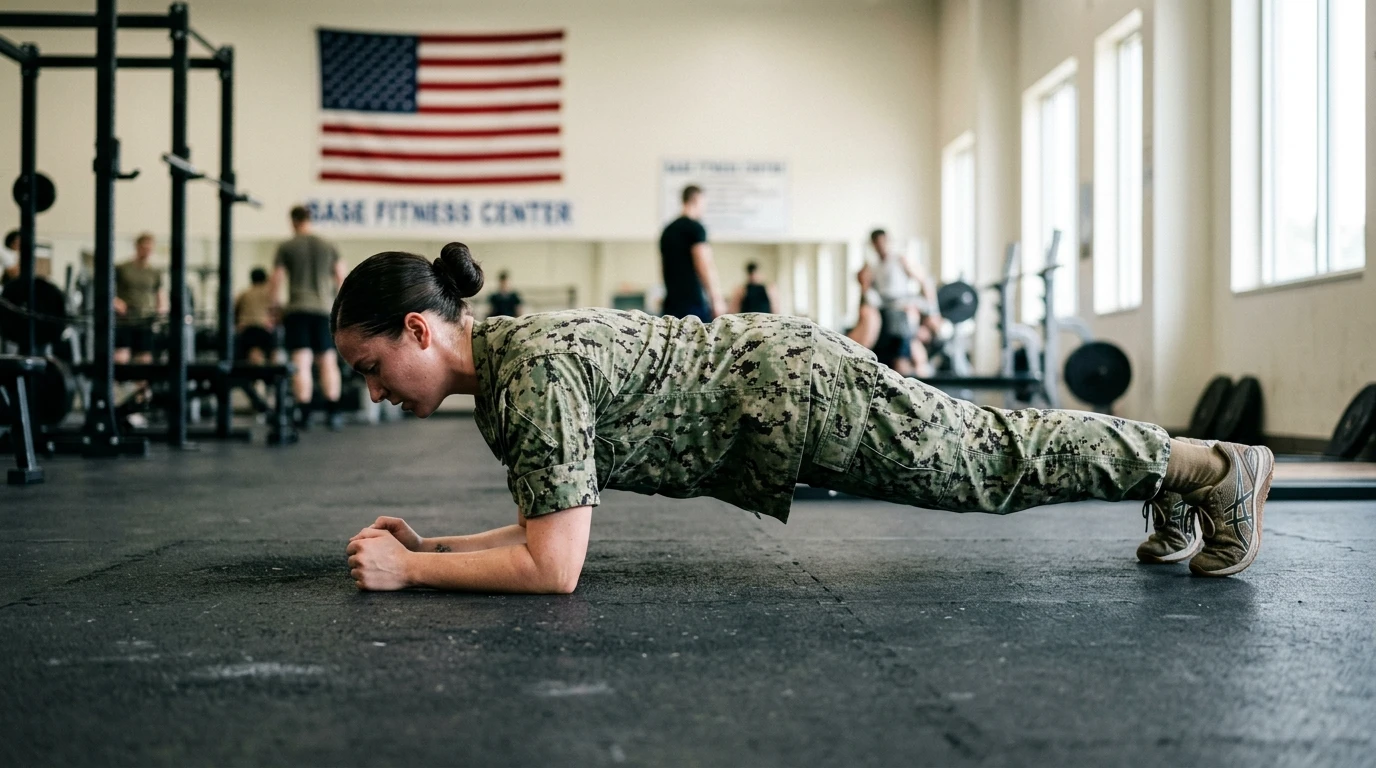
The plank fully replaced sit-ups in recent Coast Guard updates — a change made in alignment with the Navy’s Physical Readiness Test, and one driven by research showing the plank reduces lumbar injury risk while still distinguishing core endurance levels meaningfully. See our plank standards guide for the science on plank duration and form.
3. Cardio Event (Choose One)
Members choose between three cardio options before test day:
- 1.5-Mile Run — Standard timed run. Flat course, indoor or outdoor.
- 12-Minute Swim — Distance-based swim event. Members under 30 must cover at least 500 yards (males) or 400 yards (females) in 12 minutes.
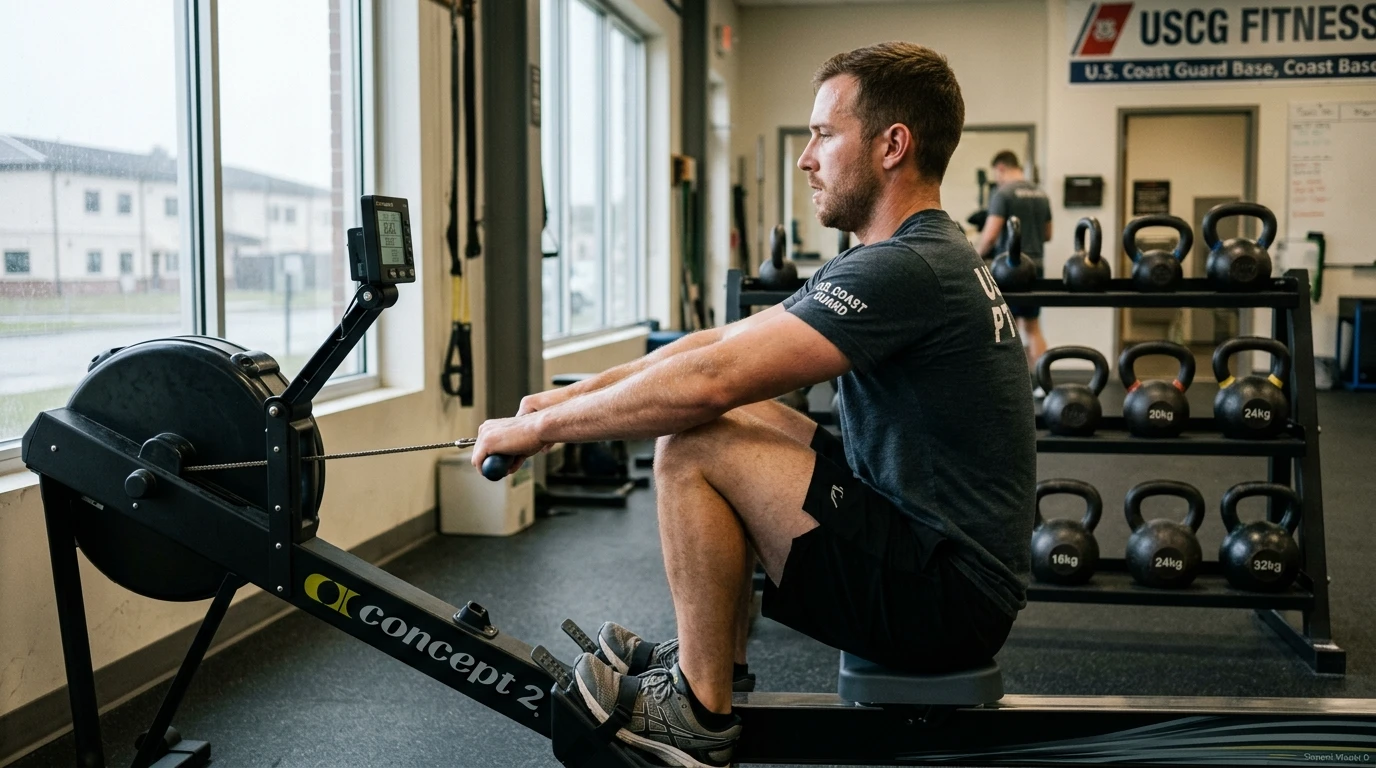
- 2,000-Meter Row — Timed row on a Concept2 ergometer or equivalent.
The cardio choice is locked once selected and submitted before the test. Members can’t change events mid-test or between events.
Standards by Age & Gender
The Coast Guard PFT uses age and gender brackets similar to other military fitness tests. Members must hit the minimum for all three events to pass — failing any single event fails the entire PFT regardless of performance on the other two.
Under 30 — Male
| Event | Minimum Standard |
|---|---|
| Push-ups | 29 in 60 seconds |
| Plank | 1:18 |
| 1.5-mile run | 12:29 |
| 12-minute swim | 500 yards |
| 2,000-meter row | 9:20 |
Under 30 — Female
| Event | Minimum Standard |
|---|---|
| Push-ups | 15 in 60 seconds |
| Plank | 1:09 |
| 1.5-mile run | 15:05 |
| 12-minute swim | 400 yards |
| 2,000-meter row | 10:40 |
Standards scale upward with age (older members need fewer push-ups, slower run times, and shorter plank holds). Members 30+ should consult the current Boat Crew Physical Fitness Standards age-band tables, available via the Coast Guard’s internal Physical Readiness Program (PRP) SharePoint.
How to Choose the Cardio Event
The cardio choice is the highest-leverage decision in PFT prep. Three principles:
Pick the run if…
- You have a consistent running history and can run 2+ miles comfortably
- You don’t have reliable pool access for training
- You’re prepping for boot camp or OCS where the run is the dominant event
Pick the swim if…
- You have prior competitive or sustained swimming experience
- You’re stationed near reliable pool facilities
- Lower-extremity injuries make sustained running impractical
Pick the row if…
- You have an erg available and can train consistent technique
- You’re lifting heavy outside of PT and want a lower-impact cardio option
- Knee or hip issues compromise running performance
Test all three during the diagnostic window or on your own time before locking your choice. The “right” event is the one where your scoring buffer is largest above the minimum — not the one that matches your historical training.
How to Train for Each Event
Push-Up Training
Push-ups respond to volume more than intensity. 3 sessions per week, 4 sets per session at 60–70% of your 60-second max, with 90 seconds rest between sets. The 60-second time constraint rewards rep-pacing as much as raw strength — most members add 10–15 reps to their PFT push-up score in 4–6 weeks of structured volume work without increasing maximum strength.
Plank Training
Daily holds beat weekly max efforts. Three sub-max holds per day (60–90 seconds each, focusing on perfect form) plus one weekly max-effort attempt produces 30–60 second improvements in 4 weeks for most untrained members. Pair with hollow body holds and dead bugs for complete anti-extension core development.
1.5-Mile Run Training
Three quality runs per week beats five mediocre runs:
- Long easy run — 3-4 miles at conversational pace
- Tempo run — 1 mile at goal PFT pace minus 10 seconds per mile
- Interval session — 6 × 400m at 5K race pace, with 90 seconds rest
Swim Training
For the 12-minute swim, build sustainable freestyle pace. Sets of 100 yards on the 2:00 (15 seconds rest between) build the aerobic base. Once you can hold 1:45 per 100yd for 5 sets, you’re well above the 500yd-in-12-minutes threshold. For under-30 males that’s the under-2:24 per 100yd pace — meaningfully easier than the typical perception of the swim test.
Row Training
The 2,000-meter row is the rowing world’s standard test distance. Train at the goal split-per-500m pace: 9:20 total = 2:20 per 500m (males under 30). Build via 4 × 500m at goal pace with 90 seconds rest, then 2 × 1000m at goal pace, then full 2000m time trials every 2 weeks.
Common Coast Guard PFT Mistakes
- Locking the cardio choice without testing all three. Most members default to the run by habit. Some would score significantly more buffer above minimum on the swim or row.
- Training push-ups to max effort weekly. Volume work outperforms max-effort sessions for 60-second test events. Save max effort for the test itself.
- Skipping plank prep. The plank is new — many members underestimate how hard 1:18 is when held with strict form. Daily training beats once-weekly attempts.
- Going out too fast on the 1.5-mile run. Most failed runs come from a fast first mile that destroys the second. Negative split pacing (faster second half than first) consistently produces better times.
- Ignoring body composition. Although the tape test is being phased out, the body composition pre-screening still applies before the PFT. Members concerned about pre-screening should consult their medical officer.
FAQ
When does the Coast Guard PFT become mandatory?
July 1, 2026. From this date forward, all active duty and Selected Reserve members are required to take the PFT annually. Results are recorded at the unit level. Individual scores are explicitly not used as a punitive measure at rollout, though leadership has stated members are “highly encouraged” to use their results to inform individual fitness training plans.
How does the Coast Guard PFT compare to the Navy PRT?
Very similar. The Coast Guard explicitly aligned its PFT structure with the Navy’s Physical Readiness Test (PRT) — both use push-ups + plank + cardio choice (run/swim/row), both replaced sit-ups with planks, and both use age-and-gender banded standards. The Coast Guard’s swim distances and cardio thresholds are slightly different from the Navy’s, but the training overlap is significant.
Did the Coast Guard really not have a fitness test before?
Not service-wide. Specific career fields — boat crews, rescue swimmers, law enforcement personnel, specialty units — have always had physical standards. Initial training (boot camp, OCS, Academy) has always included physical testing. But after initial training, the only Coast Guardsmen required to meet ongoing physical standards were those in physically demanding mission sets. The 2026 PFT changes that.
What happens if I fail the PFT?
At rollout, scores are not currently used as a punitive measure — meaning a failed PFT doesn’t automatically affect promotion or assignment decisions. However, the Coast Guard has been explicit that this policy may evolve, and that members should use their results to inform training plans. For boat crew members, rescue swimmers, and other specialty personnel with existing physical standards, those standards remain in place independently of the service-wide PFT.
Are there special standards for boot camp or OCS?
Yes. Initial training (boot camp, Officer Candidate School, Coast Guard Academy) maintains its own physical assessments that pre-date the 2026 service-wide PFT. Recruits and officer candidates should consult their specific training command’s standards rather than relying on the service-wide PFT thresholds.
Where’s the official source for the standards?
ALCOAST 082/26 (the Coast Guard’s official service-wide message) and the Coast Guard’s Physical Readiness Program (PRP) SharePoint site. The Coast Guard Boat Crew Physical Fitness Standards form the technical basis for the new PFT. Always verify against current published versions — fitness standards have changed multiple times in the last 24 months across the joint force and may be updated again.
Bottom Line
The Coast Guard PFT going service-wide on July 1, 2026 is the largest single change to Coast Guard fitness policy in the service’s history. For most members, the standards are achievable with 8–12 weeks of structured preparation — the test isn’t designed to fail Coast Guardsmen, it’s designed to establish a baseline of physical readiness across the force. Train all three components, test all three cardio options before locking your choice, and run a 4-week build to the minimums plus 25% buffer before taking the official PFT. For broader military fitness training, see our Marine Corps PFT, Air Force PT test, AFT score chart, Navy SEAL physical requirements, and military calisthenics workout guide.