
Gymnase Tips is reader-supported. Some links may be Amazon affiliate links; if you buy through them we may earn a small commission at no extra cost to you.
TL;DR — What Are the Best Weighted Vest Workouts?
The best weighted vest workouts are push-ups, pull-ups, squats, lunges, dips, and burpees — compound bodyweight movements where the vest adds load near your center of gravity, increasing muscular demand without changing movement mechanics. The extra weight amplifies time under tension on muscles already doing real work. Below: 14 exercises with sets/reps, a weight chart by level, and 3 complete routines.
- Weighted Push-Ups
- Weighted Pull-Ups
- Weighted Dips
- Weighted Pike Push-Ups
- Weighted Inverted Rows
- Weighted Squats
- Weighted Lunges
- Weighted Step-Ups
- Weighted Box Jumps
- Weighted Burpees
- Weighted Plank Hold
- Weighted Vest Walking
- Mountain Climbers with Vest
- The Murph Workout
Table of contents
Why Train with a Weighted Vest? (What the Research Says)
Yes — weighted vest training increases muscle mass, burns more calories, and may improve bone density, according to three recent controlled trials. This is not speculation. The data is specific.
A 2024 study from Korea University put participants through 8 weeks of circuit training with weighted vests. The vest group gained 7.5% more skeletal muscle mass and reduced insulin resistance (HOMA-IR) by 27.1% compared to controls (Source: Kim et al., Journal of Exercise Science & Fitness, 2024). The non-vest circuit group improved too — just significantly less.
A single trial by Bellman et al. at the University of Gothenburg compared heavy-load (~11% BW) versus light-load weighted vests worn 8 hours per day for 5 weeks. The heavy-load group lost fat mass and waist circumference without changing diet or activity levels. The proposed mechanism: a biological “gravitostat” in the long bones that senses sustained loading and downregulates body fat (Source: Bellman et al., BMC Medicine, 2025).
The INVEST trial at Wake Forest University — one of the largest NIH-funded weighted vest studies — tracked 150 older adults over 12 months. Among vest wearers, more time spent standing or walking was associated with smaller declines in hip bone mineral density, while the weight-loss-only group saw the opposite pattern (Source: Fanning et al., Frontiers in Aging, 2026). The takeaway: the vest does not reverse bone loss on its own, but staying active while wearing it makes a measurable difference.
How to Choose Your Vest Weight (by Exercise and Level)
Start at 5-10% of your body weight for most exercises, but the ideal load varies: pull-ups need less (5%) while squats can handle more (10-20%). The ACSM recommends beginning at roughly 5% of body weight and progressing gradually (Source: ACSM, 2026). Use the table below to find your starting weight.
For a 180 lb / 82 kg person, 5% is 9 lbs and 10% is 18 lbs. Most adjustable vests let you add or remove weight plates in 2-5 lb increments, so you can dial in the right load for each exercise.
Weight Selection Table (% of Body Weight)
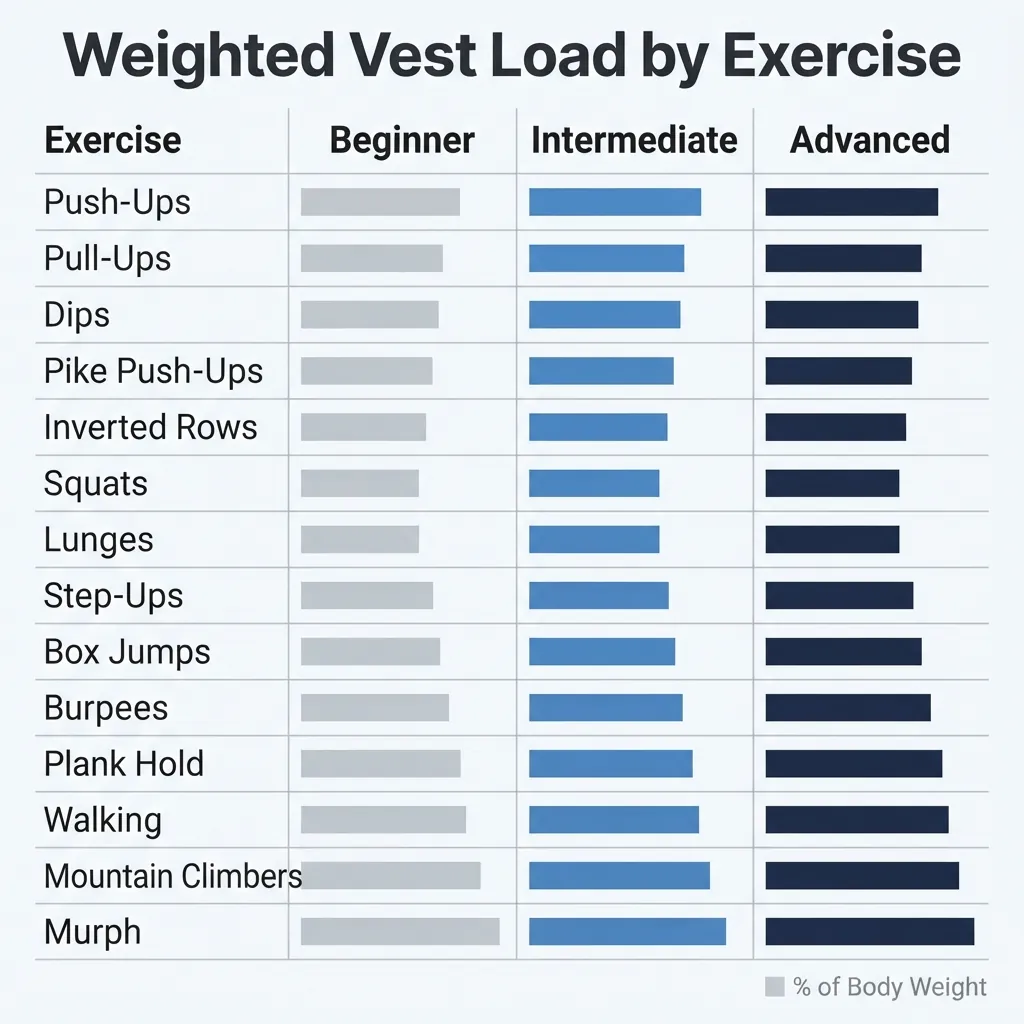
| Exercise | Beginner | Intermediate | Advanced |
|---|---|---|---|
| Push-Ups | 5-8% | 10-12% | 15-20% |
| Pull-Ups | 3-5% | 5-8% | 10-15% |
| Dips | 5-8% | 8-12% | 12-18% |
| Pike Push-Ups | 3-5% | 5-8% | 8-12% |
| Inverted Rows | 5-8% | 8-12% | 12-15% |
| Squats | 8-10% | 12-15% | 15-20% |
| Lunges | 5-8% | 10-12% | 12-18% |
| Step-Ups | 5-8% | 8-12% | 12-15% |
| Box Jumps | — | 5-8% | 8-10% |
| Burpees | 5% | 8-10% | 10-15% |
| Plank Hold | 5-8% | 10-12% | 12-15% |
| Walking | 5-10% | 10-15% | 15-20% |
| Mountain Climbers | 5% | 5-8% | 8-10% |
| Murph | — | 10% (~20 lb) | 10%+ (~20 lb Rx) |
Rule of thumb: if the vest changes your form, it is too heavy. Drop 5% and build back up over 2-3 weeks. For detailed sizing and fit guidance, see our what size weighted vest should I get guide.
Best Upper Body Weighted Vest Exercises
The best upper-body weighted vest exercises are push-ups, pull-ups, and dips — compound pressing and pulling movements where the vest loads your torso without restricting range of motion. These three alone cover chest, back, shoulders, and arms.
Weighted Push-Ups
Muscles: Chest, triceps, anterior deltoids
Difficulty: Beginner-friendly
| Level | Sets x Reps |
|---|---|
| Beginner | 3 x 10-15 |
| Intermediate | 4 x 8-12 |
| Advanced | 5 x 6-10 |
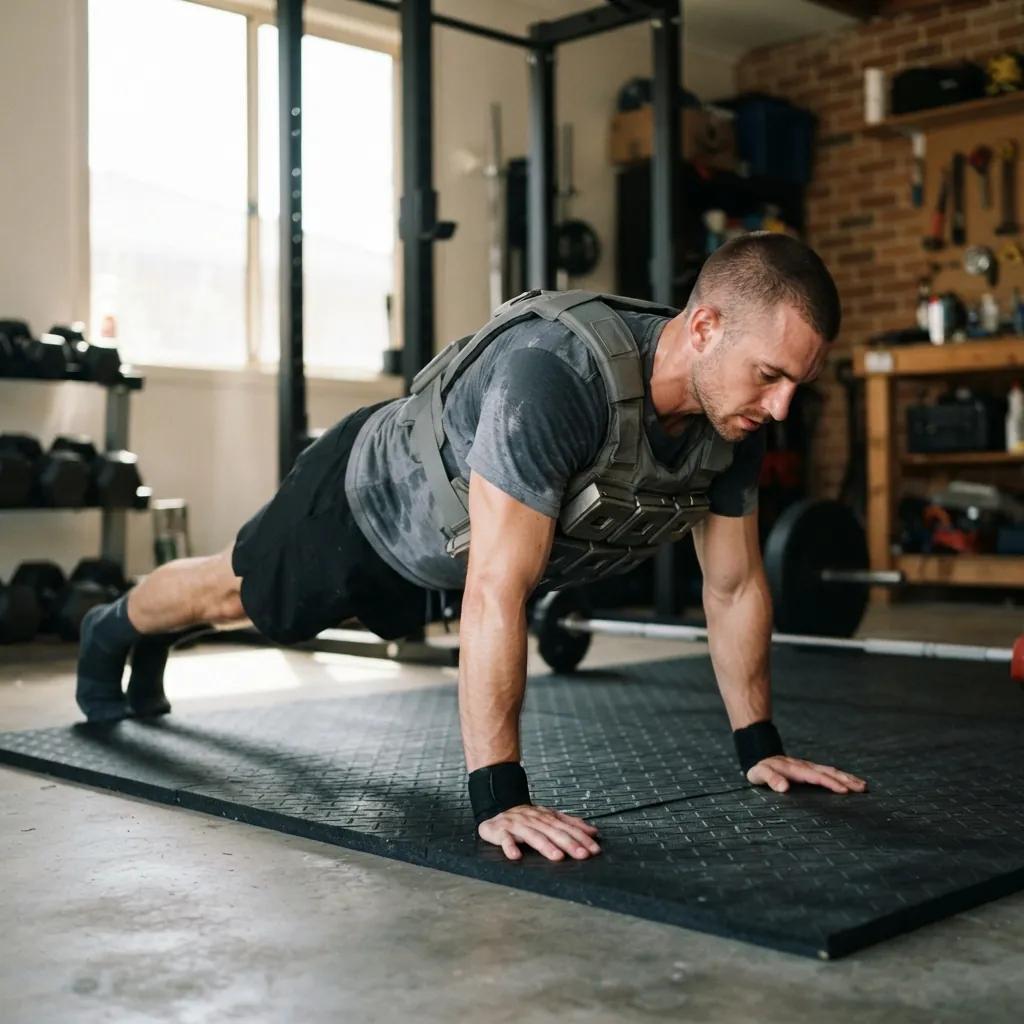
Hands shoulder-width, full range of motion on every rep. No sagging hips — if your lower back dips, the vest is too heavy. This is one of the best exercises you can do with a vest because progressive overload on a push-up is otherwise limited to harder variations.
Calisthenics progression: Incline push-up → Standard → Decline → Weighted → Weighted decline.
Weighted Pull-Ups
Muscles: Lats, biceps, rear deltoids
Difficulty: Intermediate
| Level | Sets x Reps |
|---|---|
| Beginner | 3 x 3-5 (or assisted) |
| Intermediate | 3 x 6-8 |
| Advanced | 4 x 6-10 |
Start from a dead hang. No kipping. If you cannot do 8 strict bodyweight pull-ups yet, the vest is premature — build the base first. A doorway pull-up bar is all you need at home.
Calisthenics progression: Band-assisted → Standard → Weighted → Weighted L-sit.
Weighted Dips
Muscles: Chest, triceps, anterior deltoids
Difficulty: Intermediate
| Level | Sets x Reps |
|---|---|
| Beginner | 3 x 5-8 |
| Intermediate | 3 x 8-12 |
| Advanced | 4 x 8-12 |
Slight forward lean targets the chest. Stay upright for more triceps. Use parallel bars or a dip station. The vest distributes load more evenly than a dip belt for moderate weights, though a belt allows heavier loading for pure strength work. For more weighted arm training, see our calisthenics arm workout guide.
Weighted Pike Push-Ups
Muscles: Shoulders, triceps
Difficulty: Intermediate
| Level | Sets x Reps |
|---|---|
| Beginner | 3 x 6-8 |
| Intermediate | 3 x 8-12 |
| Advanced | 4 x 8-10 |
Feet elevated on a box, hips piked high, head moves toward the floor. This is a handstand push-up progression step — the vest adds the shoulder loading that makes it an actual strength builder rather than just a mobility drill.
Weighted Inverted Rows
Muscles: Upper back, biceps, rear deltoids
Difficulty: Beginner-friendly
| Level | Sets x Reps |
|---|---|
| Beginner | 3 x 8-12 |
| Intermediate | 3 x 10-15 |
| Advanced | 4 x 10-15 |
Set a bar at waist height (a Smith machine or low gymnastics rings work). Pull your chest to the bar. This is a pull-up regression and a solid complement on upper-body days — it hits the mid-back angle that pull-ups miss. If you are building toward your first calisthenics upper body workout, start here.
Best Lower Body Weighted Vest Exercises
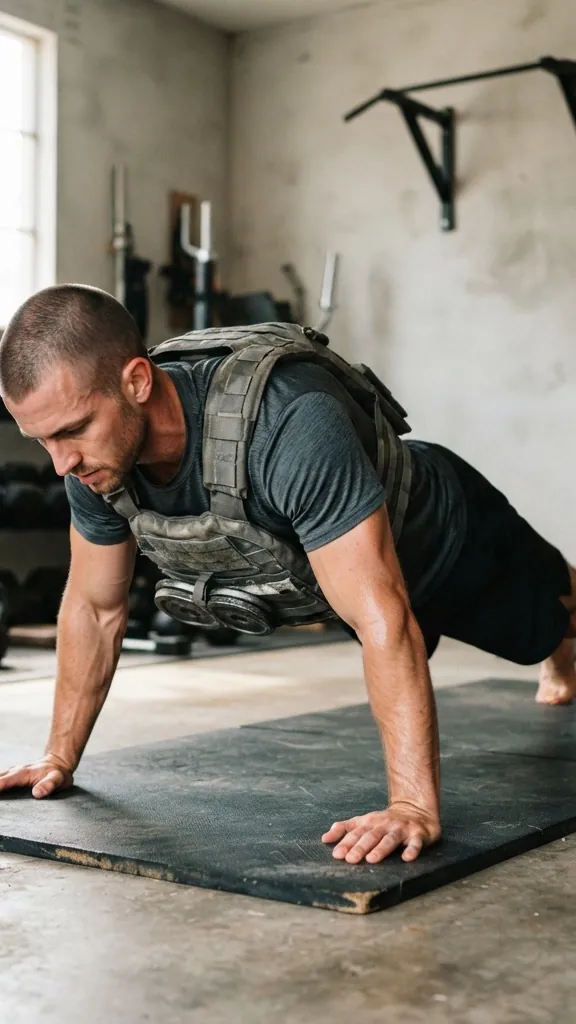
Squats, lunges, and step-ups are the most effective lower-body weighted vest exercises — the added load increases time under tension on the quads, glutes, and hamstrings without requiring a barbell. If you train at home with no rack, the vest fills the progressive overload gap.
Weighted Squats
Muscles: Quads, glutes, hamstrings, core
Difficulty: Beginner-friendly
| Level | Sets x Reps |
|---|---|
| Beginner | 3 x 12-15 |
| Intermediate | 4 x 10-12 |
| Advanced | 4 x 12-15 (heavier vest) |
Full depth — hip crease below the knee. Knees track over toes. The vest sits on your torso, so the loading pattern feels more like a front squat than a back squat. That is fine. It forces you to stay upright.
Weighted Lunges
Muscles: Quads, glutes, hamstrings
Difficulty: Beginner-friendly
| Level | Sets x Reps |
|---|---|
| Beginner | 3 x 8/leg |
| Intermediate | 3 x 10-12/leg |
| Advanced | 4 x 12/leg |
Walking lunges or reverse lunges — both work. Reverse lunges are easier on the knees. Keep your torso upright and take a long enough step that both knees hit roughly 90 degrees at the bottom.
Weighted Step-Ups
Muscles: Quads, glutes, calves
Difficulty: Beginner-friendly
| Level | Sets x Reps |
|---|---|
| Beginner | 3 x 8/leg |
| Intermediate | 3 x 10-12/leg |
| Advanced | 4 x 10-12/leg |
Use a box or bench at knee height. Drive through the heel of the top foot — do not push off the back foot. That cheat removes the single-leg loading you are here for.
Weighted Box Jumps
Muscles: Quads, glutes, calves (plyometric)
Difficulty: Intermediate to Advanced
| Level | Sets x Reps |
|---|---|
| Intermediate | 3 x 5 |
| Advanced | 4 x 5-8 |
Start with a low box (16-20 inches). Land softly. Step down — do not jump down with the vest on, because the added weight multiplies impact force on your joints. Beginners should skip this entirely until bodyweight box jumps feel effortless.
Core and Conditioning Exercises with a Weighted Vest
Burpees, planks, and weighted walks are the top conditioning exercises with a vest — they spike heart rate and core engagement simultaneously. These round out a full-body program.
Weighted Burpees
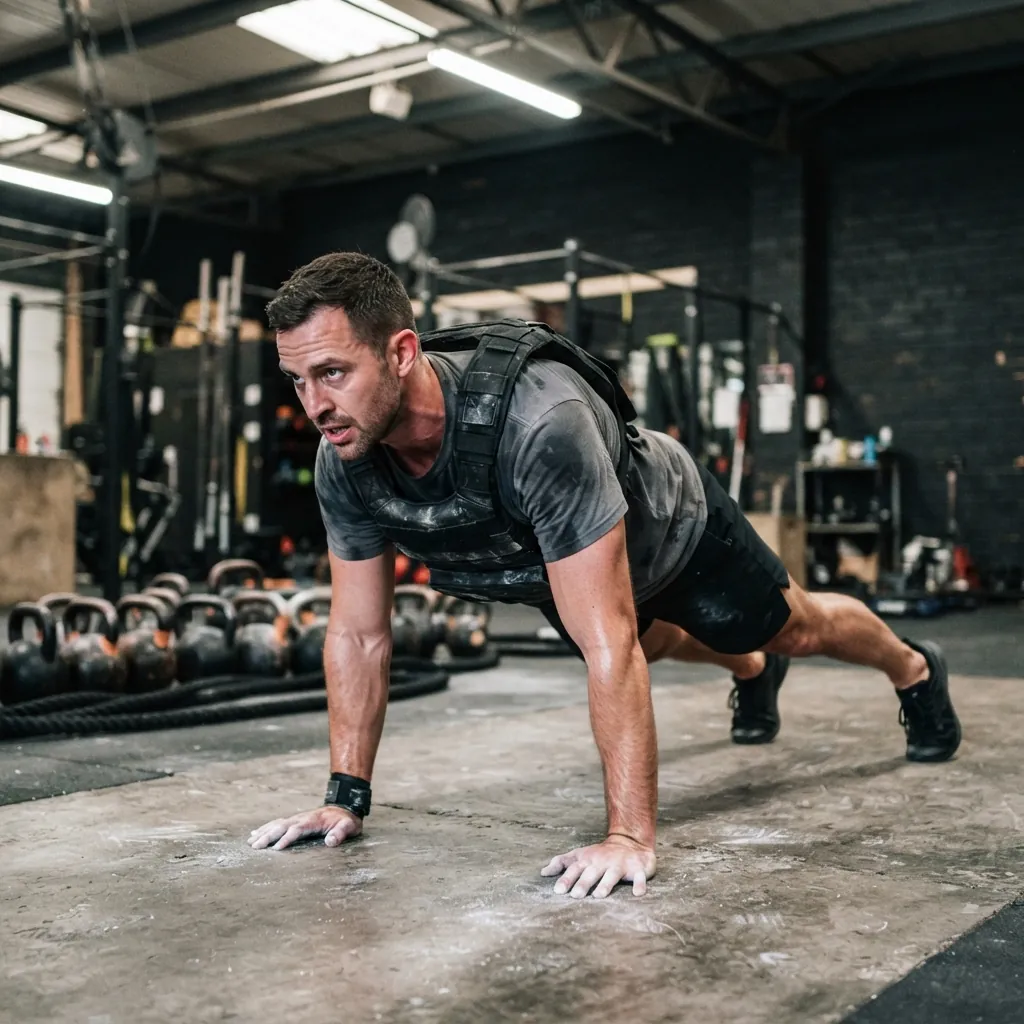
Muscles: Full body (chest, shoulders, quads, core)
Difficulty: Intermediate
| Level | Sets x Reps |
|---|---|
| Intermediate | 3 x 8-10 |
| Advanced | 4 x 10-12 (or 30s on / 30s off intervals) |
Control the descent. A sloppy weighted burpee is a shoulder injury waiting to happen. Chest touches the floor at the bottom. Full hip extension at the top. If you train bodyweight circuit training style, weighted burpees fit right in as a conditioning finisher.
Weighted Plank Hold
Muscles: Core (rectus abdominis, obliques, transverse abdominis)
Difficulty: Beginner-friendly
| Level | Hold Time |
|---|---|
| Beginner | 3 x 20-30s |
| Intermediate | 3 x 30-45s |
| Advanced | 3 x 45-60s |
Elbows under shoulders. Squeeze your glutes. The vest makes a 30-second plank feel like a minute. If you can hold 60 seconds with the vest, you are strong enough to move on to harder core work.
Mountain Climbers with Vest
Muscles: Core, hip flexors, shoulders (stabilizers)
Difficulty: Intermediate
| Level | Sets x Duration |
|---|---|
| Intermediate | 3 x 20s |
| Advanced | 4 x 30s |
Drive knees toward your chest in a high plank position. The vest turns a cardio drill into a core-and-shoulder stability exercise. Keep your hips level — no bouncing. Rest 30-45 seconds between sets.
Weighted Vest Walking
Muscles: Full body (low intensity), cardiovascular system
Difficulty: Beginner-friendly
Walking with a vest at ~15% of body weight increases calorie burn by roughly 12% compared to unloaded walking at the same pace — a finding from a 2014 ACE-commissioned study that aligns with more recent data (Source: McCormick & Kravitz, ACE ProSource, 2014). A 2024 US Army study confirmed this direction: metabolic cost of walking increases with added vest load (Source: Looney et al., Medicine & Science in Sports & Exercise, 2024).
Start with 20-30 minutes at a brisk pace. Work up to 45-60 minutes. This is rucking without the backpack — and the vest distributes weight better across your torso. For vest sizing specifics, check our what size weighted vest should I get guide.
The Murph Workout (with Vest)
The full Murph: 1-mile run, 100 pull-ups, 200 push-ups, 300 squats, 1-mile run — all wearing a 20 lb vest (men) or 14 lb vest (women) (Source: CrossFit). Named after Lt. Michael P. Murphy, a Navy SEAL who received the Medal of Honor posthumously for his actions during Operation Red Wings in Afghanistan (Source: U.S. Navy / Wikipedia).
Scaled version for intermediates: Partition the reps into 20 rounds of 5 pull-ups, 10 push-ups, 15 squats. Use a lighter vest (10 lb). Skip the vest entirely on the runs if needed. Most experienced athletes finish in 45-60 minutes. This is not a weekly workout — treat it as a monthly test or a conditioning benchmark. If you like this style, our military calisthenics workout guide has similar programming.
3 Complete Weighted Vest Workout Routines
Here are three complete weighted vest workouts you can do at home with just a vest and a pull-up bar — one for each training level. Each routine maps to the 6-week progressive overload plan below.
Beginner Routine (Weeks 1-2 of the 6-Week Plan)
Vest load: 5% BW | Duration: ~25 min | Equipment: Vest + pull-up bar
| Order | Exercise | Sets x Reps | Rest |
|---|---|---|---|
| 1 | Weighted Squats | 3 x 12 | 90s |
| 2 | Weighted Push-Ups | 3 x 10 | 90s |
| 3 | Weighted Inverted Rows | 3 x 10 | 60s |
| 4 | Weighted Lunges | 3 x 8/leg | 60s |
| 5 | Weighted Plank Hold | 3 x 20s | 60s |
Warm-up: 5 min walk (with vest on) + 10 bodyweight squats + 10 arm circles.
Cool-down: 5 min walk + stretch quads, chest, lats.
Intermediate Routine (Weeks 3-4)
Vest load: 8-10% BW | Duration: ~30 min | Equipment: Vest + pull-up bar + box/bench
| Order | Exercise | Sets x Reps | Rest |
|---|---|---|---|
| 1 | Weighted Pull-Ups | 3 x 6 | 60s |
| 2 | Weighted Push-Ups | 4 x 10 | 60s |
| 3 | Weighted Step-Ups | 3 x 10/leg | 60s |
| 4 | Weighted Dips | 3 x 8 | 60s |
| 5 | Weighted Lunges | 3 x 10/leg | 45s |
| 6 | Weighted Plank Hold | 3 x 30s | 45s |
Warm-up: 5 min brisk walk (vested) + dynamic stretches.
Cool-down: 5 min walk + foam roll quads and lats.
Advanced Routine (Weeks 5-6)
Vest load: 10-15% BW | Duration: ~40 min | Equipment: Vest + pull-up bar + box/bench + dip bars
| Order | Exercise | Sets x Reps | Rest |
|---|---|---|---|
| 1 | Weighted Pull-Ups | 4 x 8 | 45s |
| 2 | Weighted Decline Push-Ups | 4 x 10 | 45s |
| 3 | Weighted Box Jumps | 3 x 5 | 60s |
| 4 | Weighted Dips | 4 x 10 | 45s |
| 5 | Weighted Squats | 4 x 12 | 45s |
| 6 | Weighted Burpees | 3 x 10 | 30s |
| 7 | Weighted Plank Hold | 3 x 45s | 30s |
Warm-up: 5 min jog (vested) + leg swings + push-up walkouts.
Cool-down: 5 min walk + full-body stretch.
Murph-lite option: Replace the above with 800m run, 50 pull-ups, 100 push-ups, 150 squats, 800m run (partitioned into 10 rounds). Same vest load.
6-Week Progressive Overload Plan for Weighted Vest Training
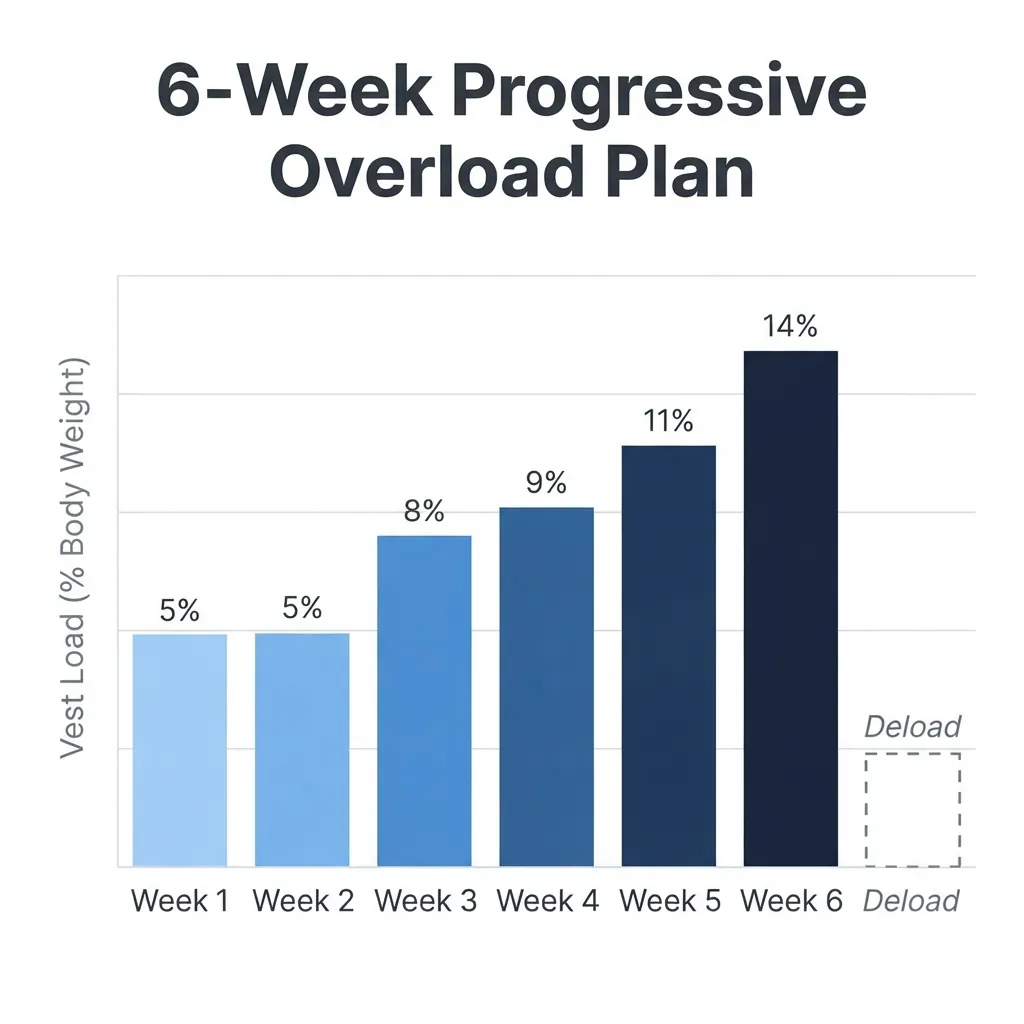
Add weight gradually: start at 5% of your body weight in weeks 1-2, increase to 8% in weeks 3-4, and reach 10-15% by weeks 5-6 — while also progressing exercise difficulty. This is how calisthenics programming works: you add load AND move to harder variations.
| Week | Vest Load (% BW) | Sets x Reps | Exercise Progression Notes |
|---|---|---|---|
| 1 | 5% | 3 x 10-12 | Standard variations. Focus on form with the vest. |
| 2 | 5% | 3 x 12-15 | Same exercises, higher reps. Build endurance under load. |
| 3 | 8% | 3-4 x 8-10 | Add 1 exercise per session. Reduce rest to 60s. |
| 4 | 8-10% | 3-4 x 10-12 | Introduce step-ups and pike push-ups. |
| 5 | 10-12% | 4 x 8-10 | Swap standard push-ups for decline. Add box jumps. |
| 6 | 12-15% | 4-5 x 6-10 | Full advanced routine. Test a Murph-lite if ready. |
Deload: After week 6, drop to 5% BW for one recovery week before starting the cycle again with a higher baseline. If any joint feels off during weeks 5-6, hold the current load for an extra week instead of adding weight.
This progression integrates the calisthenics skill tree: you are not just adding vest weight, you are also moving through harder exercise variations. By week 6, a beginner who started with standard push-ups at 5% BW is doing decline push-ups at 12% BW. That is real progressive overload on two axes — load and leverage. For more on this approach, see our list of military calisthenics exercises where the same principle applies.
What Exercises Should You Avoid with a Weighted Vest?
Avoid heavy barbell back squats, overhead barbell presses, and high-impact gymnastics skills (muscle-ups, backflips) while wearing a weighted vest — the added torso load changes your center of gravity and increases spinal compression.
Exercises where spinal loading is already near your limit do not need more weight strapped to your chest. The vest shifts your center of mass forward, which throws off balance under a heavy barbell. It also restricts thoracic extension, which you need for clean overhead pressing mechanics.
Skip high-impact plyometrics beyond box jumps (depth jumps, broad jumps for distance) until you have at least 6 weeks of vested training under your belt. The landing forces with an extra 15-20 lbs are significant. Use a boot camp workout format instead — controlled conditioning with bodyweight-only impact.
Frequently Asked Questions
How Heavy Should a Weighted Vest Be for Working Out?
Start at 5-10% of your body weight. For a 180 lb person, that is 9-18 lbs. The ACSM recommends beginning at 5% and progressing toward 10-20% as your body adapts (Source: ACSM, 2026). The right weight also depends on the exercise — pull-ups need less load than squats. See our what size weighted vest should I get chart for detailed recommendations.
Can You Build Muscle with a Weighted Vest?
Yes. A 2024 study from Korea University found that 8 weeks of weighted vest circuit training increased skeletal muscle mass by 7.5% compared to controls (Source: Kim et al., Journal of Exercise Science & Fitness, 2024). The vest provides progressive overload on bodyweight movements — the same mechanism that drives muscle growth with barbells.
Is It Good to Do Push-Ups with a Weighted Vest?
Absolutely. Weighted push-ups are one of the most effective vest exercises because they apply progressive overload to a movement most people already do well. Once you can hit 20+ bodyweight push-ups with clean form, adding 5-10% BW via a vest keeps the stimulus in the strength-building rep range.
How Often Should You Train with a Weighted Vest?
Two to three sessions per week with at least 48 hours between sessions. This follows standard resistance training frequency guidelines — the vest increases mechanical stress on muscles and joints, so recovery time matters. Walking with a vest is lower-intensity and can be done more frequently (4-5 days per week).
Do Weighted Vests Reduce Belly Fat?
Not through spot reduction — that is not how fat loss works. A single trial by Bellman et al. (2025) at the University of Gothenburg found that wearing a heavy vest (~11% BW) for 8 hours daily over 5 weeks reduced fat mass and waist circumference without diet or exercise changes, via the gravitostat mechanism (Source: Bellman et al., BMC Medicine, 2025). During workouts, the vest increases calorie burn, which supports overall fat loss when combined with a caloric deficit. But you cannot target belly fat specifically.
Is a Weighted Vest Better Than a Dip Belt for Calisthenics?
Different tools for different jobs. A weighted vest works best for push-ups, squats, burpees, walking, and conditioning — exercises where you need hands-free loading. A dip belt is better for dips and pull-ups when you need heavier loads (30+ lbs), because it hangs weight from your hips instead of compressing your torso. For a complete calisthenics arm workout, you will probably want both.
Sources
- Kim, J. et al. (2024). “Weighted vest intervention during whole-body circuit training improves serum resistin, insulin resistance, and cardiometabolic risk factors in normal-weight obese women.” Journal of Exercise Science & Fitness, 22(4), 463-473. https://pmc.ncbi.nlm.nih.gov/articles/PMC11550068/
- Bellman, J. et al. (2025). “Increased weight-load improves body composition by reducing fat mass and waist circumference, and by increasing lean mass in participants with obesity.” BMC Medicine, 23:317. https://link.springer.com/article/10.1186/s12916-025-04143-6
- Fanning, J. et al. (2026). “Does time spent upright moderate the influence of a weighted vest on change in bone mineral density during weight loss among older adults?” Frontiers in Aging. https://pmc.ncbi.nlm.nih.gov/articles/PMC12932580/
- McCormick, J. et al. / ACE (2014). “Improve Walking Workouts with Weighted Vests.” ACE ProSource. https://www.acefitness.org/continuing-education/prosource/march-2014/3695/ace-research-improve-walking-workouts-with-weighted-vests/
- Looney, D. et al. (2024). “Metabolic Costs of Walking with Weighted Vests.” Medicine & Science in Sports & Exercise, 56(6), 1177-1185. https://journals.lww.com/acsm-msse/fulltext/2024/06000/metabolic_costs_of_walking_with_weighted_vests.19.aspx
- ACSM (2026). “Hot Topic: Are Weighted Vests Worth the Hype?” https://acsm.org/hot-topic-are-weighted-vests-worth-the-hype/
- CrossFit (n.d.). “Murph Hero Workout.” https://www.crossfit.com/murph-workout
- Wikipedia (n.d.). “Michael P. Murphy.” https://en.wikipedia.org/wiki/Michael_P._Murphy
- Wake Forest News (2025). “We’re putting weighted vests to the test. Here’s what our research shows.” https://news.wfu.edu/2025/10/20/were-putting-weighted-vests-to-the-test-heres-what-our-research-shows/