
Last updated June 2026 — James Nolan, NSCA-CPT, Gymnase Tips senior trainer (12 yrs coaching, 8 yrs calisthenics-specific).
TL;DR — What Is the Best Calisthenics Workout Plan?
The best calisthenics workout plan is a three-tier progression: a 3-day full-body beginner block (weeks 1–8), an 8-week Push/Pull/Legs intermediate block (weeks 9–24), and a periodized 5–6 day advanced skill split (weeks 25–52). Each tier uses progressive overload across six movement patterns. Grab the free PDF and Google Sheet tracker below.
Quick Comparison — Which Tier Are You?
Take the 3-rep gating test before you pick a tier. Do them cold, strict form, one set each:
- Push-ups (chest to fist, full lockout)
- Pull-ups (dead hang, chin over bar)
- Plank (forearms, hollow body)
If you score 0–9 push-ups, 0 pull-ups, or under 30s plank, you start at Beginner. Sailed past 10 push-ups, 1 pull-up, and 60s plank? You can open at Intermediate. Crushed 25 push-ups, 10 pull-ups, and have a 30-second wall handstand? Advanced.
| Level | Prereqs | Days/wk | Split | Session | Weeks to next tier |
|---|---|---|---|---|---|
| Beginner | 0–9 push-ups, 0 pull-ups | 3 | Full-body A/B | 30–40 min | 8 |
| Intermediate | 10+ push-ups, 1+ pull-up, 60s plank | 4 | Push / Pull / Legs+Core / Conditioning | 45–60 min | 16 |
| Advanced | 25+ push-ups, 10+ pull-ups, 30s wall HS | 5–6 | Skill split + periodization | 60–90 min | Repeat blocks |
How a Calisthenics Workout Plan Actually Works
A calisthenics workout plan organizes six movement patterns — horizontal push, vertical push, horizontal pull, vertical pull, squat, and core — and forces measurable progress on each one every week. That’s the whole game. Everything else is decoration.
Three principles make it work:
- Progressive overload. Add reps, slow tempo, shorten rest, or move to a harder variation each week. The NSCA defines progressive overload as the gradual increase of stress placed on the body during training — without it, adaptation stalls (Source: NSCA, Kinetic Select). “Three sets of push-ups, forever” is not a plan.
- 1:1 push-to-pull ratio. Mismatched volume is the single most common cause of the rounded-shoulder posture I see in self-taught lifters. Every push set gets a pull set.
- 48-hour recovery, trained 2× per week minimum. A Schoenfeld meta-analysis found training each muscle group at least twice a week produces greater hypertrophy than once-weekly training when volume is equated (Source: Schoenfeld et al., Sports Medicine, 2016). The beginner full-body and intermediate PPL splits both hit this floor.
The American College of Sports Medicine classifies bodyweight resistance as an effective stimulus for strength, hypertrophy, and cardiometabolic health across adult populations (Source: ACSM). Cleveland Clinic frames calisthenics as functional, equipment-light, and HIIT-equivalent for conditioning (Source: Cleveland Clinic, 2024). The plan below operationalizes both.
Beginner Calisthenics Workout Plan (Weeks 1–8)
The beginner tier is three full-body sessions per week — Monday, Wednesday, Friday — alternating Circuit A and Circuit B. Total time: 30–40 minutes including warm-up. If you’re truly day-one untrained, run our brand-new beginners start here primer first, then come back.
Circuit A — Weeks 1–8
| Exercise | Sets | Reps | Rest | Tempo | Form cue |
|---|---|---|---|---|---|
| Incline push-up | 3 | 8 | 60s | 2-0-1 | Hollow body, ribs down |
| Inverted row (hip-height bar) | 3 | 8 | 60s | 2-1-1 | Scapular retraction at top |
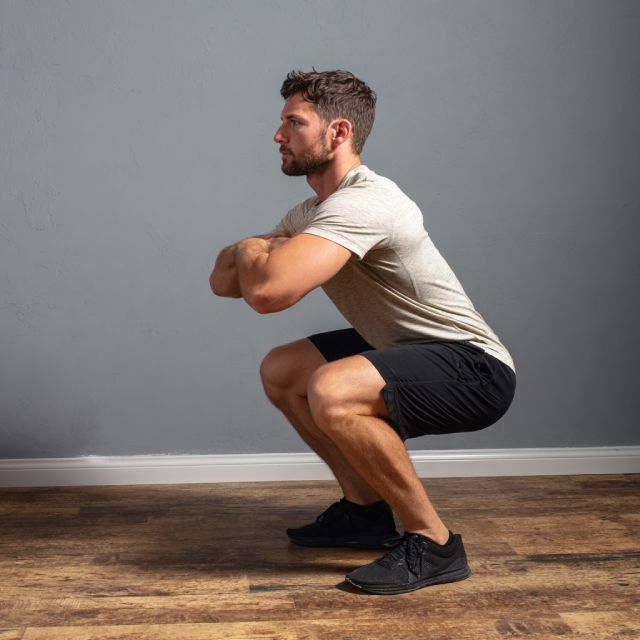
| Air squat | 3 | 15 | 45s | 2-0-1 | Knees track over mid-foot |
| Plank | 3 | 30s | 45s | hold | Glutes squeezed, no sag |
| Glute bridge | 3 | 12 | 45s | 2-1-1 | Full hip extension, no overarch |
Circuit B — Weeks 1–8
| Exercise | Sets | Reps | Rest | Tempo | Form cue |
|---|---|---|---|---|---|
| Reverse lunge | 3 | 10/leg | 60s | 2-0-1 | Knee gently kisses floor |
| Incline push-up | 3 | 8 | 60s | 2-0-1 | Elbows ~45° from torso |
| Dead hang | 3 | 20s | 60s | hold | Active shoulders, no shrug |
| Bird-dog | 3 | 8/side | 30s | 2-1-2 | Hip square to floor |
| Side plank | 3 | 20s/side | 30s | hold | Stack hips, drive top hip up |
Weekly progression rule:
- Weeks 1–2: Numbers as written.
- Weeks 3–4: +2 reps per set across all exercises; +5s on holds.
- Weeks 5–6: Move incline push-ups to standard floor push-ups; +5s on holds.
- Weeks 7–8: Add a 4th set to push-up and squat. Test 1-rep max push-up count and max plank hold on the last Friday.
Form-cue I drill with every beginner: on the inverted row, the failure mode is always elbow-pull before scap retraction. Start each rep by pinching shoulder blades back and down, then pull. On planks, “hollow body” beats “flat back” — ribs tucked, posterior pelvic tilt, no lumbar sag.
Graduation benchmark (move to Intermediate when you can): 10 strict floor push-ups, 1 bodyweight pull-up (or 20s dead hang), 60s plank. Most consistent trainees hit this in 6–8 weeks; if you don’t, repeat weeks 5–8. See also our calisthenics chest exercises and pull-up form fundamentals guides.
Intermediate Calisthenics Workout Plan (Weeks 9–24, PPL)
The intermediate tier runs 16 weeks: an 8-week base block (weeks 9–16) builds volume tolerance, then an 8-week intensification block (weeks 17–24) tightens tempo and introduces unilateral variations. Four sessions per week — Push, Pull, Legs+Core, Conditioning.
Weekly schedule: Mon Push · Tue Pull · Wed off/mobility · Thu Legs+Core · Sat Conditioning · Sun off.
Push Day
| Exercise | Wk 9–16 | Wk 17–24 | Rest | Tempo | Form cue |
|---|---|---|---|---|---|
| Standard push-up | 4 × 12 | 4 × 15 | 60s | 3-0-1 | Elbows 45°, full lockout |
| Decline push-up | 3 × 10 | 4 × 10 | 75s | 3-0-1 | Hollow body holds |
| Pike push-up | 3 × 10 | 4 × 8 | 75s | 3-1-1 | Stack shoulders over wrists |
| Diamond push-up | 3 × 10 | 3 × 12 | 60s | 2-0-1 | Elbows brush ribs |
| Parallel bar dip | 3 × 10 | 4 × 10 | 90s | 3-0-1 | Shoulders down, no shrug |
Pair push day with our calisthenics shoulder workout and calisthenics arm workout accessories if you want extra delt/tri volume.
Pull Day
| Exercise | Wk 9–16 | Wk 17–24 | Rest | Tempo | Form cue |
|---|---|---|---|---|---|
| Pull-up | 4 × max | 5 × max | 90s | 2-1-2 | Scap depression to start |
| Inverted row | 4 × 12 | 4 × 12 | 60s | 2-1-2 | Chest meets bar |
| Chin-up | 3 × 6 | 4 × 6 | 90s | 3-0-1 | Full lockout, no kip |
| Scapular pull-up | 3 × 10 | 3 × 12 | 45s | 1-2-1 | Slow scap descent |
| Dead hang | 3 × 30s | 3 × 45s | 45s | hold | Active, no passive shoulder |
For deeper back hypertrophy work, see our calisthenics back workout; for pull mechanics, the pull-up form fundamentals guide drills scap depression.
Legs + Core Day
| Exercise | Wk 9–16 | Wk 17–24 | Rest | Tempo | Form cue |
|---|---|---|---|---|---|
| Bulgarian split squat | 4 × 8/leg | 4 × 10/leg | 75s | 3-1-1 | Front shin near vertical |
| Reverse lunge | 3 × 12/leg | 3 × 12/leg | 60s | 2-0-1 | Torso upright |
| Single-leg glute bridge | 3 × 12/leg | 3 × 15/leg | 45s | 2-1-1 | Hip square |
| Hollow hold | 3 × 30s | 3 × 45s | 45s | hold | Lumbar pinned |
| Hanging knee raise | 3 × 10 | 3 × 12 | 60s | 2-1-2 | No swing |
More options in our bodyweight leg workouts and calisthenics core workout articles.
Saturday Conditioning
- 5 rounds for time: 10 push-ups · 8 pull-ups · 15 air squats · 10 burpees. Rest 90s between rounds.
- Or a 20–25 minute Zone 2 run/ruck.
Form-cue from the field: pike push-ups fail at the shoulder stack, not the press. If your hips are too low (butt back), you’re doing a decline push-up and calling it pike — walk feet closer, hinge harder, get hips over shoulders. On chin-ups, cue “shoulders away from ears” before the pull starts; this teaches scap depression and saves elbow tendons.
Graduation benchmark to Advanced: 25 strict push-ups, 10 strict pull-ups, 30-second wall handstand, 60-second hollow hold, full pistol squat negative.
Advanced Calisthenics Workout Plan (Weeks 25–52, Skill Split)
The advanced tier runs four 4-week blocks (base → intensity → peak → deload) repeated through weeks 25–52. Five to six sessions per week. Skill work goes first in the session while the nervous system is fresh; strength work follows.
Weekly split:
- Mon: Skill (handstand) + Push volume
- Tue: Skill (front lever progression) + Pull volume
- Wed: Legs + Core + Mobility
- Thu: Skill (planche progression) + Push intensity (archer / one-arm progressions)
- Fri: Skill (muscle-up) + Pull intensity
- Sat: Conditioning or optional skill practice
- Sun: Rest
4-Week Block Structure
| Week | Volume | Intensity | Skill density | Notes |
|---|---|---|---|---|
| 1 (Base) | High | Moderate | 2 sets/skill | Reintroduce variations |
| 2 (Intensity) | Moderate | High | 3 sets/skill | Push tempo and holds |
| 3 (Peak) | Low | Very high | 4 sets/skill | Test PRs late week |
| 4 (Deload) | 50% | 50% | 1 set/skill | Mobility focus |
Advanced Skill Targets
| Skill | Working step | Volume/session |
|---|---|---|
| Freestanding handstand | Wall HS → 5s freestanding | 5 × 30s |
| Front lever | Tuck → advanced tuck → straddle | 5 × 8s |
| Planche | Tuck → straddle | 5 × 8s |
| Muscle-up | Explosive pull-up → high pull → strict | 5 × 2 |
| One-arm push-up | Archer → assisted OAP → full | 4 × 3/side |
| Pistol squat | Box pistol → full → weighted | 4 × 5/leg |
| Dragon flag | Tuck → straight | 4 × 5 |
For step-by-step regressions, see our push-up progression ladder and pistol squat progression.
Deload rule: every fourth week, cut volume in half and skip max-effort skill attempts. If two sessions in a row feel worse than the previous block’s best, that’s an unscheduled deload signal — take it. After a full four-block cycle, repeat the cycle with one progression step harder per skill.
Calisthenics Skill Progression Standards (Rep Benchmarks)
Use this table to know exactly when you’ve earned the next variation. Hit the rep target with strict tempo (3-0-1 unless noted), then move up. This is the consolidated chart competitors skip.
| Family | Step 1 | Step 2 | Step 3 | Step 4 | Step 5 | Step 6 |
|---|---|---|---|---|---|---|
| Push | Incline 3×12 | Standard 3×12 | Decline 3×10 | Diamond 3×8 | Archer 3×6/side | One-arm 3×3 |
| Pull | Dead hang 30s | Negative pull-up 3×3 | Pull-up 3×5 | Chin-up 3×8 | Archer pull-up 3×3/side | One-arm progression 3×1 |
| Squat | Air squat 3×20 | Reverse lunge 3×12/leg | Bulgarian split 3×10/leg | Box pistol 3×6/leg | Pistol 3×5/leg | Weighted pistol 3×5/leg |
| Core | Plank 60s | Hollow hold 45s | Hanging knee raise 3×10 | Hanging leg raise 3×8 | Tuck dragon flag 3×6 | Dragon flag 3×5 |
| Handstand | Wall plank 60s | Wall HS chest-to-wall 30s | Wall HS back-to-wall 60s | Freestanding HS 10s | Freestanding HS 30s | HSPU (wall) 3×5 |
| Muscle-up | Pull-up 8 reps | Chest-to-bar 3×5 | Explosive pull-up 3×3 | High pull (sternum) 3×3 | Negative MU 3×2 | Strict MU 3×1 |
Realistic Results Timeline (Week 2 → Month 6)
Honest milestones for a previously untrained adult eating 0.7–1g protein per lb of bodyweight and sleeping 7+ hours. No 30-day-transformation lies.
| Milestone | What you’ll feel | What you’ll see | What WON’T happen yet |
|---|---|---|---|
| Week 2 | DOMS fading, sessions feel less brutal | Slight pump post-workout | No visible muscle change. No scale move. |
| Week 6 | Reps add themselves — “I owned that set” | Better posture; first definition in shoulders | No abs unless you started lean |
| Month 3 | Skills click — first clean pull-up, first 60s plank | Visible deltoid + upper-back development; +1 to 2 lbs lean mass | No muscle-up. No front lever. No “calisthenics body” yet. |
| Month 6 | Sessions feel like skill practice, not survival | 25+ push-ups, 8–12 pull-ups, visible V-taper, ~4–8 lbs lean mass for men | No freestanding handstand. No planche. |
Year-one men typically gain 8–15 lbs of lean mass on a structured plan with protein and sleep in line; women 4–8 lbs. Year-two gains are roughly half. If the scale isn’t moving and you’re stuck on reps, the problem is almost always protein, sleep, or volume — in that order.
Plateau Troubleshooting — Decision Tree
When progress stalls for two consecutive weeks on the same exercise, walk this tree in order. Most plateaus break by step 2.
Same logic applies to pull-ups (where grip-failure usually masquerades as back weakness — add dead hangs; drill our pull-up form fundamentals) and squats (where ankle mobility usually masquerades as quad weakness — add ATG squat holds).
Download the Plan — Free PDF + Google Sheet Tracker
Grab the full 52-week plan as a printable PDF, plus a Google Sheet tracker that auto-calculates your weekly rep totals and flags when you’ve hit graduation benchmarks. No email required.
- PDF: /downloads/calisthenics-workout-plan.pdf
- Google Sheet: Copy to your Drive
Weekly Schedule Templates (All 3 Tiers)
Beginner — 3 days/week
| Mon | Tue | Wed | Thu | Fri | Sat | Sun |
|---|---|---|---|---|---|---|
| Circuit A | Walk/rest | Circuit B | Walk/rest | Circuit A | Mobility | Rest |
Intermediate — 4 days/week
| Mon | Tue | Wed | Thu | Fri | Sat | Sun |
|---|---|---|---|---|---|---|
| Push | Pull | Mobility | Legs + Core | Rest | Conditioning | Rest |
Advanced — 6 days/week
| Mon | Tue | Wed | Thu | Fri | Sat | Sun |
|---|---|---|---|---|---|---|
| Skill HS + Push vol | Skill FL + Pull vol | Legs + Core + Mobility | Skill Planche + Push int | Skill MU + Pull int | Conditioning | Rest |
Nutrition + Recovery in 60 Seconds
You will not out-train under-eating or under-sleeping. The non-negotiables:
- Protein: 0.7–1.0 g per lb of bodyweight per day, spread across 3–4 meals.
- Sleep: 7–9 hours nightly. Muscle protein synthesis peaks during deep sleep — skimping here erases workout gains.
- Hydration: ~0.5 oz per lb of bodyweight, more on training days.
- Deload: every 4–6 weeks at intermediate+, drop volume 50% for one week.
- Mobility: 10 minutes daily, especially shoulders, hips, ankles. Handstands and pistols are mobility-gated before they’re strength-gated.
Full breakdown in our maximize muscle building guide.
Common Mistakes That Kill Your Calisthenics Workout Plan
No progression mechanism. “Three sets of push-ups, three days a week” is a routine, not a plan. Every week must add reps, slow tempo, or change variation. If you can’t tell me what you’ll do next Monday, your plan has already failed.
Push-pull imbalance. Most home lifters run 3× more push than pull volume. Six months later: rolled shoulders, forward neck, chronic upper-back lockup. Match 1:1 from week one. If you can’t pull as much as you push, that’s the bottleneck — fix it.
Skipping mobility. Calisthenics demands shoulder, hip, and ankle ranges most desk-bound adults have lost. Without 10–20 minutes daily, you’ll never hit a clean handstand or a full pistol — not because you’re weak, but because your joints won’t let you into position. Start with our beginning mobility exercises for calisthenics.
No pull-up bar. A $25 doorway bar is the single highest-ROI purchase you’ll make. Without one, your pull volume collapses to inverted rows, which plateau by week 8. See the calisthenics workout equipment priority list.
FAQ
Keep Going — Specialized Plans
- Beginner calisthenics routine (day-one primer)
- Push-up progression ladder
- Pull-up form fundamentals
- Pistol squat progression
- Calisthenics chest exercises
- Calisthenics back workout
- Calisthenics shoulder workout
- Calisthenics arm workout
- Calisthenics core workout
- Bodyweight leg workouts
- 28-day calisthenics challenge
- Maximize muscle building
Sources
- ACSM — bodyweight resistance position statement — acsm.org
- Cleveland Clinic — Calisthenics Workout Routine and Benefits — health.clevelandclinic.org/calisthenics
- NSCA — Progressive Overload (Kinetic Select) — nsca.com
- Schoenfeld BJ, Ogborn D, Krieger JW (2016) — Effects of Resistance Training Frequency on Measures of Muscle Hypertrophy: A Systematic Review and Meta-Analysis. Sports Medicine 46:1689–1697 — pubmed.ncbi.nlm.nih.gov/27102172


Pingback: Military Calisthenics: 2026 Guide + Free 4-Week Plan
Pingback: Calisthenics Leg Workout: 10 Exercises + 4-Week Routine
Pingback: NLP for Permanent Weight Loss: Rewire Your Brain, Ditch Diets Forever
Pingback: Yoga for Focus: 5 Poses to Improve Concentration
Pingback: Calisthenics Chest Workout: 9 Exercises for Bigger Pecs
Pingback: 25 Push-Up Variations Ranked Easiest to Hardest (2026 Guide) - gymnasetips.com
Pingback: Dumbbell + Bodyweight Workout: 5-Day Hybrid Plan for Muscle & Strength - gymnasetips.com
Pingback: Fat Loss Exercises at Home: 15 Moves That Actually Work (Ranked) - gymnasetips.com
Pingback: Calisthenics vs Weights: Which Builds More Muscle? (Honest Comparison) - gymnasetips.com
Pingback: Calisthenics Shoulder Workout: 8 Exercises for Capped Delts
Pingback: Hybrid Training: Mixing Dumbbells with Calisthenics for Faster Gains - gymnasetips.com
Pingback: How to Build Muscle Without Weights
Pingback: Calisthenics Core Workout: 10 Exercises for a Stronger Midsection
Pingback: Calisthenics Upper Body Workout: 4-Week Push-Pull Split
Pingback: Calisthenics Exercises Chart: 50+ Moves Sorted by Muscle Group
Pingback: Calisthenics Mobility Exercises: 10 Essentials for Beginners
Pingback: Calisthenics Workout Equipment: 8 Items That Actually Matter
Pingback: Daily Calisthenics Routine: 7-Day Schedule